


The Ultimate Thermostat Checkup to Save You a Service Fee


Discover the Essential Benefits of Regular Air Conditioning Maintenance
Regular maintenance of your air conditioning system ensures optimal performance and longevity. It helps prevent costly repairs while improving energy efficiency, keeping your home comfortable year-round.

Routine checks can significantly reduce energy bills and extend the life of your unit.


Is Your Thermostat the Problem? Check This Before You Call for Repair
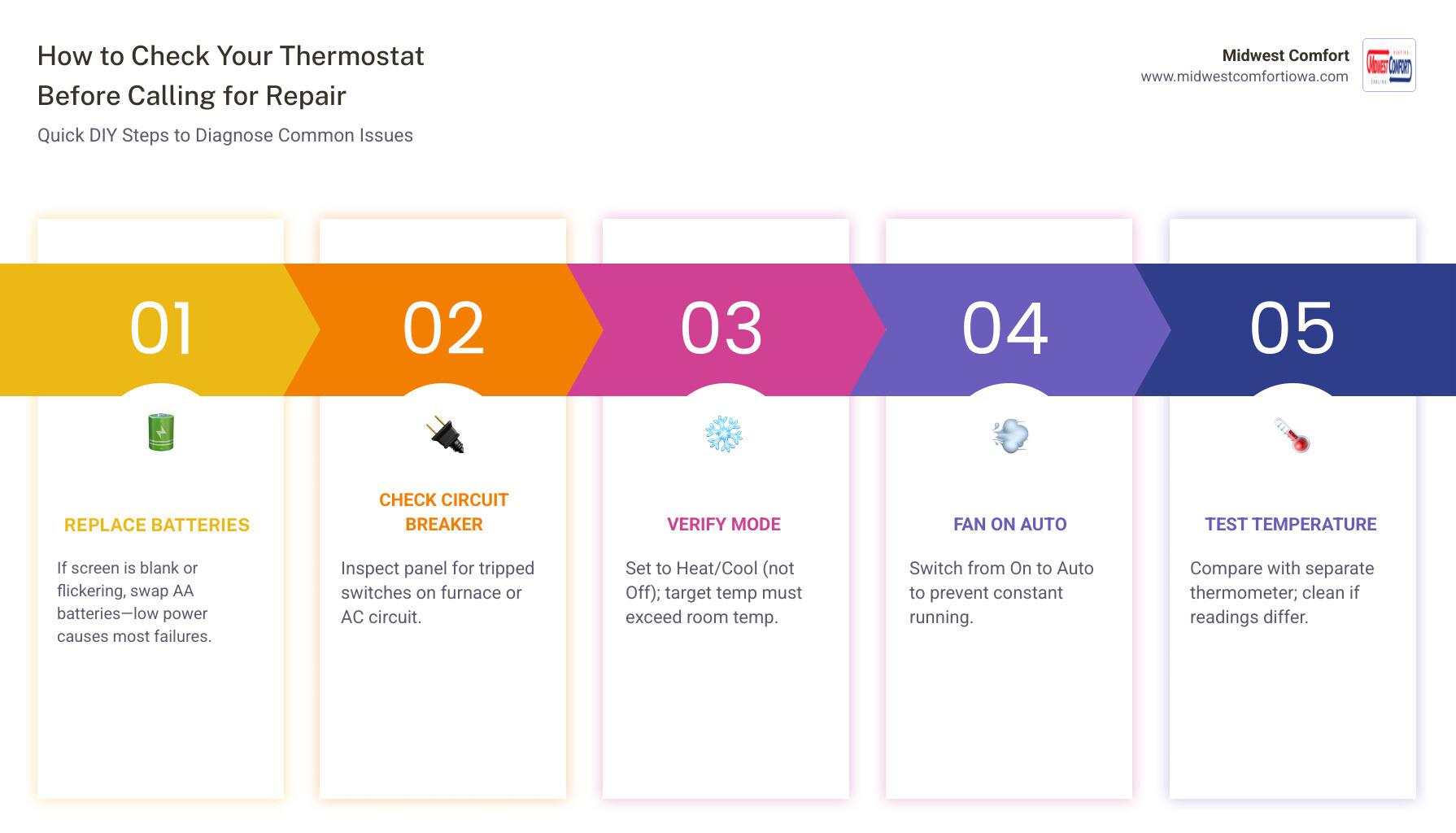
How to check your thermostat before calling for repair is simpler than most Des Moines homeowners expect — and doing it yourself could save you from an unnecessary service visit. Before you pick up the phone, run through these quick checks:
- Replace the batteries if the screen is blank or flickering
- Check the circuit breaker for a tripped switch tied to your furnace or air handler
- Verify the mode — confirm it's set to "Heat" or "Cool" (not "Off") and that the target temperature is set higher or lower than the current room temperature
- Check the fan setting — it should usually be on "Auto," not "On"
- Clean the thermostat interior — dust buildup can throw off temperature readings
- Inspect wiring connections — look for loose or corroded wires at the terminal block
- Test temperature accuracy — place a separate digital thermometer nearby and compare readings
If all of those check out and your HVAC system still isn't behaving, that's when it's time to call a professional.
Your thermostat is the command center for your entire heating and cooling system. When something feels off — your home is too cold, too warm, or your system seems to run nonstop — the thermostat is the first place to look. Roughly 25 percent of furnace repair calls turn out to be thermostat-related, not furnace-related. That means a lot of homeowners are paying for service visits that a five-minute check could have prevented.
The good news: most basic thermostat problems are easy to spot once you know what to look for. This guide walks you through every step so you can diagnose the issue with confidence — and only call for backup when you actually need it.
How to check your thermostat before calling for repair: The Power Basics
When your home starts feeling more like a walk-in freezer than a cozy sanctuary, it’s easy to panic and assume the furnace has breathed its last breath. But before you start looking up a Thermostats Des Moines IA specialist, we need to talk about power. If your thermostat doesn't have it, your HVAC system won't know it’s time to get to work.
Checking for power and battery life
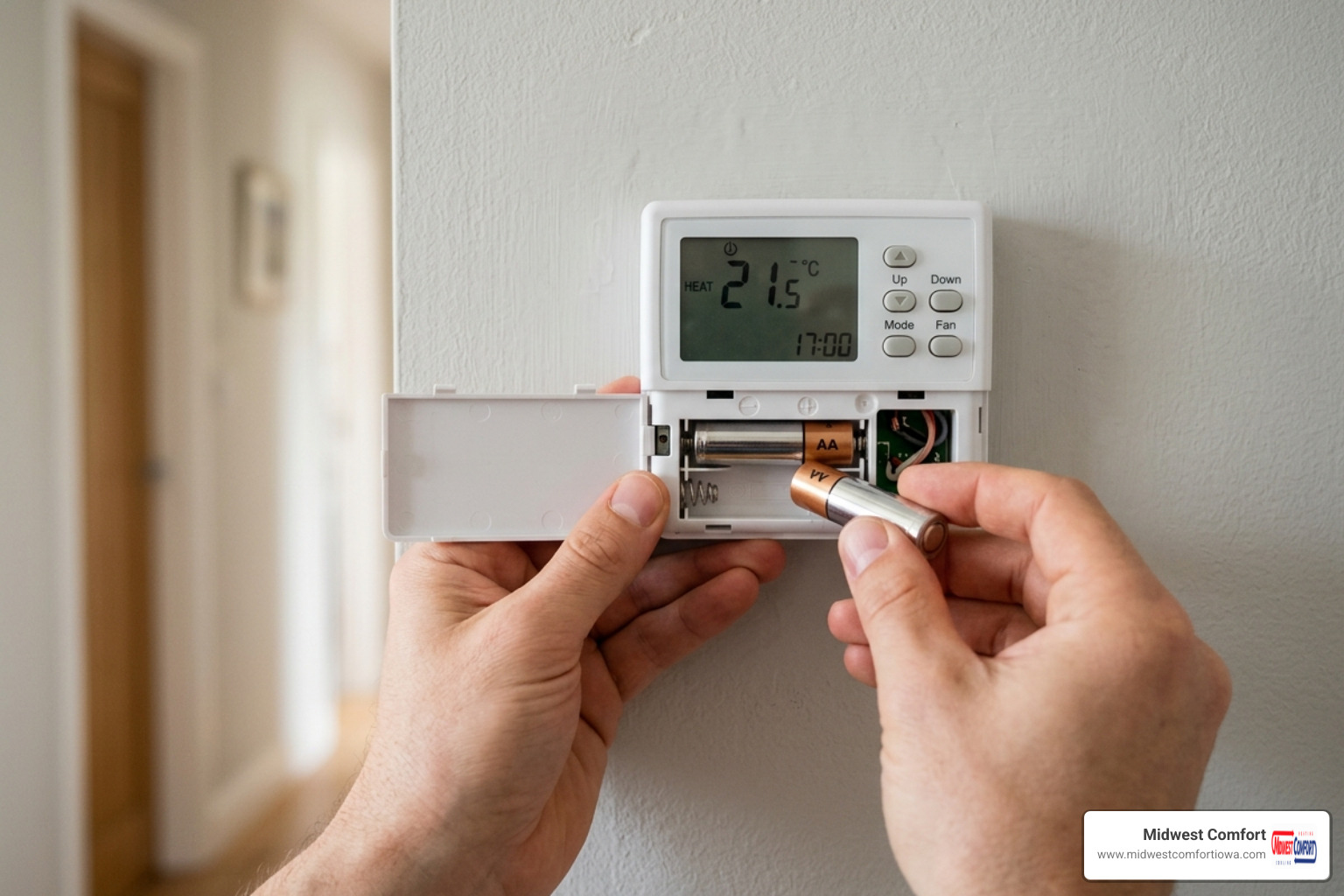
It might sound like "Tech Support 101," but you would be surprised how many service calls in West Des Moines are resolved simply by swapping out two AA batteries. Most digital thermostats rely on batteries to keep their display active and communicate with your HVAC unit.
As we move through April 2026, many of the newer smart models are hardwired, but millions of homes still use battery-operated units. Look for a low battery symbol or a display that seems suspiciously dim or flickering. If the screen is completely blank, that is a major red flag.
We recommend changing your thermostat batteries annually—perhaps at the same time you check your smoke detectors. If you find that your AC Thermostat is Failing in West Des Moines, a fresh set of high-quality alkaline batteries is the first and cheapest diagnostic tool in your arsenal.
Inspecting the circuit breaker and furnace switch
If fresh batteries don't bring the screen back to life, or if your thermostat is hardwired and still unresponsive, the problem might be further up the line. Your HVAC system has its own dedicated circuit breaker in your home's electrical panel. Go to your breaker box and look for switches labeled "Furnace," "AC," or "HVAC." Even if the switch doesn't look like it has moved, flip it all the way to "Off" and then back to "On." Sometimes a breaker can trip internally without moving the handle to the center position.
Don't forget the "secret" switch! Most furnaces in the Des Moines area have a power switch located right on the side of the unit or on a nearby wall. It looks exactly like a standard light switch. It’s remarkably easy for someone to accidentally flip this switch while moving boxes in the basement or reaching for a holiday decoration. If that switch is off, the thermostat loses its 24-volt power supply from the furnace transformer, and nothing will happen when you try to turn on the heat.
Verifying Settings and Calibration for Better Comfort
Sometimes the thermostat has power, but it’s just confused. We’ve seen many cases where a "broken" system was simply a victim of a clicked button or a curious toddler.
How to check your thermostat before calling for repair by verifying modes
It sounds simple, but verify that the system is actually set to the correct mode. During the transition seasons in Iowa, it’s common to flip between heat and cool. Ensure the switch is firmly in the "Heat" position for winter or "Cool" for summer.
Check the fan settings as well. If your fan is set to "On," the blower will run continuously, even when the system isn't heating or cooling. This can lead to drafts that make you feel like the system isn't working. Switching the fan to "Auto" ensures it only runs when the furnace or AC is actually conditioning the air.
Also, look for "Hold" or "Temporary" settings. If someone manually overrode the schedule, the thermostat might be waiting for a time that hasn't arrived yet. Clearing all overrides and returning to the programmed schedule is a key part of how to check your thermostat before calling for repair. If you find you’re constantly fighting your old unit, it might be time for a Thermostat Replacement to get a more reliable interface.
Testing temperature accuracy and calibration
Does your thermostat say it’s 72°F, but you’re shivering in your slippers? It might be out of calibration. Thermostats can experience "sensor drift" over time, where the internal components no longer accurately read the ambient air temperature.
To test this, tape a high-quality digital thermometer to the wall about an inch away from your thermostat. Wait about 15 to 20 minutes for the reading to stabilize. If the two devices are more than 2 degrees apart, your thermostat needs recalibration or replacement.
That placement matters. If your thermostat is mounted near a drafty window, in direct sunlight, or right next to a heat-producing lamp, it will give a false reading. This leads to the system turning off too early or running too long. If you're noticing these issues in Ankeny, a Thermostat Replacement Ankeny IA might be necessary to relocate the unit to a more "neutral" interior wall for Better Comfort.
Physical Maintenance: Cleaning and Wiring Inspections
If the software and settings are fine, it’s time to look under the hood. You don't need to be an engineer to perform basic physical maintenance on your thermostat.
How to check your thermostat before calling for repair by cleaning internal components
If you have an older mechanical thermostat (the kind with a dial or a sliding bar), dust is your enemy. Dust bunnies can get trapped in the bi-metal coils or between electrical contact points, preventing the signal from reaching your furnace.
Gently pry off the cover. Use a soft-bristled brush or a can of compressed air to carefully blow away any debris. If you see a small glass vial with silver liquid inside, that’s a mercury switch. These must be perfectly level to work correctly. If the thermostat has been bumped and is now crooked, it might not trigger the system properly. A quick check with a small level can solve this in seconds. For those in the Ankeny area, if cleaning doesn't work, we can help with a Thermostat Repair Ankeny IA.
Inspecting low-voltage wiring connections
Behind that plastic cover is a set of very thin wires. Over years of vibrations or even just house settling, these wires can wiggle loose from their terminals.
Safety First: Before touching any wires, turn off the power to your furnace at the breaker box.
Once the power is off, check that each wire is firmly tucked into its terminal (labeled R, G, W, Y, etc.) and that the screws are tight. Look for any signs of corrosion or "burnt" smells, which indicate an electrical short. If you decide to remove the thermostat to look closer, always take a photo of the wiring first! This ensures you know exactly where each colored wire belongs. If the wiring looks like a bird's nest of tangles and corrosion, a Thermostat Replacement Des Moines IA is often the safest and most effective path forward.
Understanding Thermostat Types and Lifespan
In 2026, we have more choices than ever when it comes to home climate control. Understanding what you have helps you know how it might fail.
| Thermostat Type | Average Lifespan | Common Troubleshooting |
|---|---|---|
| Mechanical | 15–20 Years | Dust buildup, leveling issues, manual calibration. |
| Programmable | 10–12 Years | Battery failure, software glitches, relay wear. |
| Smart/Wi-Fi | 8–10 Years | Wi-Fi connectivity, firmware updates, C-wire power issues. |
Most thermostats last about 10 years on average. High-quality models can stretch to 15 or 20 years with the right care, but technology moves fast. If your thermostat is over a decade old, it may lack the precision of modern units. Older thermostats can also cause "short cycling," where the system turns on and off too frequently, putting unnecessary wear on your compressor or heat exchanger.
If you are upgrading, look for units with strong warranties. For example, some premium brands offer 10-year registered warranties when installed by a professional. Upgrading to a Smart Thermostat can also save you up to 10% a year on heating and cooling costs by automatically adjusting the temperature when you’re away or asleep.
Frequently Asked Questions about Thermostat Troubleshooting
What is short cycling and how does it relate to thermostat issues?
Short cycling is when your HVAC system turns on and off every few minutes without ever reaching the desired temperature. While this can be caused by a dirty air filter or an oversized unit, it is often a thermostat problem.
In older thermostats, the "anticipator" (a small metal tab) might be set incorrectly, telling the furnace to shut off too soon. In digital models, a failing sensor might be "tricked" into thinking the room is warm because of internal heat from the thermostat's own electronics. If your system is short cycling, checking the thermostat's location and settings is a critical step in how to check your thermostat before calling for repair.
When should I consider replacing my thermostat versus attempting a repair?
If your thermostat is more than 10 years old and starts acting up, replacement is almost always better than repair. Modern thermostats are relatively affordable and provide much better energy efficiency. If the screen is cracked, buttons are unresponsive, or the unit constantly "forgets" its program, it’s time to move on. For residents in Ankeny, a Thermostat Replacement Ankeny IA can provide a fresh start with a more reliable interface.
How can I tell if the problem is the thermostat or the HVAC unit?
There is a "pro trick" called a jumper test. By safely joining the "R" (power) wire and the "W" (heat) wire together, you bypass the thermostat entirely. If the furnace kicks on immediately, you know the furnace is fine and the thermostat is the culprit.
Warning: We don't recommend homeowners try this unless they are very comfortable with low-voltage wiring. If you're unsure, it’s much safer to call for a Thermostat Repair Ankeny IA to have a technician perform the diagnostic.
Conclusion
Taking the time to learn how to check your thermostat before calling for repair can save you time, money, and the frustration of a cold house. From the simple act of changing batteries to the more detailed work of cleaning contact points, many thermostat issues are well within the reach of a handy homeowner.
At Midwest Comfort, we believe in honest, high-quality service. We are a family-owned business serving Des Moines and surrounding areas like Polk City, Waukee, and Johnston. We want our neighbors to feel empowered in their own homes. If you’ve gone through this checklist and your home still isn't reaching that perfect temperature, we are here to help. Whether you need a quick repair or a full Thermostat Replacement Des Moines IA, our team provides tailored solutions to keep your family comfortable all year round.
Don’t suffer through another season with a temperamental thermostat. Contact Midwest Comfort for professional air conditioning and heating support today, and let’s get your home’s command center back in top shape!


Get Your HVAC Serviced Today


