
Why Understanding How a Faulty Pressure Relief Valve Creates Danger Could Save Your Home
How a faulty pressure relief valve creates danger is something every Des Moines homeowner should understand — because this small device is the last line of defense between your water heater or boiler and a catastrophic failure.
A pressure relief valve (PRV) has one critical job: automatically release excess pressure before it builds to a destructive level. When it works correctly, you never think about it. When it fails, the consequences can range from property damage to serious personal injury.
Here's a quick breakdown of the key dangers a faulty PRV creates:
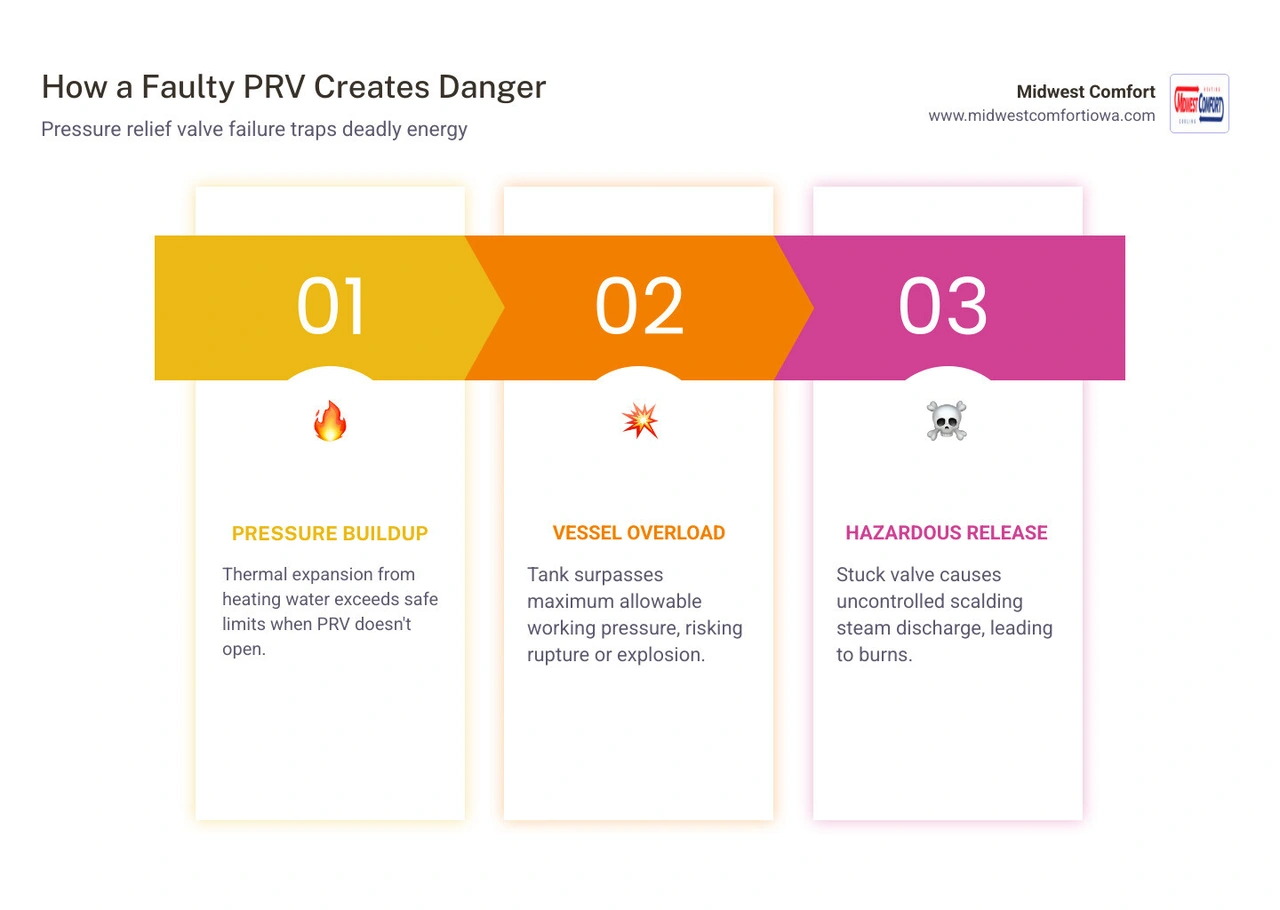
- Explosion and rupture risk — If the valve fails to open during an overpressure event, pressure inside the vessel can exceed its maximum allowable working pressure, causing pipes to burst or the tank itself to rupture
- Scalding steam and hot water discharge — A valve stuck partially open can release uncontrolled high-temperature steam, creating serious burn hazards
- Equipment damage and system failure — Chronic leaking or chattering wears down internal components and connected equipment over time
- Production slowdowns and unplanned downtime — In systems that run continuously, even a small PRV issue can trigger costly shutdowns
- Cascading system problems — A failed valve is often a symptom of broader pressure issues, meaning other components may be under stress too
The stakes are real. An overpressure protection device set too high — or one that fails to open at all — can lead to pipe rupture, explosion hazards, and personal injury. And with 72% of companies in industries like manufacturing and oil and gas making zero unplanned downtime a top priority, a poorly performing PRV isn't just a safety risk — it's an operational one too.
The good news? With the right knowledge, most PRV dangers are preventable. Properly maintained valves can stay in service for up to 30 years. The problem is that most homeowners don't know what warning signs to look for until it's too late.
How a Faulty Pressure Relief Valve Creates Danger in Your Home
When we talk about pressurized systems in your Des Moines home, we are usually referring to your water heater or boiler. These systems are designed to hold a specific amount of pressure, but water expands when it is heated—a phenomenon known as thermal expansion. If that pressure has nowhere to go, the appliance essentially becomes a ticking time bomb.
The pressure relief valve is the "emergency exit" for that extra energy. If the valve is faulty, that exit is blocked. This is exactly how a faulty pressure relief valve creates danger; it traps immense energy inside a metal tank that was never meant to hold it.
One of the most common Warning Signs of a Failing Water Heater is a valve that drips constantly or, conversely, one that is completely fused shut by mineral deposits. Both scenarios indicate that your home's primary safety mechanism is compromised.
Risk of Explosion and Rupture
Every pressurized vessel has a rating called the Maximum Allowable Working Pressure (MAWP). This is the structural limit of the tank. If a PRV fails to open when the system hits this limit, the pressure continues to climb. Eventually, the metal reaches its breaking point.
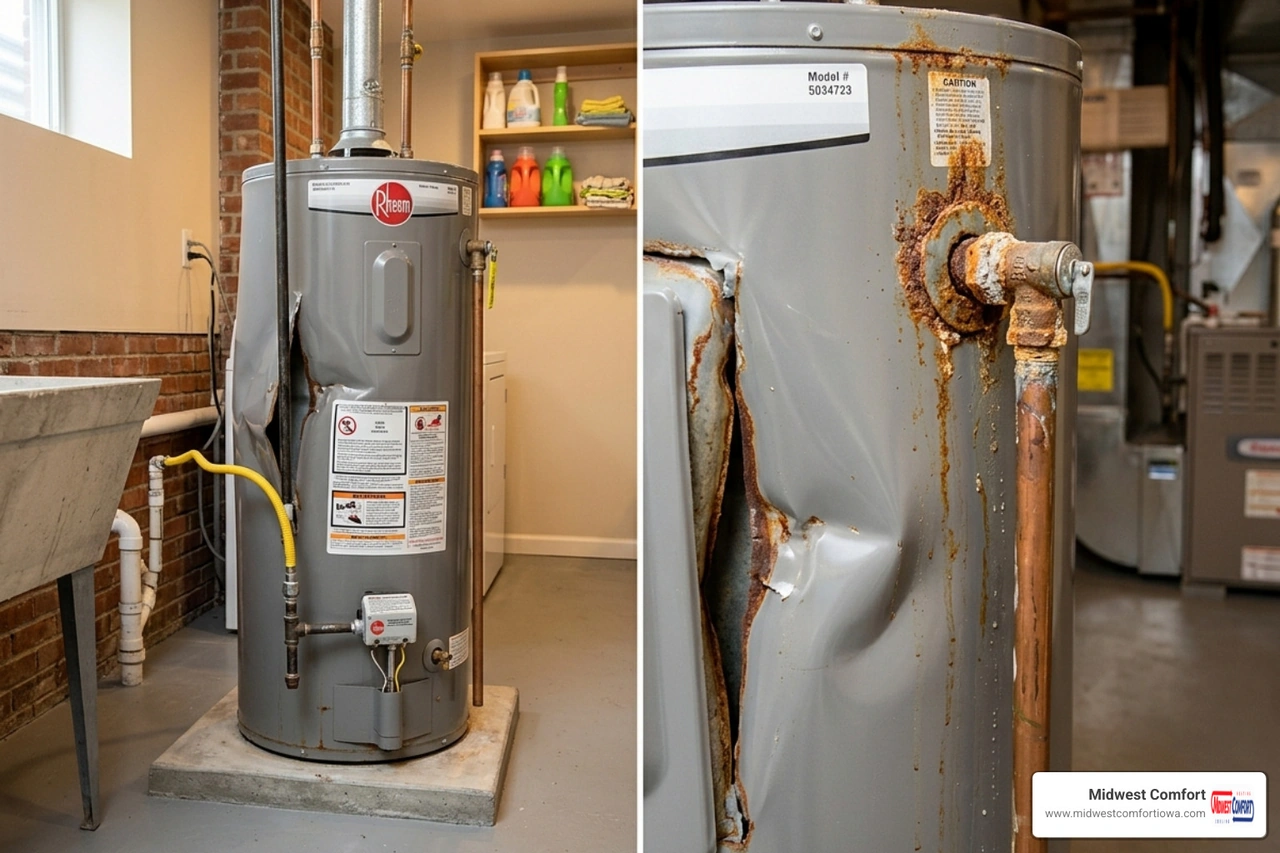
A tank rupture isn't just a "leak." It is a catastrophic structural failure. In extreme cases, a residential water heater can launch through floors and ceilings like a rocket. The blast radius of such an event can destroy an entire utility room and cause significant structural damage to your home in Ankeny or Waukee. Even if the tank doesn't "launch," a pipe rupture can release hundreds of gallons of water in minutes, leading to massive flooding and property loss.
Scalding and Personal Injury
The danger isn't always a giant explosion. Sometimes, the danger comes from the medium inside the tank. If a PRV is faulty and sticks partially open, or if it opens but fails to reseat properly, it can spray high-temperature steam and scalding water into your basement or mechanical closet.
High-pressure steam causes severe burns almost instantly. Because a faulty valve may discharge unpredictably, anyone standing near the unit during a pressure spike is at risk. This uncontrolled discharge is a major safety hazard, especially in homes with curious children or pets who might be near the appliance when it decides to vent.
Why Valves Fail and How to Spot the Signs
Understanding the "why" behind valve failure helps us prevent it. Most PRVs don't just decide to stop working; they are usually victims of their environment. In our area, including places like Clive and Johnston, hard water is a frequent culprit. Mineral buildup can "freeze" a valve in place, preventing it from moving when it needs to.
If you are trying to perform Signs You Need Water Heater Repair diagnostics, start with your ears and eyes. Are you seeing moisture around the base of the tank? Do you hear hissing sounds? These are often the first indicators that the valve's seat is no longer airtight.
Another subtle sign is When Water Heater Makes Popping Noises. While popping is often caused by sediment, the increased internal turbulence can stress the PRV, leading to premature failure.
How a Faulty Pressure Relief Valve Creates Danger Through Excessive Chattering
"Chattering" is a technical term for when a valve opens and closes extremely rapidly. It sounds like a vibrating or hammering noise. This usually happens when the valve is oversized for the system or when there is significant Signs of Sediment Buildup in Water Heater interfering with the flow.
Chattering is dangerous because the mechanical wear is immense. The constant hammering can destroy the internal spring and the valve seat in a matter of hours. Furthermore, the vibrations can loosen pipe fittings and crack nearby joints, leading to secondary leaks that are difficult to track down.
How a Faulty Pressure Relief Valve Creates Danger via Improper Installation
Sometimes the valve itself is fine, but the way it was put in creates a hazard. We often see "bad actors" in the HVAC world where the discharge piping isn't supported correctly. If the heavy metal pipe hanging off the PRV isn't supported, it puts physical stress on the valve body, warping it so it can't open or close properly.
Additionally, Water Heater Temperature Fluctuations Causes can sometimes be traced back to incorrect valve sizing. If a valve is too small, it won't be able to vent pressure fast enough to prevent a rupture. If the discharge line is restricted or "capped" (which we occasionally see in dangerous DIY "repairs"), the valve becomes completely useless.
Best Practices for Maintenance and Prevention
We believe that a proactive approach is the only way to handle pressure safety. You shouldn't wait for a hissing sound to check your PRV. While these valves can technically last 30 years, they require regular "exercise" to ensure they haven't seized up.
Healthy vs. Faulty Valve Symptoms
| Symptom | Healthy Valve | Faulty Valve |
|---|---|---|
| Visual Appearance | Clean, dry, no corrosion | Mineral crust, rust, or dampness |
| Sound | Silent during normal operation | Hissing, whistling, or chattering |
| Manual Test | Lever lifts easily, water flows then stops | Lever is stuck or water won't stop dripping |
| Surrounding Area | Dry floor and walls | Moisture, puddles, or water stains |
| System Pressure | Steady and within normal limits | Inconsistent or dangerously high readings |
Maintenance Steps for Homeowners
- Annual Manual Check: Most PRVs have a small silver lever. Once a year, you should lift this lever briefly to allow a bit of water to discharge through the drain pipe. If water flows and then stops completely when you release the lever, the valve is likely in good shape. (Warning: The water will be very hot!)
- Visual Inspections: Once a month, take a flashlight and look at the valve and the end of the discharge pipe. If you see any signs of "simmering" (small amounts of dried minerals or moisture), the valve is starting to fail.
- Pressure Margin: Ensure your system isn't running too close to the valve's "set pressure." Ideally, your operating pressure should be at least 10% to 20% lower than the pressure stamped on the valve's tag. This prevents the valve from constantly "trying" to open, which wears out the seal.
- Professional Recalibration: If you have recently upgraded your home's plumbing or changed your water heater's settings, have a professional verify that the PRV is still appropriately sized and set for the new conditions.
Frequently Asked Questions
Is a leaking pressure relief valve an emergency?
While a small drip might not cause an immediate explosion, it should be treated with urgency. A leak means the valve is no longer capable of holding its set pressure, or it is being forced open by a system-wide overpressure issue. In either case, your "last line of defense" is weakened. We recommend calling for service as soon as you notice moisture.
Why is my pressure relief valve whistling?
Whistling or squealing usually occurs when steam or water is being forced through a very tiny opening under high pressure. This often means the valve is "simmering" or partially stuck. It is a clear warning sign that the pressure is too high or the valve seat is failing.
Can I replace a pressure relief valve myself?
We strongly advise against DIY repairs on pressure relief valves. Because these are critical safety devices, they must be installed with specific torque, alignment, and discharge piping configurations to meet safety codes. A mistake during installation could render the valve useless, creating the very danger you were trying to avoid.
Conclusion
At Midwest Comfort, we’ve seen how a faulty pressure relief valve creates danger in homes across Des Moines, Altoona, and Pleasant Hill. From minor leaks that lead to mold to major failures that damage property, the risks are simply too high to ignore.
As a family-owned business, we treat your home's safety as if it were our own. Whether you're in Grimes, Norwalk, or Carlisle, our team is dedicated to providing honest, high-quality HVAC solutions that keep your pressurized systems running safely and efficiently. Don't let a small valve become a big problem.
If you suspect your water heater is acting up or you haven't had your safety valves inspected recently, reach out to us. We’re here to help you maintain a comfortable, and most importantly, safe home.
For expert assistance with your home's hot water system, visit our Water Heater Services in Des Moines page today.
