Why Getting Your Water Heater Temperature Right Matters More Than You Think
How to set the right temperature on your water heater is simpler than most people expect — and it makes a real difference for your family's safety, comfort, and energy bills.
The short answer: Set your water heater to 120°F (49°C). This is the temperature recommended by the U.S. Department of Energy and the Consumer Product Safety Commission (CPSC) for most homes. Here's why it hits the sweet spot:
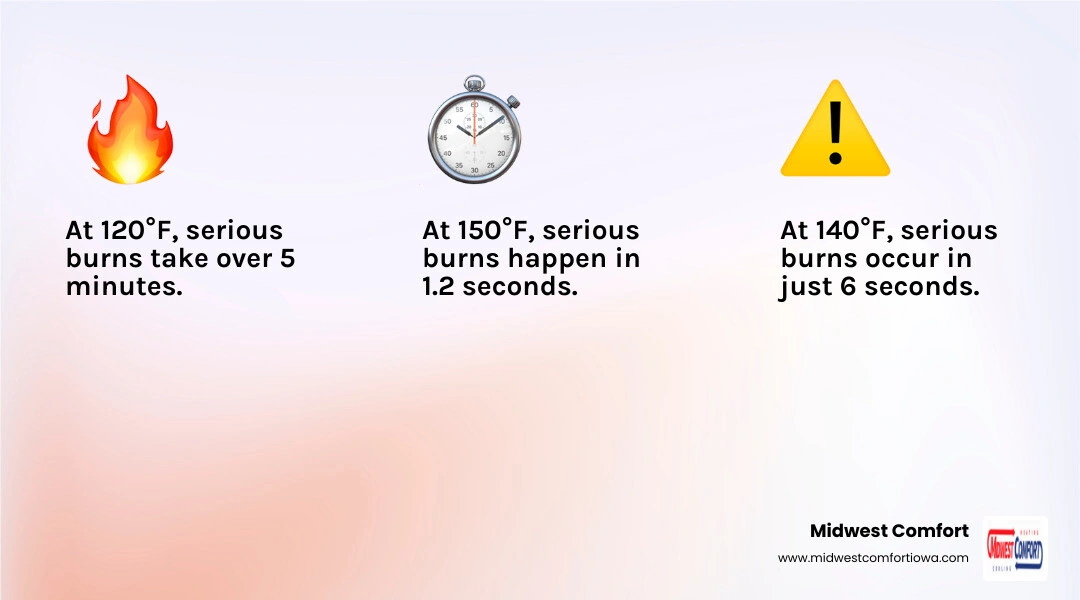
- Safe from scalding — At 120°F, it takes more than 5 minutes for serious burns to occur. At 140°F, that drops to just 6 seconds.
- Energy efficient — Water heaters account for about 18% of your home's energy use. Dropping from 140°F to 120°F can save you 4–22% on water heating costs — potentially over $400 a year.
- Bacteria control — 120°F is hot enough to keep harmful bacteria like Legionella in check for most households.
- Appliance friendly — Modern dishwashers have built-in heating elements, so 120°F is sufficient for most homes.
Most water heaters come factory-set to 140°F — higher than you need, and potentially unsafe if you have young children or elderly family members at home.
Every year, tap water scald burns lead to more than 1,500 hospital admissions and around 100 deaths across the U.S. A simple thermostat adjustment can dramatically reduce that risk in your home.
Why 120°F is the Ideal Standard for Your Home
When we talk to homeowners in Des Moines and Waukee, we often find that the "default" setting on their units is higher than it needs to be. While "hotter is better" might seem like the logic for a great shower, the reality is that 120°F is the gold standard for residential safety and efficiency.
The primary concern is the risk of third-degree burns. Because our skin sensitivity varies, especially for children and the elderly, a few degrees make a life-changing difference.
| Water Temperature | Time to Produce a Third-Degree Burn |
|---|---|
| 120°F | More than 5 minutes |
| 130°F | 30 seconds |
| 140°F | 6 seconds |
| 150°F | 2 seconds |
Beyond safety, there is the financial aspect. In our part of Iowa, winter groundwater can be quite cold. Your water heater has to work harder to bridge the gap between that chilly intake and your set temperature. By lowering the setting from 140°F to 120°F, you can reduce your standby heat loss (the energy wasted keeping water hot while you aren't using it) and save significantly on your monthly utility bills. For every 10°F reduction in water temperature, you can save roughly 3–5% on water heating costs.
However, if you find that your water temperature is jumping all over the place despite your settings, you might be dealing with Water Heater Temperature Fluctuations Causes that require a professional look.
How to Set the Right Temperature on Your Water Heater Safely
Before you go tinkering with the dials, we always recommend a "safety first" mindset. Adjusting a water heater involves either gas or electricity, so taking the right precautions is non-negotiable.
General Preparation Steps:
- Test the baseline: Run the hot water at the tap closest to the heater for about three minutes. Use a kitchen thermometer to see where you’re currently at.
- Clear the area: Ensure you have plenty of light and space to work around the unit.
- Notify the household: Let everyone know not to use the hot water while you are adjusting the settings to avoid any surprises at the tap.
If you are unsure about the age or condition of your unit before making adjustments, checking out a Water Heater Repair Waukee IA Guide can help you determine if your system is ready for a tune-up.
How to set the right temperature on your water heater (Gas)
Gas water heaters are generally easier to adjust because the thermostat is located on the outside of the tank.
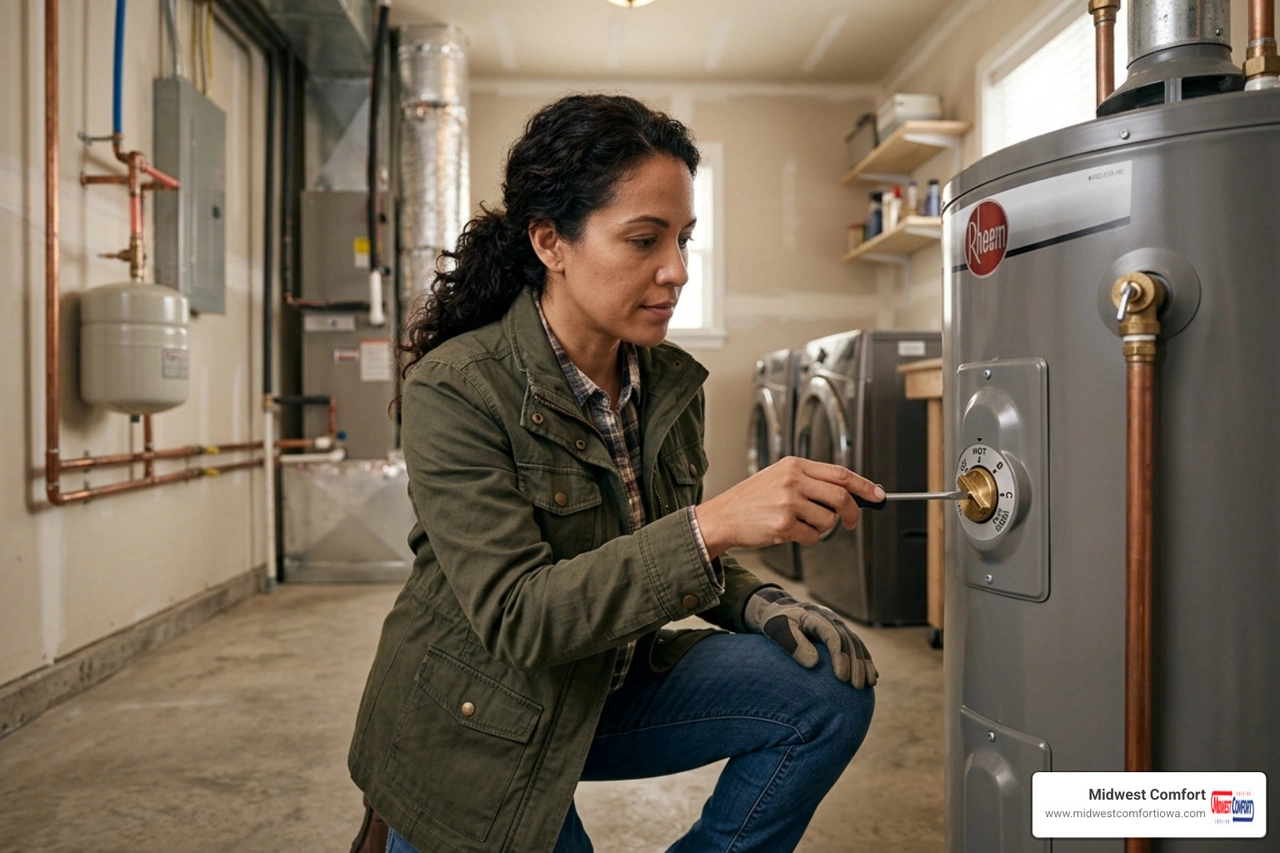
- Locate the gas valve: This is usually near the bottom of the tank. You’ll see a dial with markings like "Low," "Hot," "A," "B," "C," and "Very Hot."
- Understand the markings: Usually, the "Hot" or triangle setting represents 120°F. Each letter typically adds 10 degrees (A = 130°F, B = 140°F).
- Turn the dial: Use your hand or a flathead screwdriver to move the dial to the 120°F mark.
- Relight the pilot (if necessary): Some older models might require you to ensure the pilot light stays lit after adjustment, though most modern dials don't interfere with the pilot.
- Wait and verify: Give the tank about three hours to reach the new temperature, then test the water at the tap again.
If the dial doesn't seem to change the actual output, it might be one of the Signs You Need Water Heater Repair.
How to set the right temperature on your water heater (Electric)
Electric water heaters require a bit more care because the thermostats are hidden behind access panels and are close to high-voltage wiring.
- Turn off the power: Go to your home's electrical service panel (breaker box) and switch off the breaker for the water heater. Never skip this step.
- Remove access panels: Use a screwdriver to remove the one or two panels on the side of the tank.
- Move the insulation: Gently push aside the insulation to reveal the thermostat.
- Adjust the thermostats: Most electric heaters have two thermostats (upper and lower). Use a flathead screwdriver to turn both to the same temperature (120°F). Expert Tip: Never set the upper thermostat higher than the lower one, as this can lead to a shortage of hot water.
- Replace everything: Put the insulation back, screw the panels on, and turn the power back on at the breaker.
If you see rust or moisture inside these panels, take it as one of the Warning Signs of a Failing Water Heater.
Adjusting temperature on a tankless water heater
Tankless units are the "smart" cousins of the water heater family. They heat water on demand, which is excellent for efficiency.
- Locate the digital display: Most modern tankless units have a digital LED control panel on the front.
- Use the buttons: Simply use the "up" or "down" arrows to set the exact degree you want.
- Check the flow rate: Setting a higher temperature might slightly reduce the flow rate if the unit has to work harder to heat very cold intake water.
If you’re considering making the switch to this technology, our Affordable Water Heater Installation Guide Waukee IA covers the benefits of going tankless in the Des Moines area.
When to Consider a Higher Temperature Setting
While 120°F is our standard recommendation, there are specific scenarios where 140°F might be necessary.
- Health and Immunity: If someone in your home has a compromised immune system or a chronic respiratory condition, 140°F is more effective at killing pathogens like Legionella.
- Older Dishwashers: Some older dishwashers don't have internal "booster" heaters. To get your dishes truly sanitized, they might need 130°F or 140°F water straight from the tank.
- Large Households: If you have five people trying to shower in one hour, a higher tank temperature means the hot water lasts longer because it's mixed with more cold water at the showerhead.
- Commercial Needs: In April 2026, regulations for commercial spaces like restaurants still require much higher temperatures (often 160°F or more) for sanitization.
Safety Solution: If you must set your heater to 140°F, we strongly recommend installing thermostatic mixing valves or anti-scald valves at your faucets and showerheads. These valves mix in cold water right at the point of use, ensuring the water hitting your skin is a safe 120°F even if the tank is much hotter.
Maintenance Tips for Consistent Temperature and Longevity
Setting the temperature is only half the battle. If your tank is full of "gunk," that thermostat won't be able to do its job correctly.
- Flush the tank annually: Sediment (minerals like calcium and magnesium) settles at the bottom of the tank. This creates an insulating layer between the burner/element and the water. If you hear popping or rumbling, those are Signs of Sediment Buildup in Water Heater.
- Check the anode rod: This "sacrificial" rod attracts corrosive elements so they eat the rod instead of your tank. Check it every 2-3 years.
- Insulate your pipes: Wrapping your hot water pipes in foam sleeves helps maintain the temperature as the water travels from the basement to your second-floor bathroom.
Troubleshooting common temperature issues
Sometimes, how to set the right temperature on your water heater isn't the problem — it's a mechanical failure.
- Inconsistent Heat: This often points to a broken dip tube (the tube that sends cold water to the bottom) or a failing thermostat.
- No Hot Water: For gas, check the pilot. For electric, check the breaker or the "reset" button on the thermostat itself.
- Popping Noises: This is almost always sediment. When steam bubbles get trapped under sediment and "pop" through, it sounds like popcorn. When Water Heater Makes Popping Noises, it's time for a flush.
For more complex repairs, we've seen almost every Water Heater Repair Issues Solved by our team in the field.
Frequently Asked Questions about Water Heater Settings
How much can I save by lowering the temperature to 120°F?
Most homeowners see a reduction of 4% to 22% in their water heating costs. Since water heating is roughly 18-25% of your total energy bill, this can translate to $400 or more in annual savings. It also slows down mineral buildup, which extends the life of your unit.
What are the temperature requirements for commercial settings?
Commercial settings have much stricter rules. The FDA typically requires hot water at more than 110°F for public restroom sinks. However, commercial dishwashers often require a minimum of 160°F to 180°F to meet health codes for sanitization.
How do I test the actual water temperature at the tap?
Don't rely on the dial alone! Run the hot water at the faucet furthest from the heater for three minutes. Fill a glass and immediately stick a cooking thermometer in. If it reads higher than 125°F, your setting is likely too high for safety.
Conclusion
Finding the perfect temperature for your water heater is a balancing act between the luxury of a hot shower and the practicalities of safety and your monthly budget. For most of our neighbors in Des Moines, Ankeny, and Waukee, 120°F is the winner.
At Midwest Comfort, we understand that home maintenance can feel like a full-time job. As a family-owned business, we treat your home like our own, offering tailored HVAC and water heater solutions that fit your family's needs and budget. Whether you're in Polk City, Clive, or Norwalk, we are here to ensure your home remains the comfortable sanctuary it should be.
If you’re struggling with inconsistent temperatures or it’s simply time for an upgrade, don't hesitate to reach out to us for expert help with Water Heaters Des Moines IA. We’ll help you find the setting that’s "just right."
