The Real Reason Your AC Is Struggling (And It Costs Less Than $20 to Fix)
Understanding how dirty air filters destroy your AC performance starts with a simple truth: your air filter is the single most neglected component in your entire HVAC system — and ignoring it is quietly costing Des Moines homeowners real money every month.
Here is what a dirty air filter does to your AC system:
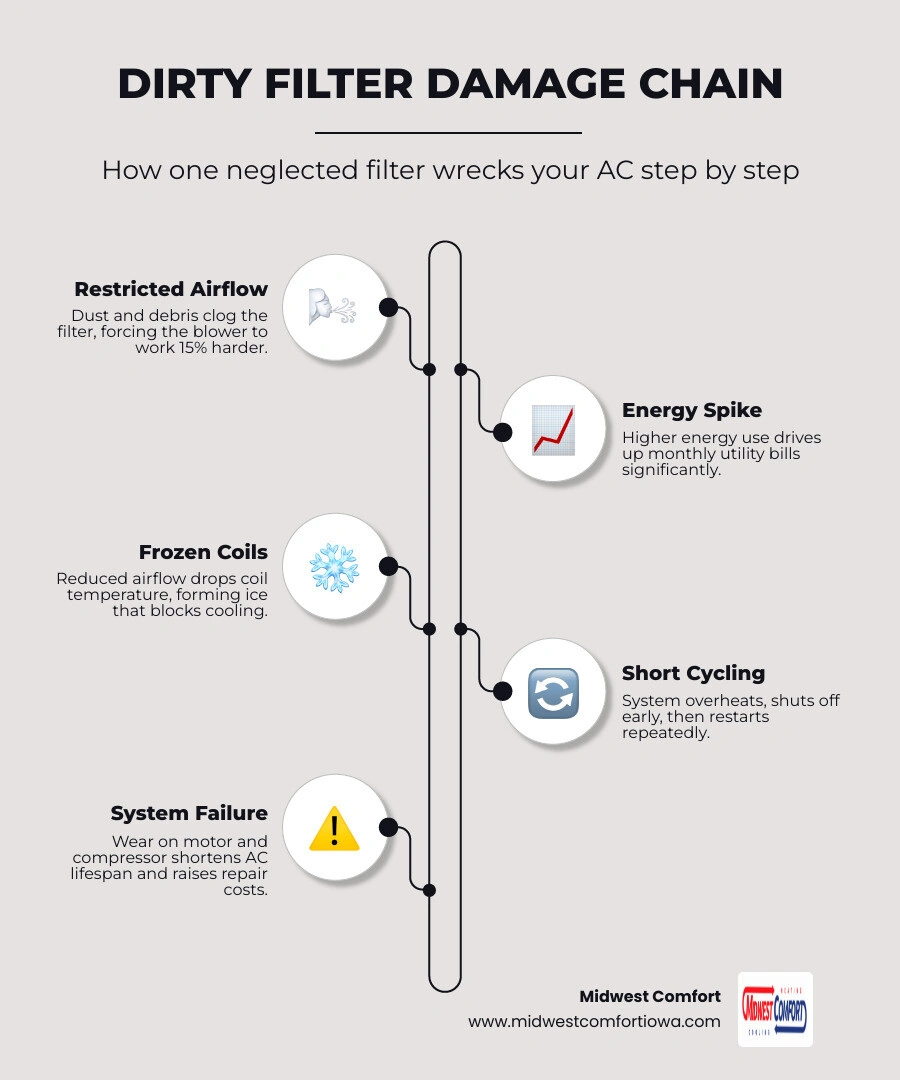
- Restricts airflow — forces your blower motor to work harder to move the same amount of air
- Spikes energy bills — the U.S. Department of Energy links clogged filters to up to 15% more energy consumption
- Freezes evaporator coils — reduced airflow causes coil temperatures to drop below freezing, forming ice
- Causes short cycling — the system overheats, shuts off early, and restarts repeatedly
- Degrades indoor air quality — a saturated filter can actually release trapped particles back into your air
- Shortens system lifespan — chronic airflow starvation wears out motors and compressors years ahead of schedule
Think of it this way: breathing through a clean straw is easy. Now imagine that straw is packed with dust, pet hair, and pollen. That is exactly what your AC blower motor is fighting against every time your filter is overdue for a change.
Heating and cooling already account for nearly half of all the energy used in a typical home. A clogged filter makes that number worse — and the damage does not stop at your utility bill. It works its way through your entire system, from the evaporator coil all the way to the compressor, which is the most expensive component your AC has.
The good news? Most of this damage is completely preventable with a filter that costs a few dollars and five minutes of your time.
How Dirty Air Filters Destroy Your AC Performance and Efficiency
It is May 2026, and as the Iowa humidity begins to climb, we see the same story play out in homes from Ankeny to Norwalk. A homeowner notices their home isn't quite as cool as it should be. They check the thermostat, see it's set to 70, but the room feels like a balmy 78. Often, the culprit isn't a massive refrigerant leak or a dead compressor — it’s a filter that looks like it’s been used to sweep a dusty barn.
Why restricted airflow is how dirty air filters destroy your AC performance
Your air conditioner doesn't actually "create" cold; it removes heat from the air inside your home. This process relies entirely on a steady stream of air passing over the cold evaporator coils. When a filter is clogged with dust, dander, and debris, it creates what we call "static pressure."
Static pressure is essentially the resistance to airflow. When this resistance gets too high, the blower motor has to work significantly harder to pull air through the filter. This is a primary factor in Dirty Air Filters Impact HVAC Performance. Not only does this reduce the amount of cool air coming out of your vents, but it also creates immense mechanical strain.
By 2026 standards, modern HVAC systems are designed with high-efficiency variable-speed motors. While these are great for saving energy, they are also sensitive to pressure drops. A clogged filter forces these motors to ramp up to maximum speed just to maintain basic airflow, leading to premature burnout. AC Maintenance Boost Performance by ensuring these motors don't have to fight an uphill battle every time they turn on.
The impact of 50% home energy use on your utility bills
Did you know that heating and cooling devour almost 50% of the energy used in your home? In a typical Des Moines household, that is the largest single expense on the monthly budget. When you consider that a dirty air filter can increase energy consumption by 15%, the math gets ugly very quickly.
According to the U.S. Department of Energy, a dirty or missing filter can increase your monthly utility bill by 15 percent or more. For a family in Waukee or Clive with a $200 summer cooling bill, that’s an extra $30 every month literally thrown out the window. Over a long Iowa summer, that’s more than enough to cover the cost of professional maintenance or a whole year's supply of high-quality filters.
The efficiency loss happens because the system has to run for much longer cycles to reach the desired temperature. If the airflow is cut by 30-50%, your AC might run for 40 minutes to do a job it should have finished in 15. This "long-cycling" is a silent efficiency killer.
Mechanical Consequences: From Frozen Coils to System Failure
If the energy bills don't grab your attention, the repair bills certainly will. We often tell our neighbors in Pleasant Hill and Altoona that neglecting a $15 filter can easily lead to a $1,500 repair. It’s a cascading chain reaction of mechanical failure.
Identifying the signs of how dirty air filters destroy your AC performance
How do you know if your filter has reached the "danger zone"? There are several 7 Signs Your HVAC System Needs Repair that often point directly back to a clogged filter:
- Frozen Evaporator Coils: This is the most common "emergency" call we receive. When airflow is restricted, the refrigerant in the coils stays too cold because there isn't enough warm air passing over it to facilitate heat exchange. Eventually, the condensation on the coils turns to ice.
- Short Cycling: If your AC turns on and off every few minutes, it might be overheating. A dirty filter causes heat to build up inside the cabinet, triggering a safety limit switch that shuts the system down to prevent a fire or motor meltdown.
- Weak Airflow: Hold your hand up to a supply vent. If it feels like a gentle whisper instead of a steady breeze, your filter is likely choking the system.
- The "Dusty" Smell: If you notice a musty or dusty odor when the AC kicks on, your filter is likely saturated and allowing particles to settle on the internal components.
| Maintenance Item | Cost Level | Potential Consequence of Neglect | Repair Cost Level |
|---|---|---|---|
| Monthly Filter Change | Very Low | Blower Motor Burnout | High |
| Filter Inspection | Free | Frozen Evaporator Coils | Medium-High |
| Visual Coil Check | Low | Compressor Failure | Very High |
| MERV Rating Match | Low | Cracked Heat Exchanger | Critical |
The danger of running your system without a filter
Some homeowners think they can "cheat" the system by removing a dirty filter and running the AC without one for a few days while they wait to go to the store. This is a gamble that rarely pays off.
Without a filter, dust and debris go directly onto the wet evaporator coils. Because these coils are damp with condensation, the dust turns into "coil mud." This mud acts as an insulator, preventing the refrigerant from absorbing heat and providing a perfect breeding ground for mold. Once the coils are coated in this sludge, a simple filter change won't fix the problem — you'll need a professional cleaning, which involves opening the plenum and using specialized chemicals.
Indoor Air Quality and Health Impacts in Des Moines
In May 2026, the air in Central Iowa is thick with more than just humidity. We deal with corn pollen, ragweed, and dust from local construction in growing areas like Grimes and Johnston. Your air filter is your home's first line of defense against these microscopic invaders.
A dirty air filter doesn't just stop working; it actually becomes a source of pollution. When a filter is completely full, the pressure from the blower motor can cause "blow-by," where dust and allergens are forced around the edges of the filter frame or through the saturated material.
For our neighbors in Des Moines who struggle with asthma or seasonal allergies, this is a serious health concern. High-quality Air Filters Des Moines IA can capture particles as small as 0.3 microns, including mold spores and bacteria. However, if that filter is clogged, those particles stay in your breathing zone, leading to itchy eyes, sneezing, and respiratory distress.
Maintenance Guide: Choosing and Replacing Your Filter
Now that we know the "why," let's talk about the "how." Replacing your filter is the easiest DIY task in home maintenance, but there are a few nuances that can make a big difference in your AC's performance.
Choosing the right MERV rating for your home
MERV stands for Minimum Efficiency Reporting Value. It’s a scale from 1 to 20 that measures how well a filter captures particles. For most homes in the Midwest, the "sweet spot" is between MERV 8 and MERV 11.
- MERV 1-4: These are the basic fiberglass filters. They protect the equipment from large dust bunnies but do almost nothing for your air quality.
- MERV 8-11: These are pleated filters that offer a great balance. They capture pollen, dust mites, and pet dander without putting excessive strain on your blower motor.
- MERV 13+: These are high-efficiency filters. While they are great for allergies, they are very thick. If your system wasn't designed for them, they can restrict airflow as much as a dirty filter.
Always check your manufacturer's recommendations in your Guide to Air Conditioner Maintenance before upgrading to a higher MERV rating. If you aren't sure, Regular AC Maintenance for Optimal Performance from a professional can include a static pressure test to see what your system can handle.
Factors that accelerate filter clogging in 2026
Not every home needs a filter change at the same interval. In 2026, several factors might mean you need to swap yours more often:
- Pets: If you have a Golden Retriever in Carlisle or a couple of cats in Adel, pet hair and dander will clog a filter in as little as 30 days.
- Home Renovations: If you’re remodeling a kitchen in Windsor Heights, the drywall dust will kill a filter in a matter of hours.
- Local Air Quality: Homes near gravel roads or active construction sites in Dallas Center or Polk City will see much faster dust accumulation.
- Smoking: Indoor smoking introduces heavy particulates that create a sticky residue on filters, making them fail much faster.
Frequently Asked Questions about AC Air Filters
How often should I change my filter if I have pets?
If you have pets, we recommend inspecting your filter every 30 days. While a standard home might go 60 to 90 days, the combination of fur and dander creates a "matting" effect on the filter surface that blocks airflow very quickly. A 30-45 day replacement cycle is usually best for pet owners to prevent energy spikes.
Can a dirty filter cause my AC to blow warm air?
Yes, absolutely. When the filter is clogged, the lack of airflow causes the evaporator coil to drop below freezing. Once the coil is a block of ice, air can no longer pass through it at all. The air that does manage to trickle through isn't cooled properly, which can lead to the system blowing warm or room-temperature air. If this happens, turn the system off immediately to let it thaw and check the filter.
What happens if I use a filter with a MERV rating that is too high?
Using a filter that is too "tight" for your blower motor is essentially the same as using a dirty filter. It creates high static pressure, chokes the airflow, and forces the motor to work harder. You might get cleaner air, but you'll do it at the expense of your blower motor's lifespan and your monthly energy bill. Always match the filter to your system's capabilities.
Conclusion
At the end of the day, your air conditioner is an investment in your family's comfort. In Des Moines, where the summer sun can be unforgiving, keeping that system running at peak performance is our top priority at Midwest Comfort. We are a family-owned business, and we treat our customers like neighbors because you are our neighbors.
Whether you are in Runnells, Norwalk, or Ankeny, we are here to help you navigate the complexities of HVAC maintenance. Don't let a simple air filter be the reason your system fails when you need it most. If you've noticed weak airflow, rising bills, or unusual noises, it might be time for more than just a filter change.
Trust the experts who know the Iowa climate inside and out. Schedule Your Professional Air Conditioning Service with Midwest Comfort today, and let’s make sure your home stays cool, efficient, and comfortable all summer long.
