Why Energy Rates in Iowa Affect Your Water Heater Choice More Than You Think
Understanding how energy rates in Iowa affect your water heater choice starts with one simple fact: the fuel you use to heat water is often a bigger cost driver than the unit itself. Iowa homeowners have a real advantage here — the state's average residential electricity rate sits about 11% below the national average, thanks largely to the fact that Iowa generates 64% of its electricity from wind. That changes the math on which water heater type actually saves you money over time.
Here is a quick breakdown of how Iowa's energy landscape shapes your options:
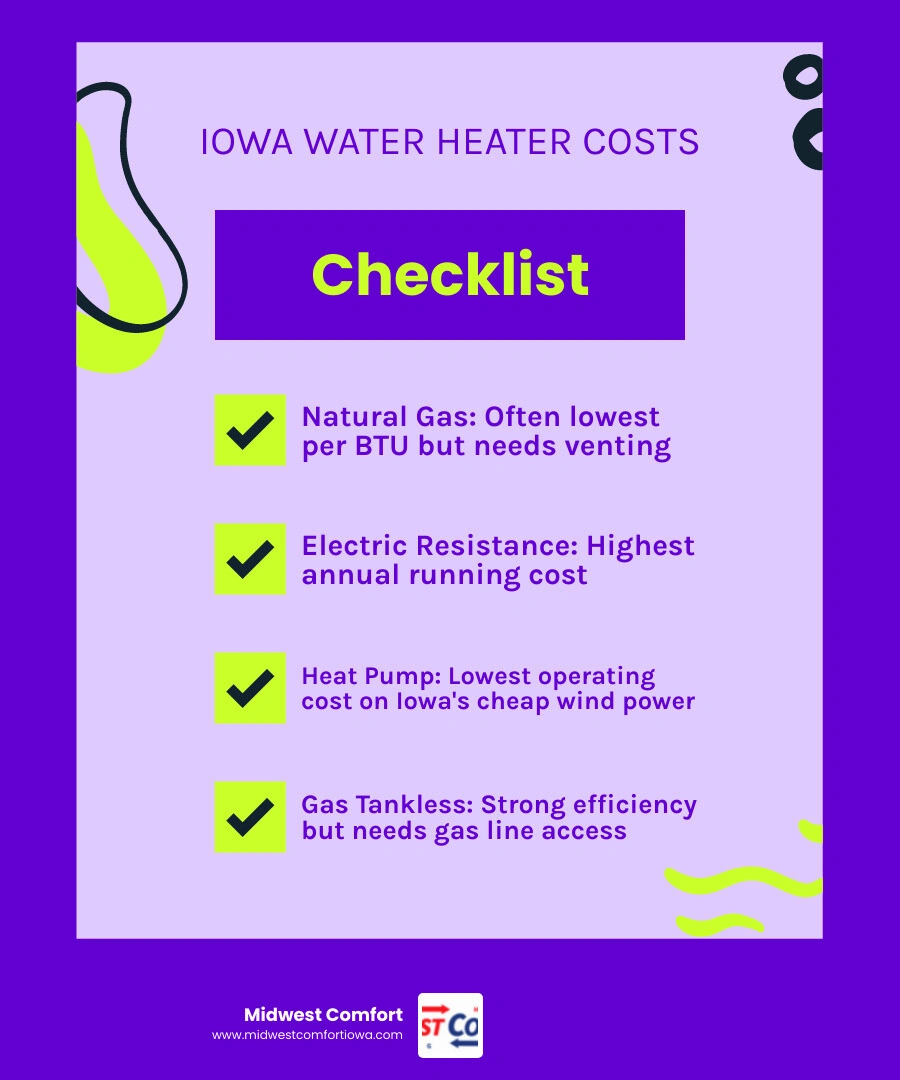
- Natural gas remains a common choice and typically costs less per BTU than electric resistance heating — but not always less than a heat pump water heater running on Iowa's affordable electricity.
- Electric resistance water heaters are simple and inexpensive to install, but they carry the highest annual operating costs of any common type.
- Heat pump water heaters use Iowa's below-average electricity rates to deliver the lowest annual running costs of any option — often a fraction of what a standard electric model costs to operate.
- Gas tankless water heaters offer strong efficiency and low annual costs, but require proper venting and gas line access that not every Iowa home has.
- Iowa's cold winters matter too — groundwater temperatures can drop close to freezing in January, making your water heater work significantly harder than it does in summer.
The right choice depends on your current fuel setup, your home's infrastructure, and how long you plan to stay. The sections below walk through each factor in detail.
How energy rates in iowa affect your water heater choice helpful reading:
- gas vs electric tankless water heater differences
- gas vs electric water heater comparison for homeowners
- how electric water heaters offer simpler installation
Understanding Iowa’s Energy Landscape and Fuel Sources
Iowa is unique when it comes to utility structures and electricity generation. Unlike states that rely heavily on coal or natural gas for power generation, Iowa is a national leader in renewable energy. As of June 2026, wind energy accounts for 64% of the state's total electricity generation. This green energy push is supported by massive infrastructure investments, such as the major wind farms built across the state.
For homeowners in the Des Moines metro area, including suburbs like Ankeny, Waukee, Johnston, and Clive, this clean energy grid directly impacts utility bills. MidAmerican Energy, which serves a massive portion of our local communities, offers a program matching 100% of retail electricity sales with renewable energy at no additional charge to customers. Meanwhile, municipal utilities and cooperatives throughout Polk and Dallas counties provide highly reliable, regulated power.
Because our electricity rates are roughly 11% below the national average, the traditional advice of "always choose natural gas for water heating" no longer holds true. When comparing fuel sources, we have to look at how efficiently a system converts that energy into hot water. While natural gas is highly effective, the clean, low-cost electricity flowing through Iowa's power lines has made electric-powered options, particularly hybrid heat pump systems, incredibly competitive.
To see how these options compare fundamentally, it helps to read our detailed gas vs electric water heater comparison for homeowners to understand how each fuel source operates.
How Energy Rates in Iowa Affect Your Water Heater Choice
When deciding on a new water heater, many homeowners focus solely on the physical footprint or the speed of hot water delivery. However, your monthly utility bills are heavily dictated by the technology inside the tank. Standby losses — the energy wasted keeping a large tank of water hot when nobody is using it — play a major role in overall efficiency.
To understand how different systems perform under typical Iowa utility structures, let's look at a side-by-side comparison of the three most common water heater technologies:
| Feature | Natural Gas Storage | Electric Resistance | Hybrid Heat Pump (HPWH) |
|---|---|---|---|
| Primary Energy Source | Natural Gas / Propane | Electricity | Electricity + Ambient Air Heat |
| Typical UEF Rating | 0.60 – 0.80 | 0.90 – 0.95 | 3.30 – 4.10 |
| Standby Energy Loss | High (due to thermal venting) | Moderate (insulated tank) | Very Low (highly insulated) |
| Recovery Speed | Fast (30–45 gallons/hour) | Slow (14–20 gallons/hour) | Moderate (uses backup elements when needed) |
| Operational Impact | Requires venting and gas line | Requires dedicated 240V circuit | Cools and dehumidifies surrounding air |
Comparing Operating Efficiency and Monthly Energy Bills
To truly measure efficiency, the industry uses the Uniform Energy Factor (UEF). The higher the UEF, the more efficiently the water heater converts its fuel source into usable hot water.
Conventional electric resistance water heaters are technically highly efficient at the point of transmission, converting 90% to 95% of electricity into heat. However, because electric resistance heating requires a massive amount of raw electrical current to warm the coils, it consumes a large amount of energy overall.
Standard gas burners typically operate at a lower UEF (around 0.60 to 0.70) because a significant portion of the heat escapes through the ventilation flue. However, because natural gas is highly concentrated, it can heat water much faster than electric resistance.
If you want to eliminate standby losses entirely, tankless water heaters are an exceptional choice. They only heat water on demand, achieving UEF ratings above 0.90 for gas models and up to 95% or higher for electric tankless units. To understand the operational differences between these systems, look over our guide on gas vs electric tankless water heater differences.
How Energy Rates in Iowa Affect Your Water Heater Choice for High-Efficiency Upgrades
If you want to maximize the benefit of Iowa's low electricity rates, hybrid heat pump water heaters (HPWH) are the gold standard. Instead of generating heat directly through electrical resistance, a heat pump water heater pulls heat from the surrounding indoor air and transfers it into the water tank. This process is incredibly efficient, allowing these systems to achieve UEF ratings between 3.3 and 4.1. This means they produce up to four times more energy than they consume.
Because Iowa's electricity is so affordable, switching to a heat pump water heater can reduce your water heating energy consumption by up to 70% compared to standard electric resistance units. This massive drop in consumption leads to a very short payback period, allowing homeowners to recoup their initial investment through monthly utility savings in just a few years.
To make the transition even more attractive, there are substantial financial incentives available for Iowa residents. Under current federal guidelines, homeowners can qualify for federal tax credits of up to $2,000 for installing an ENERGY STAR certified heat pump water heater. Additionally, local utilities like MidAmerican Energy offer rebates ranging from $300 to $500 for qualifying high-efficiency models.
These active incentives dramatically lower the financial barrier to upgrading your home. If you are trying to decide if it is time to move away from an old, inefficient unit, you can read about the long-term benefits of water heater replacement.
Environmental Factors: Iowa Winters and Water Quality
Our local weather and geological conditions play a massive role in how hard your water heater has to work. In central Iowa, we experience extreme seasonal shifts, which directly impact both the incoming municipal water supply and the performance of your home's appliances.
During the summer months, municipal groundwater entering homes in places like Grimes, Norwalk, and Pleasant Hill might hover around 60°F to 65°F. But when our freezing winters arrive, the ground freezes, and the incoming water temperature can plummet to nearly 35°F.
This means your water heater has to raise the water temperature by roughly 85°F to reach a comfortable shower temperature of 120°F. If your system is struggling to keep up during these transitions, it is important to recognize the early signs you need water heater repair before a total breakdown occurs.
How Energy Rates in Iowa Affect Your Water Heater Choice During Freezing Winters
The freezing winter temperatures affect water heaters differently depending on their fuel type and location:
- Conventional Tank Systems: Colder incoming water means the burner or heating elements must run much longer to heat a full tank. This increases your recovery time — the time it takes for the tank to heat back up after a long shower. If you have a standard electric resistance tank, this extended heating cycle can cause a noticeable spike in your winter electric bills.
- Tankless Systems: Because tankless units heat water on demand, they must instantly bridge that 85°F temperature gap. In peak winter, a tankless unit sized for a warmer climate may experience a reduced flow rate (gallons per minute) to ensure the water reaches the set temperature.
- Heat Pump Systems: If a heat pump water heater is installed in an unheated space like a cold garage or an uninsulated utility room, its efficiency will drop as the surrounding air temperature falls. In these conditions, the unit will temporarily switch to standard electric resistance mode to keep up with demand, which increases energy consumption. Installing the unit in a tempered basement is the best way to prevent this in Iowa.
When these systems struggle with extreme temperature swings, homeowners often experience sudden drops in hot water availability. To learn more about this issue, check out our guide on water heater temperature fluctuations causes.
Hard Water Challenges in Des Moines Homes
Beyond cold winters, central Iowa is notorious for hard water. The ground supply in communities like Waukee, Altoona, and Johnston contains high levels of dissolved minerals, specifically calcium and magnesium.
When hard water is heated, these minerals crystallize and settle at the bottom of tank-style water heaters, or form scale inside the heat exchangers of tankless units.
This mineral scale acts as a barrier between the heating element and the water. In gas units, the burner must heat through a thick layer of sediment, which can cause the tank bottom to overheat and degrade. In electric units, scale coats the heating elements, forcing them to run longer and hotter, which drastically shortens their lifespan and increases energy usage.
To protect your system from hard water damage, we recommend installing a home water softener and scheduling annual tank flushes or tankless descaling. If sediment buildup has already taken a toll on your system, it may be time to consult our resource on when to replace your water heater.
Key Considerations When Transitioning Fuel Types
If you are planning to switch from a gas water heater to an electric model, or vice versa, to take advantage of Iowa's energy rates, there are several structural factors you must plan for.
Converting from gas to electric is a popular choice for homeowners looking to couple their water heating with solar panels or take advantage of our clean wind-powered grid. Fortunately, electric models generally offer simpler physical placement because they do not require venting. For a breakdown of what this transition looks like, read about how electric water heaters offer simpler installation.
Infrastructure Requirements and Ventilation Needs
While electric units do not require a chimney or flue, they do have significant power requirements. A standard electric resistance or hybrid heat pump water heater typically requires a dedicated 240-volt, 30-amp circuit. If your home's electrical panel is already fully loaded, switching to electric may require a panel upgrade.
On the other hand, if you are transitioning from electric to natural gas, you must plan for proper combustion safety and ventilation. Standard gas water heaters rely on atmospheric venting, using a vertical flue to carry combustion gases safely out of the home.
If your utility room does not have direct access to a vertical chimney, you may need a power-vent model, which uses an electric fan to push exhaust gases horizontally through a side wall. This setup requires an active electrical outlet near the water heater to power the fan.
No matter which fuel source you choose, ensuring proper safety protocols during installation is absolutely vital to protect your household from gas leaks, electrical hazards, or dry-firing. Homeowners should review these critical water heater safety tips every homeowner should know to keep their systems operating safely.
Frequently Asked Questions About Iowa Water Heaters
Which fuel source is typically more efficient for Iowa homes?
In terms of raw energy conversion, hybrid heat pump water heaters are the most efficient option available for Iowa homes. By utilizing heat transfer technology rather than direct heat generation, they can achieve efficiencies up to 400%.
However, natural gas remains highly efficient for homes with high, simultaneous hot water demands because gas burners can recover and heat water much faster than standard electric elements.
Do Iowa utilities offer incentives for energy-efficient water heaters?
Yes. MidAmerican Energy offers rebates between $300 and $500 for homeowners who install qualifying ENERGY STAR certified heat pump water heaters.
Additionally, federal tax credits under the Energy Efficient Home Improvement Credit can cover up to 30% of the project cost (up to $2,000) for qualifying heat pump models. Always check with your local utility provider before purchasing to confirm active rebate requirements.
How does cold winter groundwater affect water heater performance?
During freezing Iowa winters, groundwater temperatures drop to near 35°F. This forces your water heater to work much harder to warm the water to a comfortable 120°F.
As a result, traditional tank water heaters take longer to recover after use, tankless units may experience a slight drop in water pressure to maintain temperature, and heat pump units installed in unheated spaces may rely more heavily on backup electric resistance elements.
Conclusion
Choosing the right water heater is not a one-size-fits-all decision. Iowa's unique energy profile — featuring affordable, wind-powered electricity and cold winter seasons — means that high-efficiency upgrades like hybrid heat pumps and tankless systems can offer incredible long-term value for local homeowners.
At Midwest Comfort, we provide honest, high-quality, and cost-effective HVAC and water heater solutions tailored specifically to the needs of families across the Des Moines metro area. As a family-owned business, we take pride in our family-oriented approach, offering tailored solutions, loyalty programs, and flexible payment options to ensure your home remains safe and comfortable year-round.
Whether you reside in Polk City, Granger, Waukee, Windsor Heights, Altoona, Dallas Center, Johnston, Adel, Runnells, Pleasant Hill, Grimes, Clive, Norwalk, Carlisle, or Ankeny, our experienced team is here to help you navigate your options.
If you are ready to upgrade your system or need expert advice, take a look at our Water Heater Replacement Guide Ankeny IA or our Affordable Water Heater Installation Guide Des Moines IA.
To find the perfect fit for your household's needs and start saving on your monthly utility bills, schedule a consultation with the team at Midwest Comfort today!
