
The Silent Threat That's Draining Your Water Heater's Life
How sediment buildup shortens your water heater life is simpler to understand than most homeowners realize — and the damage it causes is happening right now, quietly, at the bottom of your tank.
Here's the quick answer:
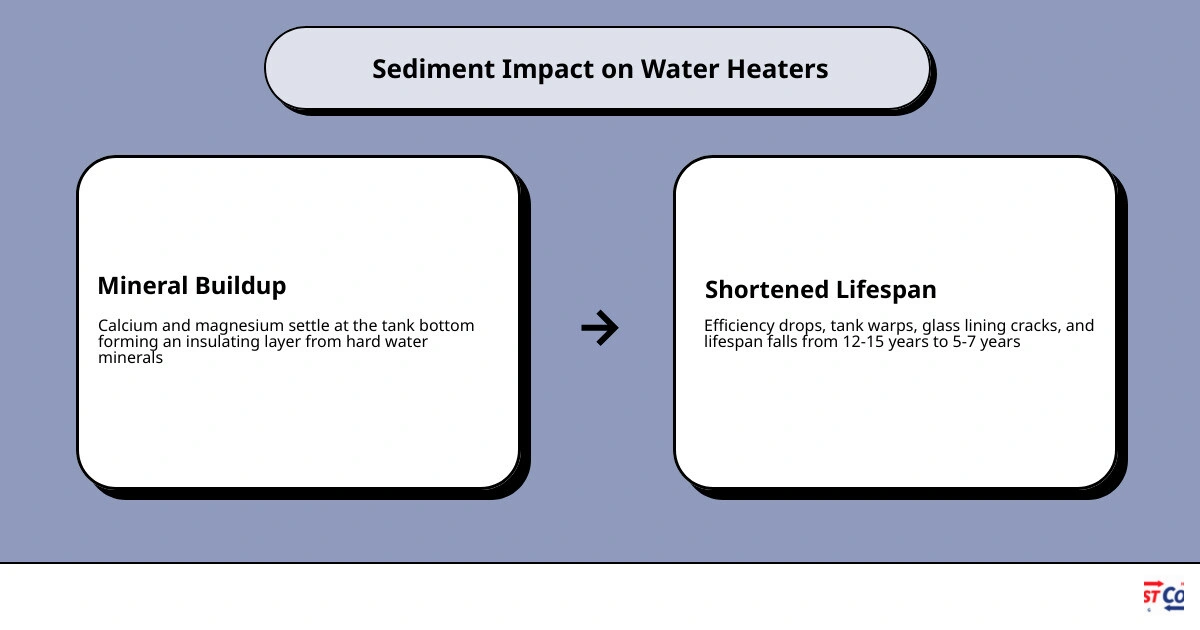
- Sediment forms when minerals like calcium and magnesium in your water supply settle to the tank bottom every time water is heated
- Efficiency drops because the sediment layer acts as insulation, forcing the heater to burn longer and work harder to reach temperature
- Physical damage follows as overheating warps the tank, cracks the glass lining, and burns out heating elements
- Hot water runs out faster because sediment physically displaces usable tank volume
- Lifespan shrinks from a healthy 12–15 years down to just 5–7 years in neglected systems
According to industry data, roughly 85% of water heater failures are directly linked to sediment accumulation — yet most homeowners don't think about it until cold showers force the issue.
For Des Moines families, this is especially relevant. Local water carries around 150 mg/L of dissolved minerals, putting it squarely in the "hard water" range. That means sediment builds up faster here than in many other parts of the country, and the damage adds up quicker than you'd expect.
The good news? This is almost entirely preventable with a few simple maintenance habits.
Understanding How Sediment Buildup Shortens Your Water Heater Life
To protect your home, it helps to understand what is actually happening inside that big metal cylinder in your basement or utility closet.
When cold water enters your water heater, it carries dissolved minerals, primarily calcium carbonate and magnesium. As the heating elements (in electric units) or the burner (in gas units) raise the water's temperature, these dissolved minerals undergo a chemical change. They precipitate out of the liquid, solidifying into tiny, sand-like particles that slowly drift to the bottom of the tank.
Over time, these loose particles pack together, forming a dense, rock-hard barrier. This mineral crust behaves like an insulating blanket wrapped around the heat source.
Understanding this process is key to recognizing the Signs of Sediment Buildup in Water Heater systems before they lead to catastrophic failures.
Depending on whether you have a gas or electric water heater, sediment affects your system in slightly different, yet equally destructive, ways:
| Water Heater Type | Primary Impact of Sediment | Common Warning Signs | Long-Term Physical Consequence |
|---|---|---|---|
| Gas Water Heaters | Insulates the bottom burner; traps heat beneath the sediment layer. | Loud popping, rumbling, or banging noises during heating cycles. | Overheated tank bottom, warped steel, cracked protective glass lining, and premature leaks. |
| Electric Water Heaters | Buries the lower heating element in mineral scale, preventing heat transfer. | Lukewarm water, slow recovery times, or a complete loss of hot water. | Heating element burnout, electrical short-circuits, and accelerated tank corrosion. |
The Science of Mineral Precipitation in Des Moines Water
Here in the Des Moines metro area—including surrounding communities like Waukee, Ankeny, and Johnston—our municipal water supply is incredibly reliable, but it does carry a notable mineral load. On average, Des Moines water contains approximately 150 milligrams per liter (mg/L) of dissolved minerals.
According to the United States Geological Survey (USGS) water hardness scale, water is classified as follows:
- Soft: 0 to 60 mg/L
- Moderately Hard: 61 to 120 mg/L
- Hard: 121 to 180 mg/L
- Very Hard: Over 180 mg/L
At 150 mg/L, our local water is firmly in the "hard" category. Every single gallon of water that enters your home contains microscopic minerals just waiting to settle out. When heated above 130°F, the rate of mineral precipitation increases dramatically. If your household uses a lot of hot water, your tank is essentially acting as a mini mineral factory, continuously depositing calcium carbonate at the bottom of the vessel.
How Sediment Buildup Shortens Your Water Heater Life by Reducing Efficiency
The primary way how sediment buildup shortens your water heater life starts with a steady drop in operating efficiency.
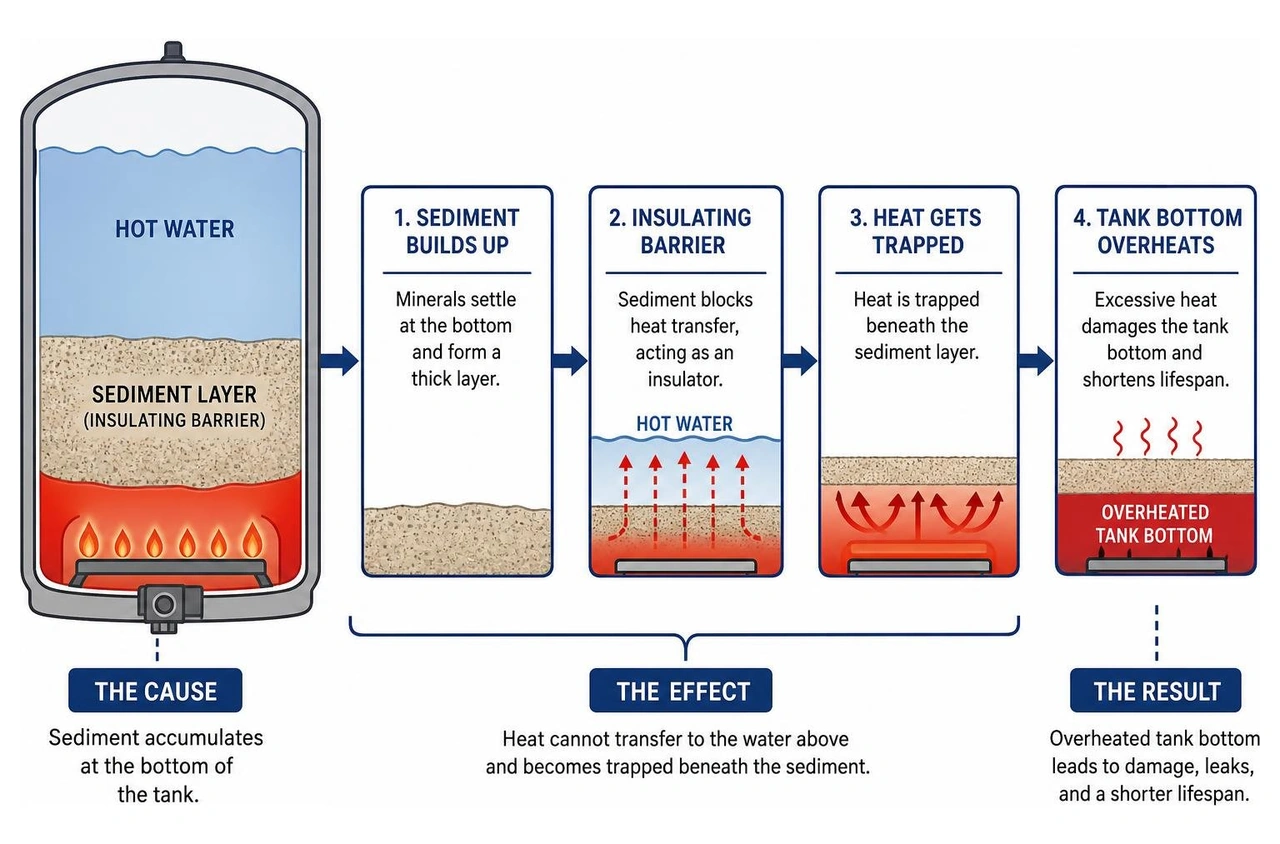
When a thick layer of sediment covers the bottom of a gas water heater or buries the lower element of an electric unit, the heat cannot easily reach the water. The heat source must run significantly longer to transfer the same amount of thermal energy to the water above.
This insulating barrier can easily reduce your water heater's efficiency by 25% to 40%. When your system has to work twice as hard to do the same job, your monthly energy bills rise. Over a single year, a heavily neglected system can cost you an extra $100 to $200 in wasted energy.
Furthermore, as the burner or elements struggle to push heat through the sediment, you will likely experience severe Water Heater Temperature Fluctuations Causes that result in sudden, unpleasant blasts of cold water mid-shower.
How Sediment Buildup Shortens Your Water Heater Life through Physical Damage
While higher energy bills are frustrating, the physical structural damage caused by sediment is what ultimately destroys the appliance.
In gas models, the burner is located directly underneath the tank. When sediment acts as a barrier, the heat from the burner gets trapped in the steel tank wall instead of transferring to the water. This leads to localized "hot spots." Under extreme, repeated thermal stress, the steel tank bottom can warp and expand.
To prevent rust, the interior of steel water heater tanks is coated with a thin, protective glass lining. When the steel tank warps due to localized overheating, this glass lining cracks, exposing the raw steel underneath to highly corrosive hot water.
At the same time, this extreme heat accelerates the depletion of your system's sacrificial anode rod—the component designed to attract corrosive elements away from the tank walls. Once the anode rod is fully consumed, the water attacks the exposed steel, leading to rust, pinhole leaks, and eventual tank failure.
To learn more about keeping your system running smoothly, check out our comprehensive Water Heater Life Extension Guide.
5 Steps to Prevent Sediment Damage and Extend System Lifespan
Taking a proactive approach to preventative maintenance is the best way to protect your investment, lower your utility bills, and add three to five years to your water heater's life.
By following these five straightforward steps, you can keep mineral accumulation at bay and ensure your system operates safely and efficiently.
Step 1: Perform an Annual Sediment Flush
Flushing your water heater once a year is the single most effective way to clear out soft mineral deposits before they bake into a solid, rock-like crust.
To perform a basic flush:
- Turn off the power: For gas units, turn the thermostat to the "Pilot" or "Off" position. For electric water heaters, shut off the dedicated breaker at your main electrical panel. Never flush an electric unit with the power on, or you will burn out the heating elements.
- Shut off the water: Close the cold water inlet valve at the top of the tank.
- Attach a garden hose: Connect a standard garden hose to the drain valve located near the bottom of your water heater. Route the other end of the hose to a floor drain, utility sink, or safely outside.
- Open a hot water faucet: Turn on a hot water faucet upstairs to break the vacuum and allow the tank to drain smoothly.
- Open the drain valve: Carefully open the drain valve. If you have an older plastic drain valve, turn it slowly to avoid snapping the handle.
- Flush with fresh water: Once the tank is empty, briefly open the cold water inlet valve for a few seconds. This sends a blast of fresh water into the bottom of the tank, swirling up and purging any stubborn sediment. Repeat this until the water flowing out of the hose runs completely clear.
- Refill and restore power: Close the drain valve, disconnect the hose, reopen the cold water inlet, and let the tank fill completely before restoring gas or electrical power.
If you ever need to stop the flow of water in a hurry during this process, make sure you know How to Shut Off Your Water Heater in an Emergency.
Step 2: Lower the Thermostat Temperature
Many water heaters are set to 140°F or higher by default. However, keeping your water at this temperature significantly accelerates the mineral precipitation process.
By lowering your thermostat to 120°F, you achieve three major benefits:
- Slower sediment formation: Lower temperatures keep minerals dissolved in the water longer, preventing them from settling out as quickly.
- Lower energy bills: You save roughly 3% to 5% on your water heating costs for every 10 degrees you lower the temperature.
- Improved safety: 120°F is hot enough to prevent bacterial growth while virtually eliminating the risk of accidental scalding.
For more helpful safety recommendations, read through our Water Heater Safety Tips Every Homeowner Should Know.
Step 3: Install a Whole-Home Water Softener
If you want to stop sediment at the source, installing a whole-home water softener is the ultimate solution.
Water softeners use an ion-exchange process to replace hard minerals like calcium and magnesium with sodium ions. Because sodium does not precipitate out of water when heated, a water softener completely eliminates the primary building blocks of water heater sediment.
This not only keeps your water heater tank pristine, but it also protects your washing machine, dishwasher, plumbing fixtures, and showerheads from scale buildup.
Step 4: Inspect and Replace the Sacrificial Anode Rod
The sacrificial anode rod is a long metal rod (usually made of magnesium or aluminum) suspended inside your tank. Its sole job is to corrode so your tank doesn't have to.
Because sediment traps heat and accelerates corrosion, the anode rod in a sediment-heavy tank will degrade much faster than normal.
We recommend having your anode rod inspected every three years. If the rod is rusted down to its steel core or covered in a thick layer of mineral scale, replacing it immediately can save your tank from premature rust and structural failure.
Step 5: Schedule Professional HVAC Maintenance
While a basic DIY flush is great, it often cannot remove heavy, consolidated sediment that has already hardened at the bottom of the tank.
Professional HVAC and home comfort technicians have specialized tools and professional-grade flushing techniques to safely dissolve and remove stubborn mineral crusts.
During a professional maintenance visit, a technician will also inspect your electrical connections, test the temperature and pressure (T&P) relief valve, check the burner assembly, and evaluate the overall health of your unit to ensure safe, worry-free operation.
When to Flush, Repair, or Replace Your Water Heater
Knowing whether to maintain, repair, or completely replace a water heater depends heavily on the age of the unit and the condition of the sediment inside.
If your water heater is relatively young (under 8 years old), an aggressive professional flush can usually restore lost efficiency and clear out the tank safely. However, if a tank has been neglected for over a decade, flushing it can sometimes cause more harm than good.
Over time, hardened sediment can actually seal tiny micro-cracks in an aging tank. When you flush away that sediment, you might accidentally open up those cracks, leading to immediate leaks.
Before making a decision, it's helpful to weigh the options by reviewing When to Replace Your Water Heater and understanding the long-term Benefits of Water Heater Replacement.
Signs Your Tank Needs Immediate Professional Attention
If you notice any of the following warning signs, your water heater is likely suffering from severe sediment accumulation and needs professional service right away:
- Loud banging or popping: This occurs when water gets trapped beneath a layer of hardened sediment. As the water boils, steam bubbles burst violently through the mineral crust, creating loud, alarming noises.
- Rusty or discolored water: If your hot water looks cloudy, yellow, or rusty, it's a sign that sediment is mixing with your water supply or that the tank's interior steel is actively corroding.
- Lukewarm water or rapid depletion: If your hot showers are cut short or the water never seems to get truly hot, sediment has likely displaced your tank's storage capacity or insulated the heating elements.
- Unexplained utility bill increases: If your gas or electric bills are steadily climbing but your usage habits haven't changed, your water heater is likely working overtime to fight through a thick layer of scale.
Choosing Replacement Over Repair for Older Units
If your water heater is over 10 years old and is exhibiting severe sediment-related issues, replacement is almost always the most cost-effective and reliable path forward. Trying to repair a heavily corroded, sediment-packed tank is a temporary band-aid on a system that is nearing the end of its functional life.
Modern water heaters are vastly more energy-efficient than older models. Upgrading to a new system will immediately lower your monthly utility costs, restore consistent hot water, and give you long-term peace of mind.
To help you navigate the process, we've put together several local resources:
- Review our Water Heater Replacement Guide Ankeny IA for tailored advice in the northern metro.
- Check out our Water Heater Installation Guide Des Moines IA for a step-by-step look at what to expect during installation.
- If your system has failed completely and you need help fast, consult our Emergency Water Heater Installation Des Moines Guide.
Frequently Asked Questions About Water Heater Sediment
Can sediment buildup cause a water heater to leak?
Yes, absolutely. When sediment settles at the bottom of the tank, it traps extreme heat against the steel walls. This localized overheating warps the tank and cracks the protective glass lining. Once the glass lining is compromised, the water directly corrodes the steel, eventually leading to rust-through leaks at the base of the tank.
How often should I flush my water heater in Iowa?
Because Iowa water is moderately hard to hard (averaging 150 mg/L of dissolved minerals in the Des Moines area), we highly recommend flushing your water heater at least once a year. If you do not have a whole-home water softener and have a large household with high hot water demands, flushing the system every six months is an even safer bet.
Is water heater sediment harmful to my health?
The mineral sediment itself (calcium carbonate and magnesium) is not toxic or harmful to consume in small amounts. However, a thick layer of sediment at the bottom of a tank creates a "dead zone" where water temperature is lower. This environment can harbor and encourage the growth of anaerobic bacteria, which can cause unpleasant odors, a metallic taste, or localized water quality issues.
Conclusion
Understanding how sediment buildup shortens your water heater life is the first step toward protecting one of the most hardworking appliances in your home. By taking proactive steps—like performing annual flushes, setting your thermostat to 120°F, and keeping an eye out for warning signs—you can keep your system running efficiently and avoid the stress of a sudden, cold shower.
At Midwest Comfort, we believe in taking care of our neighbors. As a family-owned business serving the greater Des Moines area—from Ankeny and Waukee to Clive, Johnston, and beyond—we bring an honest, family-oriented approach to everything we do. We are committed to providing tailored home comfort solutions, outstanding maintenance, and flexible payment options designed to fit your family's needs.
Don't wait for your water heater to start making noise or leave you with a cold shower. Contact us today to schedule a professional inspection and flush, or visit our Midwest Comfort Water Heaters Service Page to learn more about how we can help you keep your home warm, comfortable, and running smoothly.
