
What to Do Right Now: How to Shut Off Your Water Heater in an Emergency
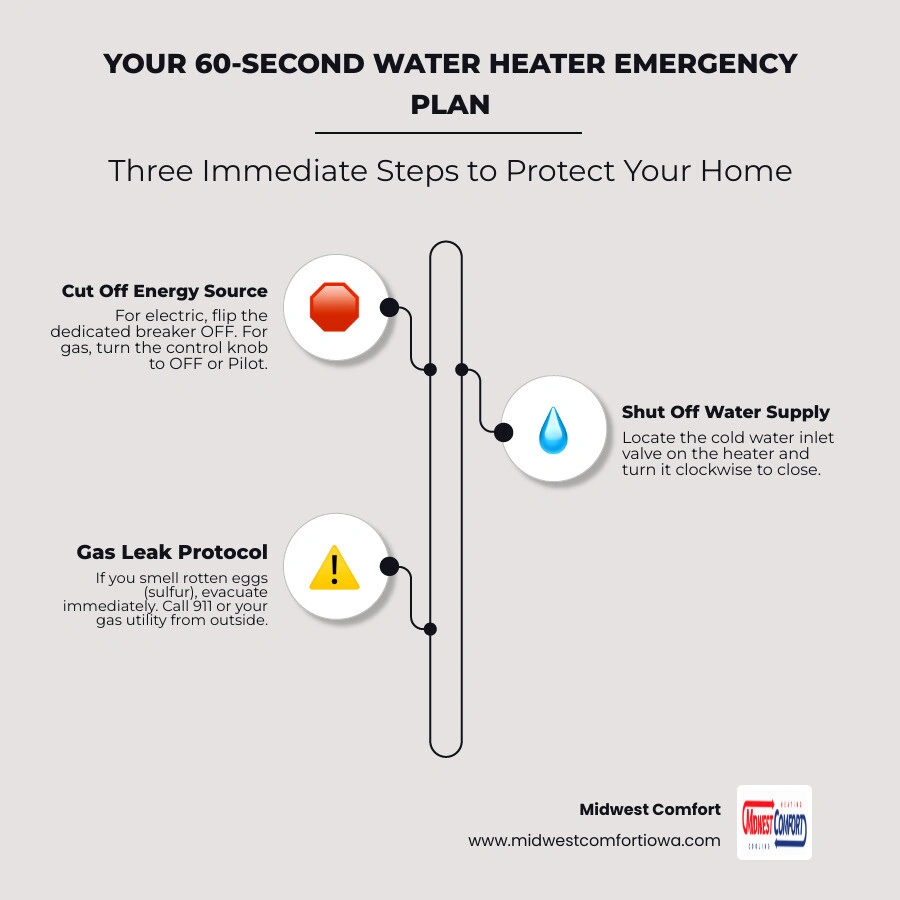
How to shut off your water heater in an emergency comes down to three fast steps — here's what to do immediately:
- Cut the power or gas first — For electric heaters, flip the dedicated double-pole breaker in your electrical panel to OFF. For gas heaters, turn the gas control knob on the unit to the OFF or Pilot position.
- Shut off the cold water supply — Turn the valve on the cold water inlet pipe (above or near the heater) clockwise to close it, or push/pull a lever handle a quarter-turn.
- If you smell gas — do not touch anything. Leave the house immediately and call 911 or your gas utility from outside.
A burst appliance hose or damaged pipe can flood your home with hundreds of gallons of water per hour. That is not a slow-moving problem — it is a race against the clock. For Des Moines homeowners, a leaking or malfunctioning water heater can go from a minor inconvenience to serious structural damage in a matter of hours, threatening floors, walls, and everything stored nearby.
Most homeowners have never practiced this shutdown. They know where the thermostat is, maybe even where the breaker box is — but when water is spreading across the basement floor, that is not the moment to start figuring it out. Knowing exactly what to do before a crisis hits is what separates a manageable cleanup from a major repair bill.
This guide walks you through every step clearly and simply, so you are ready if it ever happens.
Why Des Moines Homeowners Must Know How to Shut Off Your Water Heater in an Emergency
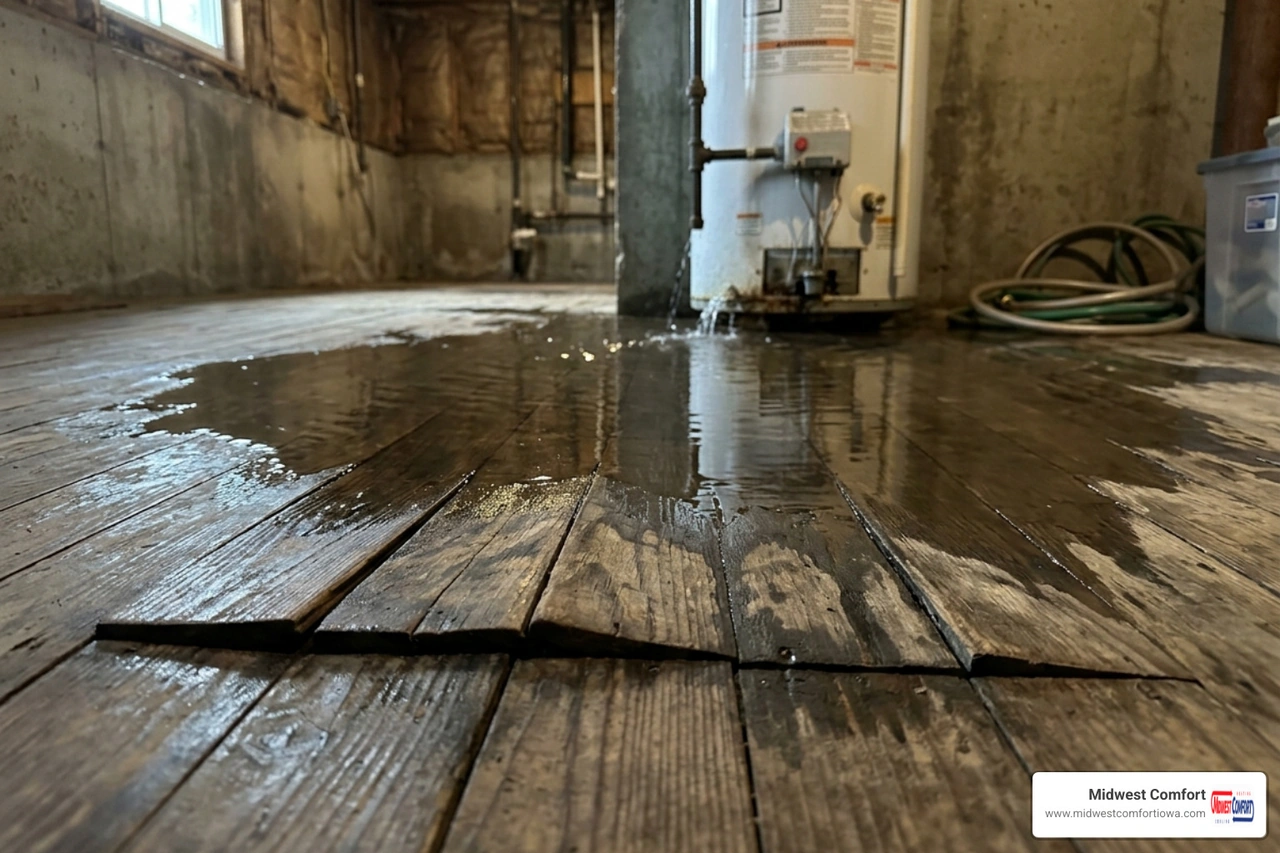
It is April 2026, and while we all hope for a smooth spring, the reality of homeownership in Iowa means being prepared for the unexpected. Whether you live in Ankeny, Clive, or right here in Des Moines, your water heater is one of the hardest-working appliances in your home. It is also one of the heaviest and potentially most destructive.
A full 50-gallon water heater weighs over 400 pounds. When that tank fails, it doesn't just "drip"—it can release hundreds of gallons of water per hour if the supply line remains open. This can lead to catastrophic flooding in your basement or utility room, ruining drywall, carpeting, and stored memories. Beyond the water damage, an unaddressed emergency can lead to electrical fires or gas leaks.
Understanding Waer Heaters and how they integrate with your home's Plumbing is essential for every resident in the Polk County area. If you find a puddle forming or hear a strange hissing sound, knowing how to shut off your water heater in an emergency is your first line of defense. By taking control in the first 60 seconds, you can prevent a manageable repair from turning into a total home restoration project.
Immediate Steps for Power and Gas Shutdown
Before you touch the water, you must address the energy source. Trying to fix a leak while the unit is still trying to heat the water is dangerous. It can lead to electrical shock or, in the case of gas units, the dangerous buildup of heat in a dry tank.
At Midwest Comfort, we always emphasize "Safety First." If you are standing in a pool of water that has reached your electrical panel or any power outlets, do not touch anything. In that specific scenario, you need to call for professional help immediately. However, if the area is safe to enter, your priority is isolation.
For residents needing Water Heater Repair Des Moines IA, the very first thing we will ask when we arrive is if the power has been killed. Doing this yourself saves time and protects the unit from further internal damage.
How to shut off your water heater in an emergency: Electric Models
Electric water heaters are high-voltage appliances, typically running on 240-volt power. They don't just plug into a standard wall outlet; they are hardwired into your home’s electrical system.
- Locate your electrical panel: This is usually in the basement, garage, or a utility closet.
- Find the correct breaker: Look for a "double-pole" breaker (one that is twice as wide as a standard breaker). It should be labeled "Water Heater." These are usually rated for 30 or 40 amps.
- Flip the switch: Move the breaker firmly to the "OFF" position.
- Check for a disconnect switch: Some newer homes in Urbandale or Grimes may have a separate disconnect box located right next to the water heater itself. If you see a small metal box with a handle or a switch near the tank, you can flip that as well.
If you are dealing with an older unit that keeps tripping the breaker, it might be time to look into Water Heater Replacement Urbandale IA to ensure your home meets current 2026 safety standards.
How to shut off your water heater in an emergency: Gas Units
Gas water heaters require a slightly different approach. You are dealing with a live flame and a combustible fuel source, so precision is key.
- The Thermostat Dial: On the front of the water heater, you will see a control box with a knob. Turn this knob to the "OFF" or "Pilot" position. This stops the burner from firing.
- The Manual Gas Valve: Follow the gas pipe leading to the heater. You should find a valve (often with a red or yellow handle). To shut off the gas, turn the handle so it is perpendicular to the pipe. If the handle is "in line" with the pipe, the gas is on. If it is "crossing" the pipe like a "T," the gas is off.
- The "Sulfur" Test: Gas companies add a chemical to natural gas that smells like rotten eggs or sulfur. If you smell this, do not turn any switches on or off, as a spark could trigger an explosion. Evacuate the house immediately.
For those in the metro area, keeping your gas systems in top shape is a priority. If you are unsure about your current setup, we can help with Water Heaters Des Moines IA inspections to ensure your shut-off valves are not seized or corroded.
Managing the Water Supply and Draining the Tank
Once the power or gas is neutralized, you have to stop the "flood." As long as your home’s water pressure is pushing into the tank, the leak will continue.
- Locate the Cold Water Inlet: Look at the top of your water heater. You will see two pipes. One is the hot water outlet (usually on the left), and the other is the cold water inlet (usually on the right). The shut-off valve is almost always on the cold water side.
- Identify the Valve Type:
- Ball Valve: A lever handle. Turn it 90 degrees until it is perpendicular to the pipe.
- Gate Valve: A round wheel handle. Turn it clockwise until it stops. Be careful—older gate valves can be brittle and may snap if forced.
- The Main Water Shut-Off: If the valve on the heater is stuck or leaking itself, don't panic. Go to your home's main water shut-off valve. In Iowa, this is usually in the basement near the water meter or in a garage. Turning this off stops all water to the house.
If you have upgraded to a modern system, such as a Tankless Water Heater Urbandale IA, you may have isolation valves (usually red and blue handles) right under the unit. Close both to isolate the heater completely.
Draining the Tank
Draining is optional but highly recommended if the tank is leaking from the bottom.
- Attach a standard garden hose to the drain valve at the bottom of the tank.
- Run the other end to a floor drain or outside (be careful, the water is hot!).
- Open a hot water faucet upstairs or flip the T&P (Temperature and Pressure) relief valve on the side of the tank to break the vacuum seal and let the water flow out.
Pro Tip: In a major natural disaster, your water heater can actually serve as an emergency water reservoir. A standard tank holds 30-80 gallons of water that can be used for hygiene or even drinking (if properly filtered and treated) if the municipal supply fails. This is a common strategy for Tankless Water Heater Ankeny IA owners to keep in mind, as they won't have this backup storage!
When to Call for Professional Water Heater Repair in Ankeny IA
Shutting off the unit is a temporary fix—it stops the damage, but it doesn't solve the problem. Some issues are minor, like a loose connection, but others are "red flags" that require an expert eye.
You should call for Water Heater Repair Ankeny IA if you notice:
- Tank Corrosion: If you see rust holes or water weeping through the side of the tank, the internal lining has failed. This cannot be patched; it requires a replacement.
- T&P Valve Failure: If the valve on the side is constantly dripping or spraying, the pressure inside your tank is reaching dangerous levels.
- Sediment Buildup: If your heater is making loud "knocking" or "popping" sounds, it's a sign of heavy sediment. This acts as an insulator, causing the bottom of the tank to overheat and eventually crack.
Annual maintenance, including flushing the tank to remove sediment, is the best way to avoid these midnight crises. If your unit is over 10 years old, it might be more cost-effective to look into Water Heater Installation Ankeny IA rather than pouring money into a failing system. Midwest Comfort provides the localized expertise Des Moines families trust to keep the hot water flowing safely.
Frequently Asked Questions about Water Heater Emergencies
What if I cannot find the dedicated water shut-off valve?
If you can't find the valve on top of the heater, or if it is behind a wall or too hot to touch, head straight for the main water supply shut-off for the entire house. This is usually located where the water line enters the house, often in the basement or a crawlspace near the front of the foundation. Turning this off is a "fail-safe" for any Plumbing emergency.
What should I do if I smell gas near the unit?
If you smell a strong "rotten egg" odor, stop what you are doing. Do not flip any light switches, do not use your phone inside the house, and do not try to shut off the gas yourself if you have to stay in the room to do it. Evacuate everyone immediately. Once you are a safe distance away, call 911 or your local gas utility. Safety protocols exist for a reason—natural gas is highly volatile.
Can I still use cold water if the heater is shut off?
Yes! If you have successfully shut off the cold water inlet valve only at the water heater, the rest of your home's cold water taps will still work. You can still flush toilets and use the cold side of your sinks. If you had to shut off the main house valve, you will have no water at all until a Water Heater Repair Des Moines IA technician can bypass the heater or install a new one.
Conclusion
Knowing how to shut off your water heater in an emergency is a vital skill for every Des Moines homeowner. Whether you are dealing with a sudden burst in the middle of a cold Iowa winter or a slow leak discovered on a Tuesday afternoon, acting fast saves your home from thousands of dollars in water damage.
At Midwest Comfort, we are a family-owned business that understands the importance of a safe, comfortable home. We take a family-oriented approach to HVAC, offering honest, high-quality solutions for our neighbors in Polk City, Ankeny, Waukee, and across the metro. From emergency isolation to long-term maintenance, we are here to ensure your home remains a place of comfort, not a construction zone.
If you’ve had to shut down your system and need a reliable, professional team to get your hot water back, contact us for expert Water Heaters Des Moines IA services today.
