Why Understanding How Iowa Severe Weather Affects Your Home Systems Could Save Your Comfort
How Iowa severe weather affects your home systems is something every Des Moines homeowner needs to understand before the next storm rolls in. Iowa sits squarely in Tornado Alley, faces brutal winter wind chills, and endures summer humidity that feels like a sauna. Each of these weather events puts direct stress on your HVAC system and indoor air quality in ways that aren't always obvious until something breaks down.
Here's a quick breakdown of how Iowa's major weather threats impact your home's core HVAC systems:
| Weather Event | Systems Most at Risk | Common Result |
|---|---|---|
| Thunderstorms & Lightning | HVAC control boards | Power surges, fried components |
| Tornadoes & High Winds | Outdoor AC units | Debris impact, airflow restriction |
| Hail | Outdoor condenser coils | Bent fins, refrigerant leaks |
| Extreme Heat & Humidity | Air conditioning, indoor air quality | Coil freezing, mold growth |
| Winter Cold Snaps | Furnace vents, heat pumps | System failure, blocked exhausts |
| Heavy Rain | Indoor air quality, radon levels | Elevated radon, humidity spikes |
Iowa isn't just weather-prone — it's weather-extreme. The state ranks high for energy consumption because HVAC systems here have to work so much harder to keep up with the climate's demands. A summer heat wave can push your AC to its limits. A polar vortex can strain a furnace. And a single severe thunderstorm can send a voltage spike through your home's wiring that quietly damages your furnace's control board long before you notice anything wrong.
The good news is that most of this damage is manageable when you know what to watch for and how to prepare.
How Iowa severe weather affects your home systems
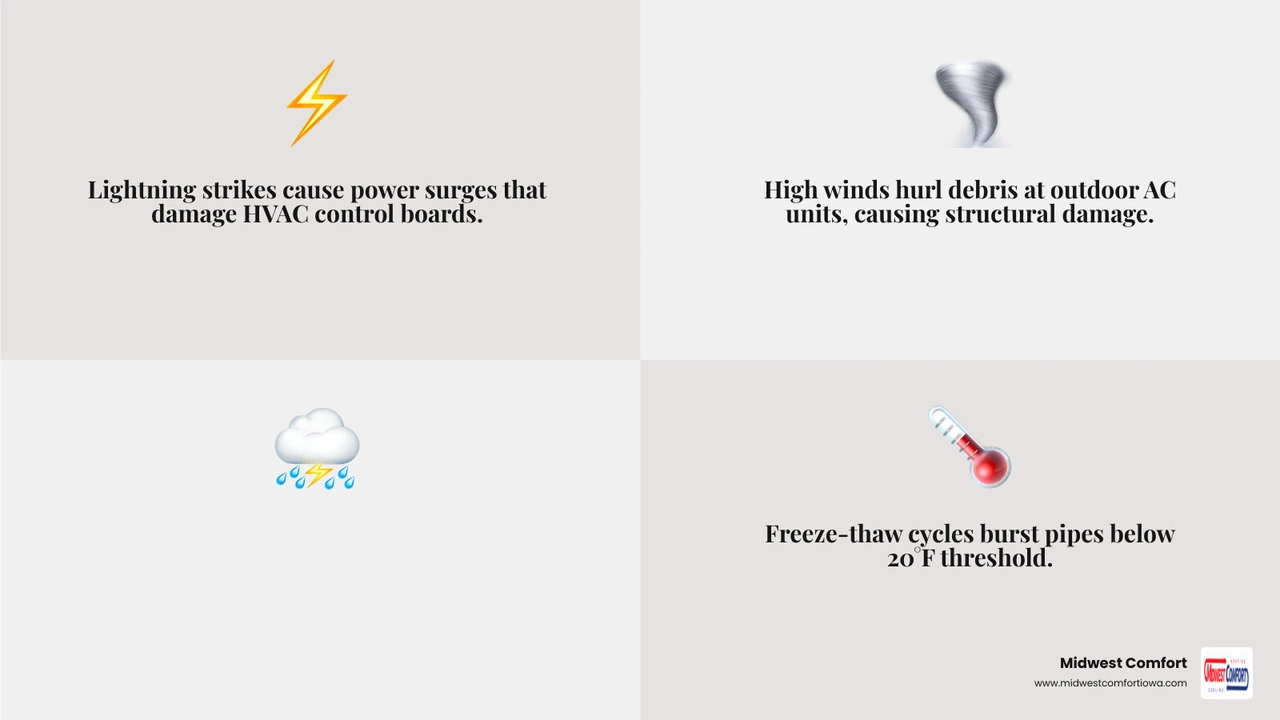
Living in the heart of Tornado Alley means our homes in Polk City, Ankeny, and Waukee are built to be "weather athletes." However, even the strongest home can struggle when faced with the sheer force of a Midwest derecho or a localized tornado. High-wind gusts, often reaching 60 mph or more during seasonal storms, create a pressure differential that can stress your home's seals and impact your HVAC ventilation.
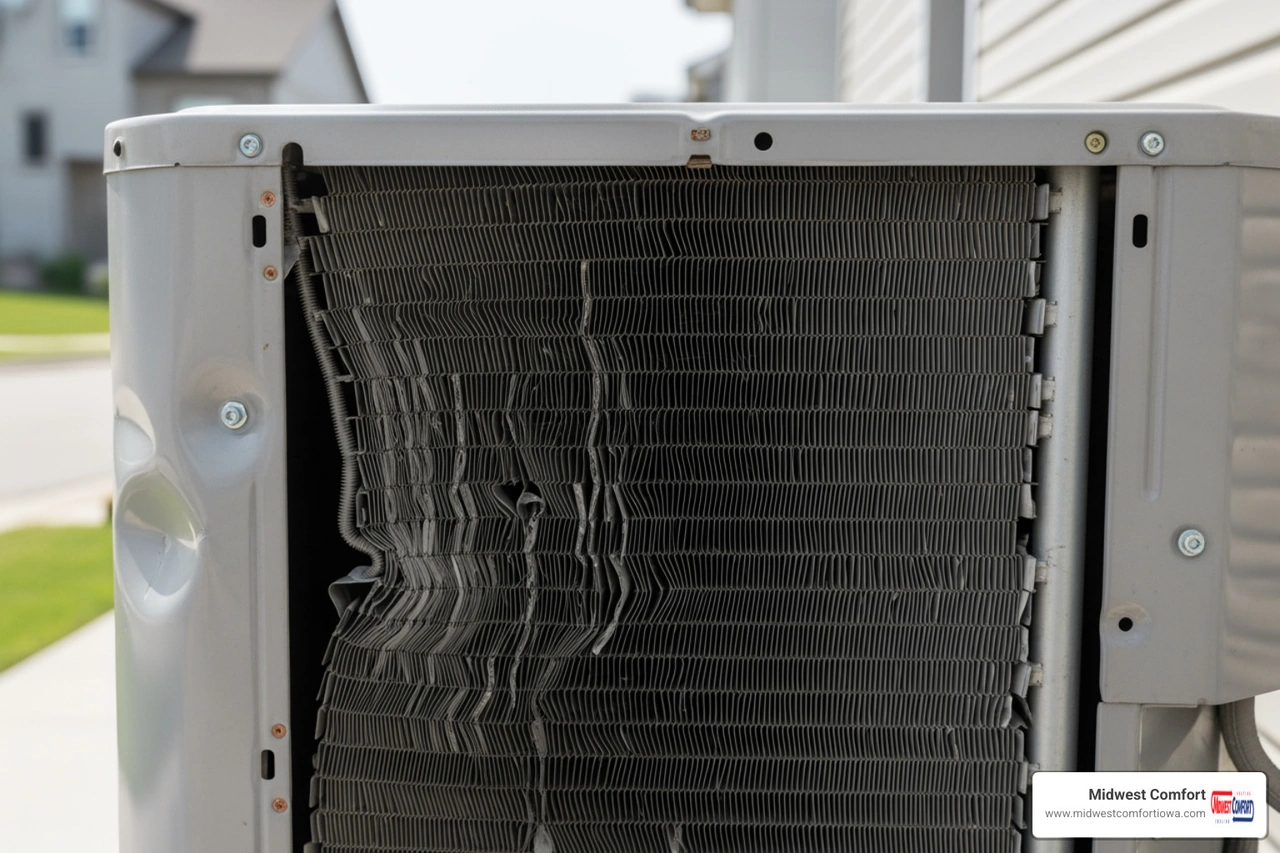
One of the most vulnerable components during these events is your outdoor AC unit. High winds can hurl branches, lawn furniture, or shingles directly into the condenser. If you notice your unit is vibrating or making a loud rattling sound after a storm, these are clear Signs You Need HVAC Repair.
Hail is another frequent visitor to Central Iowa. While we often check our cars for dents, we rarely look at the delicate aluminum fins on our AC condenser coils. Hail can flatten these fins, restricting airflow and forcing your system to work harder, which eventually leads to a premature breakdown.
How Iowa severe weather affects your home systems: Lightning and Electrical Surges
Lightning is perhaps the most underrated threat to your home’s comfort. While there is only a small chance of a direct strike on your home, indirect strikes are incredibly common. When lightning hits a nearby transformer or power line, it sends a massive voltage spike through the grid and into your home's wiring.
These surges are "silent killers" for modern HVAC systems. Today's high-efficiency furnaces and AC units rely on sensitive microprocessors and control boards. A single surge can fry these components instantly. If your system won't kick on after a storm, you may need to consult an Emergency HVAC Repair Des Moines Guide to troubleshoot the electrical failure.
I'm worried about my AC failing during a heatwave. What are the risks in Des Moines?
Iowa summers are famous for "air you can wear." This high humidity is more than just uncomfortable; it represents a significant "latent load" on your cooling system. Your AC has two jobs: lowering the temperature (sensible cooling) and removing moisture (latent cooling). In places like Grimes and Clive, the humidity often forces the AC to spend more energy removing water from the air than actually cooling the house.
When humidity is extreme, your evaporator coil becomes a magnet for moisture. If your air filter is dirty—even slightly—airflow is restricted. This combination of high moisture and low airflow can cause the condensation on the coil to freeze solid, turning your AC into a literal block of ice. This is why following an Energy Efficiency Des Moines Guide is so vital; keeping your system clean is the only way to ensure it survives a July heatwave.
How humidity strains your cooling system:
- Increased Run Times: The system stays on longer to wring moisture out of the air.
- Mold Growth: Excess moisture in ducts can lead to biological growth if the system isn't draining properly.
- Coil Freezing: Restricted airflow plus high humidity equals an iced-over unit.
- Short Cycling: The system may turn on and off rapidly as it struggles to balance temperature and humidity.
I'm worried about my furnace failing during a polar vortex. How do I protect my home's heating?
While we focus heavily on cooling in the summer, the Iowa winter is a different beast entirely. We often see temperatures drop below the threshold where heating systems must work at maximum capacity. When extreme cold hits, your furnace or heat pump is under immense pressure to maintain a safe indoor temperature.
The "freeze-thaw" cycles we experience in late winter can also impact your HVAC system's external components. For instance, ice buildup can block high-efficiency furnace exhaust pipes, leading to a dangerous system shutdown. To protect your system, it’s worth looking into 7 Better Ways to Save Energy During the Winter Season, such as ensuring your heating system is properly maintained and your home is sealed against drafts that force your furnace to work overtime.
Is the air in my basement safe? Understanding radon and storm patterns
Many homeowners in Johnston and Adel don't realize that how Iowa severe weather affects your home systems extends to the very air they breathe. Iowa has some of the highest radon potential in the country due to our soil composition. Radon is a naturally occurring radioactive gas that enters through gaps in the home's lower levels.
Severe weather and climate change are making this problem worse. Heavy rainfall saturates the soil, which pushes soil gases (including radon) toward your home. Additionally, the "stack effect"—where warm air rises and escapes through the top of your home—creates a vacuum that pulls radon in from the lower levels. During a storm, rapid changes in barometric pressure can cause "spikes" in indoor radon levels.
Ensuring your home has a reliable ventilation and indoor air quality strategy is part of the Emergency HVAC Services The Value of a Reliable HVAC Company provides. The EPA recommends taking action if your radon levels are at or above 4 pCi/L.
Identifying how Iowa severe weather affects your home systems through early warning signs
Your HVAC system often tries to tell you when it's struggling. Recognizing these signs early can prevent an expensive emergency.
- Short Cycling: If your furnace or AC turns on and off every few minutes, it’s likely overstressed or has a failing sensor.
- Unusual Noises: Rattling or buzzing in your outdoor unit can indicate debris impact or loose components from high winds.
- Musty Odors: This often follows heavy rain and indicates moisture in your ductwork or high humidity levels that your AC isn't managing.
- Visible Frost: If you see frost on your AC line set in summer, failure is imminent.
- Rising Energy Bills: A sudden spike in your utility bill often means a component is working overtime to compensate for weather-related damage.
HVAC Maintenance Saves You Money by catching these issues in your home systems before they lead to a total collapse.
Proactive Protection: HVAC Maintenance and Fortification Strategies for 2026
As we move through 2026, the technology available to protect Iowa homes has never been better. We recommend a multi-layered approach to HVAC fortification. Start with the basics: ensuring your system is sized correctly for your home's needs and that your ventilation is optimized to prevent the "stack effect" from pulling radon and cold air into your living spaces.
Next, consider specialized surge protection for your HVAC equipment. These protect your high-efficiency furnace and AC from lightning-induced voltage spikes that can fry sensitive electronics.
Your 2026 Severe Weather Checklist:
- Clear the Vents: After every snowstorm, ensure there is at least 1.5 feet of clearance around your furnace intake and exhaust pipes to prevent carbon monoxide buildup and system shutdowns.
- Install Mesh Screens: Use PVC-coated mesh over your outdoor AC unit during storm season to deflect hail and debris without trapping moisture or restricting airflow.
- Check Your Filters: Change your air filters monthly during peak summer and winter months to prevent system strain and coil freezing.
- Schedule Bi-Annual Tune-ups: Use an HVAC Maintenance Des Moines Guide to stay on top of spring AC prep and fall furnace checks.
Frequently Asked Questions about Iowa Weather and Home Systems
How does heavy rain affect my radon levels?
Heavy rain saturates the soil around your foundation. This water fills the tiny pockets in the soil, forcing the radon gas to move toward the only dry area left: the cracks and gaps in your basement or crawlspace. This often causes a temporary but significant spike in indoor radon levels.
Can a power outage damage my furnace?
Yes. It’s not usually the outage itself that causes damage, but the power "flicker" or the surge that occurs when the grid comes back online. These voltage fluctuations can damage the sensitive circuit boards in modern furnaces. We recommend turning your system off at the thermostat during an outage and waiting five minutes after power returns to turn it back on.
Why does my AC freeze up when it's hot and humid outside?
When the humidity is high, your AC's evaporator coil is covered in condensation. If your air filter is dirty or your blower motor is weak, there isn't enough warm air passing over the coil to keep that water from turning into ice. Once a thin layer of ice forms, it acts as an insulator, causing the entire coil to freeze solid.
Conclusion
At Midwest Comfort, we understand that your home is your sanctuary against the unpredictable Iowa elements. As a family-owned business serving Des Moines, Ankeny, Altoona, and the surrounding communities, we take a family-oriented approach to your comfort. We don't just fix machines; we protect the systems that keep your family safe and healthy.
Whether you're looking for tailored HVAC solutions to combat the summer humidity or need a loyalty program that ensures your furnace is ready for the next polar vortex, we are here to help. Don't wait for the next storm to test your home's limits. Schedule professional service to protect your home systems today and breathe easy knowing your "weather athlete" is in peak condition.
