How AC Refrigerant Changes Affect Homeowners in Des Moines, IA
How AC refrigerant changes affect homeowners is one of the most important HVAC questions of 2026, and the short answer is this:
- Your current system is not illegal. You do not have to replace it right now.
- New AC equipment now uses different refrigerants - R-454B or R-32 - with a much lower climate impact than the old standard, R-410A.
- Servicing older systems is getting more complex as supplies of older refrigerants tighten.
- Safety features in new units - like built-in refrigerant leak detectors - are already required by code.
If you own a home in Des Moines and have been hearing about refrigerant phase-outs, EPA mandates, and the end of R-410A, you are not alone in feeling confused. The HVAC industry is going through its biggest shift in decades, and the rules, the equipment, and service planning are all changing at once.
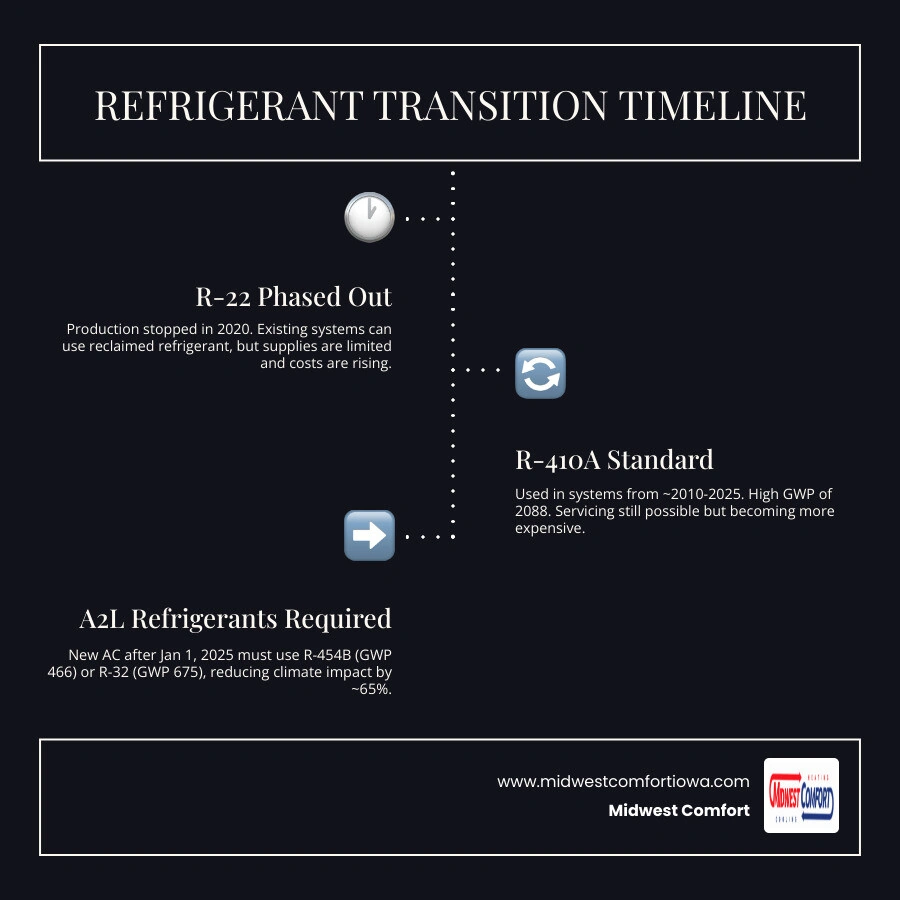
Here is the straightforward version: the U.S. Environmental Protection Agency, under the American Innovation and Manufacturing (AIM) Act of 2020, has been systematically phasing down refrigerants with high Global Warming Potential (GWP). R-22 - the refrigerant used in systems made before roughly 2010 - was already phased out of production in 2020. Now R-410A, which replaced R-22 and has been the industry standard for years, is next. New equipment manufactured after January 1, 2025 must use a next-generation refrigerant with a GWP under 700. R-410A carries a GWP of 2,088 - more than 2,000 times that of carbon dioxide. The two main replacements, R-454B (GWP 466) and R-32 (GWP 675), cut that climate impact by roughly 65%.
That shift has real consequences for homeowners - in service decisions, equipment choices, and long-term planning. This guide from Midwest Comfort breaks it all down in plain language so you can make smart decisions for your home.
What the 2025-2026 Refrigerant Transition Means for Homeowners
The 2025-2026 transition is really about one big change: new residential AC and heat pump equipment now has to use refrigerants with much lower GWP than older options.
For homeowners in Des Moines and nearby communities, that affects three things most:
- what kind of equipment you can buy new
- what your current system can still be serviced with
- how you should plan repairs versus replacement over the next few years
This change is tied to the AIM Act and broader global efforts to reduce environmental harm. R-22 was targeted because it damages the ozone layer. R-410A does not deplete ozone, but it has a very high climate impact. That is why the EPA is moving the industry toward lower-GWP refrigerants such as R-454B and R-32.
How AC refrigerant changes affect homeowners in 2026
In practical terms, how AC refrigerant changes affect homeowners comes down to planning, not panic.
If your air conditioner is cooling well, you do not need to rush into replacing it just because of the calendar. But if your system is older, leaking refrigerant, or needing repeated repairs, the refrigerant transition may push you to think more strategically than you would have a few years ago.
Homeowners are seeing changes in:
- repair planning for older systems
- replacement timing for aging equipment
- refrigerant availability for future service
- equipment design and safety features on new systems
Think of it less like your current AC suddenly becoming illegal and more like your old phone charger eventually becoming harder to find. It still works - until it becomes inconvenient, unreliable, or no longer worth the hassle.
Why the EPA is moving away from R-410A
The main reason is climate impact.
R-410A has a GWP of 2,088. The newer residential refrigerants being adopted for most systems have to come in under 700. That is a major drop. R-454B has a GWP of 466, and R-32 has a GWP of 675. Compared with R-410A, that is roughly a 65% reduction in climate impact.
This is part of a larger environmental strategy. Past refrigerant phaseouts under the Montreal Protocol have had major public health benefits. According to the research, phasing out ozone-depleting substances is expected to avoid more than 280 million skin cancer cases, about 1.6 million skin cancer deaths, and more than 45 million cataract cases in the United States among people born between 1890 and 2100.
Do you need to replace your current AC right away?
No.
There is no rule saying homeowners must remove a working R-410A or R-22 system immediately. If your system is operating properly, you can continue using it. Older units can still be serviced as long as compatible parts and legal refrigerant supplies are available.
That said, there is an important difference between "allowed" and "ideal."
- An older R-22 system may still run, but refrigerant is limited to reclaimed supply.
- An R-410A system can still be serviced, but long-term repair planning gets trickier as the market moves on.
- A system near the end of its life may not be the best candidate for major repairs.
Which Refrigerant Your Current System Uses and What That Means Next
Before making any repair or replacement decision, find out what refrigerant your system uses. That one detail tells you a lot about service options, future repair outlook, and likely system age.
How to identify whether you have R-22, R-410A, or a newer refrigerant
The easiest place to look is the outdoor condenser's nameplate or data label. It usually lists the refrigerant type clearly.
Look for markings such as:
- R-22
- R-410A
- R-454B
- R-32
You may also see a brand term like "Puron" on some older R-410A equipment. Your owner's manual may list it too, but the equipment label is usually fastest.
If the label is faded or hard to read, we recommend having a professional inspect the unit and confirm it for you.
What to expect if your system uses R-22
If your system uses R-22, it is likely older. New production and import of R-22 stopped in the U.S. in 2020. That means today, servicing depends on reclaimed refrigerant recovered from existing systems and cleaned for reuse.
That does not mean you must replace the unit today. It does mean you should be realistic about its future.
What this usually means for homeowners:
- leak repairs matter more than ever
- repeated refrigerant loss is a red flag
- major repairs may not make sense on very old equipment
- long-term reliability is usually limited by age, not just refrigerant supply
For a broader overview, see our guide to Refrigerant Guidelines For Us Homes.
What to expect if your system uses R-410A
R-410A systems are still common and can still be serviced. You do not need to replace one just because newer systems use A2L refrigerants.
But over time, homeowners should expect:
- continued service availability in the near term
- tighter refrigerant supply compared with the past
- more attention on leak repair instead of repeated recharge visits
- a narrower repair window on older units as parts and refrigerant become less convenient to source
If your R-410A unit is relatively young and in good shape, maintenance may still be the smart move. If it is older and developing leaks or major component issues, replacement may become the better long-term option.
Understanding A2L Refrigerants, Safety Features, and Leak Risks
The new generation of residential refrigerants is commonly called A2L. The two names homeowners will hear most are R-454B and R-32.
How AC refrigerant changes affect homeowners when new systems use A2L refrigerants
A2L is a safety classification. It means the refrigerant has low toxicity and is mildly flammable. That wording sounds dramatic, but the important part is that these refrigerants are difficult to ignite and burn much more slowly than highly flammable substances.
For homeowners, the key point is this: new systems are designed from the ground up for these refrigerants. They are installed under updated product standards, building codes, and safety requirements.
That means the refrigerant, equipment, sensors, airflow design, and controls all work together as a system. This is not a "pour something new into the old unit and hope for the best" situation. HVAC would be much less exciting if that worked, but here we are.
What "mildly flammable" really means for home safety
"Mildly flammable" does not mean your AC becomes a hazard sitting in your backyard.
A2L refrigerants:
- are harder to ignite than many household aerosols and solvents
- require specific conditions to ignite
- burn slowly rather than explosively under normal classification testing
- are used inside sealed systems built for that refrigerant
The updated standards also account for installation location, charge size, airflow, and mitigation measures. In plain English: the equipment has safeguards built around the refrigerant.
If a leak occurs indoors, refrigerant can displace air in a confined space and may settle low because it is heavier than air. That is one reason proper installation and leak detection matter, especially in homes with pets or small children.
How Refrigerant Detection Systems work in new AC models
Many new A2L systems include Refrigerant Detection Systems, often called RDS.
These systems are designed to detect a refrigerant leak and trigger a response before refrigerant concentration becomes a safety concern. Depending on the equipment design, that response may include:
- sensing refrigerant in the indoor unit area
- turning on the indoor blower to help disperse leaked refrigerant
- shutting down or changing system operation
- signaling a fault that tells the homeowner service is needed
This added layer of protection is one reason new equipment design is different from older R-410A systems.
Signs of a refrigerant leak and why topping off is the wrong fix
Refrigerant is not fuel. Your AC does not "use it up" during normal operation. If refrigerant is low, there is almost always a leak.
Common warning signs include:
- weak cooling
- longer run times
- warm air from vents
- ice buildup on the evaporator coil or refrigerant lines
- hissing or bubbling sounds
- higher strain on the compressor
Why "just top it off" is the wrong approach:
- it does not fix the leak
- the system will likely lose refrigerant again
- performance and efficiency stay compromised
- the compressor can be damaged by low charge
- venting refrigerant is illegal and environmentally harmful under Clean Air Act rules
A proper repair means locating the leak, fixing it, and charging the system correctly. For more on common leak problems, read Ac Refrigerant Issues And Their Solutions.
Can You Retrofit an Older AC to New Refrigerants?
In most cases, no. Homeowners should not assume R-454B or R-32 can replace R-410A or R-22 in existing equipment.
Why R-454B and R-32 are not direct replacements for older systems
These refrigerants are not universal drop-ins.
They differ in areas such as:
- operating pressures
- compressor design requirements
- oil compatibility
- refrigerant charge characteristics
- metering components
- control logic
- safety requirements for A2L refrigerants
Even if two refrigerants sound similar on paper, the system itself was engineered around one specific refrigerant and its properties. Swapping to a different refrigerant in an incompatible unit can create performance, safety, and reliability problems.
The same logic has long applied to R-22 systems too. There is no true no-compromise drop-in replacement that magically turns an old unit into a modern one.
When repair still makes sense and when replacement is the better path
Repair often still makes sense when:
- the system is newer
- the leak is minor and repairable
- the compressor and coils are in good condition
- the unit has a solid maintenance history
Replacement often becomes the better path when:
- the system is older
- leaks are recurring
- major components are failing
- the unit uses hard-to-source refrigerant
- efficiency and reliability are both declining
If your system is around 15 years old or older, refrigerant changes are often the nudge that moves replacement from "someday" to "worth planning now."
Comparing common residential refrigerants
| Refrigerant | Typical era/use | Ozone depletion impact | GWP | Flammability class | Compatible as drop-in for older systems? | Service outlook |
|---|---|---|---|---|---|---|
| R-22 | Older systems, generally pre-2010 | Yes | Higher than newer options | A1 | No | Reclaimed supply only |
| R-410A | Many systems from roughly 2010 to 2024 | No | 2088 | A1 | No | Still serviceable, but future supply tightens |
| R-454B | Newer 2025+ equipment | No | 466 | A2L | No | Main option in new equipment |
| R-32 | Newer 2025+ equipment | No | 675 | A2L | No | Main option in new equipment |
Environmental Benefits, Repair Outlook, and Available Upgrade Incentives
The environmental and health benefits of lower-GWP refrigerants
There are real environmental benefits behind this transition.
R-22 harmed the ozone layer. R-410A solved that problem but still carried a high climate burden. Lower-GWP refrigerants reduce greenhouse gas impact while supporting more modern system designs.
This matters beyond HVAC policy. The long-term benefits of refrigerant regulation are tied to public health too. Research tied to the Montreal Protocol shows major reductions in future skin cancer, skin cancer deaths, and cataracts because of ozone-layer protection efforts.
For homeowners, that means this transition is not just red tape. It is part of a larger move toward lower-emission cooling and better environmental stewardship.
How the transition affects future equipment and repair decisions
Going forward, homeowners should expect:
- newer systems with redesigned components and added safety features
- more importance placed on proper installation
- gradual changes in repair strategy for older refrigerants
- better efficiency opportunities when replacing aging equipment
Replacing old heating and cooling equipment with ENERGY STAR certified systems can reduce annual energy bills by more than $160, according to the research. That does not mean every home will see the same results, but it shows why efficiency should be part of the conversation, not just refrigerant type.
Federal tax credits and utility rebates homeowners should check
While program availability varies, there are incentives worth checking before you replace equipment.
Homeowners may be eligible for federal help under the Inflation Reduction Act for qualifying equipment, and it is also smart to check available utility rebates in the Des Moines area for high-efficiency upgrades. Programs change, so we recommend verifying current eligibility before making a final decision.
How AC refrigerant changes affect homeowners over the next several years
Over the next few years, most homeowners will not feel the transition as a single dramatic event. It will show up gradually.
Expect to see:
- R-410A still available for servicing older systems for some time
- reclaimed refrigerant playing a bigger role
- older systems becoming less attractive to repair after major leaks
- maintenance becoming even more valuable for extending system life
- replacement decisions increasingly tied to efficiency and refrigerant outlook
In other words, R-410A is not disappearing overnight. But it is no longer the future.
Smart Next Steps for Des Moines Homeowners
If you want the simple game plan, here it is:
- check your outdoor unit label for refrigerant type
- keep maintenance records
- schedule spring AC inspections
- address leak symptoms right away
- avoid repeated refrigerant top-offs
- plan ahead if your system is older or unreliable
Questions to ask before repairing or replacing your AC
Before approving major work, ask:
- What refrigerant does my system use?
- Is the issue a leak, a component failure, or both?
- Can the leak actually be repaired reliably?
- What condition are the coil, compressor, and major parts in?
- How much useful life is realistically left in this unit?
- Would repair or replacement make more sense for long-term reliability and efficiency?
Clear answers to those questions usually make the next step much easier.
How to prepare your home cooling system for the transition
You do not need to wait for a breakdown to prepare.
Helpful steps include:
- changing filters regularly
- keeping the outdoor unit clear of debris
- sealing duct leaks where needed
- using a smart thermostat to reduce unnecessary runtime
- scheduling preventive maintenance before peak summer
- improving airflow throughout the home
These basics help any system, regardless of refrigerant. They can also buy time if you are trying to get a few more good seasons out of an older unit.
When to schedule professional help
Do not wait until your AC quits on the hottest week of the summer if you can avoid it.
We recommend scheduling help when:
- your unit is due for annual maintenance
- cooling performance drops
- you hear hissing or bubbling
- you notice ice on the lines or coil
- your system uses R-22 or is an older R-410A model and you want a long-term plan
At Midwest Comfort, we help homeowners in Des Moines and surrounding communities make sense of refrigerant changes without the jargon or the scare tactics. If you want help understanding your options, learn more about our air conditioning services.
The 2026 refrigerant transition may sound technical, but the homeowner takeaway is simple: you probably do not need to replace your system today, but you do need a plan. And that is something we are always happy to help with.
