
Why Knowing How to Extend the Life of Your Water Heater Could Save You From a Cold Shower — and a Big Bill
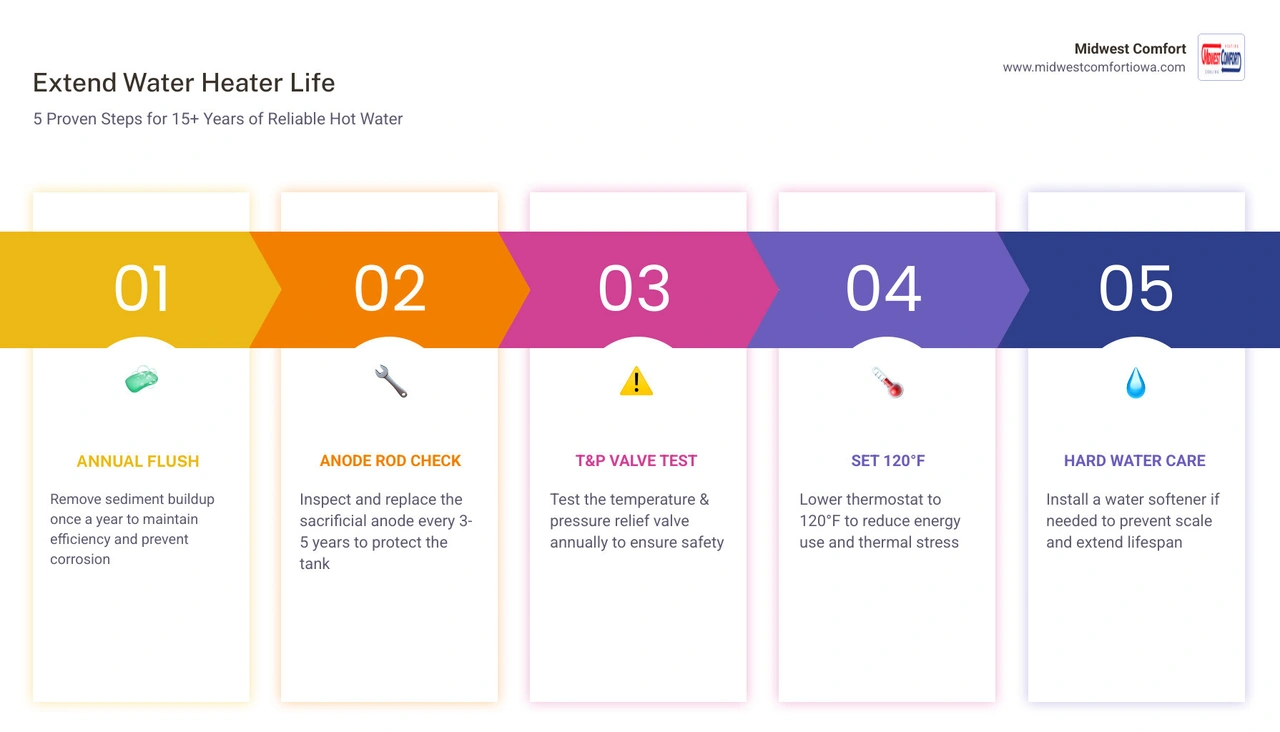
If you want to extend the life of your water heater, here are the most impactful steps you can take right now:
- Flush the tank annually to remove sediment buildup
- Inspect and replace the anode rod every 3-5 years
- Test the T&P relief valve once a year for safety
- Set the thermostat to 120°F to reduce thermal stress and energy use
- Install a water softener if you have hard water (common in Des Moines)
- Insulate hot water pipes to cut standby heat loss
- Add an expansion tank if you have a closed plumbing system
- Schedule a professional inspection every few years
Most Des Moines homeowners don't think about their water heater until the hot water disappears — usually at the worst possible moment. The truth is, the average tank water heater lasts just 8 to 12 years. But with a little consistent care, that lifespan can stretch to 15 years or more, meaning fewer emergency calls, lower energy bills, and more peace of mind for your family.
Think of it this way: your water heater works every single day, heating water for showers, dishes, laundry, and more. Iowa's hard water and cold winters add extra stress to the system. Without basic maintenance, sediment builds up, internal parts corrode, and the tank works harder than it should — shortening its life and driving up your utility costs.
The good news? Most of the steps that keep a water heater running strong are simple, low-cost, and well within reach of the average homeowner.
I'm looking for ways to make my water heater last longer in Des Moines. What is the average lifespan?
When we talk to families in Polk City, Ankeny, or Waukee, the first question is usually: "How long do I really have with this thing?" In May 2026, we are seeing that modern units are more efficient than ever, but they still have a finite "shelf life."
The average residential water heater is designed to last about a decade. However, "average" assumes a certain level of neglect. If you are proactive, you can significantly beat those odds.
| Water Heater Type | Average Lifespan | Lifespan with Maintenance |
|---|---|---|
| Traditional Tank (Gas/Electric) | 8–12 Years | 15+ Years |
| Tankless Water Heater | 15–20 Years | 25+ Years |
| Heat Pump / Hybrid | 10–15 Years | 18+ Years |
While these numbers look good on paper, the Iowa climate plays a huge role. During our freezing winters, the water entering your home is incredibly cold. When that icy water hits a warm tank, it causes the metal to contract rapidly. If your tank is already weakened by sediment or corrosion, these temperature swings can lead to hairline cracks and sudden leaks.
Understanding When to Replace Your Water Heater is vital, but our goal at Midwest Comfort is to help you delay that day as long as possible. By addressing standby heat loss and internal wear, you aren't just saving the unit; you're saving money on every utility bill. If you're currently weighing your options, our Water Heater Replacement Guide can help you understand the long-term benefits of different models.
Essential Maintenance Steps for How to Extend the Life of Your Water Heater
Think of water heater maintenance like changing the oil in your car. You wouldn't expect a truck to run for 200,000 miles without an oil change, yet many people expect their water heater to run for 15 years without ever touching it.
The biggest "silent killer" of water heaters in Des Moines and surrounding areas like Grimes and Johnston is sediment. Because our local water is rich in minerals, these particles settle at the bottom of the tank. Over time, they harden into a thick crust. This layer acts as an insulator between the burner (or heating element) and the water. The result? The heater has to run longer and hotter to get the water to your desired temperature, which literally cooks the tank from the inside out.
Learning how to extend the life of your water heater starts with recognizing the Signs of Sediment Buildup in Water Heater, such as popping or rumbling noises.
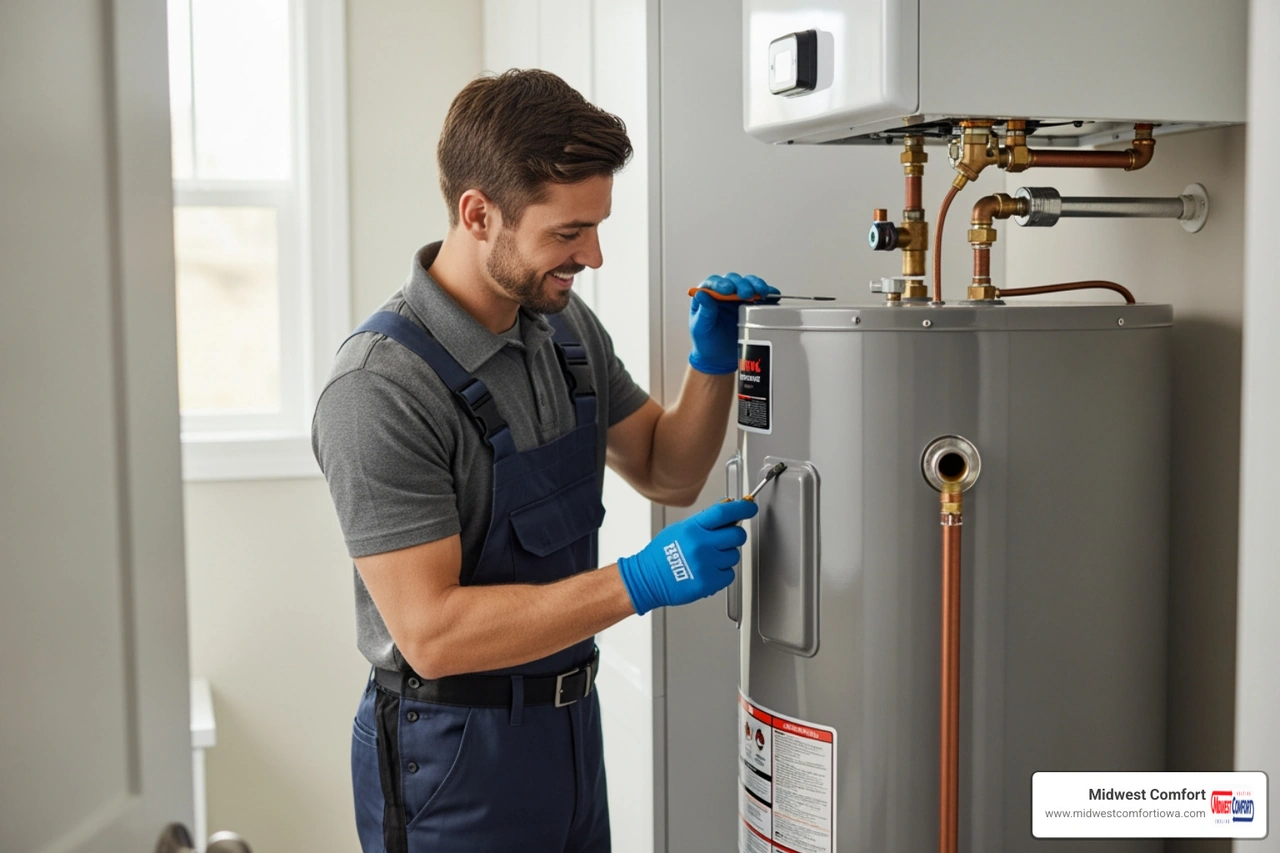
How to Extend the Life of Your Water Heater Through Annual Flushing
Flushing your tank is perhaps the single most effective DIY task you can perform. We recommend doing this at least once a year—or every six months if you live in an area with particularly heavy mineral content.
The Step-by-Step Flush:
- Safety First: Turn off the power (at the breaker for electric) or the gas (set the thermostat to 'Pilot').
- Connect a Hose: Attach a standard garden hose to the drain valve at the bottom of the unit. Run the other end to a floor drain or outside.
- Open the Valve: Open the drain valve. You may need to open a hot water faucet elsewhere in the house to break the vacuum and let the water flow.
- The "Power Flush": One trick we use is leaving the cold water supply on for a few moments while the drain is open. This uses the 55 PSI of house pressure to stir up and force out the heavy sediment at the bottom.
- Inspect the Water: If the water coming out of the hose is cloudy or full of "sand," keep flushing until it runs clear.
This simple process provides massive noise reduction and restores the efficiency of your unit. Many Water Heater Repair Issues Solved by our team actually start with a thorough descaling of the tank.
How to Extend the Life of Your Water Heater by Managing Hard Water
If you’ve ever noticed white crusty spots on your showerhead in Altoona or Clive, that’s calcium and magnesium—the same stuff that’s currently attacking your water heater. Hard water is the primary reason water heaters in Iowa fail prematurely.
When hard water is heated, the minerals "precipitate" out and stick to the heating elements or the tank walls. This causes Water Heater Temperature Fluctuations Causes that can be incredibly frustrating during your morning shower.
Solutions for Hard Water:
- Water Softeners: A whole-home water softener swaps those "hard" minerals for "soft" ones (usually sodium). This prevents scale from forming in the first place.
- Whole-House Filters: These can help remove larger sediment particles before they ever enter your tank.
- Regular Descaling: For tankless models, this involves circulating a descaling solution (like food-grade vinegar) through the heat exchanger to keep the narrow passages clear.
While a water softener is a great investment, be aware that "soft" water can actually be more corrosive to your anode rod. If you have a softener, you'll need to check your anode rod more frequently! If the damage is already done, it might be time for a Professional Water Heater Replacement to start fresh with a protected system.
Advanced Strategies to Protect Your Tank and Improve Efficiency
Beyond the basics of cleaning, there are "bodyguard" components inside your heater that are designed to die so the tank can live. If you ignore these, the tank is next on the chopping block.
The Role of the Anode Rod
The anode rod is a long metal rod—usually made of magnesium or aluminum—that hangs inside your tank. Its only job is to be more "reactive" than the steel of the tank. Through a process called electrolysis, the corrosive elements in the water will attack the anode rod instead of the tank walls.
Essentially, the anode rod "sacrifices" itself to prevent rust. Once that rod is completely dissolved, the water starts eating your tank.
- Inspection: Check it every 3 years. If you have a water softener, check it every 2 years.
- Replacement: If the rod is less than half an inch thick or looks like a rusted wire, replace it! A new rod is an inexpensive way to potentially double the life of your heater.
- Upgrade: In 2026, many homeowners are switching to powered titanium anode rods. These use a tiny amount of electricity to prevent corrosion and never need to be replaced.
Ignoring a depleted rod is one of the biggest Warning Signs of a Failing Water Heater. If you see rust-colored water, your rod is likely gone, and the tank is beginning to corrode.
Temperature and Pressure Management
High heat and high pressure are the enemies of longevity. By managing these two factors, you can reduce the physical stress on your system.
The 120°F Sweet SpotMost manufacturers ship water heaters set to 140°F. For most families in Adel or Norwalk, this is unnecessarily hot and increases the risk of scalding. By turning the thermostat down to 120°F, you:
- Slow down the rate of mineral scale buildup.
- Reduce energy consumption by up to 10%.
- Extend the life of the tank by reducing thermal expansion stress.
The T&P Relief ValveThe Temperature and Pressure (T&P) relief valve is a safety device. If the pressure inside the tank gets too high, this valve opens to prevent the tank from bursting. You should test this annually by lifting the lever and ensuring water discharges into the overflow pipe. If it doesn't move or continues to drip after you close it, it needs immediate replacement.
Expansion Tanks and InsulationIn "closed" plumbing systems (common in newer homes in Carlisle and Pleasant Hill), water has nowhere to go when it expands as it heats up. This creates "thermal expansion" which can hammer your tank and pipes. Installing a small expansion tank gives that extra volume a place to go, protecting your heater.
Additionally, insulating your hot water pipes and adding a water heater "blanket" (for older tanks) can cut standby heat loss by 30% to 45%. This means the heater cycles less often, reducing wear and tear. These are the kinds of Benefits of Water Heater Replacement and upgrades that pay for themselves in just a few years. If you're ready to upgrade, follow the Steps for Water Heater Replacement to ensure a safe installation.
Frequently Asked Questions about Water Heater Longevity
We hear a lot of the same questions when we're out servicing homes in Dallas Center and Runnells. Here are the facts you need to know for 2026.
How often should I flush my water heater?
For most homes, once a year is the gold standard. However, if you live in a part of Des Moines with very hard water, or if you notice your water heater "knocking" or "rumbling," you should move to a six-month schedule. Regular flushing prevents sediment from hardening into a "scale" that is much harder to remove later.
When should I replace my anode rod?
You should perform a visual inspection every 3 to 5 years. If the rod is more than 50% corroded or if you see the steel core wire exposed, it’s time for a new one. If you start seeing "rusty" water in your bathtub, it’s a sign the rod has already failed and the tank itself is starting to rust.
Does a water softener help my water heater?
Absolutely. By removing the calcium and magnesium that cause scale, a water softener keeps your heating elements clean and your tank efficient. Just remember: softened water is more conductive, which means your anode rod will dissolve faster. It’s a trade-off that is well worth it, provided you keep an eye on that sacrificial rod!
Conclusion
Your water heater is a workhorse, but even the best workhorse needs a break and some grooming. By following these steps—flushing the sediment, checking the "bodyguard" anode rod, and keeping the temperature at a sensible 120°F—you can easily extend the life of your water heater well beyond the decade mark.
At Midwest Comfort, we’ve spent years helping our neighbors in Des Moines, Ankeny, and the surrounding communities stay comfortable. As a family-owned business, we believe in honest, high-quality service that focuses on what’s best for your home and your budget. Whether you need a professional annual inspection to get your May 2026 maintenance on track or you're ready to discuss a high-efficiency upgrade, we’re here to provide tailored solutions that fit your family’s needs.
Don't wait for a puddle in the basement or a freezing surprise in the shower. A little preventative care today goes a long way.
Ready to ensure your hot water keeps flowing? Schedule your water heater tune-up with Midwest Comfort today!
