
The Science of Humidity: How Moisture Accelerates Filter Clogging
Knowing how often to change your AC filter in humid climates can make a real difference in your home's comfort, air quality, and energy bills — especially during a Des Moines summer when your system runs hard for months on end.
Here is a quick reference based on filter type and household conditions:
| Filter Type | Standard Humid Climate | Pets or Allergies | Peak Summer |
|---|---|---|---|
| Fiberglass (1-inch) | Every 21–30 days | Every 20–25 days | Every 20–30 days |
| Pleated MERV 8 (1-inch) | Every 45–60 days | Every 30–45 days | Every 30–45 days |
| Pleated MERV 11 (1-inch) | Every 30–45 days | Every 20–30 days | Every 30 days |
| Deep Pleated MERV 8 (4–5 inch) | Every 4–6 months | Every 3–4 months | Check monthly |
| Deep Pleated MERV 11 (4–5 inch) | Every 3–4 months | Every 2–3 months | Check monthly |
Bottom line: In a humid climate, plan to check your filter every month without exception. During peak summer months, most standard 1-inch filters need to be replaced every 30 days. Deeper media filters last longer but still need monthly inspections when humidity is high.
Most homeowners have heard the standard advice: change your AC filter every 90 days. That rule was not written with places like Des Moines in mind. When summer humidity climbs and your air conditioner runs almost constantly, a filter can go from clean to clogged in a fraction of that time.
High moisture in the air does not just add to your discomfort — it actively accelerates how fast your filter becomes saturated. Mold spores, pollen, dust, and biological contaminants all move through your system more aggressively when humidity is elevated. And once a filter is overwhelmed, your entire HVAC system pays the price.
This guide walks you through exactly what that means for your home and your replacement schedule.
To truly understand why a damp climate alters your maintenance schedule, we have to look at the physics of how air filters interact with moisture. An air filter is not just a passive screen; it is a carefully engineered matrix of fibers designed to trap microscopic particles. However, high relative humidity completely changes how these fibers behave.
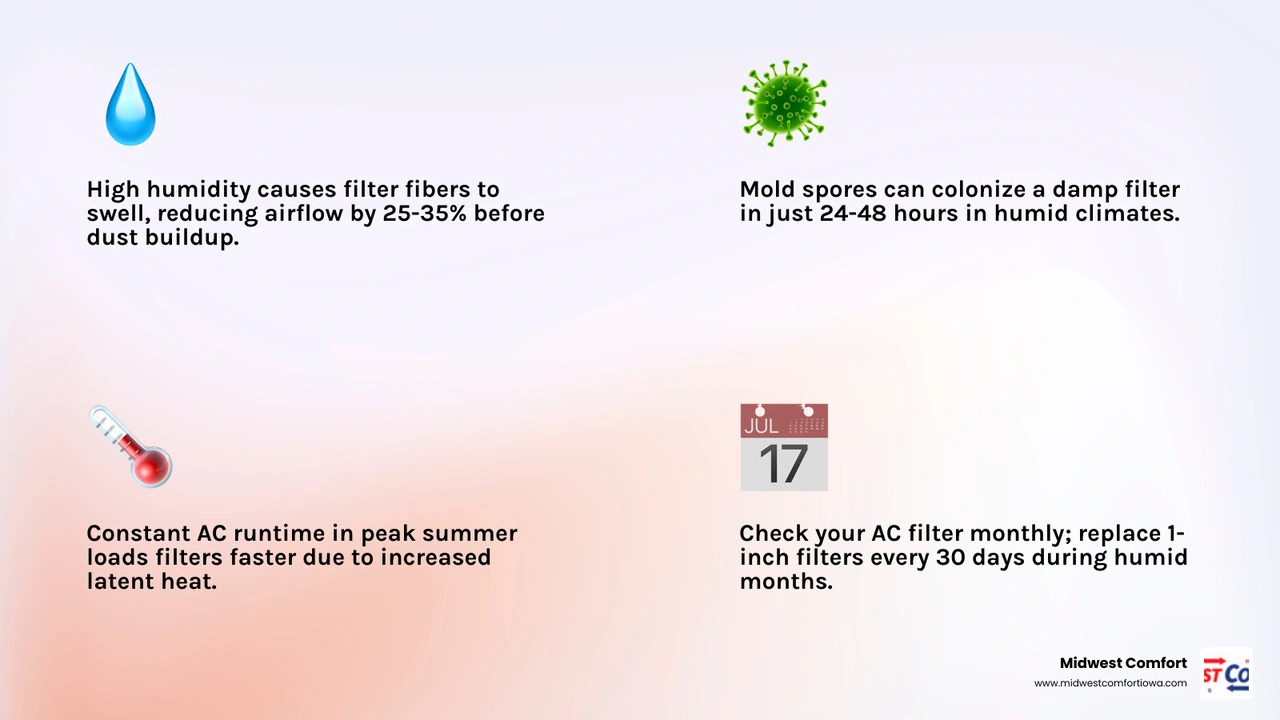
When the air is heavy with moisture, the organic fibers in standard filters absorb water vapor. This causes the individual fibers to swell. As they expand, the microscopic gaps between them shrink. This swelling alone can restrict airflow through your system by 25% to 35% before any significant amount of dust has even accumulated.
Furthermore, many modern pleated filters rely on an electrostatic charge to attract and capture tiny particles like pollen and fine dust. High indoor humidity acts as a grounding agent, effectively dissipating this electrostatic charge. When the charge is lost, the filter's fine-particle capture efficiency can drop by 15% to 20%, letting more dust bypass the filter and settle inside your ductwork and on your sensitive cooling components.
Perhaps the greatest threat in a humid environment is biological growth. Mold spores are always present in the air, but they require moisture to colonize. If your indoor humidity rises above 60%, a damp filter becomes the perfect breeding ground. Mold spores can begin to colonize and grow on damp filters in as little as 24 to 48 hours. Once mold takes hold, your air handler will actively distribute spores throughout your living spaces every time the system cycles on.
Understanding these physical and biological changes is crucial because Dirty Air Filters Impact HVAC Performance by restricting airflow, driving up utility costs, and spreading contaminants.
Why You Must Know How Often to Change Your AC Filter in Humid Climates
In a humid climate, your air conditioner does double duty. It does not just cool the air; it also acts as a giant dehumidifier. In fact, removing moisture (known as the latent heat load) can account for 30% to 50% of your system's total energy consumption during a sticky July or August in Des Moines.
Because the system must work so hard to wring moisture out of the air, it runs for much longer periods. During a hot, humid stretch in Central Iowa, a typical residential AC unit might run for 12 to 16 hours a day, compared to just a few hours a day during the mild spring. This extended runtime means your system is processing double or triple the volume of air — and therefore double or triple the amount of airborne dust, agricultural pollen, and pet dander.
When you combine extended runtimes with fiber swelling and moisture clumping, a filter that would easily last 90 days in a dry, temperate climate will reach complete saturation in 30 to 45 days. If you are concerned about keeping your family safe from airborne irritants, managing your filtration schedule is one of the most effective ways to protect your Indoor Air Quality Des Moines.
How Often to Change Your AC Filter in Humid Climates: The Recommended Schedule
Establishing a reliable schedule is the best way to prevent the efficiency losses and system strain associated with clogged filters. While a generic "every three months" template is common online, local conditions demand a much tighter timeline.
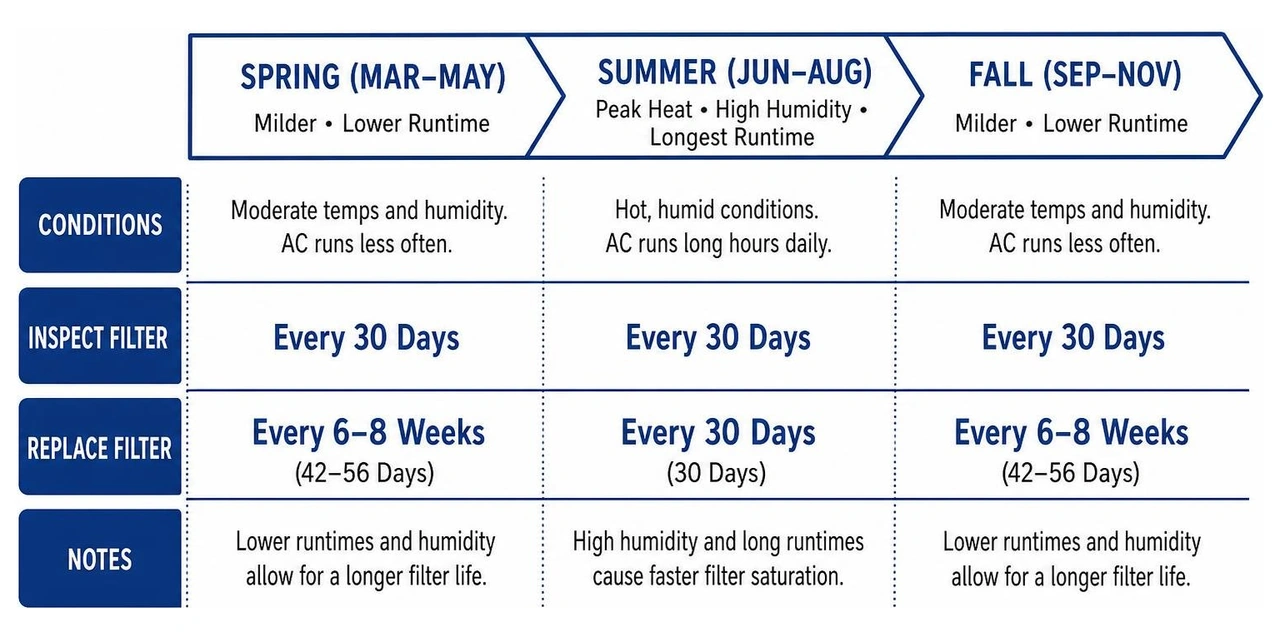
During the peak cooling season in Des Moines, we highly recommend inspecting your filter every 30 days. If you are using standard 1-inch pleated filters, you will likely need to replace them right at the 30-day mark. The combination of high runtime hours and elevated humidity levels means these thin filters simply run out of holding capacity quickly.
During the milder spring and fall shoulder seasons, your air conditioner does not have to run nearly as often. With lower runtimes and more moderate outdoor humidity, your filter does not accumulate debris as fast. During these months, you can safely extend your replacement window to every six to eight weeks.
To make finding the right filter for your specific system simple, you can explore our resources on Air Filters Des Moines IA.
Household Factors That Dictate How Often to Change Your AC Filter in Humid Climates
While the weather plays a massive role in filter lifespan, your household's daily life is just as influential. No two homes are identical, and several factors can shorten your filter's life significantly:
- Pets: Furry family members are wonderful, but they introduce a massive amount of hair and dander into the air. Pet dander can increase the overall particle load in your home's air by 40% or more. If you have a single shedding dog or cat, plan to change your 1-inch filter every 45 days. If you have multiple pets, you should check the filter every 20 to 30 days, as hair can quickly mat across the pleats and choke off airflow.
- Allergies and Asthma: If anyone in your home suffers from respiratory issues, keeping a clean, high-quality filter in place is non-negotiable. Saturated filters can begin releasing captured dust and allergens back into the air stream. For allergy-sensitive households, replacing the filter every 30 days is highly recommended to keep airborne irritants to an absolute minimum.
- Household Size: More people means more foot traffic, which stirs up settled dust from carpets and furniture. Larger families will naturally see their filters load up faster than a single occupant living in a quiet condo.
- Smoking: Indoor smoking introduces heavy tar and microscopic smoke particles that quickly coat filter fibers with a sticky residue, ruining the filter's performance in a matter of weeks.
Comparing Filter Types: Fiberglass vs. Pleated vs. High-MERV
Not all filters are created equal, and choosing the wrong type can lead to severe airflow issues, especially when humidity is factored in. Let's break down how the most common residential options perform:
Fiberglass Filters
Often referred to as "economy" filters, these are the very thin, see-through panels you buy in multi-packs. They are designed almost exclusively to protect your HVAC equipment from large debris like hair and giant dust bunnies; they do almost nothing to improve indoor air quality. In humid conditions, their loose fiberglass strands quickly become damp and lose what little structural integrity they have. They typically saturate within 15 to 30 days in the summer and must be replaced immediately if they begin to bow or sag in the slot.
Pleated Filters (MERV 8 to 11)
These are the most popular filters for residential homes. Made of synthetic materials, they offer significantly more surface area than fiberglass filters, allowing them to capture smaller particles like pollen, mold spores, and pet dander without immediately choking your airflow. Synthetic pleated filters are highly resilient against moisture and do not swell as easily as paper-based alternatives. A standard MERV 8 pleated filter typically lasts 45 to 60 days in our climate, dropping to 30 days during the muggiest summer stretches.
High-MERV Filters (MERV 13+)
While these filters are excellent at trapping incredibly fine particles, including bacteria and smoke, they present a unique challenge in humid climates. Because the filter media is so dense, it naturally creates higher airflow resistance (static pressure). When high humidity causes even minor moisture clumping on a MERV 13 filter, the static pressure can spike rapidly. If your HVAC system's blower motor was not specifically designed to handle this level of resistance, it can cause the system to overheat, short-cycle, or freeze up.
| Filter Type | Material | Typical MERV | Lifespan in Humid Summer | Airflow Resistance | Best For |
|---|---|---|---|---|---|
| Fiberglass | Spun Glass | 1–4 | 15–30 Days | Very Low | Basic system protection only |
| Standard Pleated | Synthetic | 8–11 | 30–45 Days | Moderate | Average homes, pets, light allergies |
| High-MERV Pleated | Dense Synthetic | 13+ | 20–30 Days | High | Severe allergies (requires system check) |
| Deep Media | Pleated Synthetic | 8–11 | 3–6 Months | Low to Moderate | Excellent filtration with long lifespan |
Warning Signs Your Filter Needs Immediate Replacement
Waiting for a specific date on the calendar is not always the safest approach. Your air conditioner will often drop subtle (and not-so-subtle) hints that the filter has reached the end of its useful life.
Keep an eye out for these warning signs:
- Weak Airflow: If you notice that the air coming out of your register vents feels weak or warmer than usual, a clogged filter is the primary suspect. Restricted airflow makes it incredibly difficult for your system to circulate conditioned air evenly throughout your home.
- Accumulated Dust Near Vents: When a filter becomes completely loaded, the air pressure can force dirty air to bypass the filter entirely through tiny gaps around the frame. If you start seeing a fine layer of gray dust accumulating on the walls or ceiling around your supply vents, your filter is likely overdue.
- Musty or Damp Odors: Because filters trap organic matter like skin cells and dander, any moisture in the air can cause these trapped particles to decay, creating a distinct musty smell. If your home has a stale, damp odor whenever the AC cycles on, inspect the filter for dampness or visible mold immediately.
- Ice on the AC Unit: This is a major warning sign. When a dirty filter severely restricts airflow, the cold refrigerant flowing through your indoor evaporator coil cannot absorb enough heat from your home's air. The temperature of the coil drops below freezing, causing the condensation on the coil to turn to ice. If you see ice on the copper line or the indoor unit, turn the system off immediately and check the filter.
- The Flashlight Test: This is a foolproof DIY method. Take your filter out of its slot and hold it up to a bright flashlight or light bulb. If the light cannot easily pass through the filter media, it is completely saturated with fine dust and needs to be replaced, regardless of how many days it has been installed.
Frequently Asked Questions About AC Filters in Humid Climates
Can I wash and reuse my AC filter in a humid climate?
Unless your filter is explicitly labeled as "washable" or "reusable" (usually made of a rigid plastic or metal frame with special electrostatic mesh), you must never wash it. Wetting a standard disposable paper or synthetic filter will ruin its structural integrity, causing it to collapse inside your air handler.
Even if you have a designated washable filter, we generally advise against using them in highly humid climates. Washable filters must be 100% dry before you reinstall them. If you put a slightly damp filter back into your dark, warm air handler, mold will begin to grow on it within 24 hours. If you do choose to use a washable filter, always keep a cheap disposable backup filter on hand to run in your system while the washable filter dries completely.
Should I run my HVAC fan on "ON" or "AUTO" to manage humidity?
In a humid climate, you should always set your thermostat's fan setting to AUTO rather than ON.
When your air conditioner runs, moisture condenses on the cold indoor evaporator coil and drips down into a condensate pan to drain away. When the cooling cycle ends, the coil remains soaking wet for several minutes. If your fan is set to ON, the blower motor will keep running and blow warm air across that wet coil, re-evaporating all that collected water right back into your home's air. This can quickly spike your indoor relative humidity by 10% or more, making your home feel sticky and forcing your filter to absorb unnecessary moisture.
What happens if I use a filter with too high of a MERV rating?
Using a filter with a MERV rating that is too high for your specific HVAC blower motor can cause serious damage. Filters rated MERV 13 or higher are incredibly dense. If your system's blower motor (especially older permanent split capacitor, or PSC, motors) has to fight against that heavy resistance, it will slow down, drawing more electricity and running hotter.
Over time, this extra strain can lead to blower motor burnout, frozen evaporator coils, and even compressor failure. Always consult your system's manual or ask a professional technician before upgrading to a high-MERV filter.
Conclusion
Managing how often to change your AC filter in humid climates is one of the simplest, most cost-effective ways to protect your home's comfort and your pocketbook. By keeping a fresh filter in place, you can improve your system's efficiency by 5% to 15%, directly lowering your monthly utility bills.
At Midwest Comfort, we are committed to providing honest, high-quality, and cost-effective HVAC solutions tailored to your family's needs. As a family-owned business serving Des Moines, Ankeny, Waukee, Clive, Johnston, and the surrounding areas, we bring a family-oriented approach to keeping your home comfortable all year long.
For more professional tips on keeping your system running smoothly, check out our comprehensive Guide to Air Conditioner Maintenance. Ready to ensure your cooling system is in peak condition? Explore our professional services on our Air Conditioning page or reach out to our friendly team today!
