
Is a Gas or Electric Water Heater Right for Your Des Moines Home?
Gas vs electric water heater comparison for homeowners is one of the most common questions families face when their current unit starts showing its age — and for good reason. Water heating accounts for roughly 18% of your home's total energy use, so the choice you make affects your monthly bills, your comfort, and your home's infrastructure for the next decade or more.
Here's a quick breakdown to help you decide:
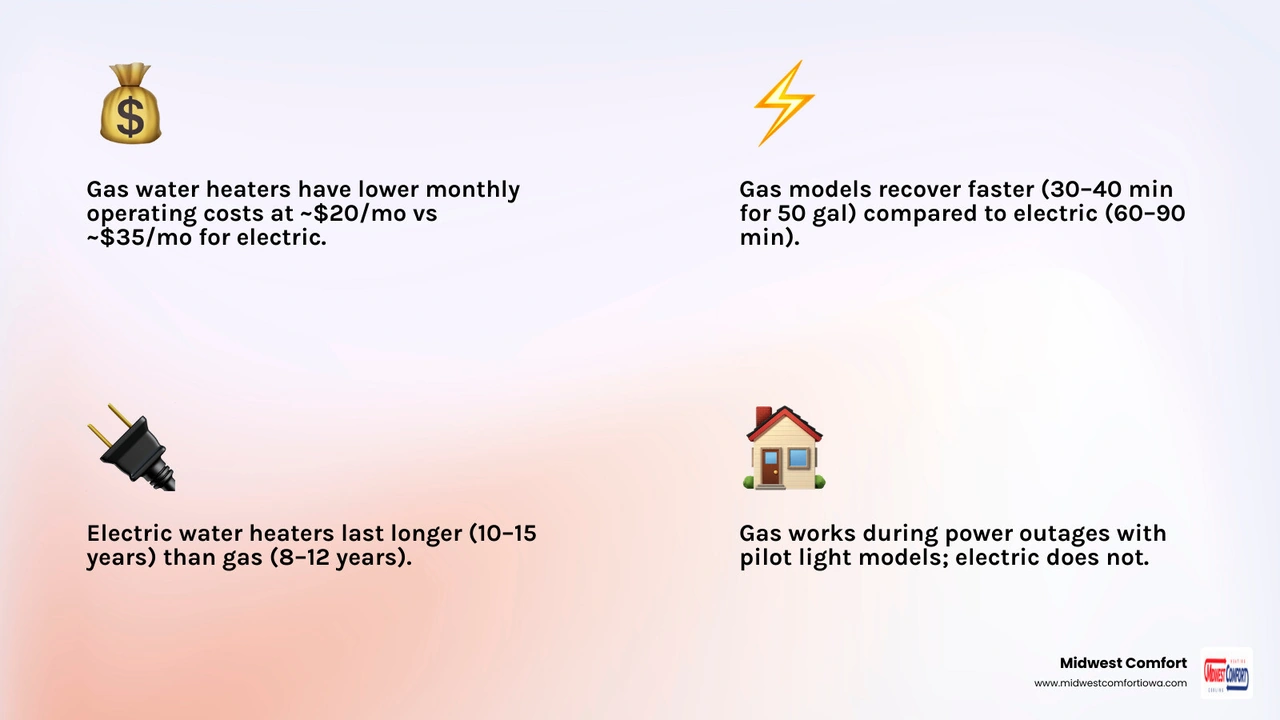
| Factor | Gas Water Heater | Electric Water Heater |
|---|---|---|
| Upfront cost | Higher | Lower |
| Monthly operating cost | Lower (~$20/mo) | Higher (~$35/mo) |
| Recovery speed | Faster (30–40 min/50 gal) | Slower (60–90 min/50 gal) |
| Lifespan | 8–12 years | 10–15 years |
| Works during power outage? | Yes (pilot light models) | No |
| Installation complexity | Higher (venting + gas line) | Lower (no venting needed) |
| Best efficiency option | High-efficiency gas tankless | Heat pump (200–300% efficient) |
| Best for | Large families, high demand | Smaller households, no gas line |
The honest answer is: neither type wins for everyone. The right choice depends on what's already in your home, how much hot water your household uses, and what energy rates look like in your area.
For Des Moines homeowners especially, factors like local utility costs, Iowa's hard water, and cold winter temperatures all play a real role in which system performs best day to day.
The sections below walk through everything — from how each type works, to installation requirements, maintenance, efficiency ratings, and when it actually makes sense to switch fuel types.
Understanding the Gas vs Electric Water Heater Comparison for Homeowners
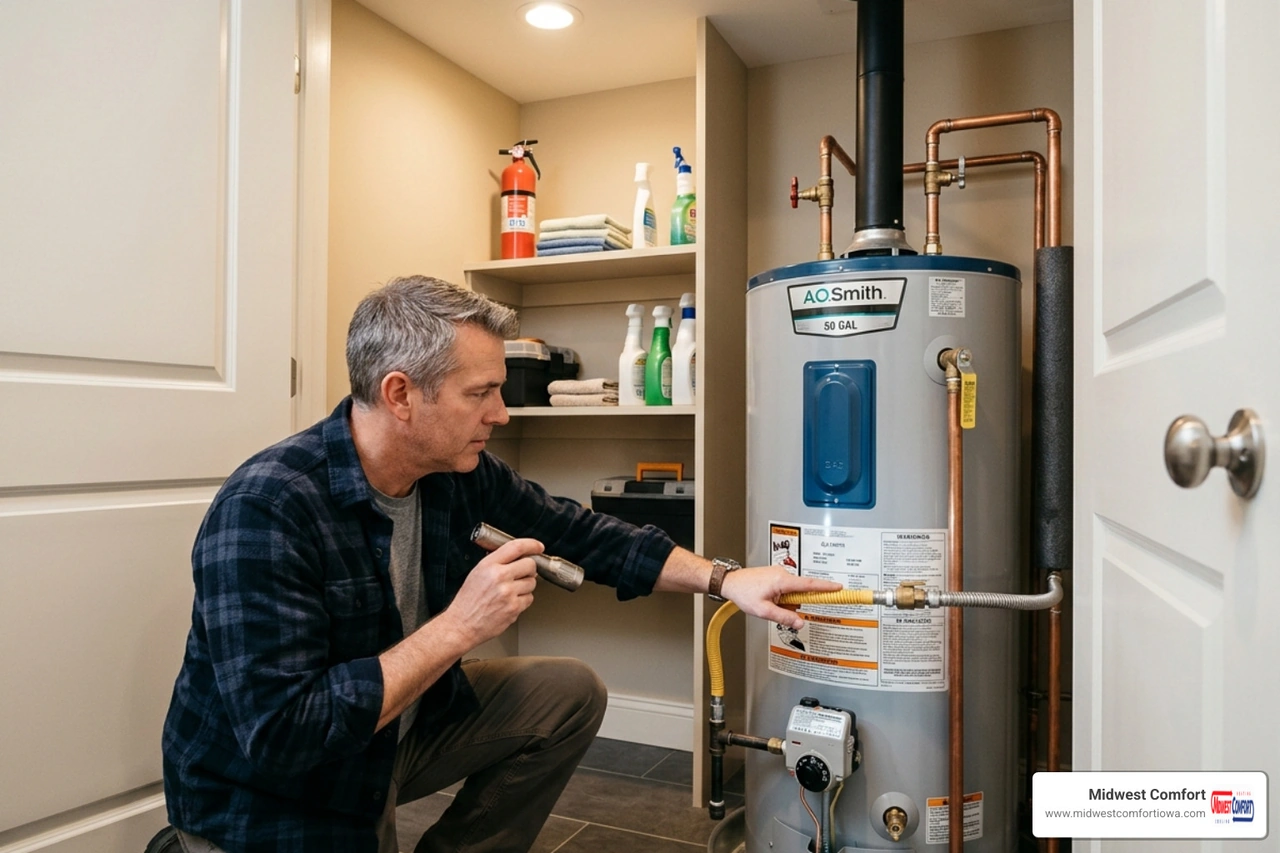
When we talk about a gas vs electric water heater comparison for homeowners, the first hurdle is often what’s already behind your utility closet door. In many Des Moines neighborhoods—from the historic homes in Windsor Heights to new builds in Waukee—the existing infrastructure largely dictates your options.
If your home currently has a gas line and a venting system, sticking with gas is often the path of least resistance. However, if you are looking to simplify your home’s systems or don’t have access to natural gas, electric models offer a versatile alternative.
There are two primary styles to consider for both fuel types: storage tanks and tankless units. Traditional tanks keep a reservoir of water hot and ready, while tankless models heat water on demand. Understanding When to Replace Your Water Heater is the first step in this journey. If your current unit is over a decade old, leaking, or struggling to keep up with your morning shower routine, it’s time to look at the mechanics of these two rivals.
Gas units use a burner to heat the bottom of a tank (or a heat exchanger in tankless models), requiring a chimney or flue to exhaust combustion gases safely outside. Electric units, conversely, use internal resistance coils—much like an oversized electric kettle—to transfer heat directly into the water. This lack of combustion means electric units don't need venting, making them easier to tuck into tight spaces like closets or crawl spaces.
Performance and Efficiency: How They Work
To truly understand how these systems stack up, we have to look at how they convert energy into hot water. Efficiency isn’t just a buzzword; it’s measured by the Uniform Energy Factor (UEF). This rating tells us how much of the energy put into the heater actually ends up as hot water.
Standard electric water heaters are incredibly efficient at the point of use, often achieving 90-95% efficiency. This is because the heating elements are submerged directly in the water, resulting in very little heat loss during the transfer process. However, they can suffer from "standby heat loss" as the water sits in the tank waiting to be used. If you find your water temperature dipping unexpectedly, you might be dealing with Water Heater Temperature Fluctuations Causes, which can happen in both gas and electric models.
Gas units generally have lower UEF ratings (around 60-70% for standard tanks) because a significant amount of heat escapes through the venting system. However, because natural gas is often more cost-effective than electricity in the Midwest, the lower thermal efficiency doesn't always translate to higher bills.
Gas Water Heater Recovery and Speed
For large families in Clive or Ankeny, "recovery rate" is the metric that matters most. This is the speed at which a water heater can heat a fresh tank of cold water after someone has drained it.
Gas water heaters are the undisputed champions of speed. They can heat water 2-3 times faster than standard electric models. A typical 50-gallon gas tank can recover in about 30 to 40 minutes, whereas an electric tank might take over an hour. If you’re noticing that your recovery time is slowing down even more than usual, it could be one of the Signs You Need Water Heater Repair. For households with back-to-back showers, laundry, and dishwashing, the raw power of a gas burner is hard to beat.
Key Factors in a Gas vs Electric Water Heater Comparison for Homeowners
While traditional electric resistance heaters are standard, the 2026 landscape has brought heat pump water heaters (also known as hybrid heaters) to the forefront. These units don't "create" heat; they "move" it from the surrounding air into the tank. This technology can achieve a staggering 200–300% efficiency.
As we look toward stricter efficiency standards, these hybrid models are becoming the go-to for eco-conscious homeowners. They significantly reduce your carbon footprint, especially if your home utilizes renewable energy sources. If you've had trouble with older electric models, many Water Heater Repair Issues Solved by modern technology involve these smarter, more efficient components that better handle the demands of a modern Iowa household.
Installation and Infrastructure Requirements in Des Moines
Installing a new water heater isn't always a "plug and play" situation. The infrastructure of your home in locations like Johnston or Pleasant Hill plays a massive role in the final setup.
For gas units, the biggest requirement is proper venting. Combustion produces carbon monoxide, which must be safely piped out of the home. Modern high-efficiency gas units often use power venting, which uses a fan to push exhaust through PVC pipes, but this requires an electrical outlet nearby. You also need a dedicated gas line, and if you're switching from a tank to a high-capacity tankless unit, that gas line might need to be upsized to handle the increased demand.
Electric units have their own requirements. A standard tank usually needs a dedicated 240-volt, 30-amp circuit. If you are moving from gas to electric, we may need to evaluate your electrical panel to ensure it has the capacity for this new load. This is especially true for electric tankless models, which can require significant amperage and may necessitate a panel upgrade.
Infrastructure Needs for a Gas vs Electric Water Heater Comparison for Homeowners
The complexity of switching fuel types shouldn't be underestimated. Converting from gas to electric involves capping gas lines and removing old venting, while moving from electric to gas requires running new lines and cutting vent holes in your home’s exterior.
When we look at Waer Heaters for our neighbors in the Des Moines area, we always start by assessing the existing footprint. If your home is already set up for one fuel type, it is almost always more cost-effective to stay with that type unless you have a specific reason to switch, such as a desire for the extreme efficiency of a heat pump model or the on-demand nature of a gas tankless system.
Maintenance and Longevity for Iowa Homes
In Iowa, our water is notoriously hard. This means it’s full of minerals like calcium and magnesium that love to settle at the bottom of your tank. This sediment acts as an insulator, forcing your heater to work harder and eventually causing the metal to overheat and fail.
The average lifespan of a residential water heater is 10 to 15 years, but this varies by type. Electric units generally last a bit longer (10–15 years) because they have fewer moving parts and no combustion taking place. Gas units typically last 8–12 years.
Knowing the Signs of Sediment Buildup in Water Heater is crucial for every homeowner. If you hear a rumbling or When Water Heater Makes Popping Noises, that’s the sound of steam bubbles escaping through a layer of sediment. Annual maintenance, including flushing the tank and checking the anode rod, is the best way to protect your investment.
Maximizing Lifespan with a Gas vs Electric Water Heater Comparison for Homeowners
To get the most out of your unit—regardless of fuel type—we recommend a few key steps:
- Flush the Tank: Do this annually to remove Iowa’s hard water deposits.
- Check the Anode Rod: This "sacrificial" rod attracts corrosive elements so they eat the rod instead of your tank. Replacing it every 3–5 years can double your heater's life.
- Temperature Settings: Keeping your heater at 120°F prevents scalding and reduces the rate of mineral buildup.
- Professional Inspections: A yearly checkup ensures that gas burners are firing cleanly or that electric elements aren't corroded.
Frequently Asked Questions
Do gas water heaters work during power outages?
This is a major selling point for gas. Traditional gas water heaters with a standing pilot light will continue to work perfectly during a Des Moines winter power outage. However, be aware that many modern high-efficiency gas models now use electronic ignitions or power vents that do require electricity. If off-grid reliability is your goal, you'll want to verify the ignition type of your specific model. Electric water heaters, unfortunately, will not work at all during an outage.
Which type of water heater is more environmentally friendly?
This is a nuanced part of the gas vs electric water heater comparison for homeowners. Electric units, particularly heat pump models, are generally considered more "green" because they can be powered by renewable energy like wind or solar. They also have zero on-site emissions. Gas heaters, while efficient, still rely on fossil fuels and release combustion byproducts. However, if your local electric grid relies heavily on coal, a high-efficiency gas unit might actually have a smaller total carbon footprint than a standard electric resistance heater.
Is it worth switching from gas to electric or vice versa?
It depends on your goals. If you are looking for the lowest monthly operating costs and have a large family, gas is usually the winner. If you want a safer system with no risk of carbon monoxide and are interested in high-tech heat pump efficiency, electric is the way to go. Just remember to factor in the infrastructure costs—switching fuel types is a significant project that involves more than just swapping the tank.
Conclusion
Choosing the right water heater is about balancing your daily needs with your home’s existing setup. Whether you’re in Grimes, Adel, or right here in Des Moines, we understand that "comfort" means never having to worry about a cold shower.
At Midwest Comfort, we take a family-oriented approach to HVAC. We aren't just here to sell you a unit; we're here to provide tailored solutions that fit your home and your budget. From exploring the latest in Waer Heaters technology to providing honest, high-quality maintenance, our team is dedicated to keeping your Iowa home running smoothly. If you're ready to upgrade or just need an expert opinion on your current system, we're here to help.
