The Operational Reality of Commercial Heating Upgrades
At Midwest Comfort Heating & Cooling, we frequently hear from building managers who are losing sleep over their aging heating equipment struggling to maintain consistent temperatures. If you are facing this scenario, you are likely wondering what to expect when upgrading a commercial boiler system in Polk County without completely shutting down your operations. Navigating the operational downtime, local permitting requirements, and project timelines right before the fall heating season requires precise planning and a clear understanding of the logistical challenges involved in a large-scale commercial boiler retrofit.
In our years of serving the Des Moines area, we've seen facility managers face a critical decision point: staging the upgrade early enough to minimize disruption to building occupants, or risking a catastrophic failure during peak winter loads. Taking a proactive approach means you can control the timeline rather than letting an emergency dictate your schedule. A successful retrofit hinges on understanding both local municipal regulations and accurate project timelines from the very beginning. From comprehensive HVAC system services to the final municipal inspection, our team ensures stakeholders have a clear roadmap of what to expect throughout every procedural phase of the upgrade.
Key logistical considerations we prioritize include:
- Occupant comfort: Ensuring tenants, students, or employees remain comfortable during the transition period.
- Workflow continuity: Scheduling heavy mechanical work outside of peak operational hours.
- Regulatory compliance: Meeting all strict codes enforced within Polk County / Des Moines commercial zones.
- Infrastructure protection: Safeguarding existing piping and building systems during the switchover.
By mapping out these operational realities early, facility managers can approach a commercial heating upgrade with confidence, knowing exactly how our technicians will execute the project from initial assessment to final commissioning.
The Critical Window: Staging Retrofits During the September Pre-Heating Season
Timing is everything when managing commercial building infrastructure. The seasonal transition period offers the safest window for taking a commercial heating system offline. Specifically, the September pre-heating season provides a brief but vital opportunity to complete heavy mechanical upgrades before overnight temperatures drop significantly. Our team knows firsthand that Central Iowa's harsh, freezing winters leave zero margin for error; delaying a necessary boiler replacement past this fall transition window introduces the critical risk of facility pipe freezing, which can cause extensive water damage and structural issues.
Deferring upgrades until emergency breakdowns occur in mid-winter is a high-risk gamble we always advise against. When a commercial boiler fails in January, facility managers are forced to scramble for temporary heating solutions, expedite equipment shipping at a premium, and rush the installation process. Understanding the real cost of delaying commercial HVAC repairs means recognizing that emergency winter retrofits compound expenses exponentially. Proactive scheduling protects sensitive facility infrastructure from catastrophic freezing while giving our mechanical contractors the necessary timeline to secure specialized equipment and finalize engineering plans.
Protecting Schools and Office Buildings from Winter Disruption
Commercial spaces like schools, corporate offices, and healthcare facilities have strict continuous operation requirements. A loss of heat does not just mean discomfort; it often mandates building closures, lost instructional days, or halted business operations.
| Factor | Planned Fall Retrofit (September) | Emergency Winter Replacement (January) |
|---|---|---|
| Equipment Sourcing | Standard lead times, multiple options available. | Expedited shipping required, limited to in-stock units. |
| Facility Downtime | Controlled, scheduled outside of peak occupancy. | Unpredictable, immediate shutdown of operations. |
| Risk of Pipe Freezing | Virtually zero, ambient temperatures remain safe. | Extremely high, requiring emergency bypass heating. |
| Labor Scheduling | Planned shifts, avoiding overtime rates. | Emergency dispatch, overnight or weekend premiums. |
By securing a spot on our schedule during the September pre-heating season, facility managers ensure that the building is fully prepared to handle the first major freeze of the year without interrupting daily operations.
Phases of a Commercial Boiler Upgrade in Polk County
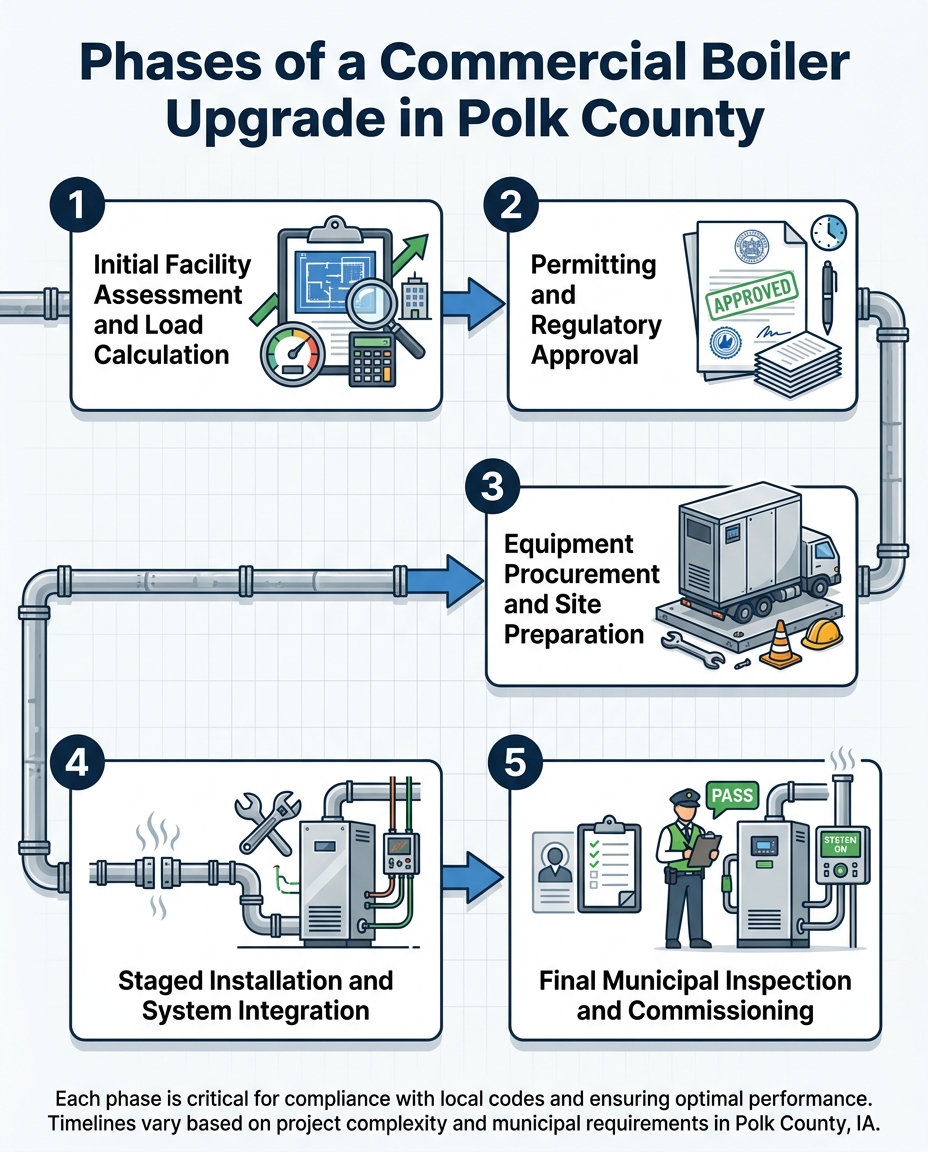
A large-scale heating upgrade is not a single event, but a carefully orchestrated sequence of technical phases. When our commercial HVAC team tackles a project, knowing exactly how these steps unfold helps our clients set realistic expectations with their stakeholders. Whether you are managing a retail complex or a large educational facility in Polk County / Des Moines commercial zones, our procedural timeline follows a strict order to ensure safety and compliance.
- Phase 1: Initial Facility Assessment and Load Calculation. Before any equipment is selected, our engineers perform a comprehensive load calculation to determine the exact heating demands of the building. This phase assesses the condition of existing piping, ventilation systems, and electrical infrastructure to ensure compatibility with modern equipment.
- Phase 2: Permitting and Regulatory Approval. Comprehensive documentation, including the load calculations and mechanical drawings, is submitted to local municipal authorities. This phase is critical for securing the legal authorization to begin heavy mechanical work.
- Phase 3: Equipment Procurement and Site Preparation. Once permits are approved, the specific commercial boilers and necessary components are ordered. Site preparation begins, which may involve safely draining and dismantling the old system, removing hazardous materials, and preparing the mechanical room for the new footprint.
- Phase 4: Staged Installation and System Integration. The core of our commercial boiler installation and replacement process involves maneuvering the new heavy equipment into place, welding pipe connections, integrating the new boiler with the existing hydronic system, and connecting electrical and gas lines.
- Phase 5: Final Municipal Inspection and Commissioning. The newly installed system undergoes rigorous testing to verify combustion efficiency, proper venting, and safe operation. Finally, a municipal inspector reviews the work to ensure full compliance with all local codes before we officially hand the system over to the facility manager.

Navigating Municipal Mechanical Permits and Building Codes
Executing a commercial heating retrofit requires strict adherence to local regulations. In Polk County / Des Moines commercial zones, the local Public Works and Building Division oversees all commercial mechanical permits. This oversight ensures that high-capacity heating systems are installed safely, properly vented, and integrated correctly with municipal gas and electrical grids.
Securing these necessary approvals requires detailed documentation. Our mechanical contractors submit proof of accurate load calculations, detailed piping schematics, and equipment specifications. Strict adherence to commercial building codes is not just about passing an inspection; it ensures long-term safety for building occupants and provides critical operational liability protection for property owners. During the project, municipal inspections are typically staged at specific milestones—such as after gas lines are run but before they are concealed, and again during the final commissioning phase.
How Efficient Permitting Keeps Projects on Schedule
Administrative delays at the permitting office can derail an otherwise perfectly planned timeline. Partnering with a contractor who possesses established municipal relationships is a significant advantage. Our team's deep knowledge of local codes and efficient permit acquisition at Midwest Comfort Heating & Cooling directly reduces project timelines. Knowing exactly what the inspectors in Polk County look for—from specific combustion air requirements to proper boiler clearances—prevents failed inspections and costly rework.
Common code compliance checkpoints we manage include:
- Combustion air supply: Ensuring the mechanical room has adequate fresh air intake for safe burner operation.
- Venting materials: Verifying that the exhaust flues are rated for the specific temperatures and condensation levels of the new equipment.
- Gas pipe sizing: Confirming the existing gas infrastructure can handle the required BTU load of modern units.
- Clearances: Maintaining legally mandated space around the boiler for future service and fire safety.
Strategies to Minimize Facility Downtime During the Retrofit
The primary concern of any facility manager facing a major infrastructure project is keeping the building operational while the heating system is replaced. Completely shutting down a commercial space during the September pre-heating season transition is rarely an option. Fortunately, our modern mechanical workflows prioritize continuous operation through strategic staging.
One of the most effective strategies we utilize is phased installation techniques. If a facility relies on multiple boilers, our contractors can sequence the replacement so that partial heating capacity remains online at all times. While one unit is dismantled and replaced, the remaining units carry the building's baseline heating load. For single-boiler facilities, we employ after-hours or weekend staging strategies to bypass peak occupancy hours in schools and offices, ensuring that heavy lifting and disruptive noise occur when the building is empty. At Midwest Comfort Heating & Cooling, our technicians specialize in executing complex heating system upgrades with minimal operational downtime through this kind of precise workflow staging.
Coordinating with Facility Managers
Clear communication between our mechanical contractors and facility stakeholders is the linchpin of a seamless retrofit. Establishing a clear chain of communication for timeline updates ensures that everyone from the maintenance staff to the executive board knows what is happening and when.
Effective coordination involves:
- Setting realistic expectations: Clearly defining how long the critical switchover day will last.
- Temporary heating solutions: Deploying bypass systems or temporary industrial heaters if the main system must be taken offline entirely for a short period.
- Daily briefings: Providing the facility manager with end-of-day progress reports and outlining the next day's objectives.
- Safety zoning: Clearly marking off mechanical rooms and staging areas to protect building occupants from construction hazards.
Long-Term Operational Benefits of Modern Commercial Boilers
While navigating the timeline and logistics of a retrofit requires effort, we always reassure stakeholders about the substantial return on investment that modern heating equipment provides. Department of Energy (DOE) commercial heating guidelines note a significant efficiency drop-off in boilers that are 15 to 20 years old. Aging equipment suffers from scale buildup, degraded heat exchangers, and outdated burner technology that wastes fuel and inflates utility overhead.
Upgrading to modern commercial systems provides vastly better load matching. Newer boilers utilize modulating burners that adjust their output precisely to the building's current heating demand, drastically reducing short-cycling and fuel waste. Furthermore, we frequently help facilities integrate modern boiler controls seamlessly with existing Building Management Systems (BMS), giving facility managers in Polk County / Des Moines commercial zones granular, remote control over their energy usage and real-time diagnostics.
Additionally, proactive facility managers can often offset the initial capital expenditure by taking advantage of commercial energy rebates and tax incentives designed to encourage high-efficiency upgrades. While specific program details fluctuate, upgrading to condensing boiler technology frequently qualifies facilities for federal tax credits and local utility incentive programs. We always recommend verifying current available programs with your utility provider or a tax professional during the planning phase.
Frequently Asked Questions About Commercial Boiler Upgrades
How long does a commercial boiler replacement take?
In our experience, a typical commercial boiler replacement takes anywhere from a few days to several weeks, depending on the complexity of the facility. The physical installation of the equipment might only take a few days, but the entire process—including load calculations, permitting, equipment procurement, and final inspections—requires careful staging over a longer timeline. Planning ahead with our team ensures the physical downtime is kept to an absolute minimum.
What permits are required for commercial HVAC in Polk County?
Commercial HVAC projects in Polk County require specific mechanical permits issued by the local Public Works and Building Division. These permits mandate that all work complies with current commercial building codes, covering gas piping, electrical connections, venting, and structural clearances. Securing these permits requires our team to submit detailed mechanical drawings and load calculations for municipal review.
How to minimize downtime during boiler replacement?
We minimize downtime through phased installations, after-hours staging, and the use of temporary heating solutions. By replacing multiple boilers one at a time, partial heating capacity can remain online to serve the building. Our contractors also schedule the most disruptive phases of the switchover during weekends or overnight hours to avoid impacting your daily operations.
What happens during a commercial boiler installation?
During installation, our crews safely disconnect, drain, and remove the old equipment from the mechanical room. We prepare the site for the new footprint, which may involve pouring new concrete pads or modifying existing piping. The new boiler is then rigged into place, connected to the building's hydronic, gas, and electrical systems, and thoroughly tested for combustion efficiency and safety before final commissioning.
Can a commercial boiler be replaced during the winter months?
Yes, our emergency crews can replace a commercial boiler during the winter, but we highly discourage it unless it is an absolute emergency. Winter replacements carry a high risk of facility pipe freezing, require expensive temporary bypass heating, and often incur premium costs for expedited equipment shipping and emergency labor. Staging the retrofit during the fall transition period is vastly safer and more cost-effective.
Plan Your Commercial Heating Retrofit Before Winter Arrives
Navigating a commercial boiler retrofit requires proactive planning, a deep understanding of local municipal codes, and strategic management of facility downtime. The September pre-heating season is the optimal time to execute these heavy mechanical upgrades, protecting your building's infrastructure from the severe risks of a mid-winter failure. A clear, realistic timeline established early in the process is the key to a successful commercial heating project that keeps your occupants comfortable and your operations running smoothly.
Do not wait for an aging system to fail when you need it most. Encourage your stakeholders to prioritize this critical infrastructure upgrade now. Reach out to our team at Midwest Comfort Heating & Cooling to schedule a comprehensive assessment. We will evaluate your current system's condition and build a realistic, code-compliant timeline tailored to your facility's specific needs.
