


Is Your Heat Pump Ghosting You? Signs You Need a Pro


Discover the Essential Benefits of Regular Air Conditioning Maintenance
Regular maintenance of your air conditioning system ensures optimal performance and longevity. It helps prevent costly repairs while improving energy efficiency, keeping your home comfortable year-round.

Routine checks can significantly reduce energy bills and extend the life of your unit.


Is Your Heat Pump Trying to Tell You Something? What Des Moines Homeowners Need to Know
Common heat pump problems and how to prevent them come down to a handful of recurring issues that most Des Moines homeowners will face at some point — and the good news is that most of them are preventable with the right habits.
Here's a quick look at the most common problems and how to stop them before they start:
| Problem | Common Cause | How to Prevent It |
|---|---|---|
| Poor heating or cooling | Dirty filters, low refrigerant | Replace filters every 1-3 months; schedule annual maintenance |
| Frozen outdoor unit | Blocked airflow, defrost cycle failure | Keep unit clear; have defrost system inspected seasonally |
| Short cycling | Oversized unit, faulty thermostat | Ensure proper sizing; check thermostat calibration |
| Unusual noises | Loose parts, worn motor bearings | Schedule regular tune-ups; don't ignore new sounds |
| Unit won't turn on | Tripped breaker, thermostat issue | Check breaker and thermostat settings first |
| Refrigerant leak | Worn components, improper installation | Annual professional inspection |
| Weak airflow | Clogged filters, blocked vents | Change filters regularly; keep vents unobstructed |
Heat pumps are one of the most efficient ways to keep a home comfortable year-round — handling both heating and cooling with a single system. But like any hardworking piece of equipment, they can develop problems that quietly chip away at performance and efficiency before you even notice something is wrong.
The average heat pump lasts around 15 years — but only with consistent care. Units that miss regular maintenance often fall short of that mark, leaving homeowners with unexpected repair bills or early replacement costs. In Des Moines, where winters can push a heat pump hard and summers aren't much easier, catching small issues early makes a real difference.
This guide walks you through the most common heat pump problems, what causes them, and — most importantly — how to prevent them from becoming costly headaches.
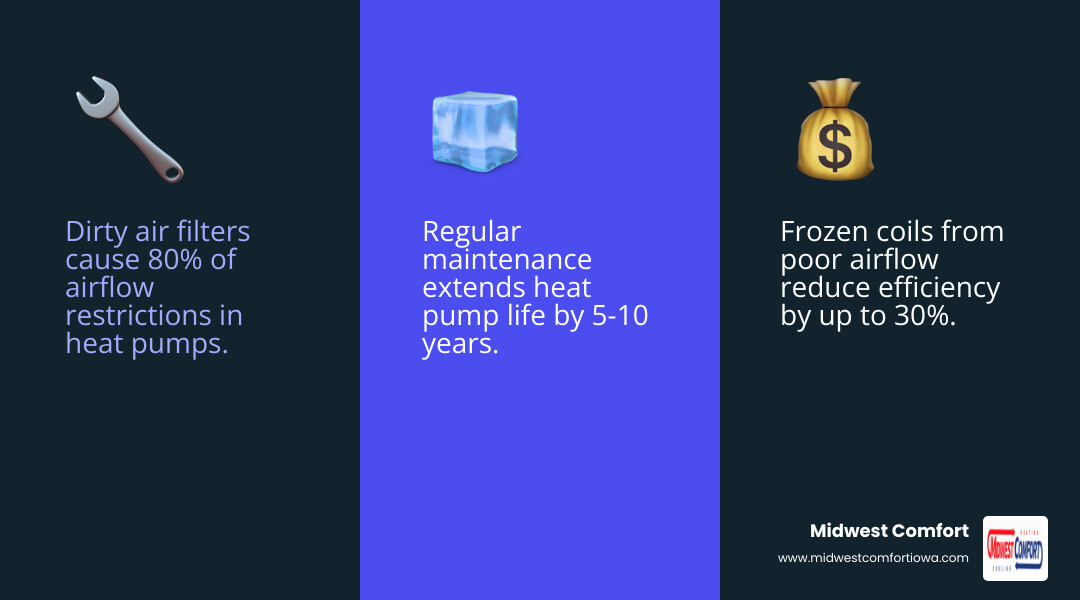
Common heat pump problems and how to prevent them: Airflow and Filtration
When we think about the "lungs" of our home, we should be looking directly at the air filters. In our experience serving families from Ankeny to Norwalk, the single most frequent cause of system failure is restricted airflow. A heat pump works by moving heat, not creating it. If air cannot flow freely over the coils, that heat transfer process grinds to a halt.
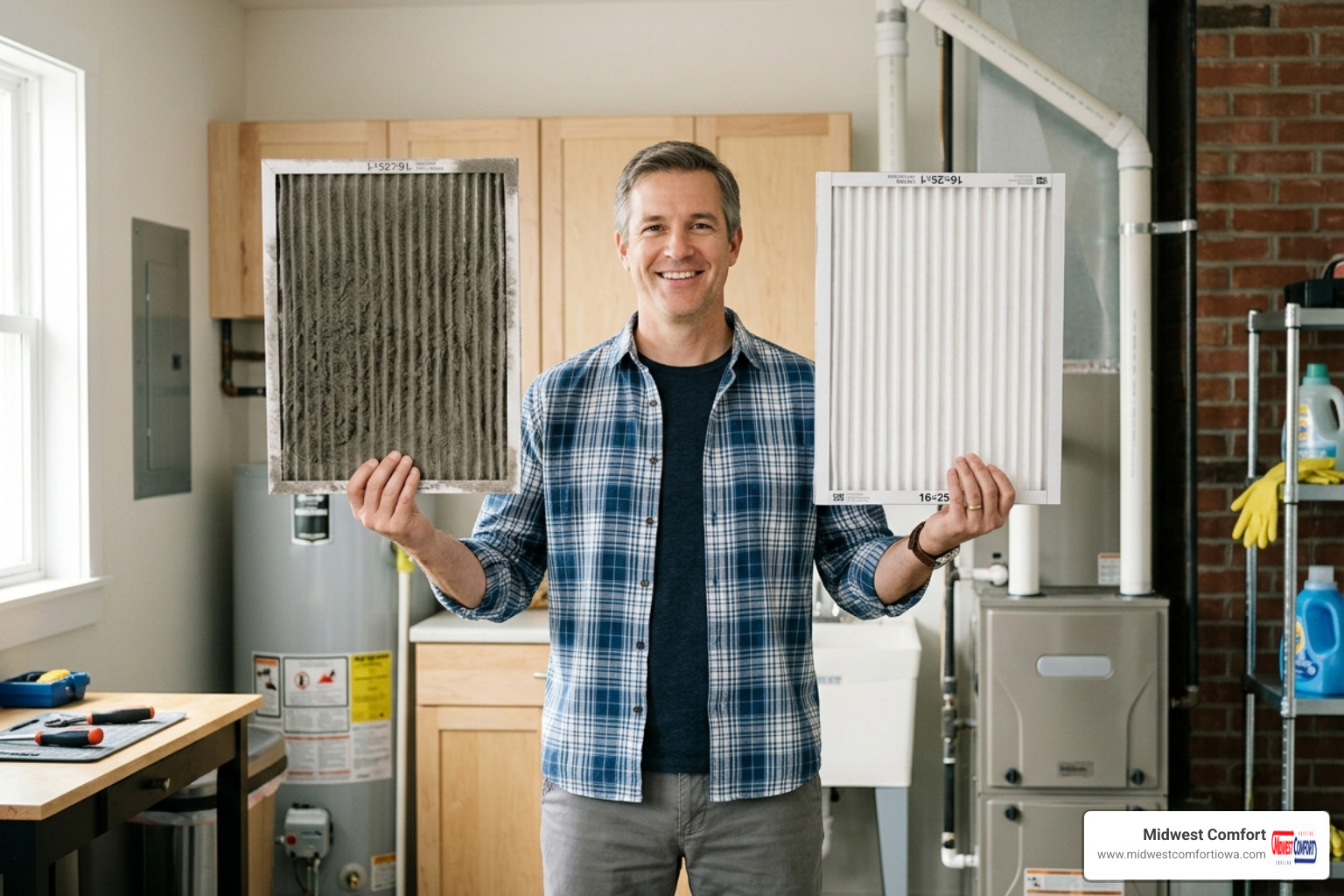
Clogged filters do more than just make the air dusty; they force the blower motor to work double-time to pull air through a wall of debris. This extra strain leads to overheating and can eventually burn out the motor. Furthermore, restricted airflow is the primary culprit behind frozen evaporator coils. When the air isn't warm enough to keep the refrigerant from getting too cold, the condensation on the coil turns to ice, encased in a block that prevents any further cooling or heating.
To keep your system breathing easy, we recommend Heat Pump Maintenance Urbandale IA routines that include checking your filters every 30 days. While some high-efficiency filters claim to last six months, the dusty seasons in Polk City or Grimes can clog them much faster.
Another often-overlooked issue is blocked return vents. It is tempting to slide a sofa over a vent or cover a register with a rug to improve a room's aesthetic, but this is a recipe for a "pressure imbalance." This imbalance makes the system "short cycle," which means it turns on and off too frequently, wearing out the starter capacitor and driving up your utility bills.
Troubleshooting common heat pump problems and how to prevent them at home
Before you assume the worst, there are several "zero-touch" checks you can perform right now. We always tell our neighbors in Waukee and Johnston to start with the simplest solutions.
- The Thermostat Check: It sounds silly, but verify the mode. Is it set to "Heat" when you want warmth? Is the fan set to "Auto" rather than "On"? If the display is blank, it might just need new batteries. Using a Heat Pump Services Complete Guide can help you understand how modern smart thermostats interact with your specific unit.
- Circuit Breaker Inspection: Heat pumps use a lot of power. Sometimes, a surge during a Des Moines thunderstorm can trip the breaker. Check your electrical panel; if the switch is in the middle or "off" position, flip it back. If it trips again immediately, stop and call us — that’s an electrical fault.
- The 2-Foot Clearance Rule: Your outdoor unit needs to "breathe" just as much as the indoor one. Ensure there is at least two feet of clear space on all sides. This means trimming back the lilacs in Windsor Heights or clearing away the snow drifts in Adel.
- Debris Removal: Check for leaves, twigs, or even animal nesting inside the outdoor cabinet. A blocked coil cannot dissipate heat, leading to a system shutdown.
Why is my outdoor unit frozen? Understanding the Defrost Cycle
Seeing a block of ice on your outdoor unit in the middle of a Carlisle winter can be terrifying. However, a light coating of frost is actually a normal part of operation. Because the outdoor coil is typically 10 to 20 degrees colder than the ambient air, moisture naturally freezes on the fins.
To handle this, your system has a built-in "defrost cycle." It essentially flips into cooling mode for a few minutes, sending warm refrigerant back outside to melt the ice. If you see steam rising from the unit and hear a "whooshing" sound, don't panic! That’s the system doing its job.
However, if the ice is thick enough to hide the metal fins, or if it stays there for hours, you have a problem. This is often caused by:
- Reversing Valve Failure: This is the part that switches the unit between heating and cooling. If it gets stuck, the defrost cycle won't trigger.
- Sensor Malfunctions: If the defrost timer or thermostat sensor fails, the unit won't know it's time to melt the ice.
- Refrigerant Leaks: Low refrigerant levels cause the coils to get much colder than they should, leading to rapid, unmanageable ice buildup.
If you suspect a malfunction, seeking Heat Pump Repair Urbandale IA is critical. Never try to chip the ice away with a screwdriver or hammer; you will almost certainly puncture the delicate refrigerant lines, turning a simple repair into a total replacement.
| Feature | Normal Frost | Emergency Ice Buildup |
|---|---|---|
| Appearance | Light, translucent coating | Thick, opaque block of ice |
| Duration | Melts within 10-15 minutes | Persists for hours or days |
| System Behavior | Periodic "whooshing" and steam | System runs constantly with no heat |
| Visibility | Metal fins still visible | Fins completely encased |
Identifying unusual noises and electrical failures
Your heat pump should hum, not scream. As we approach April 2026, many older units in Pleasant Hill and Altoona are starting to show their age through their "vocal cords." Learning the language of your HVAC system can help you catch common heat pump problems and how to prevent them before a total breakdown occurs.
- Grinding or Screeching: This usually indicates that the motor bearings are failing. Without lubrication or due to simple wear and tear, the friction creates a high-pitched sound. If ignored, the motor will eventually seize.
- Clicking: Rapid clicking when the unit tries to start often points to a failing starter capacitor or a bad relay. The capacitor acts like a battery to give the motor the "kick" it needs to start. If it’s weak, the motor just hums and clicks.
- Rattling: This is often just a loose panel or debris in the fan, but it can also indicate that the compressor is starting to work loose from its mounts.
- Hissing: This is almost always the sound of a refrigerant leak. Since refrigerant is under high pressure, it makes a distinct whistling or hissing sound as it escapes.
Electrical failures are the "silent killers" of heat pumps. Over time, wire insulation can become brittle or be chewed by pests in rural areas like Runnells or Dallas Center. Loose connections cause "pitting" on contactors, which can cause the unit to stay on indefinitely or not turn on at all. A professional Heat Pump Tune-Up Ankeny IA includes tightening these connections and testing the "draw" of your motors to ensure they aren't working harder than they should.
Why professional service stops common heat pump problems and how to prevent them
While DIY filter changes are great, there is no substitute for a professional eye. A heat pump is a complex machine involving high-voltage electricity, high-pressure chemicals, and sensitive computer boards.
Regular maintenance is the difference between a unit that lasts 10 years and one that hits the 15-to-20-year mark. During a seasonal inspection, we don't just look at the unit; we test the "vitals." We check refrigerant pressures, clean the coils (which can improve efficiency by up to 20%), and calibrate the thermostat. For our neighbors looking for Heat Pump Services Des Moines IA, these annual visits often pay for themselves through lower monthly energy bills and the prevention of emergency repairs.
As we look toward the standards of April 2026, energy efficiency has never been more important. Modern units are designed to much tighter tolerances, meaning even a small amount of dirt can cause a significant drop in performance. If your current unit is frequently breaking down or is more than 12 years old, it might be time to look into Heat Pump Installation Des Moines IA. Newer models are significantly quieter and can handle the extreme Des Moines temperature swings with much better grace than the models of a decade ago.
Frequently Asked Questions about Heat Pump Care
Why won't my heat pump turn on in the morning?
This is often related to the "lockout" feature or a thermostat schedule issue. If the outdoor temperature dropped significantly overnight, the system may be trying to engage the auxiliary heat. If that auxiliary heat (often electric heat strips) has a tripped breaker, the system won't start. First, check your thermostat to see if it’s displaying a "delay" or "wait" message. If it’s blank, check the batteries and the circuit breaker.
How often should I replace my air filters?
In the Des Moines area, we recommend checking them every month and replacing them at least every three months. However, if you have pets, live near a construction site in a growing area like Waukee, or suffer from allergies, you should replace them every 30 to 60 days. A clean filter is the easiest way to prevent airflow-related failures.
Is it normal for my heat pump to run constantly in extreme weather?
Yes! Unlike a furnace, which blasts high-temperature heat in short bursts, a heat pump is designed to run for longer cycles to maintain a steady temperature. When it’s 10 degrees in Grimes or 95 degrees in Clive, your heat pump might run almost continuously. This is actually more efficient than turning on and off frequently. However, if it’s running constantly in mild weather (around 50-60 degrees) and your home isn't reaching the set temperature, you likely have a refrigerant or airflow issue.
Conclusion
At Midwest Comfort, we understand that your home is your sanctuary. As a family-owned business, we treat every service call in Des Moines, Polk City, and the surrounding communities with the same care we’d give our own parents or siblings. We pride ourselves on providing honest, high-quality HVAC services that don't just fix the immediate problem but look at the long-term health of your system.
Whether you are in Ankeny, Norwalk, or anywhere in between, we offer tailored solutions and loyalty programs designed to keep your family comfortable through every Iowa season. Don't wait for your system to "ghost" you on the hottest or coldest day of the year. By staying proactive with common heat pump problems and how to prevent them, you can enjoy peace of mind and lower energy costs for years to come.
If you have questions about your system's performance or want to ensure your unit is ready for the upcoming season, explore our dedicated page on Heat Pumps or reach out to our team today. We’re here to help you keep your cool (and stay warm) with the reliable, cost-effective service you deserve.


Get Your HVAC Serviced Today


