
Why Every Des Moines Homeowner Should Know How a Tune Up Improves Efficiency and Lowers Bills
How a tune up improves efficiency and lowers bills comes down to one core idea: a well-maintained HVAC system doesn't have to work as hard to heat or cool your home — and that directly reduces what you pay each month.
Here's a quick summary of the key ways a tune-up cuts your energy costs:
- Cleans dirty coils and filters — restoring airflow and heat transfer so your system runs at full capacity
- Corrects refrigerant levels — preventing the compressor from overworking and wasting energy
- Lubricates moving parts — reducing mechanical friction that quietly drains power
- Calibrates the thermostat — so your system cycles accurately instead of running longer than needed
- Seals and inspects ductwork — stopping energy losses that can account for up to 20% of cooling use
- Catches small problems early — before they turn into expensive breakdowns that spike your bills overnight
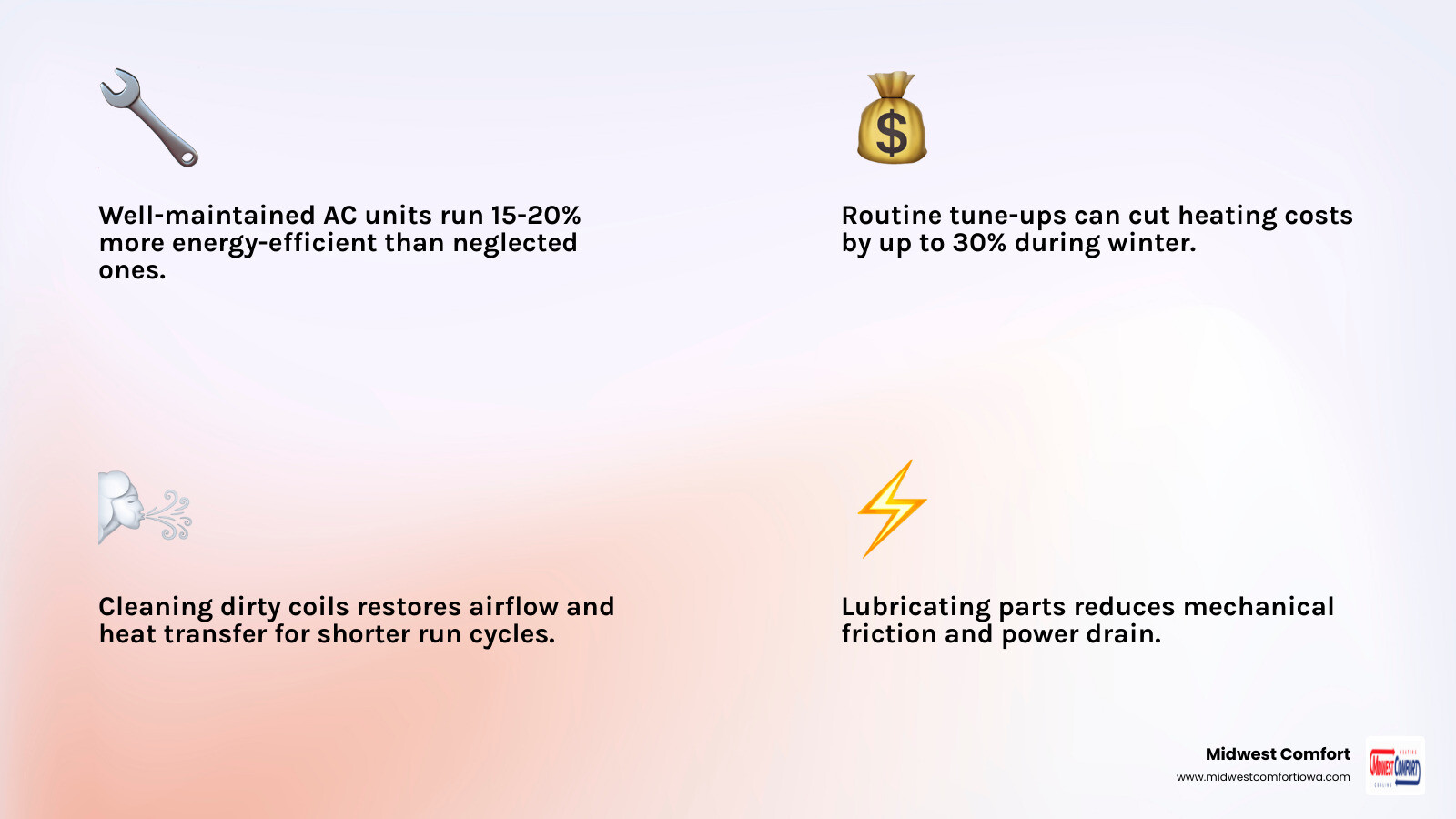
The bottom line: well-maintained AC units can be 15–20% more energy-efficient than neglected ones, and properly serviced furnaces can cut heating costs by up to 30%. For a typical Des Moines household running the heat hard through an Iowa winter, that's real money back in your pocket.
Think of it the way you think about your car. You wouldn't skip oil changes and expect the engine to keep running smoothly for years. Your HVAC system works the same way — skip the routine care, and efficiency quietly slips away while your bills quietly climb.
The good news is that a single professional tune-up, taking just one to two hours, can restore your system close to its original factory performance. That means you get the comfort you're paying for — without paying more than you should.
Understanding How a Tune Up Improves Efficiency and Lowers Bills
To really grasp the value of professional maintenance, we have to look under the hood. Most homeowners in places like Ankeny or Waukee don't think about their HVAC system until it stops working. However, the internal components are constantly battling elements that naturally degrade performance over time.
Dust is the primary enemy. When dust builds up on your evaporator coil, it acts as an unintended layer of insulation. In the summer, your AC needs to pull heat out of your indoor air. If the coil is coated in grime, that heat transfer is blocked. The system has to run longer cycles to reach the temperature you set on the thermostat. This extra runtime is exactly how a tune up improves efficiency and lowers bills; by removing that grime, we restore the system's ability to move heat quickly and efficiently.
Mechanical friction is another silent budget-killer. Motors and fans that aren't properly lubricated require more electricity to spin. It’s like trying to ride a bicycle with rusty chains—you have to peddle much harder to go the same speed. During a professional visit, we eliminate that resistance.
Why Professional HVAC Tune-Ups Matter because they address these invisible drains on your finances before they manifest as a total system failure.
| System Condition | Energy Efficiency Impact | Estimated Monthly Bill Impact | Lifespan Expectancy |
|---|---|---|---|
| Professionally Maintained | Peak (100% of Rated Efficiency) | Lowest possible for the unit | 15–20 Years |
| Neglected (3+ Years) | 15–20% Efficiency Loss | Significant Increase ($20–$50+ more) | 10–12 Years |
| Severe Neglect (Dirty Coils/Leaks) | 30%+ Efficiency Loss | Dramatic Spikes / Overheating | 7–10 Years |
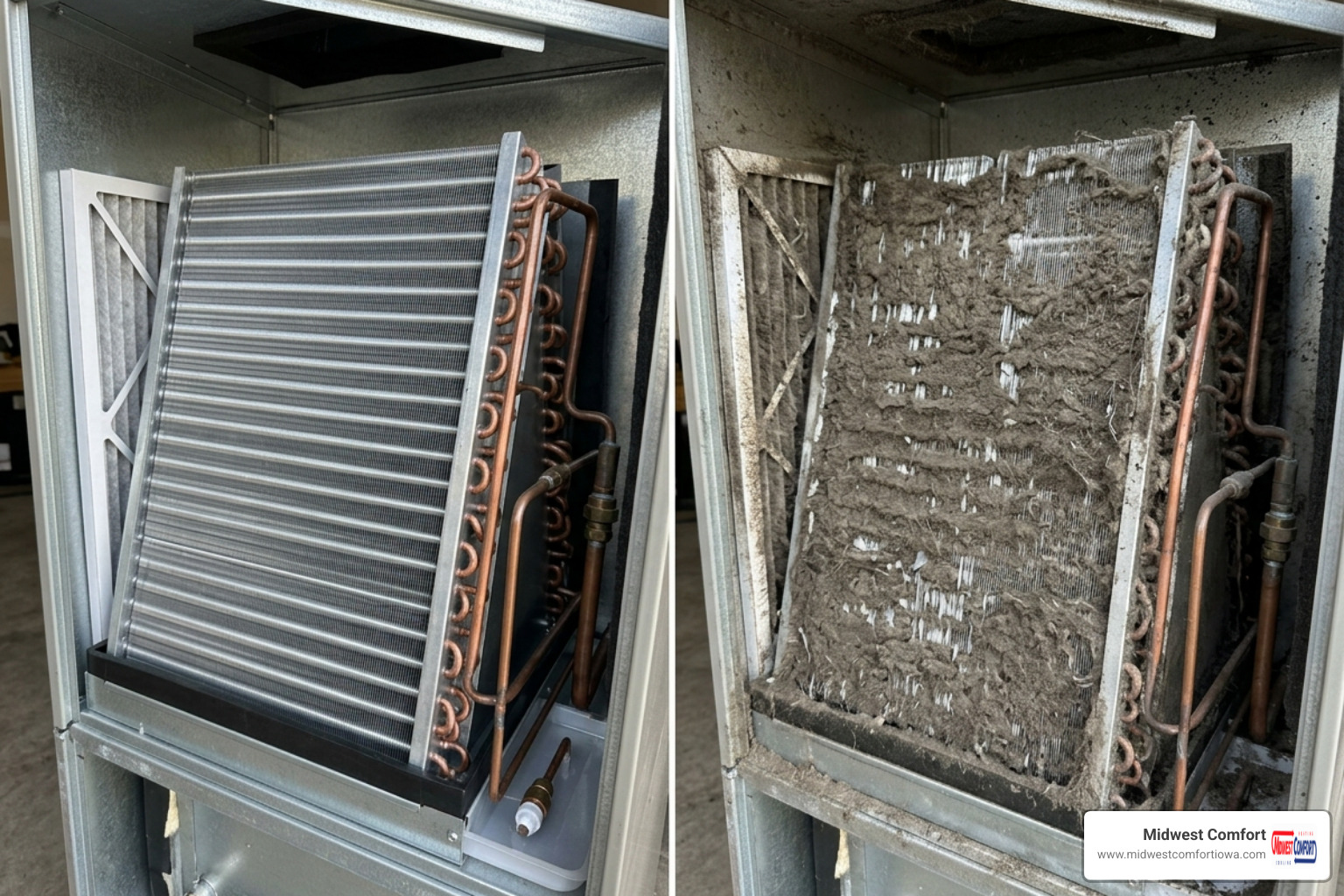
How a tune up improves efficiency and lowers bills by optimizing SEER performance
Every air conditioner comes with a SEER (Seasonal Energy Efficiency Ratio) rating. Think of this like the "miles per gallon" for your home’s cooling. When a unit is installed, it is designed to meet that rating under specific conditions. However, as filters clog and coils get dirty, that real-world SEER rating drops.
A system rated at 16 SEER might only be performing at the level of a 12 SEER unit if it hasn't been serviced in years. By performing a tune-up, we return the equipment to its "design conditions." This means we are essentially "tuning" the machine back to its factory specifications. This optimization ensures you aren't paying for 16 SEER technology while receiving 10 SEER performance.
How a tune up improves efficiency and lowers bills through precision calibration
Efficiency isn't just about the big metal box outside; it's also about the brain of the system—the thermostat. If your thermostat is out of calibration by even two or three degrees, your system may be running much longer than necessary.
Precision calibration ensures that when you ask for 72 degrees, the system delivers exactly that and then shuts off. We also check sensor responsiveness. In modern systems, sensors tell the control board when components are overheating or when airflow is restricted. If these sensors are sluggish or dirty, the system might "short cycle" (turning on and off too frequently). Short cycling is incredibly hard on electrical components and is one of the fastest ways to drive up a utility bill.
Mechanical Components and Performance Optimization
When we step into a home in Johnston or Clive, we follow a rigorous checklist. A professional tune-up is far more than just a "quick look." It is a mechanical deep-dive into the components that keep your family comfortable.
One of the most critical steps is checking refrigerant levels. An AC system that is "low on charge" is an energy hog. If the refrigerant is low, the remaining liquid has to work twice as hard to absorb heat, which can lead to the evaporator coil freezing over. Conversely, too much refrigerant can damage the compressor. Finding that "Goldilocks" zone of perfect pressure is a key part of our Guide to Air Conditioner Maintenance.
Restoring Airflow and Heat Transfer
Airflow is the lifeblood of your HVAC system. If the air can't move, the heat can't move. During a tune-up, we focus on several key areas to keep the air flowing freely:
- Blower Motor Cleaning: Dust on the blower blades reduces the amount of air the fan can push.
- Air Filter Inspection: While a simple task, a clogged filter can cut cooling energy use by up to 15% once replaced.
- Static Pressure Testing: We measure the "blood pressure" of your ducts to ensure there are no major blockages or leaks.
- Condenser Coil Power-Wash: We clear out the cottonwood, grass clippings, and dirt from the outdoor unit so it can breathe.
For our neighbors needing AC Maintenance Ankeny IA, we often find that simply clearing out the debris from a heavy Iowa spring can immediately drop the system's energy draw.
Safety Inspections and System Longevity
While efficiency is the focus for your wallet, safety is the focus for your family. This is especially true for furnaces. A cracked heat exchanger is a serious hazard that can lead to carbon monoxide leaks. Because CO is odorless and colorless, a professional inspection is the only reliable way to detect these cracks before they become dangerous.
Furthermore, tightening electrical connections prevents "pitting" and arcing, which can burn out expensive control boards. Regular maintenance also serves as a "shield" for your manufacturer's warranty. Most brands, like Bryant, require documented annual service to keep the warranty valid. If a major part fails in year seven, but you have no record of maintenance, the manufacturer may deny your claim. Our Furnace Tune-Up Des Moines Guide provides more detail on how these safety checks protect both your health and your investment.
Seasonal Timing for Central Iowa Homeowners
In the Midwest, we experience the full spectrum of weather—sometimes all in the same week! In April 2026, as we transition from the lingering Iowa cold snaps into the humid summer months, timing your maintenance is everything.
We recommend a biannual approach:
- Spring (March/April): Focus on the AC and heat pump to prepare for the first 90-degree day.
- Fall (September/October): Focus on the furnace to ensure it's ready for the sub-zero temperatures that always find their way to Des Moines.
Scheduling HVAC Maintenance Des Moines IA during these "shoulder seasons" ensures you aren't stuck waiting for a technician during the busiest weeks of the year when everyone else's system is breaking down.
Why Biannual Visits are Essential in April 2026
The Iowa climate is particularly harsh on outdoor machinery. High humidity in the summer puts a massive latent load on your AC, meaning it has to work extra hard just to remove moisture from the air. If your system is sluggish, your home will feel "sticky" even if the temperature is low.
By performing an AC Tune-Up Urbandale IA in the spring, we ensure the dehumidification process is working perfectly. This allows you to set your thermostat a few degrees higher while still feeling cool, which is another way how a tune up improves efficiency and lowers bills.
Protecting Your Manufacturer Warranty
Think of your HVAC warranty as an insurance policy you’ve already paid for. To keep that policy active, you must follow the "fine print," which almost always specifies annual professional maintenance. We provide a documented service history with every visit, giving you peace of mind that if a catastrophic failure occurs, you are covered. For those in the suburbs, Furnace Maintenance Urbandale IA is the best way to ensure your heating system stays under its protection plan for its entire 15-to-20-year lifespan.
Frequently Asked Questions about HVAC Efficiency
Can I perform an HVAC tune-up myself?
While we love a good DIY spirit, a full HVAC tune-up requires specialized tools that the average homeowner doesn't have in the garage. You can (and should!) change your air filters every 30 to 90 days and keep weeds and debris at least two feet away from your outdoor unit.
However, handling refrigerants requires federal EPA certification, and testing high-voltage electrical components or gas valves carries significant safety risks. A professional has the diagnostic equipment to see "inside" the system's performance in ways a visual check cannot. For comprehensive HVAC Maintenance Ankeny IA, it’s always best to let a trained technician handle the technical heavy lifting.
What are the signs that my system needs an immediate tune-up?
If it’s been more than a year, you’re already due! But keep an eye (and ear) out for these red flags:
- Unexplained Utility Spikes: If your bill is 20% higher than the same month last year without a major weather change.
- Frequent Cycling: The system turns on and off every few minutes.
- Strange Noises: Squealing, banging, or grinding sounds often indicate a failing belt or motor.
- Uneven Temperatures: One room is a freezer while the other is a sauna.
If you notice these, check out our Signs Your Furnace Needs Maintenance for a deeper troubleshooting look.
How long does a professional maintenance visit take?
A thorough, high-quality tune-up usually takes between one to two hours. We don't believe in "splash and dash" service. We take the time to clean the coils, test the capacitors, check the heat exchanger, and provide you with a full service report.
When you know What to Expect During Furnace Service, you can see why that time is necessary to ensure every safety and efficiency check is completed correctly.
Conclusion
At Midwest Comfort, we understand that your home is your sanctuary. As a family-owned business, we treat your HVAC system with the same care we give our own. We aren't just here to fix things when they break; we are here to ensure they run efficiently, safely, and affordably for as long as possible.
Whether you are in Des Moines, Polk City, or Norwalk, our goal is to provide honest, high-quality service that fits your family's needs. By understanding how a tune up improves efficiency and lowers bills, you're taking the first step toward a more comfortable and cost-effective home.
Don't wait for the first Iowa heatwave to find out your AC isn't up to the task. Schedule your seasonal tune-up with Midwest Comfort today and start saving on your energy bills immediately!
