


How Ductless Systems Save Energy with Zone Control


Discover the Essential Benefits of Regular Air Conditioning Maintenance
Regular maintenance of your air conditioning system ensures optimal performance and longevity. It helps prevent costly repairs while improving energy efficiency, keeping your home comfortable year-round.

Routine checks can significantly reduce energy bills and extend the life of your unit.


Why Understanding How Ductless Systems Save Energy with Zone Control Could Cut Your Iowa Energy Bills
How ductless systems save energy with zone control comes down to two straightforward ideas: they eliminate the energy wasted in leaky ductwork, and they let you heat or cool only the rooms you're actually using.
Here's a quick summary of how it works:
- No duct losses - Traditional ducted systems lose 20-30% of conditioned air before it ever reaches a room. Ductless systems have no ducts, so none of that energy is wasted.
- Zone-by-zone control - Each indoor unit conditions only the room it serves. Turn off zones in empty rooms and stop paying to heat or cool space no one is in.
- Inverter compressors - Variable-speed motors run continuously at the exact output needed, rather than blasting on and off at full power.
- Independent thermostats - Every zone has its own temperature setting, so a home office runs cool during the day while bedrooms stay off until evening.
- Result - Homeowners who switch from older ducted systems to a properly sized multi-zone ductless setup typically see heating and cooling energy drop by 20-40%.
If your Des Moines home has rooms that are always too hot or too cold, or if your energy bills seem high for the comfort you're getting, a ductless system with zone control is worth a serious look. The average household spends around $1,900 per year on energy, with roughly half going to heating and cooling alone. Cutting that by even 20% adds up fast.
The sections below walk through exactly how the technology works, how to size a system for your home, and what to expect from installation and maintenance.
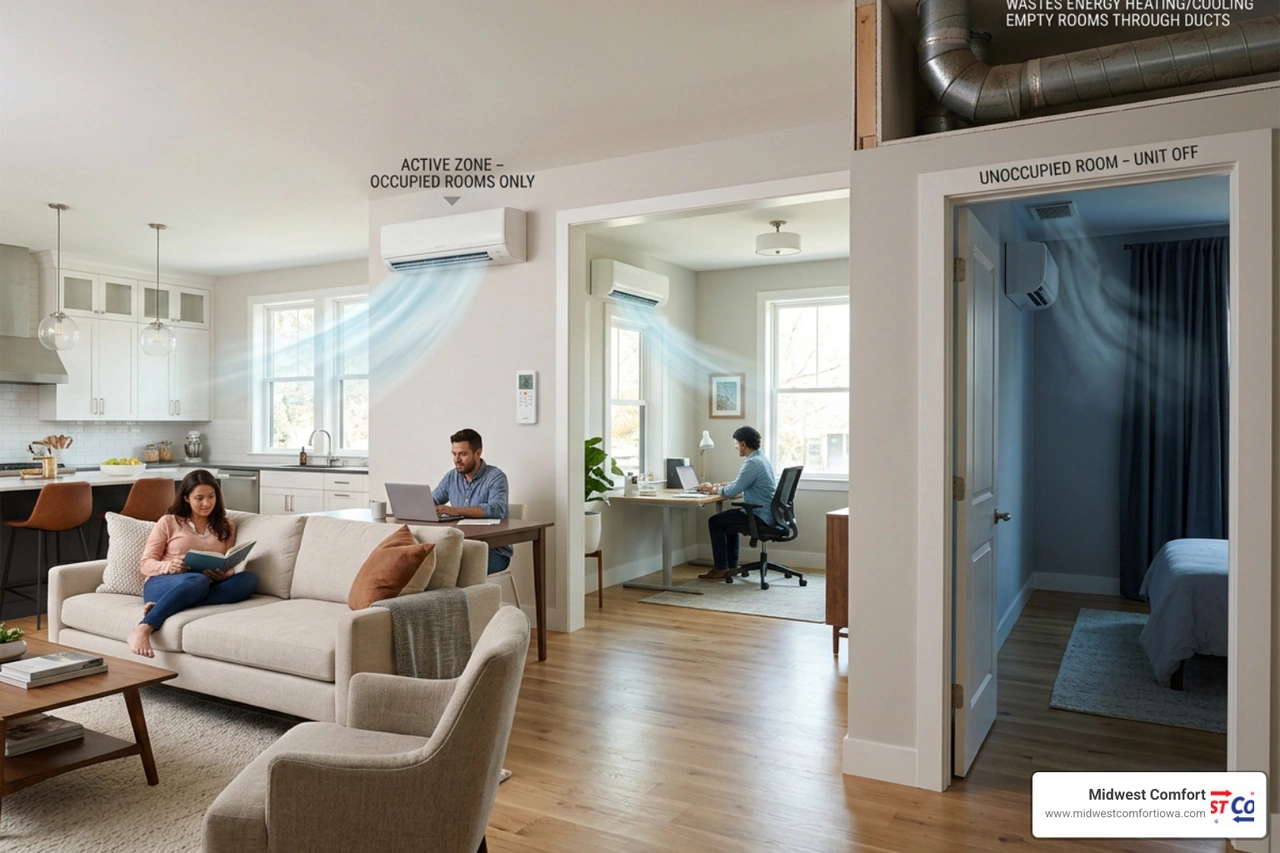
How ductless systems save energy with zone control terms to know:
- ductless mini split benefits for iowa homeowners
- how mini splits solve hot and cold spots in your home
Understanding Ductless HVAC vs. Traditional Systems
To understand why ductless mini-split systems are so efficient, it helps to look at how they differ from the traditional central HVAC systems found in many Des Moines homes.
A traditional ducted system relies on a single central air conditioner or furnace. This central unit creates heated or cooled air and then uses a powerful blower fan to force that air through a complex network of metal or flexible ducts running through your attic, basement, or crawlspaces. This is a "one-size-fits-all" approach. When the thermostat in your hallway calls for cooling, the central system turns on and sends conditioned air to every single register in the entire house, regardless of whether anyone is in those rooms.
A ductless mini-split system, on the other hand, is a type of heat pump that completely bypasses the need for ductwork. Instead of one massive central unit, a ductless system uses a slim outdoor condenser unit connected to one or more individual indoor air handlers. These indoor units are mounted directly on the wall, ceiling, or floor of the specific rooms you want to heat or cool.
Instead of moving air through bulky ducts, the outdoor and indoor units are connected by small copper lines containing refrigerant, along with power and control cables. These lines only require a small three-inch hole through the exterior wall. The indoor unit draws in air from the room, passes it directly over a cooling or heating coil, and blows it back out into the space.
Because ductless systems are heat pumps, they don't actually generate heat from scratch like an electric furnace or baseboard heater. Instead, they move heat from one place to another. In the summer, they absorb heat from inside your home and dump it outside. In the winter, they reverse the process, extracting heat from the cold outdoor air and transferring it indoors. This makes them incredibly efficient—often 30% to 50% more efficient than standard electric heating systems.
To learn more about how these configurations stack up against each other, you can read our detailed Central AC vs Ductless Mini Split Comparison.
Comparing Ducted and Ductless Systems
When evaluating these systems, there are several key practical differences to keep in mind:
- Noise Levels: Traditional central systems can be quite loud when they kick on, sending a rush of air through the vents and vibrating the ductwork. Ductless indoor air handlers are engineered for whisper-quiet operation. Many models operate at sound levels as low as 19 to 22 decibels—which is quieter than rustling leaves. The loudest components (the compressor and outdoor fan) are located entirely outside.
- Space Requirements: Central systems require substantial space for the indoor furnace or air handler, plus valuable attic, closet, or basement space for the duct network. Ductless systems take up zero floor space. The indoor units have a compact, space-saving design, and the outdoor condenser has a slim profile that can easily fit in narrow side yards or be mounted on exterior walls.
- Installation Complexity: Retrofitting a home with new ductwork is a major construction project that involves cutting into walls, ceilings, and closets. It can take weeks and cause significant disruption. Installing a ductless system is far simpler. Since it only requires a small wall penetration for the refrigerant lines, a professional team can often complete a multi-zone installation in just a day or two with minimal mess.
How Ductless Systems Save Energy with Zone Control
The secret weapon of ductless efficiency is zone control. In a traditional home, you have one thermostat that controls the temperature of the entire house. If your upstairs bedrooms are hot but your downstairs living room is cold, the central system will keep running to cool the upstairs, freezing out the downstairs in the process.
Ductless systems solve this by giving you independent control over different areas, or "zones," of your home. A single multi-zone outdoor condenser can connect to multiple indoor air handlers (typically between two and five, and sometimes up to eight). Each indoor unit is controlled by its own wireless remote, wall-mounted thermostat, or smartphone app.
This means you can set the temperature in your master bedroom to a cool 68°F for sleeping, keep an unused guest room at 78°F, and turn off the unit in your home office entirely when you finish working for the day. You are only conditioning the specific rooms you are using, which prevents massive amounts of energy waste. For a closer look at how this solves common comfort issues, read about How Mini Splits Solve Hot and Cold Spots in Your Home.
Eliminating the "Duct Tax": How Ductless Systems Save Energy with Zone Control
When you use a ducted system, you pay a mandatory "duct tax" to your utility company. According to the U.S. Department of Energy, typical ducted systems lose 20% to 30% of their conditioned air through leaks, cracks, and poorly sealed joints in the ductwork before it ever reaches your living spaces. In older homes, or homes with poorly maintained ducts, this distribution loss can rise to 40%.
Furthermore, ducts are often routed through unconditioned spaces like hot attics or freezing crawlspaces. In the summer, an attic can easily reach 140°F. As cold air travels through the metal ducts in that scorching attic, the air is warmed up by conduction before it blows out of your registers. Your AC has to work much harder just to overcome this heat gain.
By delivering conditioned air directly into the room from the indoor unit, ductless systems completely eliminate these distribution and conduction losses. Every single watt of energy you pay for goes directly into heating or cooling the air you actually feel.
Occupancy-Based Heating and Cooling: How Ductless Systems Save Energy with Zone Control
Think about how you use your home. You probably spend your daytime hours in the kitchen, living room, or home office, and your nighttime hours in the bedrooms. Yet, a central system continues to heat or cool all of those empty rooms all day and night.
With a zoned ductless system, you can practice occupancy-based climate control. By turning off units in unoccupied rooms or setting them to an energy-saving "eco-mode," you dramatically reduce your overall energy consumption. This level of customization ensures you enjoy premium comfort exactly where you are, without paying to condition empty air. For more tips on maximizing your home's layout, check out our guide on Mini Split AC Systems for Home Comfort.
Typical Energy Savings
So, what do these technological advantages translate to on your monthly utility bills? Homeowners who transition from older, inefficient ducted systems to properly sized multi-zone ductless setups typically see their heating and cooling energy consumption drop by 20% to 40%.
Because heating and cooling make up about half of the average household's utility costs, these savings accumulate quickly. To learn more about optimizing your home's overall efficiency in the Des Moines metro area, explore our resources on Energy Saving HVAC Des Moines.
| Efficiency Metric | Standard Central AC / Heat Pump | Ductless Mini-Split System |
|---|---|---|
| Cooling Efficiency (SEER2) | 14 to 20 | 20 to 30+ (Up to 35) |
| Heating Efficiency (HSPF2) | 7.5 to 9.5 | 10 to 12.5+ |
| Ductwork Energy Loss | 20% to 40% loss | 0% (No ducts) |
| Zoning Capability | Limited (Requires expensive dampers) | Built-in (Standard) |
The Technology Behind Zoned Efficiency: Inverters and Sensors
At the heart of a ductless system's efficiency is inverter-driven compressor technology. Traditional central air conditioners use single-stage compressors that operate on a simple "on/off" cycle. When the indoor temperature rises above your thermostat setting, the compressor turns on at 100% capacity, blasts cold air until the temperature drops, and then shuts completely off.
This constant cycling is incredibly inefficient. It is highly comparable to driving a car in stop-and-go city traffic, which burns far more fuel than cruising smoothly on the highway. Starting up an electric motor also requires a massive surge of electricity (known as an inrush current), which spikes your energy usage.
Inverter technology works more like a dimmer switch or cruise control. The variable-speed compressor continuously adjusts its speed to match the exact heating or cooling load of the home. If a room only needs a tiny amount of cooling to maintain its temperature, the compressor will ramp down to run at just 10% or 15% of its maximum capacity. It runs continuously at this ultra-low speed, consuming a fraction of the power and eliminating the frequent, energy-hungry start-up spikes.
Smart Sensors and Automation
Modern ductless systems also incorporate high-tech features to push energy efficiency even further. Many premium indoor units feature infrared motion detectors and occupancy sensors (such as 3D thermal scanning sensors).
These sensors actively scan the room to detect human presence. If you leave the room for an extended period, the system will automatically shift into an energy-saving eco-mode, letting the temperature drift slightly. As soon as you walk back in, the unit detects your presence and quickly ramps back up to your preferred comfort setting. Some sensors can even detect where people are standing in a room and direct the airflow either directly toward them for fast cooling or away from them to prevent drafts.
Sizing, Siting, and Selecting Your Multi-Zone System
To maximize the energy-saving benefits of zone control, a ductless system must be meticulously planned and sized. Sizing a ductless system is not a matter of guessing based on square footage. An experienced technician must perform a Manual J load calculation, which takes into account factors like wall insulation values, window orientation, ceiling heights, local climate design temperatures, and internal heat gains from appliances and occupants.
Sizing each individual indoor unit correctly is vital. If an indoor unit is oversized for the room it serves, it will cool the space too quickly, leading to short-cycling, poor humidity control, and increased wear and tear. If it is undersized, it will run constantly at maximum speed, wasting energy and failing to keep you comfortable.
Additionally, the total capacity of the indoor units must be properly matched to the capacity of the outdoor condenser. This matching is verified using the Air-Conditioning, Heating, and Refrigeration Institute (AHRI) directory to ensure the combined system operates at its peak rated efficiency.
Single-Zone vs. Multi-Zone Configurations
When planning your system, you will choose between single-zone and multi-zone setups:
- Single-Zone Systems: Consist of one outdoor condenser connected to one indoor air handler. These are ideal for targeted comfort in a specific problem area, such as a new sunroom addition, a finished basement, or a garage workshop.
- Multi-Zone Systems: Connect a single, larger outdoor condenser to multiple indoor units throughout the home. This allows you to create a comprehensive, whole-home comfort solution.
If you are replacing an older system in Waukee, our Ductless Replacement Waukee Guide can help you weigh your options.
Determining the Right Number of Zones
The ideal number of zones depends entirely on your home's layout, architectural style, and how you use your living spaces.
For example, a standard two-story home might be divided into three or four zones: one for the main open-concept living and kitchen area downstairs, and separate zones for each of the main bedrooms upstairs. This allows you to keep the downstairs units off at night while only conditioning the bedrooms where you are sleeping. A professional HVAC partner can help you map out these zones to align with your daily routines.
Cold-Climate Performance and Ratings
Because we experience freezing winters here in Iowa, choosing a system with excellent cold-climate performance is essential. When shopping for a ductless heat pump, look for the following efficiency ratings:
- SEER2 (Seasonal Energy Efficiency Ratio 2): Measures cooling efficiency. Look for ratings of 20 to 30+ for maximum energy savings.
- HSPF2 (Heating Seasonal Performance Factor 2): Measures heating efficiency. Look for a rating of 10 or higher.
Standard heat pumps can lose capacity as the outdoor temperature drops, occasionally requiring a backup heating source. However, specialized cold-climate heat pumps are designed to operate at 100% heating capacity in temperatures well below freezing, and some can continue extracting heat from outdoor air down to -15°F or colder. This reliable performance eliminates the need for expensive backup heating systems in many homes.
Air Filtration and Dehumidification Dynamics
Ductless systems do more than just control temperature; they also play a major role in managing indoor air quality and humidity.
During the hot, humid Iowa summers, moisture control is crucial for comfort. Traditional air conditioners dehumidify by cooling the air until moisture condenses on the indoor coil. However, because they cycle on and off rapidly, they often fail to remove enough humidity, leaving your home feeling damp and clammy.
Ductless units, with their continuous inverter operation, keep the indoor coil cold for longer periods, allowing them to extract moisture from the air much more effectively. Most units also feature a dedicated "dry mode," which prioritizes moisture removal without over-cooling your home.
Additionally, because ductless systems do not blow air through dusty, dirty ductwork, they prevent the spread of allergens, dust, and pet dander. Each indoor unit contains its own multi-stage filtration system, which can include enzyme and carbon filters to trap microscopic particles and neutralize odors. To understand how proper airflow and ventilation tie into home efficiency, read about Energy Efficiency Through Ventilation.
Maintenance Practices for Peak Zoned Efficiency
While ductless systems are incredibly reliable, they do require regular maintenance to keep running at peak efficiency. Fortunately, the most important maintenance task is simple enough for any homeowner to handle: cleaning the indoor air filters.
Unlike central systems that use disposable paper filters replaced every few months, ductless units feature reusable, washable mesh filters. Because these units pull air directly from the room, these filters can accumulate dust and pet hair relatively quickly. We recommend checking and washing these filters every two to four weeks during periods of heavy use. Simply pop open the front panel of the indoor unit, slide the filters out, rinse them under warm tap water, let them air dry completely, and slide them back in. Keeping these filters clean ensures unrestricted airflow, which keeps your energy bills low and protects the indoor motor.
For deeper maintenance, such as cleaning the indoor evaporator coils, checking refrigerant levels, and flushing the condensate drain lines, you should schedule professional service once or twice a year. If you live in Windsor Heights, check out our Mini Split Service Windsor Heights Guide for expert tips on keeping your system in top-tier shape.
Whole-Home Comfort vs. Targeted Additions
Ductless systems are incredibly versatile. They are highly popular as targeted comfort solutions for specific areas that your central HVAC system struggles to reach. This includes finished basements, converted garages, attic guest suites, or home additions.
However, they are also outstanding as whole-home heating and cooling solutions. This is particularly true for older or historic homes in the Des Moines area that were built before the advent of central air and rely on radiator heat or baseboard heaters. Installing ductwork in these homes can be nearly impossible without destroying historic plaster walls and sacrificing ceiling height. A multi-zone ductless system provides modern, highly efficient climate control while preserving the architectural integrity of your home. If you are located in Johnston, read more about local options in our Ductless System Johnston guide.
Installation Best Practices and Pitfalls
A ductless system is only as efficient as its installation. Because these systems rely on precise refrigerant charges and high-pressure lines, proper installation requires specialized tools and expertise.
Common installation pitfalls include poorly made flare joints, which can lead to slow refrigerant leaks over time. A leak not only hurts the system's cooling and heating capacity but also forces the compressor to work harder, driving up your energy bills and potentially leading to system failure.
During a professional installation, technicians will perform a nitrogen pressure test to ensure all joints are completely airtight, followed by a vacuum pull to remove all moisture and non-condensable gases from the lines before charging the system with refrigerant. If you are in Polk City, discover how to ensure a flawless setup by reading our guide on Ductless Installation Polk City.
Is a Zoned Ductless System Right for Your Home?
To determine if a zoned ductless system is the right choice for your home, ask yourself the following questions:
- Do you have rooms in your home that are consistently too hot in the summer or too cold in the winter?
- Are you currently paying to heat or cool large areas of your home that are rarely used?
- Does your home lack existing ductwork, or are your current ducts old, leaky, and difficult to access for repairs?
- Are you planning a home addition, basement remodel, or garage conversion?
- Are you looking for a whisper-quiet system that allows everyone in your household to set their own preferred temperature?
If you answered yes to any of these questions, a zoned ductless system could be an excellent investment for your comfort and your wallet. For a deeper dive, take a look at our article on Ductless Mini Split Benefits for Iowa Homeowners.
Frequently Asked Questions about Ductless Zone Control
Can I heat one zone while cooling another with a multi-zone system?
In standard residential multi-zone setups, all indoor units connected to a single outdoor compressor must operate in the same general mode—either all heating or all cooling. You cannot have one bedroom cooling while the living room is heating. However, you can absolutely have some units running while others are turned completely off, which is where the primary energy savings come from.
How many zones do I need for a standard 1,500 square foot home?
For a typical 1,500-square-foot home with three bedrooms and an open living area, three to four zones are usually ideal. This typically includes one larger unit for the main living/kitchen space and smaller, individual units for each of the bedrooms. A professional load calculation will help determine the exact configuration.
How often do ductless filters need to be cleaned?
To maintain optimal airflow and energy efficiency, you should check and clean the reusable mesh filters in your indoor units every two to four weeks. If you have pets or live in a dusty area, you may need to clean them more frequently.
Conclusion
When it comes to keeping your home comfortable through hot Iowa summers and freezing winters, you shouldn't have to choose between premium comfort and low energy bills. By eliminating the energy losses of leaky ductwork and allowing you to condition only the rooms you are actively using, a zoned ductless system offers the ultimate combination of efficiency, customization, and whisper-quiet performance.
At Midwest Comfort, we are proud to be a family-owned, local HVAC provider serving Des Moines, Ankeny, Waukee, Polk City, Windsor Heights, Johnston, and the surrounding communities. We bring a warm, family-oriented approach to every job, offering tailored comfort solutions, loyalty programs, and flexible payment options to fit your family's needs.
Ready to take control of your home comfort and start saving on your energy bills? Schedule your professional mini-split installation with Midwest Comfort in Ankeny today, and let our family take care of yours!


Get Your HVAC Serviced Today


