
Why Knowing How Hail and Severe Storms Affect Your Outdoor Unit Could Save You Thousands
How hail and severe storms affect your outdoor unit comes down to a few key threats — and knowing them can help you act fast before small damage becomes a major repair bill.
Quick answer: Here's what severe storms do to your outdoor AC unit:
| Storm Type | What It Damages | Result |
|---|---|---|
| Hail | Aluminum condenser fins, coils, fan blades | Reduced airflow, lost efficiency, refrigerant leaks |
| High winds & debris | Fan blades, coil fins, housing | Bent or broken components, blocked airflow |
| Heavy rain & flooding | Electrical components, control board, capacitor | Short circuits, corrosion, system failure |
| Lightning & power surges | Control board, compressor, thermostat | Immediate component failure or premature burnout |
Every spring and summer, Des Moines homeowners deal with some of the most punishing storm weather in the Midwest — and your outdoor AC unit sits right in the middle of it. Hail, high winds, flooding, and lightning don't just damage roofs and cars. They quietly take a toll on the condenser sitting in your backyard, often in ways you won't notice until your system stops cooling on the hottest day of the year.
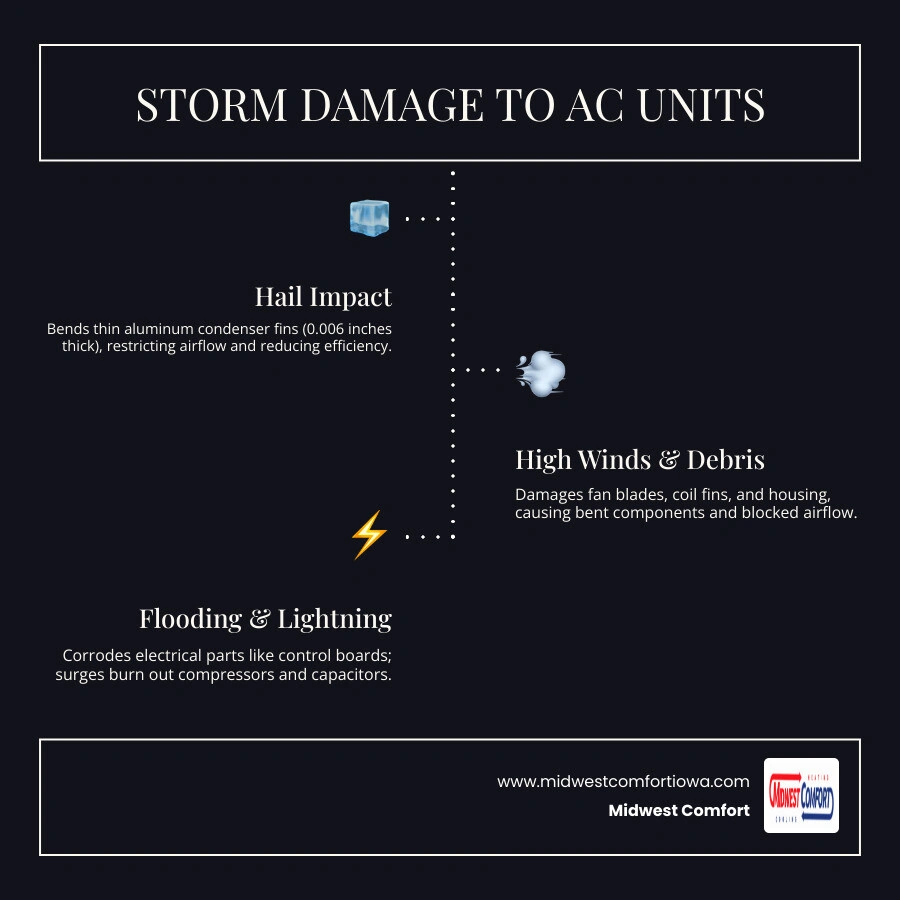
The National Weather Service estimates that hailstorms occur roughly 7,000 times per year across the country. The aluminum fins that line your condenser coil are only about 0.006 inches thick — about as fragile as aluminum foil — making them especially vulnerable. A single bad storm can bend those fins, restrict airflow, and quietly start driving up your energy bills month after month.
This guide walks you through exactly what storm damage looks like, what to do right after a storm, and how to protect your system before the next one rolls in.
Identifying the Threats: What Severe Weather Can Damage Your HVAC?
In April 2026, as we move through another active storm season in Central Iowa, it is important to recognize that "severe weather" isn't a single thing. Different elements of a storm attack your outdoor unit in different ways.
- Heavy Rain and Flash Flooding: While modern AC units are built to handle rain, they aren't designed to be submarines. If your yard has poor drainage, standing water can seep into the base pan. This leads to rust, corrosion, and, in severe cases, the destruction of electrical components like the contactor or control board.
- Lightning Strikes and Power Surges: A direct strike is rare, but a nearby strike can send thousands of volts through utility lines. This surge can fry sensitive circuitry in an instant.
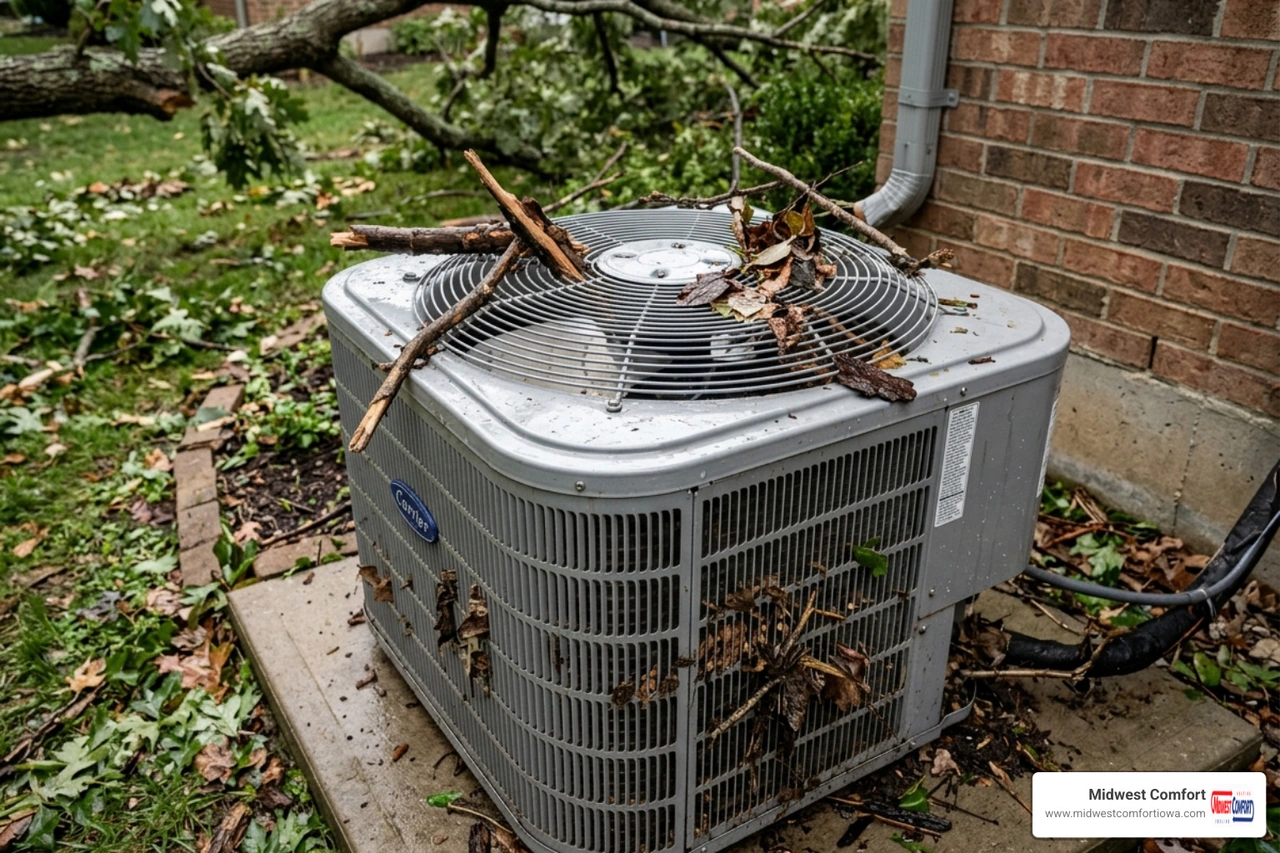
- High Winds and Flying Debris: Spring wind gusts in Des Moines can exceed 60 miles per hour. These winds turn backyard items—like mulch, branches, or loose garden tools—into projectiles.
- Flying Debris: When debris gets lodged inside the unit, it can jam the fan motor or bend the fan blades. If the fan is obstructed and tries to start, the motor can burn out in minutes due to excess amperage.
Regular HVAC Maintenance Des Moines is the best way to ensure your unit is structurally sound and properly positioned to withstand these threats.
How Hail and Severe Storms Affect Your Outdoor Unit
The most frequent culprit for HVAC damage in the Midwest is hail. To understand how hail and severe storms affect your outdoor unit, you have to look at the "skin" of the machine: the condenser coil and its aluminum fins.
These fins are responsible for dissipating heat. Because they need to transfer heat quickly, they are incredibly thin—about 0.006 inches. When hailstones, which can range from the size of a pea to a golf ball, strike these fins, they flatten them instantly. This isn't just a cosmetic issue; it's a functional failure. Flattened fins block the airflow required for the unit to "breathe," forcing the entire system to work harder to cool your home.
If you suspect your unit has taken a hit, scheduling AC Maintenance Urbandale can help identify if the damage is minor or if it requires a more serious intervention.
Understanding how hail and severe storms affect your outdoor unit's efficiency
The impact on your wallet is often felt long before the machine actually breaks down. When fins are bent, the heat transfer process is inhibited. This leads to a massive drop in efficiency.
| Damage Level | Measurement | Impact on Unit |
|---|---|---|
| Minor | Surface scuffs, tiny dings | Negligible impact on immediate cooling. |
| Moderate | Fins bent > 1/8 inch deep; up to 30% surface area covered | Efficiency loss up to 15%; noticeable increase in run time. |
| Severe | Indentations 1/4 to 3/8 inch deep; > 30% surface area covered | Efficiency loss up to 30%; $30-$50 monthly increase in energy costs. |
Blocking airflow doesn't just make the unit run longer; it makes it run hotter. A compressor's internal temperature can rise from a normal 120°F to over 200°F in just minutes when airflow is restricted. This heat is the "silent killer" of HVAC systems. A routine AC Tune-Up Urbandale can help catch these efficiency drops early.
Long-term risks of how hail and severe storms affect your outdoor unit
If you ignore the damage because the air is still "blowing cold," you are likely shortening the lifespan of your system. The long-term consequences include:
- Refrigerant Leaks: Hail impact can stress the copper refrigerant lines and brazed joints. Over time, these stresses turn into slow leaks.
- Oil Starvation: If the unit is forced to run at extreme temperatures, the oil that lubricates the compressor can break down or fail to return properly, leading to a catastrophic "seized" compressor.
- Premature Failure: A system designed to last 15 to 20 years might fail in 10 if it is constantly fighting restricted airflow and overheating.
Preventing these issues requires a commitment to Annual Maintenance Johnston to ensure the system is operating within manufacturer specifications.
Immediate Steps to Take After a Storm Hits Des Moines
Once the clouds clear over Polk County, your first priority is safety. Never approach an outdoor unit if there is standing water around it or if you see downed power lines.
- Turn Off the Power: If you suspect damage, go to your electrical panel and flip the circuit breaker for the AC to "off." This prevents the unit from trying to start with a jammed fan or shorted wires.
- Visual Inspection: From a safe distance, look for obvious signs of trouble. Are there large dents in the top? Are the side fins flattened? Is there a pile of branches or mulch inside the unit?
- Document Everything: Take clear photos and videos from multiple angles. This is crucial for insurance purposes.
- Check the Thermostat: Does it have power? Is it displaying an error code?
- Call the Pros: If you see "hail pings" or the unit makes a new rattling or grinding sound, it’s time for a professional assessment.
Getting a quick HVAC Maintenance Ankeny check-up after a major weather event can prevent a small electrical glitch from turning into a total system replacement.
Proactive Strategies to Shield Your HVAC System
You don't have to be a victim of the next Iowa storm. There are several ways to "harden" your home's comfort system:
- Professional Hail Guards: These are heavy-duty metal screens designed to take the impact of ice while still allowing for the 2,500 to 3,000 cubic feet per minute of airflow your unit needs. They typically cost much less than a full coil replacement.
- Surge Protection: We recommend installing a dedicated HVAC surge protector at the outdoor disconnect box. This acts as a localized "firewall" for your compressor and control board.
- The 2-Foot Rule: Keep at least two feet of clear space around your unit. Trim back shrubs and remove loose yard decorations that could become flying debris.
- Strategic Landscaping: Planting tall, dense evergreens about three feet away can act as a natural windbreak, but ensure they don't block access for technicians.
If you have a heat pump, Heat Pump Maintenance Urbandale is even more critical, as these units sit lower to the ground and have more sensitive reversing valves that can be damaged by debris or flooding.
Navigating Insurance Claims for Storm-Damaged AC Units
Many homeowners in Des Moines and surrounding areas like Grimes and Clive don't realize that storm damage to an HVAC unit is typically covered under a standard homeowner's insurance policy. However, the clock is ticking.
The Texas Department of Insurance—and many local Iowa providers follow similar logic—often requires claims to be filed within 90 days of the storm. To make your claim successful:
- Provide Professional Proof: Insurance adjusters are great at roofs, but they aren't HVAC experts. A written report from a licensed technician explaining how the damage affects the unit’s performance is your strongest evidence.
- Don't Settle for "Combing": Some adjusters may suggest "combing" out the fins. While this can help minor damage, it never restores the unit to 100% efficiency. For units under warranty, manufacturers often require a full coil replacement to keep the warranty valid.
- Check Your Deductible: Be aware of whether you have a separate hail deductible.
While you're looking at the AC, don't forget to have your indoor system checked too; Furnace Maintenance Urbandale is a good time to ensure no water intrusion affected your indoor furnace or ductwork during the heavy rains.
Frequently Asked Questions about Storm Damage
Should I turn off my AC during a severe storm?
Yes. If the storm includes frequent lightning or high winds, it is safer to turn the system off at the thermostat. This protects the compressor from power surges and prevents the fan motor from burning out if debris gets lodged in the blades while it's running.
Does homeowner's insurance cover hail damage to my AC?
In most cases, yes. Because the outdoor unit is considered a permanent part of the home's structure, hail damage is typically a covered peril. Always document the date of the storm and take photos immediately.
Can I straighten bent AC fins myself?
While "fin combs" are sold at hardware stores, we don't recommend DIY straightening for moderate to severe damage. The aluminum is incredibly fragile; one wrong move can puncture the underlying refrigerant tubes, turning a simple airflow problem into an expensive refrigerant leak.
Conclusion
At Midwest Comfort, we know that your home is your sanctuary. As a family-owned business serving the greater Des Moines area—from Ankeny and Johnston to Waukee and Norwalk—we’ve seen how hail and severe storms affect your outdoor unit. We pride ourselves on providing honest, high-quality, and cost-effective solutions tailored to your family's needs.
Don't wait for the first 90-degree day to find out your AC was a casualty of a spring storm. Whether you need a routine HVAC Maintenance Urbandale visit or a detailed damage assessment for an insurance claim, our team is here to help.
Schedule your professional storm damage inspection today and keep your family comfortable all summer long.
