
The Reality of Late-Summer RTU Failures in the Downtown Grid
Your commercial rooftop unit is running nonstop, but the upper floors of your building still feel uncomfortably warm. Understanding exactly how we handle emergency commercial AC failures in downtown Des Moines is critical when a sudden breakdown threatens your facility's operations. At Midwest Comfort Heating & Cooling, we know firsthand that a catastrophic commercial rooftop unit (RTU) failure doesn't just cause temporary discomfort—it immediately jeopardizes business continuity, tenant safety, and facility compliance.
To navigate these high-stakes emergencies, facility managers need a reliable partner for commercial HVAC services. The extreme stress placed on commercial cooling equipment as summer peaks often leads to sudden, irreversible breakdowns. Intense, humid heat waves in late August push aging commercial HVAC equipment to the breaking point. When a unit fails under this immense load, our technicians frequently see the indoor temperature of a large commercial footprint rise to dangerous levels within hours.
Successfully resolving a downtown RTU failure requires a highly specific methodology. It demands far more than basic technical repair skills. Restoring cooling to a high-rise or a sprawling commercial complex involves a mastery of urban logistics, strict safety protocols, and rapid decision-making. Here is our first-person methodology—honed over years of serving Des Moines businesses—for tackling these intense, end-of-season emergencies and getting your building back online safely.
Rapid Triage: Diagnosing Catastrophic Failures Under Pressure
When a commercial cooling system fails during a heat wave, the clock starts ticking immediately. Immediate dispatch and rapid on-site assessment are essential to mitigate tenant discomfort and protect sensitive equipment inside the building. Just last August, our dispatch team received a frantic call from a local facility manager on the hottest day of the summer when their building's air conditioner went out completely. One of our lead technicians arrived by late morning and had the immediate system issue repaired within an hour. While not every catastrophic failure can be fixed that quickly, our rapid triage process dictates the next critical steps.
The Problem: A sudden loss of cooling usually triggers alarms for facility managers, especially when outdoor temperatures are soaring. The immediate symptom is a rapid rise in indoor humidity and temperature, often accompanied by unusual noises from the roof or tripped electrical breakers.
The Cause: During late August end-of-season cooling stress, commercial systems run continuously at maximum capacity. In our experience, this relentless operation can cause contactors to weld shut, motors to overheat, or compressors to suffer catastrophic internal damage.
The Solution: Our technicians perform a systematic diagnostic protocol to determine the exact point of failure. We measure electrical draw, check refrigerant pressures, and inspect the physical integrity of the compressor. Clear, transparent communication with facility managers regarding timelines and next steps begins the moment we complete this assessment.
Assessing End-of-Season Compressor Fatigue
Identifying signs of irreversible damage caused by continuous high-load operation is the most critical part of the triage phase. If a compressor has suffered a terminal mechanical failure, we must evaluate the safety and viability of temporary cooling measures while planning a full replacement. Over countless commercial service calls, our team has developed a strict decision-making matrix to determine if an aging RTU can be repaired under emergency conditions or if it requires full replacement. If you need emergency AC repair and replacement, this assessment ensures you make the most operationally sound decision.
| Assessment Factor | Indicators for Repair | Indicators for Replacement |
|---|---|---|
| Equipment Age | Under 10 years old with a solid maintenance history. | Over 15 years old, facing late August end-of-season cooling stress. |
| Damage Extent | Isolated electrical issue (e.g., blown fuses, bad contactor). | Catastrophic compressor failure, severe coil leaks, or grounded motors. |
| Part Availability | OEM parts are stocked locally and immediately available. | Obsolete parts requiring weeks of lead time during peak season. |
| Refrigerant Type | System uses current, environmentally compliant refrigerants. | System relies on phased-out refrigerants (like R-22). |
Why Downtown Des Moines HVAC Replacement is 80% Urban Logistics
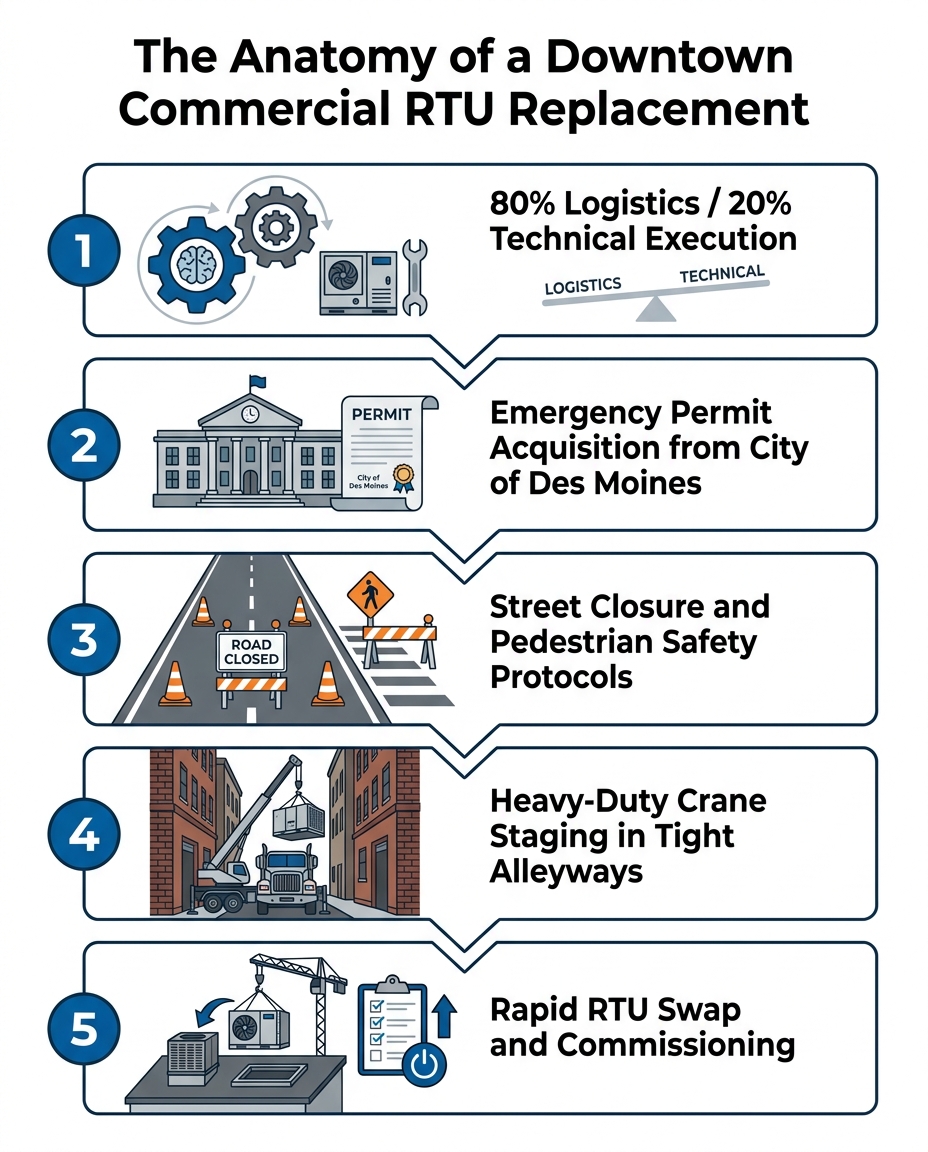
Replacing a commercial RTU in a suburban strip mall is a relatively straightforward technical task. However, executing that same replacement in the urban core is primarily a logistical challenge. In fact, our crews often say that downtown commercial HVAC replacement is roughly 80% urban logistics and 20% technical installation. The physical environment dictates every move we make.
Downtown Des Moines tight-alley commercial districts present specific, unavoidable obstacles. The city's infrastructure includes a complex network of one-way streets, pedestrian skywalks, and highly restricted staging areas. You cannot simply park a standard service truck next to a high-rise and hoist a 3,000-pound unit onto the roof. These environments require specialized heavy-duty cranes, extensive rigging equipment, and a highly coordinated ground crew.
This is where Midwest Comfort Heating & Cooling's established history with complex downtown logistics and tight-alley access becomes your greatest asset. We understand the turning radiuses required for massive crane trucks. We know which alleys can support heavy outriggers and which cannot. We map out the exact path the crane boom must take to avoid power lines, skywalks, and neighboring structures.
Working with a trusted AC company in Des Moines means partnering with a team that already knows how to navigate these municipal hurdles. Our deep local knowledge prevents administrative delays and logistical missteps that could otherwise lead to days of extended facility closure. We handle the heavy lifting—both literally and administratively—so your building can return to normal operations.
Securing Permits and Navigating City Right-of-Ways
Before a crane ever arrives on site, a mountain of administrative protocol must be cleared. In our years of navigating Des Moines municipal codes, we've mastered the administrative protocol required for a safe, legal, and compliant RTU replacement.
- Emergency Permit Acquisition: We immediately contact the City of Des Moines Permit and Development Center to secure emergency crane permits. Standard permits can take weeks, but our established relationships with local authorities help expedite this process during critical failures.
- Right-of-Way Approvals: Staging a crane in Downtown Des Moines tight-alley commercial districts almost always requires municipal right-of-way usage. We file for the necessary temporary street, alley, or lane closures.
- Traffic and Pedestrian Management: We design and implement strict safety protocols for vehicular and pedestrian traffic. This includes setting up approved barricades, scheduling flaggers, and ensuring clear perimeters around the drop zone.
- Structural Verification: We confirm that the existing roof curb and structural supports meet current building codes and can safely bear the weight of the new, often larger, high-efficiency equipment.
Coordinating with Municipal Authorities
Navigating the specific requirements for emergency street closures is not something a facility manager should have to handle while dealing with a hot building. We take the lead on all municipal coordination. Ensuring all ASHRAE standards and local municipal safety guidelines are strictly followed protects your facility from liability and ensures the physical safety of everyone in the vicinity.

Executing the Crane Lift: Safety Protocols and Tight-Alley Navigation
The physical execution of the replacement is a highly choreographed event. Staging heavy equipment in confined urban spaces requires absolute precision. For our crews at Midwest Comfort, coordinating high-rise crane operations and executing them with minimal downtime is a core part of our service. The crane operator, the ground crew, and our rooftop technicians maintain constant radio contact throughout the entire process.
The Staging Process: Once the street or alley is secured, the crane is positioned and stabilized using heavy outriggers. In Downtown Des Moines tight-alley commercial districts, there is zero margin for error. The crane must be perfectly leveled before the boom is extended.
The Extraction: The failed RTU is safely disconnected from the building's electrical and ductwork systems. Our rigging team secures the unit, and the crane carefully lifts it away from the building envelope. We take extreme care to ensure the roof membrane is not damaged during this extraction.
The Installation: The new unit is hoisted into the air. Rooftop technicians guide the crane operator using precise hand signals and radio commands to lower the new RTU perfectly onto the existing roof curb or a newly installed curb adapter. A perfect seal is established to prevent future water intrusion and air leaks.
Minimizing Tenant Disruption
Strategic scheduling of the lift is vital to avoid peak business hours whenever possible. We often execute these lifts early in the morning or during weekends to minimize noise and disruption to the building's tenants. Maintaining clear communication with facility managers throughout the physical installation ensures that building occupants are kept informed and safe while the heavy machinery is in operation.
Protecting Your Investment After an Emergency Installation
Once the new unit is physically set on the roof, our technical work begins. We execute a rigorous post-installation commissioning process to ensure the new RTU operates at peak efficiency. This involves connecting the high-voltage electrical lines, tying in the low-voltage control wires, and sealing the ductwork connections. We then power on the unit, verify proper airflow, check refrigerant charge, and ensure the thermostat is communicating correctly with the new system. As an added benefit, upgrading to a high-efficiency system often means federal tax credits or local utility incentive programs may apply to qualifying installations (we always advise readers to verify current programs with their utility or a tax professional).
After surviving a catastrophic failure during late August end-of-season cooling stress, the focus must shift from reactive emergency response to proactive system management. You do not want to repeat this stressful process next summer. Regular, scheduled inspections mitigate the risk of sudden breakdowns during peak cooling seasons.
Key Post-Installation Steps We Perform:
- Airflow Balancing: Ensuring conditioned air reaches all zones of the commercial space evenly.
- Sensor Calibration: Verifying that economizers and CO2 sensors are functioning to code.
- Vibration Testing: Checking that the new unit operates smoothly without transferring noise into the building.
- Documentation: Providing the facility manager with all warranty information, baseline operating metrics, and compliance paperwork.
Transitioning to a structured maintenance approach protects this massive capital investment. Enrolling in a proactive HVAC maintenance plan ensures that our trained technicians are regularly monitoring your system's health, cleaning the coils, and replacing filters before minor wear and tear escalates into another major emergency.
Frequently Asked Questions About Commercial AC Emergencies
What is the process for an emergency commercial HVAC replacement?
The process begins with our rapid triage to confirm the unit cannot be repaired. From there, we immediately source a replacement unit, secure emergency crane permits from the city, and arrange for street or alley closures. Once logistics are approved, we stage the crane, extract the old unit, set the new RTU, and perform a full system commissioning.
How are rooftop AC units replaced in downtown areas?
Replacing units in urban cores requires specialized heavy-duty cranes and strict municipal coordination. Because Downtown Des Moines tight-alley commercial districts lack open staging areas, our team must carefully navigate one-way streets and secure right-of-way permits to safely hoist the equipment over the building envelope.
How long does it take to replace a commercial rooftop AC unit?
While the physical crane lift and installation can often be completed by our crews in a single day, the overall timeline depends heavily on logistics. Securing the necessary municipal permits, coordinating street closures, and sourcing the exact commercial unit can add several days to the process, which is why rapid initial assessment is so critical.
Do you need a permit to replace a commercial HVAC unit in Des Moines?
Yes, replacing a commercial unit requires multiple permits. You need mechanical permits for the HVAC work itself, as well as specific right-of-way and crane permits from the City of Des Moines Permit and Development Center to legally stage heavy equipment on city streets or alleys.
How do you lift an AC unit to a commercial roof?
We use heavy-duty mobile cranes operated by certified professionals. The existing unit is disconnected, rigged with heavy-duty straps, and lifted off the roof curb; the new unit is then rigged, hoisted into the air, and carefully guided into place by our rooftop technicians using radio communication.
What steps can facility managers take to prevent end-of-season RTU failures?
The best prevention is a strict, proactive maintenance schedule. Facility managers should ensure coils are cleaned, electrical connections are tightened, and moving parts are lubricated before the late August end-of-season cooling stress pushes aging components to their breaking point.
Restore Your Building's Comfort with Minimal Disruption
Handling a catastrophic RTU failure in an urban environment requires a team that masters both technical HVAC skills and complex urban logistics. When your system fails during late August end-of-season cooling stress, you need immediate action, clear communication, and a flawless safety record.
At Midwest Comfort Heating & Cooling, we understand the pressure facility managers face when a building loses cooling. Our established protocols ensure your emergency will be handled safely, legally, and efficiently, minimizing downtime and protecting your tenants. If your commercial rooftop units are struggling to keep up, or if you need to establish a reliable emergency response protocol for your facility, reach out to our team today to secure your building's comfort and compliance.
