
How Long Does an AC Unit Last in Iowa? Here's Your Quick Answer
How long does an AC unit last in Iowa is one of the most common questions Des Moines homeowners ask — and the honest answer depends on how well the system is cared for.
Here's a fast breakdown:
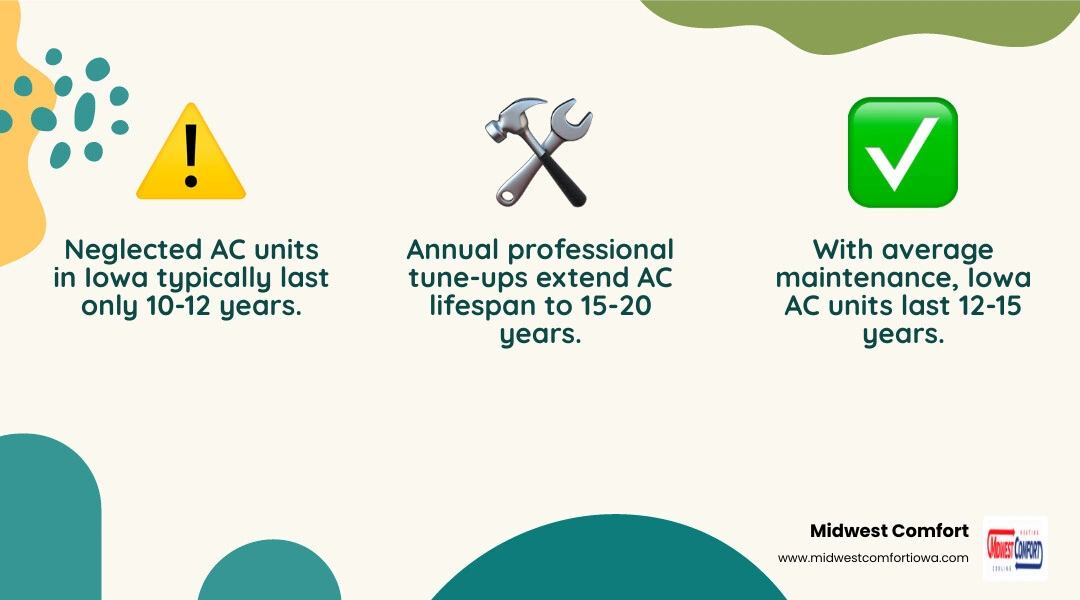
| Condition | Typical Lifespan |
|---|---|
| Neglected or poorly maintained | 10–12 years |
| Average maintenance | 12–15 years |
| Annual professional tune-ups | 15–20 years |
Most central air conditioners in Iowa fall somewhere in that 12–15 year window. Push that with consistent maintenance and you can realistically hit 15 years or more. Skip the upkeep, and you may be shopping for a replacement much sooner than you'd like.
Iowa's climate makes this a real issue. Hot, humid summers put heavy strain on cooling equipment. Temperature swings from season to season wear components down faster than in more moderate climates. And when your AC is fighting humidity levels that regularly spike into the 70–80% range during peak summer, it's working harder than most homeowners realize.
The good news? A lot of that wear is preventable. Understanding what shortens — and what extends — your system's life puts you in control. This guide walks you through everything Iowa homeowners need to know, from the factors that affect durability to the signs it's time for a replacement.
Understanding How Long Does an AC Unit Last in Iowa
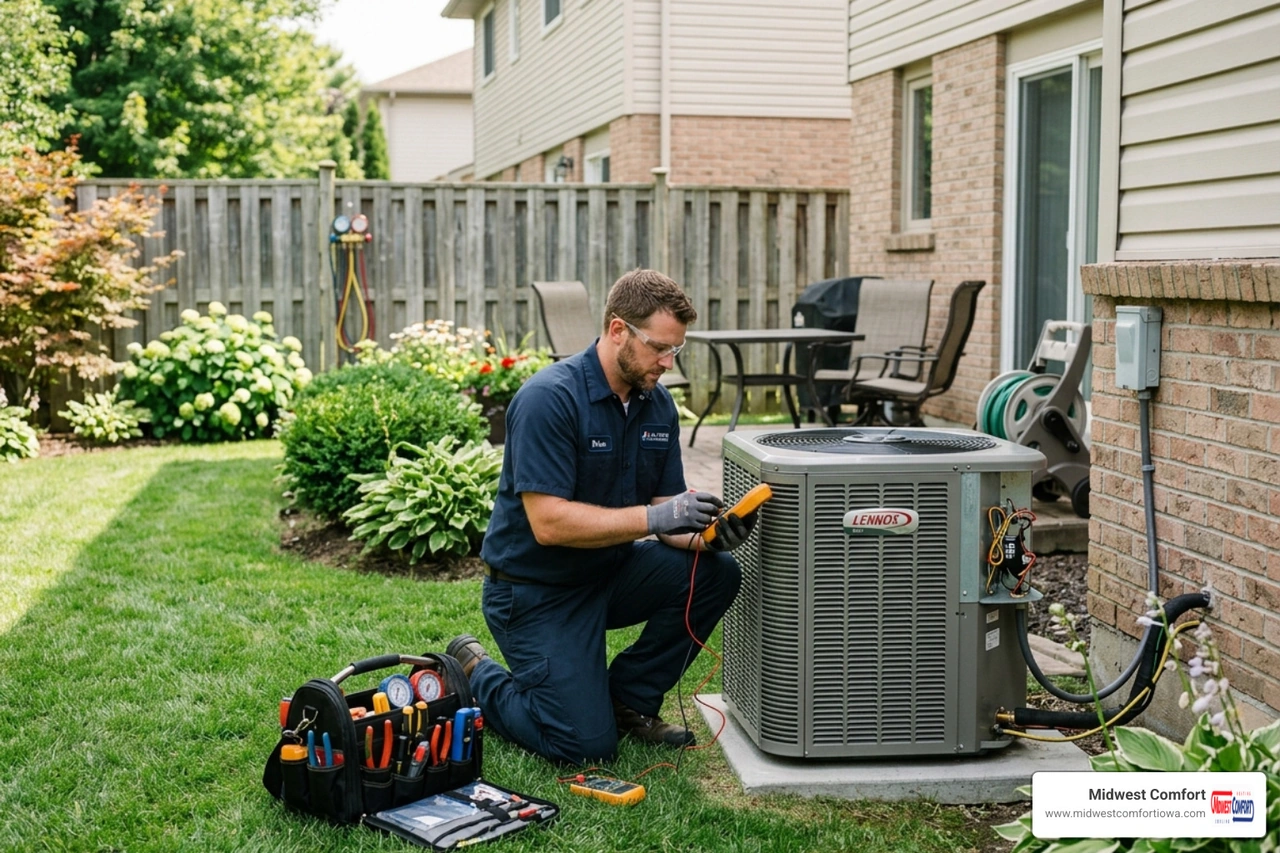
When we talk about the lifespan of a cooling system in Central Iowa, we have to look at the "useful life" of the equipment. Technically, a machine can be repaired indefinitely, but there comes a point where the frequency of breakdowns and the drop in efficiency make it a poor investment.
In cities like Des Moines, Ankeny, and Waukee, the standard benchmark is 12 to 15 years. This range is common because our systems aren't running year-round like they would in Arizona, but when they are running, they are working under significant stress. A unit that is neglected—meaning filters aren't changed and coils are caked in Iowa dust—will likely hit the "retirement" phase closer to 10 or 12 years.
However, we often see well-maintained systems in the Polk City and Grimes areas reaching 17 to 20 years. This longevity is achieved through a combination of high-quality installation and consistent seasonal service. If you are curious about the specifics of transitioning to a new system, our AC Replacement Guide provides a deeper look at what to expect during that process.
Factors Influencing How Long Does an AC Unit Last in Iowa Homes
Several localized factors determine whether your unit will be a "long-hauler" or an early casualty.
- Humidity Levels: Iowa summers are notoriously "soupy." High humidity forces your AC to run longer cycles to remove moisture from the air, putting extra miles on the compressor.
- Temperature Swings: Our 100-degree summer days followed by freezing winters mean the outdoor unit undergoes massive thermal expansion and contraction, which can stress metal components and electrical connections.
- Pollen and Agricultural Dust: In communities like Dallas Center or Adel, the surrounding farmland can lead to high levels of dust and debris. If these particles clog the outdoor condenser coils, the system can't release heat efficiently, leading to overheating.
- System Sizing: A unit that is too small will run constantly, wearing itself out. Conversely, an oversized unit will "short cycle," turning on and off rapidly, which is incredibly hard on the motor.
- Installation Quality: The best unit in the world won't last if the ductwork is restrictive or the refrigerant charge was set incorrectly on day one. For those in the northern suburbs, our Central Air Replacement Ankeny IA Guide highlights why proper setup is the foundation of longevity.
Regional Variations in Equipment Longevity
While the 12–15 year average holds true for most of the Des Moines metro, local conditions can shift the needle. In more urbanized areas like Windsor Heights or Clive, "heat island" effects can keep outdoor units running slightly longer into the night. In rural areas near Runnells or Carlisle, the primary threat is often debris and cottonwood seeds that clog units during the spring.
| Maintenance Level | Estimated Lifespan (Iowa) | Common Failure Mode |
|---|---|---|
| Neglected | 10–12 Years | Compressor failure due to overheating |
| Average | 12–15 Years | Fan motor or capacitor issues |
| Well-Maintained | 15–20 Years | General efficiency loss/obsolescence |
The Impact of Iowa’s Extreme Seasons on System Longevity
Iowa is unique because we experience roughly 6,600 heating degree days per year. While that sounds like a heating statistic, it affects your AC too. Because our homes are sealed tight for the winter, the first time you flip that switch in May, your AC is often dealing with stagnant air and components that haven't moved in six months.
The thermal stress of an Iowa July—where the heat index can climb well over 100 degrees—forces the system to reach peak capacity. If the unit is already struggling with a minor issue, like a low refrigerant charge or a dirty coil, these extreme days will expose those weaknesses. This is often when "freezing up" occurs. When ice forms on your indoor or outdoor coils, it effectively chokes the system. If you find yourself in this situation, knowing what to do when your AC freezes up can save you from a permanent compressor failure.
Maximizing Your Cooling System with Regular Maintenance
If you want to beat the averages and keep your system running for two decades, maintenance isn't optional—it’s the secret sauce. We like to tell our neighbors in Altoona and Pleasant Hill that an AC unit is like a car; you wouldn't drive 100,000 miles without an oil change, yet many homeowners go years without looking at their AC.
Annual tune-ups do more than just clean things up. They involve checking refrigerant levels, tightening electrical connections, and lubricating moving parts. A clean system doesn't just last longer; it runs more efficiently, which keeps your monthly utility bills in check. For a head start on your seasonal chores, check out our tips for Spring Cleaning Your Air Conditioning Ankeny.
How Long Does an AC Unit Last in Iowa with Professional Tune-ups?
With a pro looking at your system every spring, a 15- to 20-year lifespan becomes a very realistic goal. Professional service allows for the "early diagnosis" of small problems. A $200 capacitor repair today can prevent a $3,000 compressor replacement next year.
In Des Moines, we focus on airflow optimization during these visits. If your system is "starved" for air because of duct issues or dirty coils, it has to work twice as hard to cool your home. By ensuring the system "breathes" properly, we reduce the mechanical strain on the motor. For a deeper dive into why this matters, see our AC Repair Des Moines IA Complete Guide.
Essential DIY Care for Iowa Homeowners
While we handle the technical stuff, there are several things you can do to protect your investment:
- Filter Replacement: This is the single most important task. In Iowa, we recommend checking your filter every month. If you have pets or live near a construction site in a growing area like Grimes or Waukee, you may need to change it every 30 days.
- Outdoor Clearance: Keep at least two feet of clear space around your outdoor unit. Trim back bushes, tall grass, and weeds that can block airflow.
- Debris Removal: After a big Iowa thunderstorm, check the top of your unit for branches or leaves.
- Thermostat Habits: Avoid "cranking" the thermostat down to 60 degrees in hopes of cooling the house faster. It doesn't work that way; it just makes the system run longer.
Many of these principles apply to your heating system as well, as seen in our Top Furnace Maintenance Tips.
Recognizing When to Repair vs. Replace Your Iowa AC
Even with the best care, every system eventually reaches its finish line. The question is: how do you know when you’ve crossed it?
One of the biggest red flags for older units (pre-2010) is the type of refrigerant they use. R-22 (Freon) has been phased out, making repairs involving refrigerant leaks incredibly expensive. If your 15-year-old system has a leak, it’s almost always more cost-effective to replace it with a modern, high-efficiency unit.
Other signs include:
- Rising Energy Bills: If your usage hasn't changed but your bill is climbing, the system is likely losing its efficiency.
- Frequent Repairs: If you've had to call us twice in the last two seasons, you're likely entering the "breakdown" phase of the equipment lifecycle.
- Odd Noises: Squealing, grinding, or banging sounds often indicate a failing motor or compressor.
- The $5,000 Rule: A common industry heuristic is to multiply the age of the unit by the repair cost. If the result is more than $5,000, replacement is usually the smarter financial move.
If you are noticing these issues, read through our guide on Signs You Need HVAC Repair or our list of 7 Signs Your HVAC System Needs Repair to help you decide your next steps.
Frequently Asked Questions
Navigating home cooling can be confusing. Here are some of the most common questions we hear from our customers in the Des Moines metro area. For more general troubleshooting, you can also view our page on the Most Common HVAC Issues and How to Fix Them.
How often should I change my air filter in Iowa?
At a minimum, you should check your filter every 30 days. Standard 1-inch pleated filters usually need replacing every 1–3 months. If you use a high-capacity 4-inch media filter, you might get 6 months out of it. However, during the peak of the Iowa summer or if you have heavy pet dander and seasonal allergens, you should lean toward more frequent changes. A clogged filter is like a breathing mask for your AC; if it's blocked, the system suffocates.
Does Iowa’s humidity shorten AC life?
Yes, indirectly. Your Air Conditioning unit is actually a dehumidifier first. It removes heat by removing moisture. When humidity is high, the evaporator coil has to work much harder, and the condensate drain line is constantly active. This heavy workload leads to faster wear on the compressor and can eventually cause corrosion on the coils if the system isn't cleaned regularly.
Is it worth repairing a 15-year-old unit?
Usually, no. At 15 years, you are at the end of the expected lifespan for an Iowa AC unit. The "efficiency gap" between a 15-year-old unit and a modern SEER2-rated system is massive. You could be saving 20–40% on your cooling costs by upgrading. We typically follow the ASHRAE 50% rule: if the repair cost is more than half the cost of a new system, or if the unit is over 15 years old, replacement is the operationally correct decision.
Conclusion
At Midwest Comfort, we understand that your home is your sanctuary, and in the middle of an Iowa July, that sanctuary needs to be cool. We are a family-owned business dedicated to providing honest, high-quality HVAC services to our neighbors in Des Moines, Ankeny, Johnston, and throughout the surrounding communities.
Our family-oriented approach means we don't just look at you as a job number; we offer tailored solutions and loyalty programs designed to keep your family comfortable for the long haul. Whether you’re looking to squeeze a few more years out of an aging unit or you’re ready to explore a high-efficiency Air Conditioning replacement, we’re here to help.
If your system is struggling to keep up with the Hawkeye heat, don't wait for a total breakdown. Give us a call today, and let’s make sure your home stays the coolest spot on the block.
