
When Minor Cooling Issues Collide with Extreme Midwest Heat
Before July weather patterns fully arrive, understanding the real cost of delaying commercial HVAC repairs during peak Iowa summers is the single most important step a facility manager can take. July in the Midwest brings aggressive cooling loads, with average highs sitting firmly in the upper 80s and frequently spiking much higher. When a commercial building begins showing signs of minor cooling anomalies—like short-cycling, uneven temperature zones, or weak airflow—the immediate temptation is often to defer the maintenance request. Property managers frequently hope to save immediate budget by pushing a service call to the next quarter, assuming the system will simply power through the season.
Here is the thing: ignoring these early warning signs never results in long-term savings. What starts as a minor mechanical inefficiency quickly cascades into total system failure under the crushing demand of a peak Iowa summer (90+ degree days). A commercial cooling system does not just lower the air temperature; it actively manages indoor air quality, protects sensitive physical assets, and creates a safe baseline for human occupancy. When that system is compromised, the entire operation is at risk.
Business continuity relies heavily on a fully functioning cooling and dehumidification system. The decision point for business owners is clear: either address a minor anomaly proactively on a predictable schedule, or wait until a Midwest heatwave turns a small mechanical strain into a catastrophic facility shutdown. By partnering with experts for comprehensive commercial HVAC services, facility managers can protect their operations from the severe financial and logistical fallout of an unexpected summer breakdown.
How Small Anomalies Cascade into Total System Failure
The problem: Commercial cooling systems are highly complex, interconnected networks of mechanical and electrical components. When one piece of the system begins to underperform, it does not simply stop working in isolation. Instead, it forces every other component to compensate for the lost efficiency.
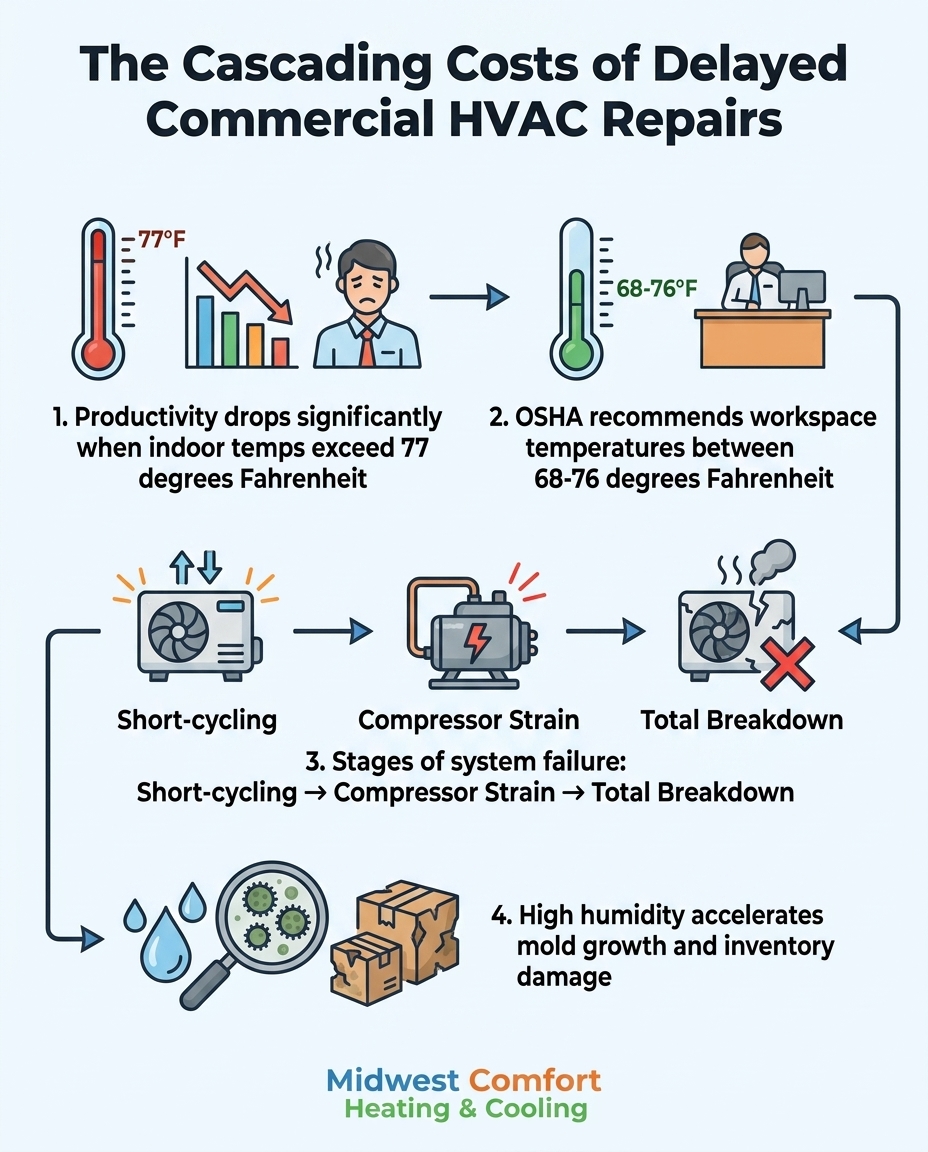
The cause: Consider a scenario involving weak airflow or short-cycling—where the unit turns on and off rapidly without ever completing a full cooling cycle. In Des Moines commercial districts, buildings require aggressive, sustained cooling output to maintain comfortable temperatures across large square footage. When short-cycling occurs, the system's most critical components are subjected to massive electrical and mechanical stress. The starting sequence of a commercial air conditioner draws the highest amount of amperage and puts the most physical wear on the internal mechanisms. Repeating this sequence dozens of times an hour, rather than running in long, efficient cooling cycles, creates a rapid domino effect of component degradation.
The solution: Early intervention halts this domino effect before it can compromise the entire system. Addressing a failing capacitor, a clogged commercial air filter, or a minor refrigerant leak is a highly manageable, predictable process. Contrast this with the complexity of an emergency overhaul, which often requires sourcing heavy-duty commercial parts during the busiest season of the year. Proactive monitoring and timely adjustments are the foundational elements of boosting AC performance and extending the lifespan of the equipment.
The Hidden Strain on Commercial Compressors
The compressor acts as the heart of any commercial HVAC system, responsible for pumping refrigerant through the lines to absorb and disperse heat. When a system suffers from weak airflow or a dirty evaporator coil, the refrigerant cannot absorb enough heat from the building's interior. This causes liquid refrigerant to flow back into the compressor—a condition known as "liquid slugging."
Compressors are designed to compress gas, not liquid. When liquid slugging occurs, or when the system is forced into continuous operation without ever reaching the thermostat's set temperature, the compressor inevitably overheats. Over time, the internal motor windings break down, leading to a complete compressor burnout. Replacing a commercial compressor is a major, labor-intensive undertaking that often leaves a building without cooling for an extended period. By catching the early signs of strain, property managers prevent the heart of their HVAC system from suffering a fatal, heat-induced failure.
The High Humidity Threat to Sensitive Commercial Inventory
In the Midwest, heat is only half of the cooling equation. Iowa's humid continental climate features exceptionally high dew points during the summer months. This specific climate reality dictates that commercial cooling systems must dehumidify as aggressively as they cool. When a commercial AC unit begins to fail, its dehumidification capacity is often the first function to suffer. The system may still blow cold air, but if it is short-cycling or lacking sufficient airflow, it will not run long enough to pull excess moisture out of the indoor environment.
During a peak Iowa summer (90+ degree days), indoor moisture levels can spike rapidly if the HVAC system is compromised. This high humidity poses a severe threat to sensitive commercial inventory and physical business assets. Retailers, warehouses, and office spaces all house materials that degrade quickly when exposed to prolonged dampness.
The direct risks of unmanaged indoor humidity include:
- Accelerated mold and mildew growth: Organic materials, ceiling tiles, and drywall can harbor rapid mold proliferation when indoor humidity remains above 60 percent for extended periods.
- Damage to sensitive electronics: Server rooms, computer networks, and specialized medical or manufacturing equipment are highly susceptible to condensation and moisture-induced short circuits.
- Inventory spoilage: Perishable goods, paper products, textiles, and wood furnishings can warp, rot, or become unsellable when the indoor climate is not strictly controlled.
- Compromised indoor air quality: High humidity traps airborne particulates and volatile organic compounds (VOCs), creating a stale, unhealthy breathing environment for occupants.
Inventory spoilage and asset degradation are direct consequences of deferred maintenance. When a facility loses its ability to manage moisture, the financial losses quickly outpace the cost of a standard service call. To protect the physical assets inside the building, securing prompt commercial air conditioning repair at the first sign of a humidity imbalance is absolutely critical.
Plummeting Employee Productivity in Uncomfortable Workspaces
Beyond the mechanical and physical asset risks, the human cost of delayed HVAC repairs represents a massive hidden expense for businesses. Commercial buildings are ultimately designed to facilitate human work, and the environment inside those buildings directly dictates how effectively that work can be performed.
The Occupational Safety and Health Administration (OSHA) provides clear indoor temperature guidelines, recommending that workspaces remain between 68 and 76 degrees Fahrenheit to ensure safe and comfortable conditions. When a commercial HVAC system struggles to keep up with the heat in Des Moines commercial districts, indoor temperatures can easily breach these guidelines by early afternoon.
Authoritative data highlights just how expensive an uncomfortable workspace can be. Studies conducted by the Lawrence Berkeley National Laboratory show that employee productivity drops significantly when indoor temperatures exceed 77 degrees Fahrenheit. As the temperature and humidity rise, the body is forced to expend more energy simply trying to cool itself down. This physiological strain leads to predictable outcomes in a professional setting.
| Workspace Condition | Physiological Impact | Operational Consequence |
|---|---|---|
| Optimal (68°F - 76°F) | Thermal comfort maintained | Baseline productivity, high focus, standard error rates |
| Elevated (77°F - 80°F) | Mild thermal stress, distraction | Decreased typing speed, sluggish decision-making, lethargy |
| Severe (81°F+) | High thermal stress, dehydration risk | Significant drop in output, higher error rates, safety hazards |
| High Humidity (60%+) | Inability for sweat to evaporate | Physical discomfort, respiratory irritation, severe fatigue |
A hot, humid environment leads directly to lethargy, decreased mental focus, and higher error rates among staff. In a retail setting, this translates to poor customer service. In an office, it means missed deadlines and sluggish output. In a manufacturing or warehouse environment, it dramatically increases the risk of workplace accidents. These productivity losses are a hidden but substantial operational expense. When a facility manager defers a necessary HVAC repair, they are inadvertently choosing to pay for that repair through lost labor efficiency and reduced daily output.
Operational Downtime: The True Expense of Emergency Shutdowns
The problem: The ultimate risk of ignoring early warning signs is a complete system failure during the hottest weeks of the year. When a commercial HVAC system shuts down entirely during a peak Iowa summer (90+ degree days), the building rapidly becomes uninhabitable.
The cause: Because modern commercial buildings are tightly sealed for energy efficiency, they rely entirely on mechanical ventilation and cooling. Without it, the indoor temperature can exceed the outdoor temperature within a matter of hours due to solar heat gain and the internal heat generated by lighting, computers, and human bodies.
The solution: Mitigating this risk requires a fundamental shift in how maintenance is prioritized. The operational impact of a complete HVAC failure is severe. If the environment becomes unsafe, business owners are forced to send employees home, cancel client meetings, or turn retail customers away at the door. This level of operational downtime is devastating to a company's bottom line. Furthermore, the reputational damage that occurs when a commercial facility cannot maintain a safe, comfortable environment can linger long after the air conditioning is restored. Clients and customers expect a professional, climate-controlled experience; failing to provide one damages brand trust.
Contrast the predictable nature of scheduled maintenance with the chaotic disruption of an emergency repair scenario. Scheduled repairs can be planned for off-hours, minimizing disruption to daily workflows. Emergency shutdowns, by definition, happen at the worst possible times. When a catastrophic failure does occur, rapid response times are essential to mitigating these severe disruptions. Midwest Comfort Heating & Cooling's reliable, rapid response times serve as a critical safety net, protecting local businesses from extended operational downtime when unexpected failures strike. If your system is showing signs of imminent failure, it is vital to schedule urgent commercial cooling repairs immediately to avoid a full facility closure.
Shifting from Reactive Fixes to Proactive Business Continuity
To truly protect a commercial facility from the cascading costs of delayed repairs, property managers must change how they view their HVAC systems. Shifting away from a reactive, run-to-failure model requires a proactive, strategic approach.
- View HVAC as a business continuity asset: The first step is a mindset shift. Commercial cooling is not merely an overhead expense or a luxury; it is a critical piece of infrastructure that enables the business to generate revenue. Treating it as a business continuity asset justifies the investment in regular, specialized care.
- Identify minor anomalies early: Train on-site staff to report early warning signs. If a specific zone in the building is consistently warmer than others, if the system is making unusual grinding or squealing noises, or if humidity levels feel unusually high, these should trigger an immediate professional inspection rather than a "wait and see" approach.
- Maintain consistent energy efficiency: Consistent care does more than prevent breakdowns; it maintains optimal energy efficiency and dehumidification capacity. A well-maintained system draws less electricity to achieve the same cooling output, lowering monthly utility burdens in Des Moines commercial districts.
- Establish a reliable professional partnership: The most effective way to ensure proactive care is to establish a relationship with local commercial HVAC experts before an emergency strikes. Having a dedicated team that understands the specific mechanical layout and history of your building streamlines the troubleshooting process.
By implementing a structured approach to system care, facility managers eliminate the guesswork and anxiety associated with extreme weather events. Enrolling in a comprehensive preventative HVAC maintenance plan ensures that minor issues are identified and resolved long before they require emergency intervention.
Protect Your Operations Before the Next Heatwave Hits
The evidence is clear: deferring minor commercial HVAC repairs is a high-risk gamble that ultimately costs businesses far more in the long run. The operational and financial breakdown shows exactly how minor mechanical strains cascade into expensive downtime, severe inventory damage, and massive drops in employee productivity. Addressing cooling anomalies early provides the clear justification needed to approve proactive maintenance budgets.
Do not wait until a peak Iowa summer (90+ degree days) forces your facility to shut its doors. A minor repair today is the best defense against a catastrophic failure tomorrow. Take the time to explore professional options to safeguard your facility's comfort, protect your physical assets, and maintain optimal workforce productivity. Reach out to local commercial cooling experts to secure your building's climate control and ensure seamless business continuity all season long.
Frequently Asked Questions
What happens if you don't maintain commercial HVAC during the summer?
If you neglect commercial HVAC maintenance during the summer, minor mechanical inefficiencies quickly compound under the heavy cooling load, leading to severe component strain. This lack of care typically results in short-cycling, overheating compressors, and eventually, total system failure. Additionally, unmaintained systems consume significantly more electricity, driving up operational costs while failing to properly cool the building.
How long can a business run without AC in high humidity?
A commercial building can become uncomfortably warm and dangerously humid within just a few hours of an AC failure. Because modern commercial spaces are tightly sealed, they rely entirely on mechanical ventilation; without it, indoor temperatures can quickly exceed outdoor temperatures. High humidity accelerates this discomfort, making the environment unsafe for employees and hazardous to sensitive inventory by the end of a single business day.
What are the earliest signs a commercial AC needs repair?
The earliest signs of trouble include uneven cooling across different zones of the building, a noticeable increase in indoor humidity, and the system turning on and off rapidly (short-cycling). You might also hear unusual grinding or squealing noises coming from the mechanical room or notice an unexpected spike in monthly energy usage. Addressing these anomalies immediately prevents them from turning into catastrophic breakdowns.
How does indoor temperature directly affect employee productivity?
Indoor temperature directly impacts the body's ability to focus; studies show productivity drops significantly when workspace temperatures exceed 77 degrees Fahrenheit. As the environment becomes hotter and more humid, employees experience lethargy, decreased cognitive function, and higher error rates. Maintaining the OSHA-recommended range of 68 to 76 degrees Fahrenheit ensures optimal comfort, safety, and operational efficiency.
Why is rapid dehumidification critical for commercial spaces in the Midwest?
Rapid dehumidification is critical in the Midwest because the region experiences a humid continental climate with exceptionally high summer dew points. If a commercial AC system fails to pull excess moisture from the air, the resulting dampness can accelerate mold growth, warp wood, and destroy sensitive electronics. Proper dehumidification protects physical business assets and ensures healthy indoor air quality for all occupants.
