Waking Up to a Freezing House: The 2 AM Decision
Your thermostat reads 58 degrees, but you distinctly set it to 70 before going to bed. The house is silent, the air from the vents is stagnant, and a quick glance out the window confirms that the first unexpected early fall cold snap has officially hit the Des Moines metro. At Midwest Comfort Heating & Cooling, we know firsthand that this jarring experience introduces many homeowners to the reality of middle-of-the-night furnace failures in Urbandale. At 2 AM, shivering in the hallway, you face an immediate decision: is this a catastrophic mechanical breakdown that requires waking up an emergency technician, or is it a simple airflow issue that you can safely resolve yourself?
For immediate assistance with your HVAC services or to upgrade your heating systems, the local professionals at Midwest Comfort Heating & Cooling are standing by.
The truth about late-night breakdowns: In our years of restoring heat to Des Moines area homes, our team has noticed a surprising pattern. A significant percentage of these late-night heating panics are not actually complete mechanical disasters. Instead, they are built-in safety shutoffs triggered by suffocated airflow. Modern heating equipment is designed to protect your home from fire hazards, and when something restricts the air, the system will shut itself down entirely. Understanding how to identify these easily correctable issues can save you from a stressful, freezing night and help you determine exactly when you need to make that emergency phone call.
The Mechanics Behind a Late-Night Furnace Lockout
To understand why your heating system abandons you in the middle of the night, you have to look at the specific weather patterns in Urbandale. During September and October, daytime temperatures can be comfortable, but overnight temperatures can rapidly plummet into the 30s. This sudden drop forces your heating equipment to work harder and run longer than it has all year. These extended, demanding cycles expose underlying issues that simply do not show up during shorter, milder heating runs.
When a furnace runs continuously to combat a freezing night, it generates an immense amount of internal heat. If that heat cannot escape into your ductwork, the system's safety mechanisms take over. This is where the dreaded "hard lockout" occurs.
The Impact of Rapid Temperature Drops
Longer cycles mean higher stress: When the outside temperature drops twenty or thirty degrees in a few hours, your system has to run extended cycles to maintain your indoor comfort. If your blower motor is struggling, or if your ductwork is partially blocked, these long cycles cause heat to build up inside the cabinet. A system might survive a ten-minute cycle with poor airflow, but a forty-minute cycle during a hard freeze will push it past its breaking point.
Exposing hidden weaknesses: These rapid temperature drops act as a stress test for your entire heating infrastructure. Our technicians frequently see components that are slightly worn or out of calibration fail when forced to run continuously. This is why the highest volume of emergency calls consistently occurs during the first major overnight freeze of the season.
Understanding the High-Limit Switch
The primary safety guard: The high-limit switch is a critical safety component located just above the heat exchanger. Its sole job is to measure the internal temperature of the furnace cabinet. If the heat exchanger gets too hot, the high-limit switch immediately cuts the power to the gas burner to prevent a fire hazard or a cracked heat exchanger.
The hard lockout sequence: When the high-limit switch trips, the blower fan will usually continue to run to cool the system down. Once cooled, the furnace will try to ignite again. If the underlying overheating issue is still present, the switch will trip a second or third time. After multiple failed attempts, the control board initiates a hard lockout. The system shuts down completely and refuses to turn on, leaving you in the cold until the issue is addressed.
The Number One Culprit: Suffocated Airflow from Summer Filters
When the Midwest Comfort Heating & Cooling team responds to these early-season heating emergencies, we frequently discover the same root cause: a forgotten summer air filter. During the heavy, humid days of summer, your air conditioning system pulls significant amounts of dust, pollen, pet dander, and debris into the filter. By the time that first early fall cold snap arrives, that filter is often completely clogged.
Starting your furnace with a suffocated summer filter immediately starves the system of the cold return air it needs to regulate its internal temperature. If you want to avoid these late-night lockouts entirely, enrolling in a preventative maintenance plan ensures these transitions are handled by professionals before the freezing weather arrives.
The Summer-to-Fall Transition Trap
The invisible barrier: A clogged filter acts like a brick wall inside your ductwork. The blower motor strains to pull air through the thick layer of summer dust. Because it cannot pull enough air into the system, it cannot push enough air over the heat exchanger. Without that constant flow of air absorbing the heat and carrying it into your living room, the heat exchanger rapidly overheats.
Real-world consequences: During a sudden late-September cold spell last year, an emergency call required our lead technician Mick to diagnose a furnace that had stopped working just as temperatures plummeted. He quickly identified the root cause, sourced the necessary replacement part, and restored the heat. Later that same night, he even resolved a secondary, simpler airflow issue that arose, proving that thorough professional diagnostics go beyond just a quick patch. Proper seasonal preparation catches these cascading issues before they leave you freezing.
How Restricted Airflow Triggers Short-Cycling
The rapid on-and-off loop: When the heat exchanger overheats due to a dirty filter, the high-limit switch cuts the burner. The system cools down, tries again, and overheats again. This rapid on-and-off behavior is known as short-cycling. It is incredibly damaging to the internal components and wastes a massive amount of energy.
The final shutdown: If the short-cycling is allowed to continue, the control board will eventually recognize the repeated safety faults and trigger the hard lockout. At this point, simply changing the filter will not turn the system back on; the furnace requires a specific reset procedure or professional intervention to clear the fault codes.
Safe, External-Only Troubleshooting Before Making the Call
Before you pick up the phone at 2 AM, there are several external components you can safely check. As a locally trusted team, we believe in extreme transparency, and we actively want to save you from an unnecessary emergency call if the fix is something simple. However, you must prioritize safety. Never open the internal cabinet, attempt to bypass safety switches, or handle internal wiring.
Thermostat and Power Verification
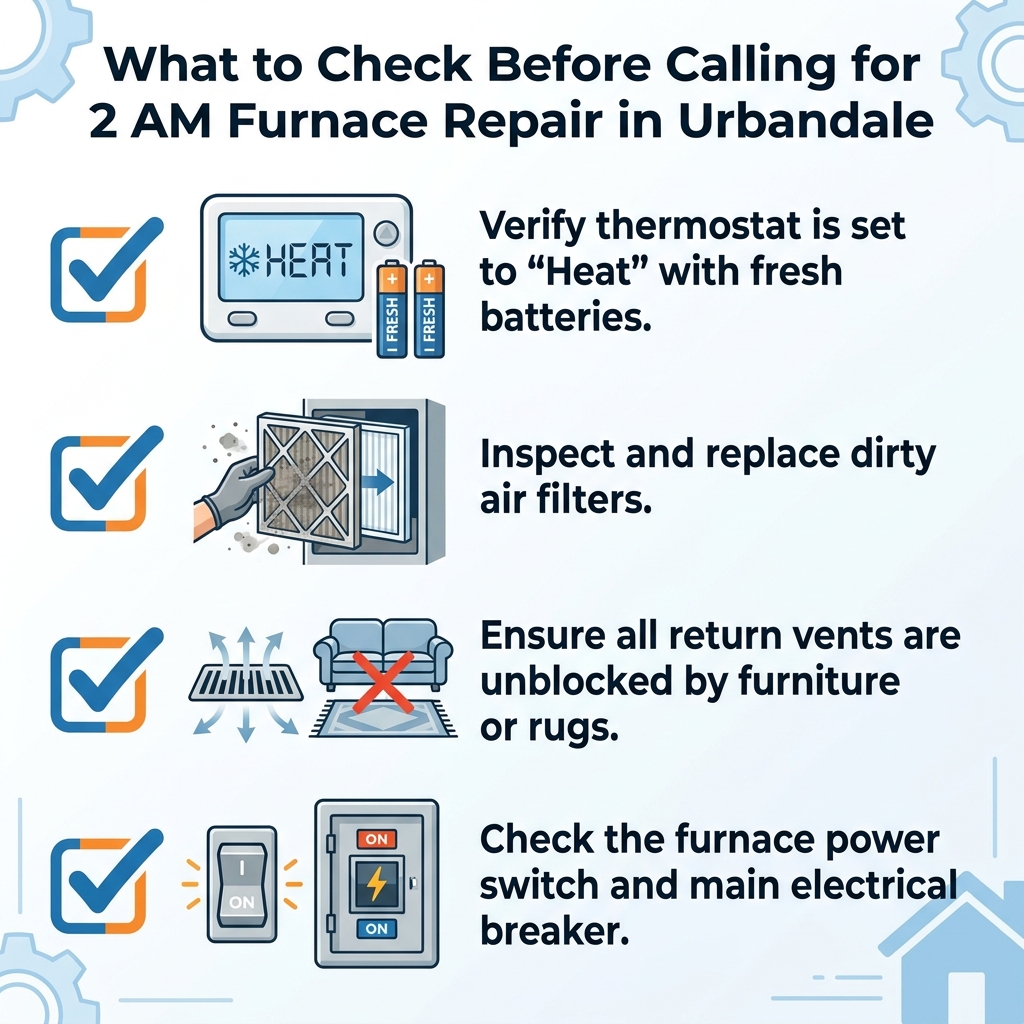
- Verify the thermostat mode: Ensure the thermostat is explicitly set to "Heat" and not accidentally left on "Cool" or "Off." Set the fan switch to "Auto."
- Check the batteries: A blank screen or a flashing low-battery indicator means the thermostat cannot send the signal to the control board. Replace the batteries with fresh ones.
- Inspect the emergency shut-off switch: Look for a switch that resembles a standard light switch near your heating equipment. It is incredibly common for someone to accidentally bump this switch, cutting all power to the unit.
- Check the electrical breaker: Open your main electrical panel and look for the breaker labeled for your heating system. If it has tripped to the middle position, flip it completely off, then back on.
Filter and Vent Inspection
- Perform the light test on your filter: Pull the air filter out of its slot. Hold it up to a bright light bulb. If you cannot clearly see light shining through the material, the filter is suffocating your system and must be replaced immediately.
- Clear the return vents: Walk through every room in your home and locate the large return vents (usually on the wall or floor). Ensure no furniture, heavy drapes, or new area rugs are blocking them.
- Open the supply registers: Check the smaller supply vents in each room. Closing vents in unused rooms does not save energy; it actually increases the static pressure inside your ductwork and contributes to overheating. Keep them fully open.

When to Stop Troubleshooting and Call a Professional
If you have verified that the thermostat has power, replaced the dirty filter, cleared all the vents, and the system still refuses to produce heat, your external troubleshooting journey is over. It is time to call an expert. Attempting to open the cabinet to manually reset internal limit switches or clean flame sensors without proper training is dangerous and can void your warranty.
Understanding what happens when you call for 24-hour HVAC repair at 2 AM helps relieve the stress of the situation. A qualified technician will arrive equipped to diagnose the exact mechanical failure safely and efficiently.
Identifying Mechanical Failures
Beyond simple airflow: In our experience, once airflow issues are ruled out, the problem usually lies within the mechanical or electronic components. A failed blower motor will prevent air circulation entirely. A faulty hot surface ignitor will prevent the gas from lighting. A dirty or damaged flame sensor will cause the burner to light for a few seconds and then immediately shut off.
The danger of repeated resets: Safety switches that have tripped multiple times due to overheating can become weak and faulty. Even if the original airflow issue is resolved, a damaged high-limit switch may require professional replacement before the system will operate reliably again.
| Symptom | Likely Cause | Required Action |
|---|---|---|
| System runs for 3 minutes, shuts off, repeats | Overheating / Short-Cycling | Check filter; if clean, call a professional. |
| Thermostat is blank and unresponsive | Dead batteries or tripped breaker | Replace batteries; check main electrical panel. |
| Loud grinding or squealing noises | Failing blower motor bearings | Turn system off immediately; call a professional. |
| Distinct smell of natural gas or burning plastic | Gas leak or electrical short | Evacuate home, call gas company, then call HVAC tech. |
When to Make the Emergency Call
Protecting your property: You should make the emergency call if the indoor temperature is dropping rapidly toward freezing, which puts your plumbing at risk of bursting. You should also call immediately if you have vulnerable family members, such as infants or the elderly, who cannot safely tolerate the cold.
Routine care prevents emergencies: Even systems that seem fine can struggle under heavy loads. In a recent early-fall maintenance visit, our technicians performed a thorough diagnostic on a system that was no longer running in top shape. By addressing the wear and tear early, the homeowner gained the confidence that their equipment was fully prepared for the upcoming winter. Proactive care is always less stressful than reactive emergency repairs.
True 24/7 Emergency Response in the Des Moines Metro
At Midwest Comfort Heating & Cooling, we know there is a massive difference between a company that advertises "24/7 service" and a company that actually provides true emergency response. Many homeowners experience the deep frustration of calling a hotline at 2 AM, only to reach a remote answering service that simply takes a message and promises a callback the next business day. When your home is actively freezing, a message pad does not help.
Midwest Comfort Heating & Cooling provides genuine emergency support across the Urbandale service area. This means we have local technicians actively running calls and driving fully stocked trucks in your neighborhood, regardless of the hour.
The Difference Between Answering Services and Active Technicians
Real-time dispatching: An answering service takes messages; active technicians take action. When you call us in the middle of the night, you are connected with a system designed to deploy help immediately. Real-time dispatching ensures a faster response when your home's temperature is dropping rapidly.
Equipped for the unexpected: A true emergency response vehicle is stocked with the most common replacement parts, including ignitors, flame sensors, capacitors, and universal blower motors. The goal is to restore your heat during that very first visit, not just to diagnose the problem and leave you waiting for parts until morning.
What to Expect When We Arrive
Thorough diagnostics: When our technician arrives at your Urbandale home, they will perform a comprehensive inspection. This includes verifying all external airflow factors, testing the electrical components, and reading the specific fault codes stored in your control board.
Honest communication: We prioritize clear communication and a straightforward path to restoring your heat. You will receive a detailed explanation of exactly what failed, why it failed, and what it will take to fix it, all without the pressure or panic often associated with late-night breakdowns.
Frequently Asked Questions About Late-Night Furnace Emergencies
Why is my furnace short cycling at night?
Your furnace is likely short-cycling at night because restricted airflow is causing the internal heat exchanger to overheat. During colder overnight temperatures, the system runs longer cycles, which quickly exposes the restriction caused by a dirty air filter or blocked return vents. The high-limit safety switch detects the dangerous heat buildup and shuts the burner off prematurely. Once it cools down, it tries again, creating a rapid on-and-off loop that damages the equipment.
What should I check before calling for emergency furnace repair?
Before calling for an emergency repair, you should verify your thermostat settings, check the air filter, and inspect your electrical panel. Ensure the thermostat is set to "Heat" and has fresh batteries. Pull the air filter and replace it immediately if it is clogged with dust. Finally, confirm that the emergency shut-off switch near the unit hasn't been bumped and that the main electrical breaker hasn't tripped.
What constitutes a true furnace emergency?
A true furnace emergency occurs when the loss of heat threatens the safety of your family or the structural integrity of your home. If indoor temperatures are dropping rapidly toward freezing, your water pipes are at risk of bursting, which causes catastrophic water damage. Additionally, any situation involving the smell of natural gas, sparking electrical components, or burning odors is an immediate emergency requiring professional intervention.
How do I safely reset my furnace after a hard lockout?
You can safely attempt to reset a hard lockout by turning off the power to the furnace at the main electrical breaker for about five minutes, then turning it back on. This clears the temporary fault codes from the control board. However, if the system immediately goes back into a lockout after the reset, do not attempt it again. Repeated resets bypass safety controls and can severely damage the unit; at this point, you need a professional diagnostic.
Can a dirty filter really cause my furnace to stop working completely?
Yes, a severely dirty filter is one of the most common reasons a furnace stops working completely. The thick layer of dust acts like a wall, preventing the blower motor from pulling in enough cold air to regulate the system's internal temperature. This suffocated airflow causes the heat exchanger to rapidly overheat, tripping the safety limit switches and eventually forcing the control board into a complete system lockout to prevent a fire.
Restoring Your Peace of Mind Before the Next Freeze
Waking up to a freezing house at 2 AM is a stressful experience that no homeowner wants to face. While the reality of middle-of-the-night breakdowns in Urbandale often points to simple, preventable airflow issues like neglected summer filters, mechanical failures do happen. By taking a few minutes to perform safe, external checks, you can often restore your heat independently. But when the problem runs deeper, having access to genuine, reliable local help makes all the difference. Schedule a proactive inspection today to ensure your system is fully prepared to handle whatever the winter weather brings, giving you the peace of mind to sleep soundly through the night.
