
The Dilemma of the Late-Summer Temperature Swing
Your air conditioner is running constantly to keep up with the afternoon heat, but you're already wondering how to safely power down your AC and test your furnace before the first frost hits. That strange balancing act is familiar to every homeowner when the seasons start to shift. You do not want to wait until a freezing night to find out your heating system is broken, but you also cannot risk damaging your cooling unit just to run a quick test. Taking a proactive approach now saves you from emergency breakdowns later.
Living in the Des Moines area means dealing with incredibly volatile late-summer temperature swings. At Midwest Comfort Heating & Cooling, our team sees this exact scenario play out every August. It is not uncommon to experience an 85-degree afternoon that rapidly drops into a chilly 55-degree evening. This creates a specific challenge: you still need your cooling equipment for those hot afternoons, but you also need the peace of mind that your heating equipment will actually ignite when the freezing temperatures inevitably arrive.
The decision point for most homeowners is figuring out exactly when and how to flip the thermostat from cool to heat for a brief test. Waiting until the first freezing night in October often results in emergency "no-heat" scenarios, leaving families shivering while waiting for a repair. Instead, performing a safe, non-technical test run during the late summer is the ultimate proactive step.
Balancing Your HVAC Needs During the Transition:
| Time of Day | Typical Temperature | HVAC Priority | Action Required |
|---|---|---|---|
| Mid-Afternoon | 75°F - 85°F | Cooling and Dehumidification | Leave AC running normally to manage indoor heat load. |
| Late Evening | 55°F - 65°F | System Rest / Testing Window | Power down AC; safe window to perform a brief furnace test. |
| Early Morning | 50°F - 60°F | Mild Heating | System remains off or runs briefly to break the morning chill. |
By understanding these daily shifts, you can find the perfect window to verify your equipment. Before you touch the thermostat, it helps to understand how your heating system interacts with a proactive maintenance plan to keep both sides of your system running smoothly without interference.
Why the 'Same-Day Switch' Can Threaten Your AC Compressor
The most common mistake our technicians see homeowners make during the late-summer August transition is rapidly switching their thermostat back and forth between heating and cooling on the exact same day. This "same-day switch" creates a severe mechanical risk for your cooling system, specifically the outdoor compressor.
When you switch modes rapidly, you risk short-cycling the air conditioner. Short-cycling happens when the system is forced to turn on and off before completing a full cooling cycle, which puts immense strain on the electrical components and the compressor motor. More importantly, air conditioning compressors are designed to operate in warm weather. They should generally not be operated when outdoor temperatures drop below 60 degrees Fahrenheit.
The cascading effects of improper switching:
- Electrical strain: Rapidly reversing the call for cooling to heating and back again can overload capacitors and contactors.
- Pressure imbalances: Refrigerant needs time to equalize in the lines after the system shuts down. Forcing it back on too quickly disrupts this balance.
- Unnecessary wear: Forcing the system to fight against itself reduces the overall lifespan of the primary moving parts.
Understanding Compressor Lubrication
To understand why the 60-degree rule matters, you have to look at the oil inside your outdoor unit. Just like a car engine, your AC compressor relies on a specific type of oil for lubrication. When the weather is warm, this oil flows freely, coating the internal mechanical parts and preventing friction.
When the outdoor temperature drops, that compressor oil begins to thicken. If you run the air conditioner on a chilly morning or late in the evening when temperatures have plummeted, the thickened oil cannot circulate properly. Operating the compressor without adequate lubrication causes metal-on-metal grinding, leading to severe long-term wear or even sudden compressor failure. This is why we always advise our customers to establish a strict rule of waiting for a naturally cool evening to test the heat, rather than trying to force a test midday while the AC is still actively trying to cool the house.
Preparing the Outdoor Unit: Safe AC Power Down Steps
Before you even think about turning on the heat, you need to properly prepare your cooling equipment for its dormant period. This process does not require any tools, and you should never attempt to dismantle the unit yourself. The goal is simply to ensure the exterior is safe and clear before you shift your focus indoors.
In our years of servicing Des Moines neighborhoods, we've noticed that the most reliable systems belong to homeowners who take simple, proactive exterior steps between our professional visits. Maintaining a clear perimeter makes a massive difference in long-term reliability.
Follow these safe power-down steps:
- Verify the thermostat is set to 'Off': Before you step outside, ensure your indoor thermostat is completely switched to the "Off" position. You do not want the system kicking on unexpectedly while you are working near it.
- Clear the surrounding perimeter: Remove any late-summer debris, tall grass, twigs, or fallen leaves from around the condenser base. The unit needs at least two feet of clear space to breathe properly, even when it is not running.
- Inspect the exterior fins: Look closely at the delicate aluminum fins on the outside of the unit. Check for any signs of wear, impact damage from summer hail storms, or dirt buildup.
- Check the insulation on the refrigerant lines: Ensure the black foam wrapping around the large copper pipe is intact. If it is torn or missing, make a note to have a professional replace it during your next tune-up.
- Leave the panels alone: Reiterate to yourself that no access panels should be removed. Keep your preparation strictly to exterior observation and clearing loose debris.
Taking ten minutes to clear the area ensures that when you do finally power the cooling side down for the winter, it is sitting in a clean, protected state, ready for the snow to eventually fall.
The 10 to 15-Minute Test Run: A Safe Sequence
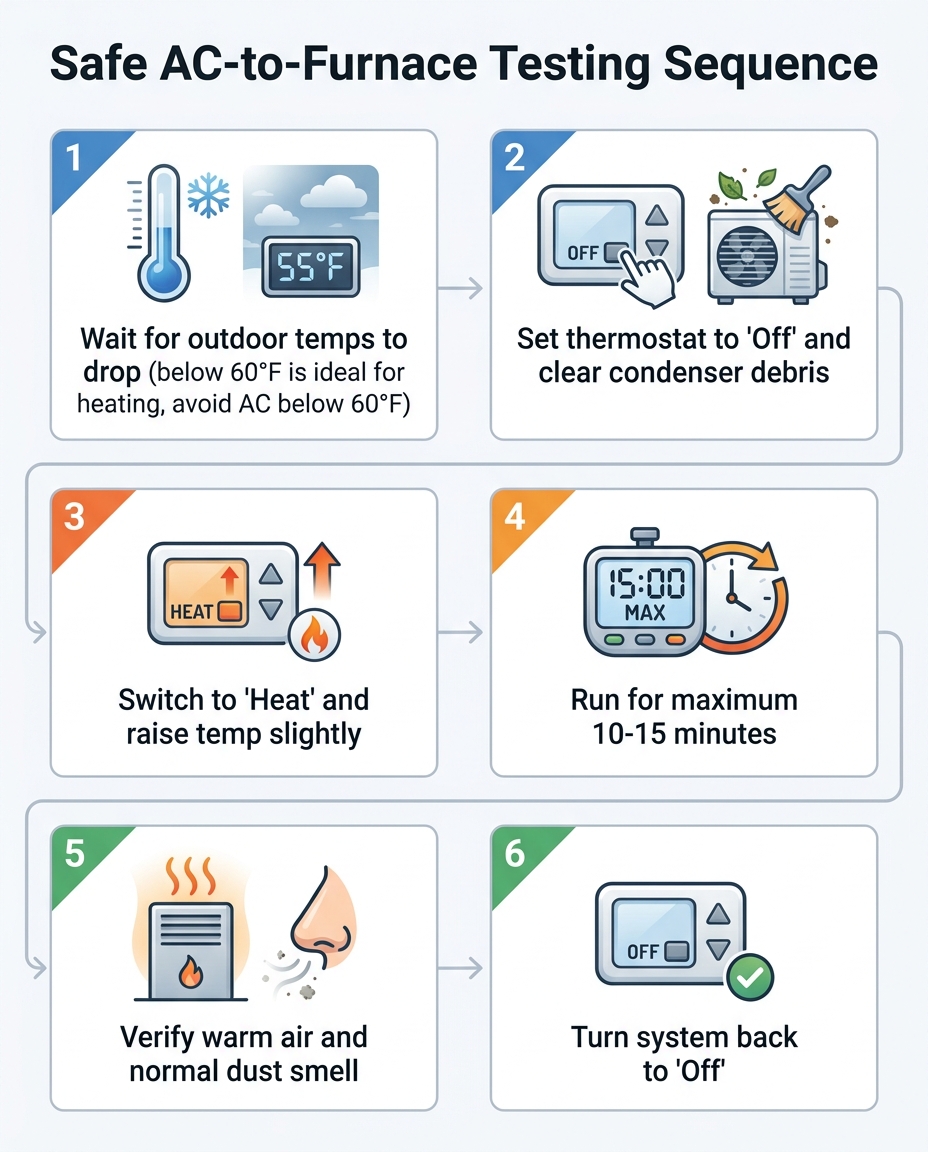
Once your cooling equipment is safely powered down and the outdoor temperature has naturally dropped below 60 degrees, you are ready to test the ignition. The goal here is a brief, controlled 10 to 15-minute test run. This gives the system enough time to cycle through its safety checks and produce heat, without overheating your home on a mild evening.
Performing this test correctly ensures your heating system is fully operational before the deep freeze arrives.
The safe testing sequence:
- Wait for the right evening: Choose a night when the outdoor temperature has naturally dropped into the 50s. This prevents your house from becoming uncomfortably hot during the test.
- Switch to 'Heat': Turn the thermostat from 'Off' to 'Heat'.
- Adjust the temperature slightly: Set the thermostat just three to four degrees above the current room temperature. This is enough to trigger a call for heat without demanding a long, extended cycle.
- Listen to the sequence: Stand near a vent or the furnace itself. You should hear the click of the thermostat, followed by the hum of the inducer motor, the click of the igniter, and finally, the rush of the main blower fan.
- Monitor the airflow: Place your hand over a nearby supply vent. Within a few minutes, you should feel a steady stream of noticeably warm air.
- Enforce the time limit: Let the system run for a strict maximum of 15 minutes. Once you have confirmed warm air is flowing steadily, turn the system back to 'Off'.

Decoding the 'Burning Dust' Smell on Startup
One of the most common reasons homeowners panic during their 10 to 15-minute test run—and a frequent late-summer call our dispatchers receive—is a distinct, slightly acrid smell coming from the vents. If you notice a burning odor during the first cycle of the season, it is important to stay calm. In almost all cases, this is completely normal.
Throughout the spring and summer, your heating equipment sits idle. During those months, microscopic particles of dust, pet dander, and household lint settle directly onto the cold metal of the heat exchanger. When you finally turn the system on, those metal components heat up rapidly, and that settled summer dust simply burns off.
This odor typically dissipates quickly, usually within the first 15 to 30 minutes of operation. Energy Star guidelines recommend ensuring clear airflow and changing your air filter before this first startup to minimize the amount of dust moving through the system.
Normal Odors vs. Warning Signs:
| Type of Odor | What It Smells Like | Cause | Required Action |
|---|---|---|---|
| Burning Dust | Slightly dry, dusty, campfire-like | Settled summer dust burning off the heat exchanger. | Normal. Open a window; it should fade in 15-30 minutes. |
| Electrical Burning | Melting plastic, ozone, hot wires | Overheating blower motor or failing electrical components. | Turn system off immediately and call for professional service. |
| Rotten Eggs / Sulfur | Distinct sulfur or garbage smell | Natural gas leak near the unit or gas valve. | Evacuate the home, call the gas company and a technician. |
By contrasting the normal dust smell with electrical burning or gas odors, you can easily tell when your system is just waking up from its summer nap versus when it requires immediate professional attention.
Identifying Silent Ignition Failures Before the Freeze
The entire purpose of testing your equipment during the late-summer August transition is to catch silent ignition failures before they become freezing emergencies. A silent failure happens when the thermostat asks for heat, but a mechanical issue stops the burner from actually lighting. Because the house is already relatively warm in August, you might not notice the failure unless you are actively listening for it.
Our technicians frequently respond to early November emergencies where a system stops working just as temperatures plummet, creating an urgent need for heat. A technician has to quickly diagnose the issue, retrieve a specific part, and repair the unit. Catching these symptoms months earlier prevents that exact stressful scenario.
Watch and listen for these specific failure symptoms:
- Repeated clicking without the blower turning on: If you hear a "click-click-click" sound but the main fan never engages, your igniter is likely failing to light the gas. The system's safety sensors are shutting it down before raw gas can build up.
- Blowing cold air after several minutes: If the main fan turns on but the air coming out of the vents remains cold after five minutes, the burner has failed to ignite, but the blower is still running its cycle.
- Short-cycling: Watch for the system turning on, running for just one or two minutes, and then shutting off abruptly, only to try again shortly after. This usually points to a dirty flame sensor or a clogged exhaust vent.
Catching these silent failures now gives you total control over the repair timeline, preventing you from waking up to a freezing house in a few weeks.
Beating the October Emergency Rush
There is a massive strategic advantage to testing your equipment early. The HVAC industry operates on highly predictable seasonal spikes. When you identify a problem during the late-summer August transition, you are operating in a calm scheduling window. When you wait until the first real frost in early to mid-October, you are joining hundreds of other Des Moines homeowners all calling for emergency service on the exact same morning.
Scheduling a standard repair in August means flexible appointment times, readily available parts, and zero stress. Scheduling an emergency call during the first frost often means premium after-hours fees, waiting in a queue, and rushing to find space heaters to keep your family warm. Proactive testing gives you a massive scheduling advantage.
When our technicians perform thorough seasonal maintenance, our customers consistently tell us how confident they feel before extreme weather hits. This is the exact peace of mind that comes with joining a structured service program like our Comfort Loyalty Program. It serves as the ultimate safety net, providing proactive inspections before the harsh Iowa winter begins, and guaranteeing priority service if something does go wrong.
Taking ten minutes tonight to run a safe test puts you entirely in control. If everything works, you can rest easy. If it doesn't, you have plenty of time to schedule fall furnace tune-ups on your own terms, long before the snow starts flying.
Frequently Asked Questions
When should I turn on my furnace for the first time?
You should turn on your furnace for a brief test run during late August or early September on an evening when outdoor temperatures drop below 60 degrees. Testing early allows you to catch ignition failures before the first real freeze hits in October. Waiting until your house is already freezing puts you at risk of joining the emergency service rush.
How long should I test my furnace before winter?
A safe test run should last a strict maximum of 10 to 15 minutes. This is just enough time to allow the system to cycle through its safety checks, ignite the burners, and push warm air through your vents. Running it any longer during mild weather will unnecessarily overheat your home and waste energy.
Why does my furnace smell like burning dust when I turn it on?
The burning dust smell is caused by the system burning off particles that have settled on the cold heat exchanger during the spring and summer months. This odor is completely normal and typically dissipates within 15 to 30 minutes of operation. If the smell resembles burning plastic, electrical wires, or sulfur, turn the system off immediately and call a professional.
Can I switch from AC to heat on the same day?
Switching from AC to heat on the exact same day is not recommended because it can cause short-cycling and put severe strain on your outdoor compressor. AC compressors should not be operated when it is cold out, and rapidly reversing the system's function can lead to electrical and pressure imbalances. Always wait for a naturally cool evening to test your heat.
What temperature should it be outside before I test my heat?
It should be consistently below 60 degrees Fahrenheit outside before you attempt to test your heating equipment. Running your air conditioner below this threshold can cause the compressor oil to thicken and lead to mechanical damage, so waiting for a cool evening ensures your AC is safely powered down first. This temperature also prevents your house from becoming uncomfortably hot during the test.
How do I know if my furnace igniter is failing?
A failing igniter will often produce a repeated clicking sound without the main blower fan ever turning on to deliver warm air. You might also notice the system blowing completely cold air, or turning on and shutting off rapidly in a process called short-cycling. If you observe any of these symptoms during your test run, you need a professional to inspect the ignition sequence.
Ready for the Transition?
Taking a few minutes to safely power down your AC and verify your heating equipment ensures you are never caught off guard by the first Iowa freeze. A clear, safe, non-technical test run gives you total peace of mind. If your system struggles to ignite, or you want the confidence of a professional inspection, securing your spot now guarantees a warm, stress-free winter.
