Why Is Your Furnace Humming But Not Starting?
Did you just turn up your thermostat for your September early fall startup, only to hear the specific sounds a failing draft inducer motor makes before your furnace quits—a strange hum or whine with no heat following? You are not alone in this frustrating experience. When you adjust the temperature, you expect to hear the familiar click of the thermostat, followed shortly by the rush of warm air through your vents. Instead, you are met with a prolonged, vibrating hum or a high-pitched screech coming from the furnace cabinet, and the burners never actually ignite.
If your system is struggling to start, our team's professional HVAC services can diagnose the issue before the cold weather sets in.
This specific timing—hearing a noise immediately after the thermostat calls for heat, but before any flames appear—points directly to a failure early in the heating cycle. Modern gas furnaces operate on a strict, non-negotiable timeline known as the pre-ignition sequence timing. Before a single drop of gas is released into the combustion chamber, the furnace must prove that it can safely vent dangerous exhaust gases out of your home. The component responsible for proving this safety step is the draft inducer motor. When this motor begins to fail, it acts as an early warning system, giving you a brief window of time to address the problem before you are left completely without heat.
What Is a Draft Inducer Motor and What Does It Do?
To understand why your furnace is making strange noises, you first need to understand the critical role of the draft inducer motor. Located inside the upper portion of your furnace cabinet, the draft inducer is a small, motorized fan that serves as the gateway to your entire heating process. It is a vital life-safety feature designed to protect your home from toxic combustion byproducts.
If you suspect this component is failing, scheduling heating repair and services with our experienced technicians immediately is the safest course of action.
When your furnace operates normally, the pre-ignition sequence timing follows a strict set of rules:
- The thermostat calls for heat: The temperature in your home drops below your set point, and a signal is sent to the furnace control board.
- The draft inducer motor activates: This is the very first mechanical action in the heating cycle. The small fan spins up to a high speed, creating a draft that pulls air through the heat exchanger.
- Residual gases are cleared: For 30 to 60 seconds, the inducer motor runs continuously. Its primary job during this window is to push any lingering, toxic gases (like carbon monoxide) from previous heating cycles out of the heat exchanger and safely up through the flue pipe to the outside of your home.
- The safety sequence is verified: Once the draft inducer achieves the correct speed and creates enough negative pressure, it signals the rest of the furnace that it is safe to proceed.
- Ignition begins: Only after the inducer motor proves it is venting properly will the igniter glow and the gas valve open to create a flame.
Because the draft inducer motor is the very first component to turn on, any mechanical or electrical failure within it will stall the entire heating process. This is a non-negotiable safety step. If the motor cannot clear the heat exchanger, the furnace will intentionally refuse to light to prevent carbon monoxide from backing up into your living space.
The 4 Specific Sounds a Failing Draft Inducer Motor Makes
When a draft inducer motor begins to fail, it rarely dies silently. Because it is a moving mechanical part exposed to extreme heat and constant cycling, it will almost always produce distinct auditory warnings. These noises occur exclusively before the gas valve opens or the burners light, making them easy to identify if you know what to listen for.
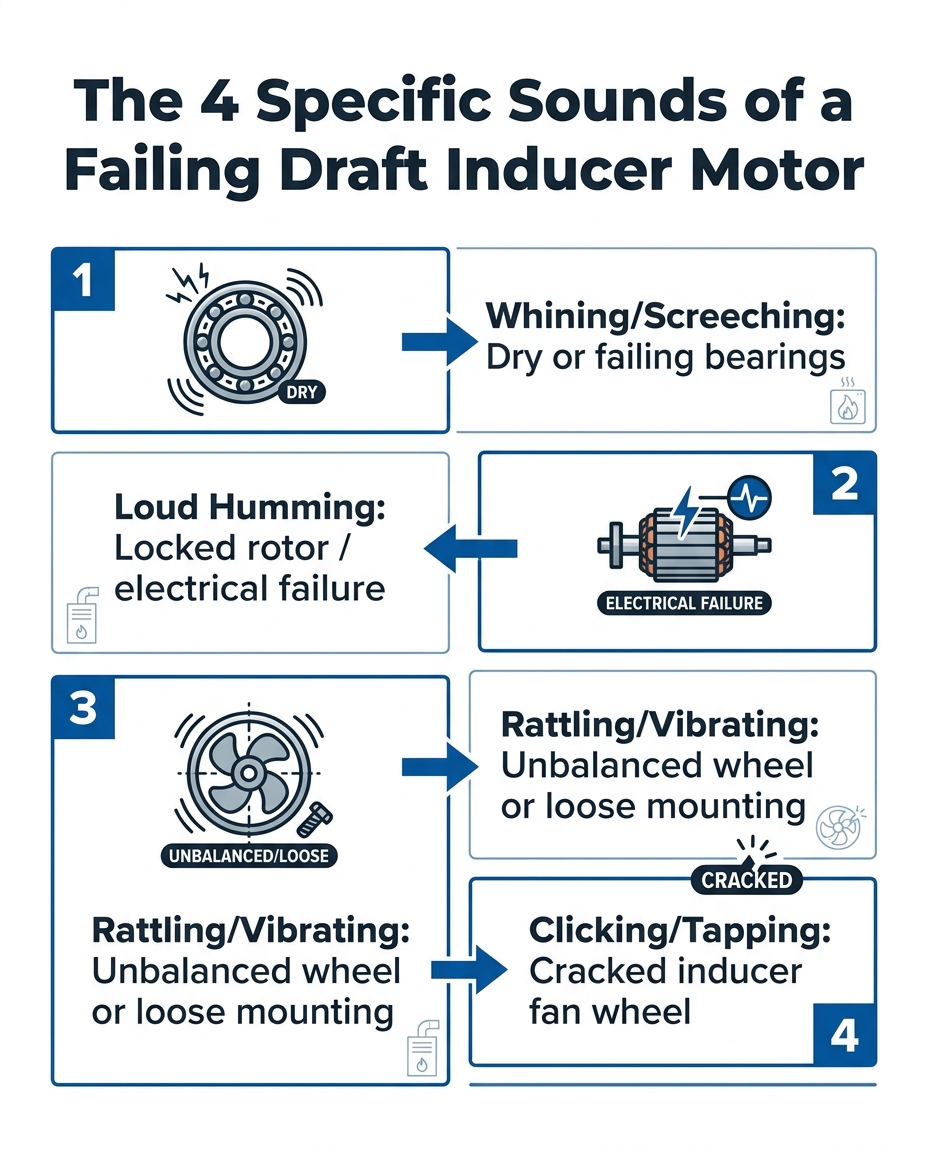
The most common sounds of a failing draft inducer include:
- High-Pitched Whining: Indicates dry or failing motor bearings.
- Loud Electrical Humming: Signals that the motor is receiving power but physically cannot spin (a locked rotor).
- Rattling or Vibrating: Suggests an unbalanced wheel, loose mounting hardware, or trapped debris.
- Clicking or Tapping: Points to a cracked inducer fan wheel striking the housing.
During a routine pre-season furnace service this early fall, our team at Midwest Comfort Heating & Cooling helped a customer who noted that their system had been making a faint noise at the end of the previous season. Our technicians were able to diagnose early motor wear, service the system, and provide helpful energy efficiency advice to keep the unit running optimally before the noise escalated into a complete breakdown.

High-Pitched Whining or Screeching
A high-pitched whine or screech is one of the earliest indicators of draft inducer trouble. This sound almost always points to failing or dry motor bearings. Over years of operation, the intense heat from the furnace can cause the factory lubrication inside the motor's sealed bearings to dry out or degrade. Without proper lubrication, the metal components grind against each other as the fan spins at high speeds.
What to watch for: This sound usually starts off relatively quiet—perhaps just a faint squeal when the furnace first kicks on—and gets progressively louder over several heating cycles. Eventually, the friction becomes so severe that the bearings seize completely, stopping the motor dead in its tracks.
Loud Electrical Humming
If you hear a loud, vibrating hum coming from the furnace cabinet but the fan is not spinning, you are likely dealing with an electrical failure or a seized motor. This is commonly referred to as a "locked rotor." When the thermostat calls for heat, the control board sends 120 volts of electricity to the inducer motor. The electrical current enters the motor's windings, creating a strong magnetic field intended to spin the fan.
What to watch for: If the bearings have completely seized, or if the motor capacitor has failed, the fan physically cannot turn. The electricity continues to surge through the stationary motor, creating a loud, aggressive hum. This is often accompanied by the furnace shutting down entirely shortly after, as the system realizes the motor is drawing too much power without actually moving air.
Rattling or Vibrating
A persistent rattling or heavy vibration during the pre-ignition sequence timing usually indicates a physical imbalance. The draft inducer fan wheel spins at a very high RPM. If that wheel becomes unbalanced—due to a buildup of soot, a broken fin, or debris that has fallen down the flue pipe—it will wobble aggressively on its axis.
What to watch for: This wobbling creates a heavy vibration that transfers through the motor housing and into the metal cabinet of the furnace itself. In some cases, the rattling is caused by the rubber isolation grommets deteriorating over time, allowing the entire motor assembly to shake loose from its mounting brackets.
Clicking or Tapping
A distinct, rhythmic clicking or tapping sound that speeds up as the fan accelerates is a clear sign of physical damage to the inducer wheel itself. Many draft inducer wheels are made of high-temperature plastics or lightweight alloys. Over thousands of heating cycles, the constant expansion and contraction from extreme temperature changes can cause these materials to become brittle and crack.
What to watch for: When the wheel cracks or warps, it loses its precise shape and begins striking the inside of the metal inducer housing as it spins. This creates a rapid tapping noise, much like a playing card stuck in the spokes of a bicycle tire. This requires immediate replacement, as the shattered wheel cannot pull enough draft to satisfy the safety sensors.
Why Your Furnace Locks Out and Refuses to Ignite
The Problem: You hear the hum or the whine, but the burners never light, and eventually, the furnace simply goes quiet and shuts down.
The Cause: This shutdown is a deliberate safety mechanism triggered by a vital sensor called the pressure switch. The pressure switch is connected to the draft inducer housing via a small rubber hose. Its sole purpose is to measure the negative pressure (the draft) created by the inducer motor. If the inducer motor fails to start, spins too slowly due to bad bearings, or has a shattered wheel, it will not create a strong enough vacuum.
When the vacuum is insufficient, the diaphragm inside the pressure switch will not close. The furnace control board constantly monitors this switch during the pre-ignition sequence timing. If the switch does not close within a specific time limit (usually about 60 seconds), the control board physically halts the heating cycle. It cuts power to the igniter and completely locks out the gas valve, preventing any raw fuel from entering the combustion chamber.
The Solution: This lockout is exactly how the furnace is designed to protect you. A humming noise followed by a complete shutdown means the system successfully prevented a potential gas buildup or carbon monoxide leak. To resolve the lockout, the failing draft inducer motor must be properly diagnosed and replaced by a professional so the pressure switch can detect the correct draft and allow the ignition sequence to proceed safely.
| Furnace Component Status | Normal Pre-Ignition Sequence | Failed Inducer Sequence (Lockout) |
|---|---|---|
| Draft Inducer Motor | Spins up smoothly to full speed | Hums, whines, or fails to spin |
| Pressure Switch | Detects strong draft, switch closes | Detects weak/no draft, switch stays open |
| Igniter / Spark | Glows brightly or sparks rapidly | Remains cold and inactive |
| Gas Valve | Opens to release fuel for combustion | Remains firmly locked shut |
The Dangers of Ignoring Pre-Ignition Furnace Noises
Ignoring a strange noise from your furnace is never a good idea, but ignoring a failing draft inducer motor carries unique and severe risks. A furnace lockout from a bad inducer motor means absolute zero heat production. While this might be a minor inconvenience during a mild autumn afternoon, it becomes a critical emergency during the extreme winter conditions we experience here in Des Moines IA. Over our years serving the local community, our team has responded to countless no-heat calls where a simple inducer motor warning sign was ignored.
With winter temperatures regularly plunging well below freezing, a sudden safety lockout during a January freeze is a dangerous situation that could have been prevented. When a furnace abruptly stops producing heat, the temperature inside a home can drop rapidly. Within a matter of hours, a house can become dangerously cold, putting vulnerable family members at risk and vastly increasing the likelihood of frozen and burst water pipes, which can cause catastrophic water damage to your property.
Even more concerning is a struggling inducer motor that still barely manages to work. If the motor is whining loudly but still managing to pull just enough draft to trick the pressure switch into closing, your furnace will light. However, if that struggling motor completely seizes and stops spinning mid-cycle, the flames will continue to burn for a brief moment without any exhaust venting. While modern safety limits are designed to catch this and shut the gas off quickly, repeated mid-cycle failures create a major carbon monoxide risk. Toxic exhaust gases can spill backward out of the heat exchanger and into your basement or utility room, eventually circulating through your air vents.
We urge you to treat these auditory warnings as an immediate call to action. A whining or humming furnace is actively begging for professional intervention before a catastrophic failure leaves you freezing in the dark.
Why Draft Inducer Motor Replacement Is Never a DIY Job
With the rise of online video tutorials, it can be tempting to try and swap out a noisy furnace part yourself to save time. However, replacing a draft inducer motor is strictly a job for licensed professionals. This is not a simple cosmetic fix; it involves handling highly sensitive life-safety systems.
Proactive care is always best when handled by our experts as part of a routine HVAC maintenance plan.
First, replacing an inducer motor requires working with high-voltage electrical connections. The motor draws 120 volts directly from the control board, and improper wiring can easily result in a dangerous electrical short, damage to the expensive circuit board, or a severe shock.
Second, and most importantly, the draft inducer motor connects directly to the heat exchanger and the flue exhaust piping. When a technician installs a new motor, they must ensure an absolutely perfect, airtight seal using high-temperature gaskets or specialized silicone. If a DIY installation leaves even a microscopic gap in this seal, toxic exhaust gases—including deadly, odorless carbon monoxide—will vent directly into your home instead of being pushed safely outside.
Finally, professional technicians have the specialized tools, such as digital manometers and combustion analyzers, to verify that the entire system is operating safely after the repair. They must test the pressure switch to ensure it is calibrated correctly to the new motor's draft, and they must verify that the gas valve is opening at the appropriate time. A DIY repair offers no way to guarantee that these critical safety interlocks are functioning as intended.
Proactive Solutions: Catching Furnace Issues Before Winter
The smartest approach to furnace health is catching problems before they evolve into emergencies. This is why a September early fall startup is highly recommended. By turning your thermostat up to 80 degrees on a mild autumn day and simply listening to the furnace run through its cycles, you can easily identify the specific whining, humming, or rattling noises of a failing draft inducer motor while the weather outside is still comfortable.
Catching a failing inducer motor early prevents emergency breakdowns on freezing nights. Just last season, our technicians helped a local Des Moines homeowner who experienced a sudden breakdown in early November when they urgently needed heat. Because they reached out to us immediately, a technician arrived quickly, diagnosed the failing part, and returned with the exact replacement to restore their heat—even fixing a second minor issue within the same hour.
Taking advantage of proactive maintenance programs can make this process even smoother. Enrolling in a program like the Comfort Loyalty Program provides the perfect safety net for homeowners testing their systems in early fall. These programs incentivize proactive, pre-season part replacements and routine checks, ensuring your equipment is thoroughly inspected by professionals before the first freeze hits. And if you do discover a problem during your test run, you have the peace of mind knowing that 24/7 emergency availability is just a phone call away, ensuring you never have to face a bitter winter night without reliable heat.
Frequently Asked Questions
What does a bad furnace inducer motor sound like?
A bad furnace inducer motor typically produces a high-pitched whine, a loud electrical hum, a heavy rattle, or a rhythmic tapping noise. These sounds occur at the very beginning of the heating cycle, immediately after the thermostat calls for heat and before the burners ignite. Whining usually indicates failing bearings, while a loud hum suggests a seized motor that cannot spin.
Will a furnace run with a bad inducer motor?
No, a furnace will safely lock itself out and refuse to run if the inducer motor is completely bad. The system relies on a pressure switch to verify that the inducer motor is successfully venting exhaust gases. If the motor fails to create a strong enough draft, the pressure switch remains open, and the control board will physically block the gas valve from opening.
Why is my furnace humming but not starting?
If your furnace is humming but not starting, it usually means the draft inducer motor is receiving electrical power but the fan wheel is physically stuck. This is known as a locked rotor, often caused by seized bearings or a failed motor capacitor. The humming is the sound of electrical current surging through the stalled motor just before the furnace shuts itself down for safety.
How do I know if my inducer motor is bad?
You can tell your inducer motor is bad if you hear distinct screeching or vibrating noises during the first 60 seconds of the heating cycle, or if the furnace repeatedly shuts off before the flames ever ignite. Additionally, if the motor feels excessively hot to the touch (if you were to carefully open the cabinet) or smells like burning electrical wire, it is actively failing.
Can a failing draft inducer motor cause a carbon monoxide leak?
Yes, a failing draft inducer motor can create a severe carbon monoxide hazard if it stops working mid-cycle or if its housing cracks. The motor's primary job is to push toxic combustion gases out of the heat exchanger and up the flue pipe. If the fan fails while the gas burners are lit, those exhaust gases can spill backward into your home's air supply.
How long does a draft inducer motor typically last?
A draft inducer motor typically lasts between 10 and 15 years, closely mirroring the average lifespan of the furnace itself. However, factors like excessive dust, poor furnace maintenance, moisture in the flue pipe, or an oversized heating system that short-cycles frequently can cause the motor bearings to wear out much earlier than expected.
