

Does Closing Registers Actually Lower Your Energy Bill?
Are you wondering if the truth about closing vents in unused rooms to save heating costs will actually change how you prepare your home for winter? The short answer is yes, and the reality often surprises homeowners who are just trying to lower their monthly energy bills. Here at Midwest Comfort Heating & Cooling, we frequently hear Des Moines homeowners asking this exact question as temperatures begin to drop. You face a common decision point: deciding whether to close off registers in unused guest bedrooms and basements to save money, or keep them open to maintain proper airflow. It seems entirely logical to shut the vent in a room nobody is using. After all, if you turn off the lights in an empty room to save electricity, shouldn't you stop pumping hot air into an empty room to save gas or electricity?
No, closing vents in unused rooms does not save heating costs; it actually increases static pressure and damages your system. Your home's central heating is not a collection of independent space heaters. It is a carefully balanced, closed-loop ecosystem designed to distribute a highly specific volume of air throughout the entire house. When you shut a register, the furnace does not magically produce less heat or consume less fuel. Instead, it continues generating the exact same amount of thermal energy, but now it has fewer pathways to distribute that air.
If you want to ensure your HVAC system operates at peak efficiency this winter, you need to understand how restricting airflow works against you. Relying on professional heating services and proper system balancing is the only proven way to reduce your energy consumption without putting your vital equipment at risk.
Understanding Airflow Dynamics: The 'Thumb Over a Hose' Analogy
To understand why shutting a vent is harmful, you need to look at the physics of modern HVAC blowers. Every furnace blower is calibrated at the factory to push a specific amount of air, measured in cubic feet per minute (CFM). When the system is installed, the ductwork is sized to accommodate that exact CFM rating. The blower motor expects a certain amount of resistance, and the system is balanced to operate smoothly under those precise conditions.
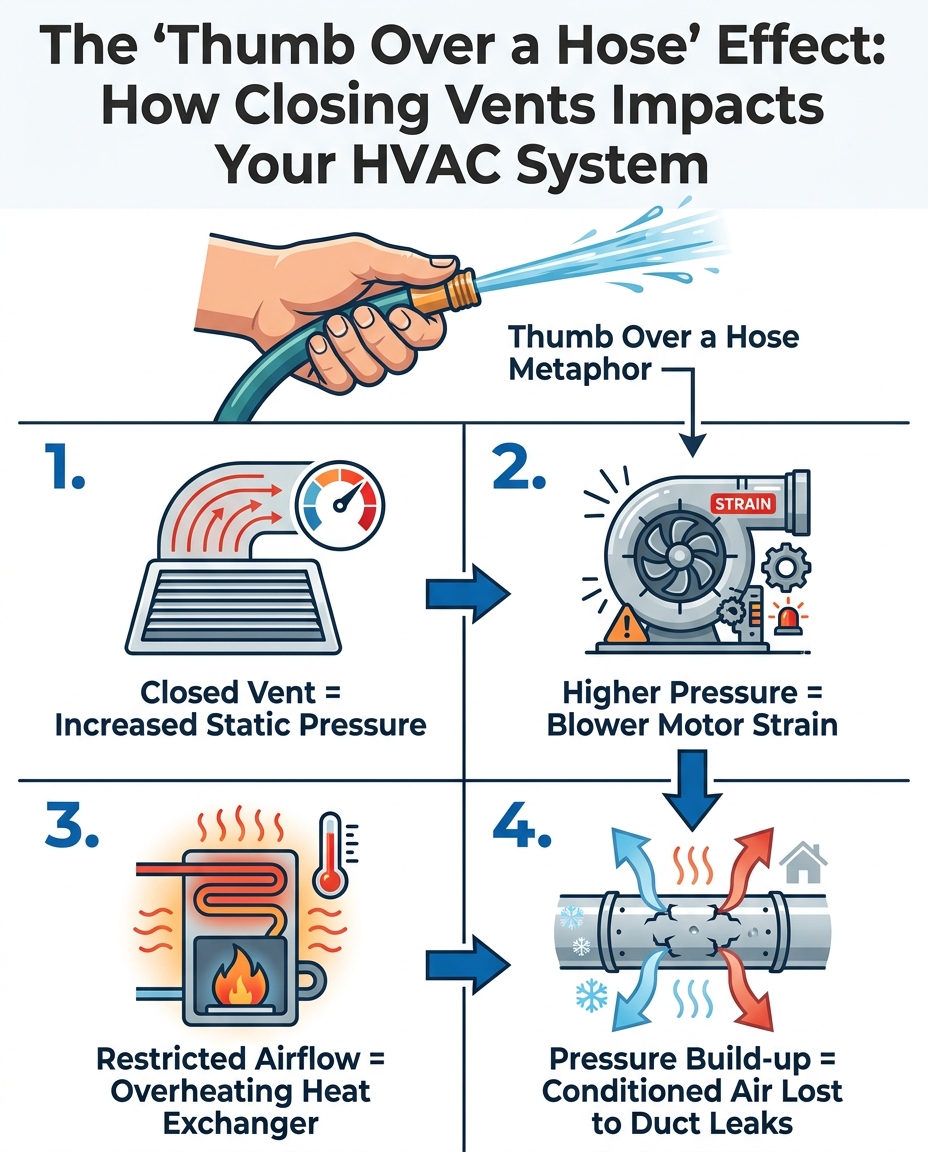
A helpful way to visualize this is the "thumb over a running hose" analogy. If you turn on a garden hose, water flows out freely. If you place your thumb over half of the nozzle, you do not reduce the amount of water coming from the spigot. You simply restrict its exit. The water pressure behind your thumb builds up intensely, and the water sprays out forcefully. In your ductwork, closing a vent acts just like your thumb on the hose. The furnace blower is still pushing the exact same CFM of air into the supply ducts, but you have removed one of the exit points.
This restriction leads directly to elevated static pressure in ductwork. Static pressure is the resistance to airflow in your heating and cooling system. When you close registers, the air has nowhere to go, causing pressure to spike inside the sheet metal or flex ducting. The furnace continues to consume the exact same amount of energy, but now it is fighting against a wall of its own pressurized air.
| System Condition | Static Pressure Level | Blower Motor Strain | Energy Consumption |
|---|---|---|---|
| All Vents Open | Normal / Balanced | Low (Operating as designed) | Standard baseline |
| 1-2 Vents Closed | Moderately Elevated | Increased RPMs and heat | Slightly higher due to motor effort |
| Multiple Vents Closed | Dangerously High | Severe (Risk of failure) | High (Wasted via duct leakage) |

The Hidden Dangers to Your Blower Motor and Heat Exchanger
The Problem: When you increase the static pressure in your ductwork by closing vents, the immediate victim is your furnace's blower motor. Modern systems often use Electronically Commutated Motors (ECM) designed to adjust their speed to maintain a constant airflow. When an ECM senses resistance from a closed vent, it automatically ramps up its RPMs to try and push past the blockage. This forces the motor to work exponentially harder, drawing more electricity and generating excess heat within the motor housing itself.
The Cause: Beyond the motor, restricted airflow creates a severe hazard for the heat exchanger. The heat exchanger is the metal component that actually warms the air before it is circulated through your home. It relies on a constant, high-volume flow of cool return air passing over it to absorb the heat and keep the metal from getting too hot. When you close vents, less air circulates. The heat exchanger cannot shed its thermal energy fast enough, causing the internal temperature of the furnace to spike dramatically. When this happens, the system's high-limit safety switch will trip, shutting down the burners to prevent a fire hazard or cracked metal.
The Solution: Keeping all registers open allows the system to breathe normally, preventing this dangerous overheating cycle. Prolonged strain from closed vents accelerates wear and tear, often leading to premature blower motor failure long before the system's expected lifespan is reached.
This isn't just a theoretical risk. In our years of servicing Des Moines HVAC systems, our team typically sees this pattern emerge during early fall cold snaps. Recently, one local customer reached out when their heat stopped working entirely, pushing out only weak, lukewarm air instead of warming the house. Our Midwest Comfort Heating & Cooling technicians diagnosed the issue as a faulty blower motor that had burned itself out from pushing against restricted airflow. We were able to replace the blower motor and confirm the rest of the furnace was still functional, saving them from having to replace the entire system. However, this kind of emergency repair is entirely preventable simply by allowing the system to operate with open, unobstructed vents.
- Frequent short-cycling: The furnace turns on and off rapidly because the high-limit switch keeps tripping from trapped heat.
- Unusual humming or whining: A strained blower motor will often become noticeably louder as it fights against high static pressure.
- Weak airflow at open vents: Counterintuitively, closing one vent can disrupt the pressure balance so much that the remaining open vents actually deliver less air.
- Higher electrical usage: Variable-speed motors consume significantly more electricity when forced to run at maximum RPMs to overcome blockages.
Duct Leakage: Where Your Forced Air Actually Goes
When you close a vent, you might assume the warm air simply travels down the ductwork to the next open register, delivering extra heat to the rooms you are actually using. Unfortunately, fluid dynamics do not work that way. When pressure builds up in the supply ducts, the forced air immediately looks for the path of least resistance.
The Path of Least Resistance
No residential ductwork is perfectly airtight. Even in newer homes, duct systems are assembled from sections of sheet metal, fiberglass board, or flexible tubing joined together with screws, tape, and mastic. Under normal operating pressures, these tiny seams and joints hold up fine. But when you close registers and artificially spike the static pressure, that trapped air exerts immense force on every single joint in the duct run.
This pressure forces your freshly conditioned, expensive warm air out through tiny, unsealed seams in the ductwork before it ever reaches your living space. Instead of heating the master bedroom or the living room, you end up heating the attic, the crawlspace, or the inside of your basement walls. You are paying to run the furnace, but the heat is bleeding out into unconditioned zones where you cannot feel it.
This phenomenon is closely related to the hidden risks of blocking return vents. Whether you restrict the supply side by closing registers, or restrict the return side by pushing a sofa over a grille, you are choking the system's airflow. Both actions cause a severe pressure imbalance that forces conditioned air out of the ducts and pulls unconditioned, dusty air in from the walls, destroying your home's energy efficiency.
Why Iowa Winters Turn Airflow Issues into Safety Risks
Understanding airflow is important everywhere, but our local climate dramatically changes the stakes. As the team at Midwest Comfort Heating & Cooling knows all too well, Des Moines winters are freezing and demand continuous heating. When average low temperatures plummet into the teens or single digits, your furnace must run almost continuously to maintain safe indoor temperatures and keep the frost at bay.
Closing vents during peak Iowa cold snaps forces the furnace to push against high static pressure exactly when it is working its hardest. During a mild early fall day, a furnace might only run for ten minutes at a time, giving a strained blower motor a chance to cool down between cycles. But in the dead of winter, that same motor might run for forty-five minutes out of every hour. If it is fighting against closed registers the entire time, the friction and heat buildup compound rapidly.
A mid-winter blower motor burnout isn't just an inconvenience; it's a severe safety risk for the home and its plumbing. If your furnace fails overnight during a sub-zero freeze because the motor finally gave out from high static pressure, the temperature inside your house will drop dangerously fast. This puts your family's comfort at risk and creates a high probability of frozen, bursting water pipes that can cause thousands of dollars in water damage. System reliability depends entirely on unobstructed airflow, and gambling with that airflow during a Midwestern winter is never worth the perceived energy savings.
Better Alternatives for Early Fall Pre-Heating Season Prep
If closing vents is off the table, how can you actually manage your heating costs and keep your home comfortable? The key is focusing on early fall pre-heating season prep as the critical window to balance airflow and ensure your system is ready for the heavy lifting ahead. Taking proactive steps now prevents pressure-related breakdowns later.
- Verify all registers are fully open: Walk through every room in your house, including unused guest rooms, bathrooms, and basements. Ensure the louvers on every supply register are dialed completely open. Check that no heavy furniture, area rugs, or floor-length curtains are obstructing the airflow.
- Upgrade to a smart thermostat with room sensors: If your goal is to avoid overheating unused rooms while keeping the main living areas comfortable, a smart thermostat is the correct technological solution. By placing remote temperature sensors in the rooms you actually use, the thermostat will average the temperature based on occupancy, shutting the furnace off when the occupied rooms reach the target temperature, without requiring you to physically restrict airflow anywhere.
- Invest in a zoned HVAC system: If you truly want to stop heating unused portions of the house, you need a professionally installed zoning system. These systems use motorized dampers inside the ductwork that communicate with the main blower, safely reducing the motor's speed when a zone closes so that static pressure remains perfectly balanced.
- Schedule your seasonal tune-up: The most effective way to ensure your system is operating efficiently is through routine heating maintenance. During a tune-up, a technician will actually measure the static pressure using a manometer, check the blower motor's amp draw, and verify the temperature rise across the heat exchanger.
The smart approach: As your local Des Moines HVAC experts, we highly recommend joining our Comfort Loyalty Program as a proactive way to ensure your heating system maintains proper airflow year-round. Regular professional inspections allow us to catch pressure-related wear and tear early, clean the blower wheel to maximize CFM output, and guarantee your furnace is dialed in for maximum efficiency before a mid-winter breakdown occurs.
Frequently Asked Questions About Heating Efficiency and Airflow
Does closing vents save heating costs?
No, closing vents in unused rooms does not save heating costs. In fact, it disrupts the system's delicate pressure balance, causing significant energy waste through duct leakage and reduced efficiency. Because the furnace generates the same amount of heat regardless of open or closed vents, restricting the airflow simply forces that warm air out through unsealed duct joints into your attic or crawlspace. You end up paying for heat that never reaches your living areas.
Why is my furnace overheating?
Restricted airflow prevents the blower from pulling enough cool return air over the heat exchanger. This causes internal temperatures to spike rapidly, triggering the high-limit safety switch to shut the system down. When vents are closed or air filters are heavily clogged, the metal heat exchanger cannot shed the thermal energy it produces. Repeated overheating causes the furnace to short-cycle and can eventually crack the heat exchanger, requiring a major repair.
What happens if you block a heating vent?
Blocking a heating vent increases static pressure inside the ductwork almost instantly. This forces the blower motor to work much harder to push the required volume of air, accelerating wear and potentially causing premature failure. Whether the vent is blocked intentionally by closing the louvers, or accidentally by placing a couch or rug over it, the physical restriction creates a bottleneck that strains the entire forced-air system.
How many vents can I safely close?
HVAC professionals recommend keeping all vents open to maintain proper system balance and optimal airflow. Closing even one or two vents can alter the static pressure enough to impact performance and efficiency. Modern systems are designed with a specific ductwork layout calculated to match the blower's cubic-feet-per-minute (CFM) output. Removing any of those supply points throws off the math and creates unnecessary resistance.
Does closing vents redirect heat to other rooms?
While it may seem like air is redirected to open vents, the increased pressure actually forces the air out of microscopic duct leaks before it arrives. This results in less heated air reaching the intended living spaces overall. Even if a slight increase in airflow is felt at the remaining open registers, the overall volume of conditioned air successfully delivered to the home drops because the blower motor cannot overcome the immense static pressure buildup.
Keep Your Vents Open and Your Home Comfortable
A clear, scientifically grounded understanding of static pressure proves that keeping your vents fully open is always the best strategy for your home. Treating your central heating like a collection of space heaters only leads to wasted energy, severe blower motor strain, and the risk of a cracked heat exchanger. Your HVAC equipment is engineered to breathe, and restricting that airflow works against the very design of the machinery.
Managing your heating efficiency safely means relying on proper maintenance and smart thermostat technology, not restricting airflow to unused rooms. As the weather cools down, take the time to walk through your home and ensure every register is clear and open. Then, protect your investment by scheduling a professional inspection to measure your static pressure and ensure your system is fully prepared for the winter ahead.
