
Preparing for the Deep Freeze: Making the Right Furnace Choice This Fall
When September arrives and the leaves begin to turn, comparing single-stage vs two-stage furnaces for unpredictable Iowa winters becomes a top priority for homeowners looking to replace aging heating equipment. The fast-approaching heating season creates a sense of urgency, especially if your current system struggled through the end of last winter. Deciding whether the enhanced comfort and efficiency of a two-stage furnace justifies the higher conceptual upfront investment is a major decision. The core of this choice comes down to how the equipment operates: do you want a system that blasts heat at 100% capacity every time it turns on, or one that adapts to the fluctuating daily temperatures we experience during the mild September/October transitions to deep winter freezes?
Making the right choice now ensures your home remains comfortable long before the first polar vortex hits. If you are exploring your options for comprehensive HVAC services, understanding how these two distinct technologies handle local climate extremes is the first step toward a more comfortable, energy-efficient home.
Understanding Single-Stage Furnaces: The All-or-Nothing Approach
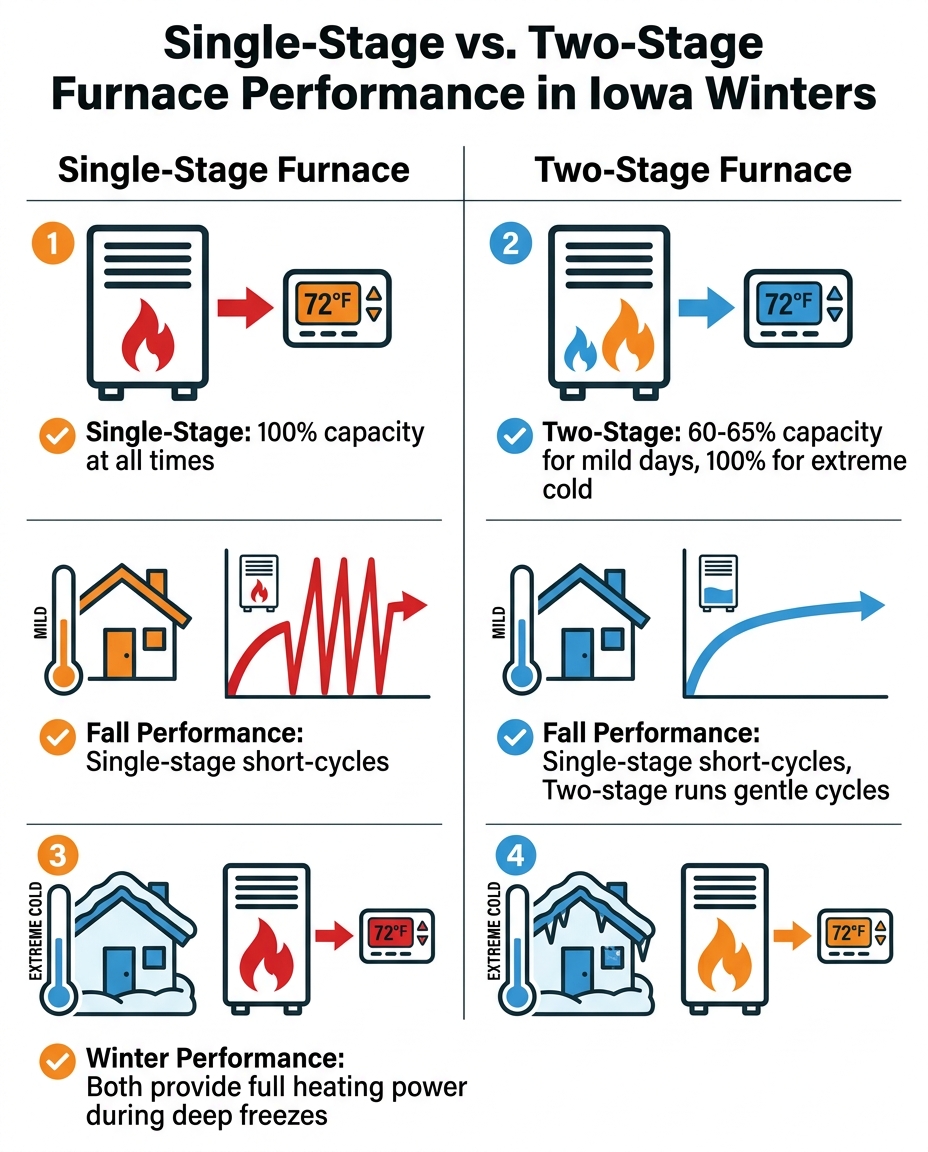
To make an informed decision about your home's heating, it helps to understand the baseline technology that has powered American homes for decades. A single-stage furnace operates on a very simple premise: it is either completely on, or completely off. Whenever the thermostat calls for heat, the system fires up its burners and runs at 100% of its heating capacity, regardless of what the temperature is outside.
The Mechanics of Traditional Heating
The problem: This all-or-nothing approach is highly effective at generating heat, but it lacks the nuance required for transitional seasons in the Des Moines metro area. On a mild 55-degree autumn day, your home only needs a gentle push of warm air to maintain a comfortable 70 degrees indoors.
The cause: Because a single-stage furnace can only operate at its maximum output, it quickly floods the home with too much heat. The thermostat registers that the target temperature has been reached (or exceeded) in a matter of minutes, and immediately shuts the system down. This phenomenon is known as short-cycling.
The solution: While upgrading your equipment through professional heating installation and replacement can resolve these issues, it is important to recognize the specific drawbacks of sticking with single-stage technology. Short-cycling leads to uneven temperatures across different rooms, noticeable cold spots, and significantly increased wear and tear on the furnace's internal components. Just as driving a car in stop-and-go traffic burns more gas and wears out the brakes faster than highway driving, a furnace that constantly starts and stops will consume more energy and face a higher risk of premature breakdowns. While these systems generally come with a lower initial equipment cost, they fundamentally lack the adaptability needed for shoulder seasons.
How Two-Stage Furnaces Adapt to Fluctuating Weather
A two-stage furnace, as the name implies, offers two distinct levels of heat output. Instead of only having a "high" setting, these systems feature a gas valve and blower motor that can operate at a lower capacity—typically around 60% to 65% of the system's total power—as well as a full 100% capacity for extreme conditions.
Perfectly Suited for the Des Moines Climate
This dual-capacity design is perfectly suited for the specific climate challenges of Des Moines, where a pleasant 70-degree afternoon can rapidly drop to a freezing 40-degree night. During the mild September/October transitions to deep winter freezes, a two-stage furnace will almost exclusively run on its lower stage. By operating at 60% capacity, the system produces a gentler, more continuous stream of warm air.
- Longer, gentler heating cycles: Because the furnace isn't blasting maximum heat, it runs for longer periods before reaching the thermostat's setpoint. This eliminates the abrupt temperature swings associated with single-stage units.
- Elimination of short-cycling: The lower heat output perfectly matches the mild heating demand of early fall, preventing the system from rapidly turning on and off.
- Improved indoor air quality: Longer run cycles mean that the air in your home is circulating through the furnace filter more frequently, trapping more dust, allergens, and airborne particles.
- Better humidity control: Consistent air circulation helps maintain more balanced indoor humidity levels, preventing the dry, stale air that often plagues homes in the winter.
When the true deep freeze arrives in January and temperatures plummet below zero, the two-stage furnace automatically detects that the lower stage is no longer sufficient to keep up with the heat loss. It seamlessly shifts into its second stage, utilizing its full 100% capacity to ensure your home stays perfectly warm even on the coldest nights of the year.
Side-by-Side Comparison: Single-Stage vs. Two-Stage Performance
To help visualize the differences between these two technologies, it is helpful to look at a direct comparison of how they perform across various metrics throughout the Des Moines metro area heating season.
| Performance Metric | Single-Stage Furnace | Two-Stage Furnace |
|---|---|---|
| Heat Output | 100% capacity only (All-or-nothing) | 60-65% low stage / 100% high stage |
| Temperature Consistency | Noticeable temperature swings (1-3 degrees) | Highly consistent, even temperatures |
| Fall/Mild Weather Performance | Prone to short-cycling and uneven heating | Runs smooth, gentle cycles on low stage |
| Deep Winter Performance | Provides maximum heat to keep up with extreme cold | Automatically shifts to 100% capacity when needed |
| Energy Efficiency (AFUE) | Generally lower to mid-range efficiency | Typically higher efficiency ratings |
| Initial Equipment Investment | Lower conceptual upfront cost | Higher conceptual upfront cost |
The primary takeaway: While both systems will successfully keep your home warm when the temperature drops below zero, the two-stage system provides vastly superior comfort, quieter operation, and better energy management during the other 75% of the heating season.

Weighing the Investment: Is a Two-Stage System Worth It?
One of the most common questions homeowners ask during a heating replacement is whether the advanced technology of a two-stage system is truly worth the investment. It is true that two-stage furnaces represent a higher initial equipment cost compared to traditional single-stage models. However, evaluating the total value requires looking beyond the day of installation.
Long-Term Savings and System Lifespan
Because a two-stage furnace spends the majority of its life operating on its lower, energy-conserving stage, it consumes less fuel over the course of a typical winter. Furthermore, the reduction in short-cycling means the internal components—such as the blower motor, ignitor, and heat exchanger—experience significantly less mechanical stress. This reduced wear-and-tear often translates to fewer mid-season breakdowns and a longer overall lifespan for the equipment, helping to offset the initial equipment costs over time.
Additionally, qualifying high-efficiency two-stage installations may be eligible for generic federal tax credits or local utility incentives. While programs vary, taking advantage of these incentives can help bridge the gap in upfront investment. Exploring flexible financing options can also make upgrading to a premium system highly manageable on a monthly basis.
The Importance of Professional Sizing
At Midwest Comfort Heating & Cooling, our expertise lies in matching the exact right furnace technology to a homeowner's specific layout, comfort needs, and budget. We perform rigorous professional load calculations to ensure your new system is perfectly sized. An oversized two-stage furnace will still short-cycle, negating all of its benefits.
For example, one local homeowner recently needed to replace a 30-year-old AC and furnace unit during a busy summer. Our installers worked seamlessly around their ongoing driveway replacement to complete the job on schedule, and our team even assisted with the necessary rebate paperwork to ensure they received the maximum available incentives for their high-efficiency upgrade. Getting the installation right is just as important as picking the right equipment.
Exploring Alternative High-Efficiency Options for Cold Climates
While natural gas furnaces are the traditional standard for heating in the Des Moines metro area, modern heating technology offers several other high-efficiency paths that are worth exploring before making a final replacement decision.
Cold-Climate Heat Pumps
Historically, heat pumps were only recommended for mild southern climates because they struggled to extract heat from the air when temperatures dropped below freezing. Today, advancements in variable-speed compressor technology have changed the landscape. Modern cold-climate heat pumps can efficiently heat a home even when outdoor temperatures dip well below zero. If you are interested in moving away from fossil fuels or maximizing your home's electrical efficiency, learning about cold climate heat pump performance in Iowa winters is a highly recommended step.
Dual-Fuel (Hybrid) Systems
For homeowners who want the ultimate in flexibility and efficiency, a dual-fuel or hybrid system combines an electric heat pump with a traditional gas furnace.
- Mild fall days: The heat pump handles all the heating duties using highly efficient electricity.
- Deep winter nights: When the temperature drops past the heat pump's optimal efficiency point, the system automatically switches over to the gas furnace for heavy-duty heating.
This hybrid approach allows you to leverage the most cost-effective fuel source at any given time, providing unparalleled adaptability for unpredictable weather patterns.
Protecting Your Heating Investment Before the Freeze
Regardless of whether you choose a single-stage furnace, a two-stage unit, or a hybrid system, heading into late fall with an aging or unmaintained system carries significant risks. The mild September/October transitions to deep winter freezes can lull homeowners into a false sense of security, only for their equipment to fail during the first major cold snap when HVAC companies are busiest.
The Value of Proactive Action
One local homeowner experienced this firsthand when their older furnace suddenly stopped running in early November just as freezing weather was expected. Fortunately, a technician was able to quickly identify the issue, retrieve the necessary part, and repair the furnace to get it running again. However, relying on emergency repairs is stressful and often preventable.
Proactive replacements prevent these emergency no-heat situations entirely. If your current system is over 15 years old, requires frequent repairs, or struggles to heat your home evenly, scheduling an estimate while the weather is still relatively mild gives you the time to make a thoughtful, unhurried decision.
If your system is newer, enrolling in a preventative maintenance plan is the single best way to protect your investment. Regular professional tune-ups extend the lifespan of whichever furnace type you own, ensure safe operation, and keep the system running at its peak efficiency all winter long.
Frequently Asked Questions About Furnace Upgrades in Iowa
Is a two-stage furnace worth the investment in Iowa?
Yes, a two-stage furnace is generally highly recommended for Iowa's climate because it adapts effortlessly to wide temperature swings. It provides efficient, gentle comfort during mild falls and shifts to maximum power for harsh winter deep freezes. The resulting energy savings and improved indoor comfort often justify the initial cost over the lifespan of the unit.
Why does a single-stage furnace short-cycle in the fall?
A single-stage furnace operates at 100% capacity every time it turns on. On mild 50-degree days in the fall, it produces too much heat too quickly for the home's actual needs, causing the thermostat to shut the system off rapidly. This continuous on-and-off process is known as short-cycling and can lead to uneven temperatures and premature wear.
How does a two-stage furnace work during a deep freeze?
When outdoor temperatures drop significantly and the home begins losing heat rapidly, the two-stage furnace detects that its lower 60% stage cannot keep up with the thermostat's demand. It automatically shifts into its second stage, utilizing its full 100% heating capacity to maintain indoor warmth and combat the extreme cold.
Does a two-stage furnace run constantly?
While it does not run constantly, a two-stage furnace does run for longer, gentler cycles at a lower capacity compared to a single-stage unit. These longer cycles actually use less energy than frequent on/off short-cycling, and they provide significantly more even heating and better humidity control throughout the home.
What is the disadvantage of a two-stage furnace?
The primary disadvantage of a two-stage furnace is a higher conceptual initial equipment cost compared to a traditional single-stage unit. Additionally, the internal components are more technologically advanced, which can sometimes make out-of-warranty repairs slightly more complex, underscoring the importance of routine preventative maintenance.
Can I get tax credits for upgrading my furnace?
Qualifying high-efficiency furnaces and heat pumps may be eligible for federal tax credits and local utility rebates designed to encourage energy conservation. Because these programs frequently change, you should always verify current programs and eligibility requirements with a professional HVAC installer or a tax advisor before making your purchase.
Secure Your Winter Comfort with the Right Heating Solution
Ultimately, the right furnace choice depends on striking the perfect balance between your upfront budget and your desired long-term comfort. A clear, climate-specific comparison reveals that while single-stage furnaces get the job done, two-stage systems are uniquely equipped to handle the wild temperature swings of the Des Moines metro area effectively and efficiently.
Don't wait until the first blizzard is in the forecast to evaluate your heating needs. By taking action in the early fall, you gain the time to weigh your options, explore high-efficiency models, and ensure your home is prepared for whatever the weather brings. Contact a professional today to book a consultation and secure your family's winter comfort with a heating solution tailored exactly to your home.
