
Cold Climate Heat Pump Performance in Iowa Winters: What You Need to Know
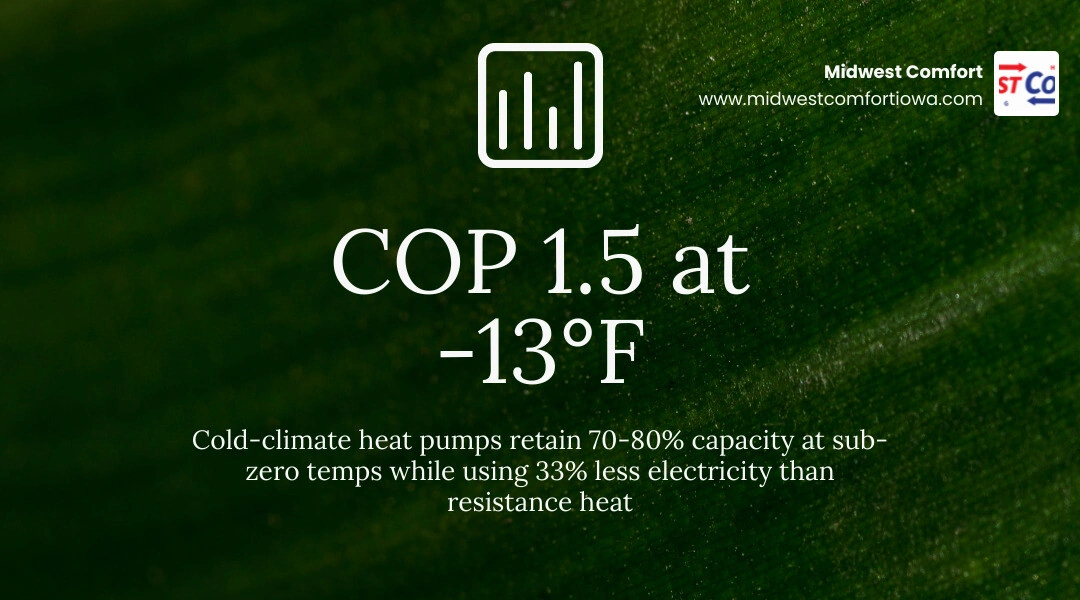
Cold climate heat pump performance in Iowa winters is a lot better than most homeowners expect. Modern cold-climate heat pumps can maintain 70% to 80% of their rated heating capacity even at -13°F, and they deliver a COP (coefficient of performance) of around 1.9 at 5°F and 1.5 at -13°F. That means even on Iowa's coldest days, these systems produce significantly more heat per unit of electricity than electric resistance heating.
Here is a quick snapshot of what to expect:
| Outdoor Temperature | Typical COP | Capacity Retained |
|---|---|---|
| 47°F | ~3.5 | 100% (rated) |
| 32°F | ~2.9 | ~90% |
| 17°F | ~2.2 | ~80% |
| 5°F | ~1.9 | ~70-75% |
| -13°F | ~1.5 | ~70-80% |
Iowa sits in climate zones 5 and 6, where temperatures dip below 5°F for roughly 100 to 200 hours per year — that is only 2% to 4% of the entire heating season. A properly sized cold-climate heat pump can handle 96% to 98% of your home's heating needs without ever calling on backup heat.
If you have been wondering whether a heat pump can really keep your Des Moines home warm when a polar vortex rolls in, the honest answer is: yes, with the right equipment and installation. The old reputation of heat pumps as "only good for mild winters" is based on older technology that no longer reflects what today's inverter-driven systems can do.
This guide breaks down the real performance numbers, the key technical factors, and the best system choices for Iowa homeowners — so you can make a confident decision about your home's heating.
Cold climate heat pump performance in iowa winters terms you need:
Evaluating Cold Climate Heat Pump Performance in Iowa Winters
When the winter wind sweeps down from the north across places like Grimes, Johnston, and Polk City, heating systems in Central Iowa face a brutal test. To understand how a modern system handles these extremes, we have to look closely at how does a heat pump work in extreme cold climates.
Older heat pumps relied on single-stage compressors. These systems were either fully on or fully off, and their ability to extract heat dropped drastically as soon as the temperature fell below freezing. Today's cold-climate heat pumps are built with inverter-driven, variable-speed compressors. Instead of shutting down or losing all capacity, they adjust their speed in real-time to match the heating demand of your home.
Furthermore, engineering advancements like vapor-injection technology allow the system to boost refrigerant flow and compression efficiency when outdoor temperatures drop below zero. This means that even when the air outside feels absolutely freezing, the refrigerant in the outdoor unit is cold enough to absorb what little thermal energy remains in the air and pump it inside your home.
Real-World Expectations for Cold Climate Heat Pump Performance in Iowa Winters
Many homeowners ask us what kind of efficiency they will actually see when temperatures drop. Efficiency is measured by the Coefficient of Performance (COP). A COP of 1.0 means the system delivers exactly the same amount of heat energy as the electrical energy it consumes (which is the efficiency of standard electric baseboard heaters).
In the real world, the benefits of heat pump installation shine through because a cold-climate heat pump delivers:
- At 5°F: A typical COP of 1.9, meaning it is 190% efficient.
- At 0°F: A COP of approximately 1.7 to 1.8, still nearly twice as efficient as electric resistance heat.
- At -13°F: A COP of 1.5, which represents a 50% efficiency advantage over standard electric coils.
Capacity retention is another major victory for modern engineering. While a standard heat pump might lose most of its heating capacity at 32°F, a certified cold-climate system can maintain 70% to 80% of its rated capacity all the way down to -13°F, ensuring your indoor spaces in Waukee or Altoona remain warm and comfortable.
Do Iowa Homeowners Need Backup Heating Systems?
This brings us to a crucial concept: the "balance point." This is the specific outdoor temperature at which the heating requirement of your home perfectly matches the maximum heating capacity of your heat pump.
For a well-insulated home in Ankeny or Clive, a properly sized cold-climate heat pump can have a balance point as low as 5°F or even 0°F. When temperatures fall below this balance point, the system needs a small boost to keep up. This is where auxiliary (or backup) heat comes in.
Because temperatures in Central Iowa fall below 5°F for only 100 to 200 hours per year, a backup heating source is rarely used. However, having a backup plan — whether it is built-in electric resistance coils or a gas furnace in a dual-fuel setup — is highly recommended. It ensures that during extreme polar vortex events, your family stays safe and warm. You can read more about how these dynamics impact your home's comfort in our guide on heat pump benefits for iowa homeowners.
Technical Variables: Airflow, Duct Static Pressure, and Elevation Impacts
While the numbers on a manufacturer's spec sheet look impressive, real-world performance depends heavily on the quality of the installation and the unique physics of your home.
| Performance Variable | Laboratory Baseline | Real-World Impact (Iowa Conditions) |
|---|---|---|
| Indoor Airflow Rate | Manufacturer Rated CFM | Low airflow reduces COP by ~11% at 5°F |
| Duct External Static Pressure (ESP) | Low Static (.1 to .3 in. w.g.) | High ESP restricts airflow, reducing heating capacity |
| Elevation (Des Moines area ~800-1000 ft) | Sea-Level Ratings | ~1% to 1.5% capacity reduction (negligible) |
National Renewable Energy Laboratory (NREL) testing has highlighted just how sensitive these advanced systems are to airflow and installation parameters.
Key Factors Affecting Cold Climate Heat Pump Performance in Iowa Winters
Airflow is the lifeblood of any heat pump. During NREL laboratory testing of a Bosch cold-climate heat pump, researchers found that at an outdoor temperature of 5°F, the system's COP was approximately 11% higher at the highest tested indoor airflow rate compared to the lowest tested rate.
If your ductwork is restrictive, or if your system has high external static pressure (ESP), the indoor fan has to work much harder. Many modern systems use constant-torque ECM blowers. While these blowers are highly efficient, high static pressure forces them to ramp up, which can trigger safety limits in the control board that restrict the compressor's maximum speed. This results in a sudden drop in heating capacity right when you need it most.
This is why proper commissioning, including measuring duct ESP and verifying actual indoor airflow rates, is critical. Neglecting these steps can lead to some of the common heat pump problems and how to prevent them, such as unexpected energy bill spikes during cold snaps.
The Impact of Iowa's Elevation on Heating Capacity
Another technical detail often overlooked is elevation. Air is less dense at higher elevations, which reduces its ability to carry heat.
While NREL's high-altitude testing (around 5,280 feet) showed a capacity decrease of 5.5% and a COP decrease of 4.7% compared to sea-level ratings, the elevation in the Des Moines metro area ranges from about 800 to 1,000 feet. This means the impact of elevation on your heat pump in Windsor Heights or Dallas Center is very minor — typically around a 1% to 1.5% reduction in capacity.
However, we still account for this minor drop during our Manual S equipment selection process to ensure your system is perfectly matched to our local environment. For a deeper look at high-efficiency performance in local suburbs, check out our article on the energy efficient heat pump windsor heights homeowners trust.
System Configurations: Centrally Ducted vs. Multi-Zone Mini-Splits
Choosing the right physical setup for your home is just as important as choosing the right technology. The two primary configurations are centrally ducted systems and multi-zone mini-splits. Both rely on inverter-driven compressors, but they distribute heat very differently. To learn more about selecting the right physical setup, read our guide on heat pump installation for comfort.
Centrally Ducted Heat Pumps for Whole-Home Comfort
If your home in Des Moines, Norwalk, or Carlisle already has a central ductwork system from a traditional furnace, a centrally ducted heat pump is often the most straightforward upgrade.
These systems replace your outdoor air conditioner and indoor evaporator coil with a heat pump system that utilizes your existing ducts. Because they use variable-speed blowers, they provide incredibly uniform temperatures throughout the house, eliminating the hot and cold spots common with older single-stage furnaces. If you are looking to replace your current system, you can explore the best heat pump installation des moines options to find a setup that fits your home perfectly.
Multi-Zone Mini-Splits for Targeted Heating
For homes without ductwork — such as historic homes in older Des Moines neighborhoods — or for home additions in Waukee and Ankeny, multi-zone mini-splits are an exceptional alternative.
These systems use small, whisper-quiet indoor units mounted directly on the walls or ceilings of individual rooms, connected to a single outdoor compressor via small refrigerant lines. Mini-splits offer incredible zoning capabilities, allowing you to heat only the rooms you are using.
NREL testing of multi-zone mini-splits showed excellent capacity maintenance of 64.6% at 5°F compared to 47°F, nearly matching the manufacturer-rated performance of 65.8%. If you live in the northern metro, you can read our localized heat pump installation guide ankeny ia for more specific advice.
Hybrid Dual-Fuel Systems vs. All-Electric Setups
One of the biggest decisions you will make when planning an upgrade is whether to go completely electric or install a hybrid dual-fuel system. To see how these systems are installed locally, check out the best heat pump installation guide des moines ia.
How Dual-Fuel Systems Handle Extreme Iowa Cold Snaps
A hybrid dual-fuel system pairs an electric heat pump with a high-efficiency gas furnace.
- Most of the Winter: The heat pump handles the heating on cool and moderately cold days (typically down to 25°F or 30°F), operating at peak efficiency.
- During Extreme Cold: When temperatures plunge below the designated switchover point, the system automatically turns off the heat pump and engages the gas furnace.
This configuration is incredibly popular in Central Iowa because it gives you the best of both worlds: the ultra-high efficiency of a heat pump during 95% of the winter, and the rapid, high-temperature heating of a gas furnace during severe sub-zero cold snaps. For those interested in this flexible setup, we have put together an affordable heat pump installation guide des moines ia to help you weigh your options.
Going All-Electric with Cold-Climate Technology
If your goal is to completely eliminate fossil fuels from your home, an all-electric setup is entirely feasible in Iowa.
With an all-electric system, the cold-climate heat pump serves as the primary heat source. To handle the rare hours when temperatures fall below the system's balance point, electric resistance heat strips are installed inside the indoor air handler. These heat strips act as an automatic safety net, kicking on only when the heat pump needs assistance to maintain your thermostat's setpoint.
While electric resistance heat is less efficient than the heat pump itself, it is only used during a tiny fraction of the year, keeping your overall seasonal energy consumption very low. You can learn more about the complete scope of these systems in our heat pump services complete guide.
Installation and Maintenance Best Practices for Polar Vortex Events
A cold-climate heat pump is only as reliable as the quality of its installation. When a polar vortex drops temperatures well below zero in places like Polk City, Granger, or Adel, proper installation practices are the difference between a cozy home and a cold emergency.
To keep your system running optimally year-round, refer to our heat pump maintenance checklist for each season.
Sizing and Placement Strategies for Sub-Zero Reliability
Standard air conditioners are sized based on your home's cooling load. In Iowa, however, our heating load is significantly larger than our cooling load. If a heat pump is sized only for summer cooling, it will be severely undersized for winter heating, forcing the system to rely heavily on expensive backup heat.
We use precise Manual J load calculations to size the heat pump correctly for heating, while utilizing variable-speed inverter technology to ensure it doesn't short-cycle during the humid summer months.
Physical placement is also critical:
- Elevation: The outdoor unit must be elevated 12 to 24 inches on a sturdy stand to keep it well above the local snow line and prevent ice from blocking the drain pan during defrost cycles.
- Wind Protection: Installing the unit away from the prevailing winter winds helps maintain efficiency and prevents snow from drifting into the fan blades.
For more information on proper sizing and placement, explore our guide on how a heat pump installation enhance comfort.
Controls and Thermostat Habits to Prevent Efficiency Loss
How you interact with your thermostat plays a massive role in your winter utility bills. With a traditional furnace, turning the thermostat down 10 degrees at night and ramping it back up in the morning is a great way to save energy. With a heat pump, this habit actually backfires.
When you ask a heat pump to raise the indoor temperature by more than 2 or 3 degrees at once, the control board assumes the system is failing to keep up and automatically engages the auxiliary electric backup heat. This "surprise" use of electric resistance heat can cause winter electric bills to spike.
Instead, the best practice is to "set it and forget it." Keeping a steady temperature allows the inverter compressor to run at a low, continuous, highly efficient speed. If you do want to use setbacks, limit them to no more than 3 degrees, or use a smart thermostat specifically configured to ramp up temperatures slowly without triggering the backup heat.
Regular maintenance is also essential to keep sensors clean and ensure the defrost cycle functions perfectly. You can learn more about this in our article on how proper maintenance extends heat pump lifespan.
Frequently Asked Questions About Iowa Heat Pump Performance
Do cold-climate heat pumps work when temperatures drop below zero in Iowa?
Yes, modern cold-climate heat pumps are fully capable of operating at sub-zero temperatures. Thanks to advanced inverter-driven compressors and specialized cold-weather refrigerants, these systems can extract usable heat from outdoor air at temperatures as low as -15°F to -25°F. While their efficiency and capacity decrease in extreme cold, they still deliver reliable heat well below zero.
What is the typical efficiency of a heat pump during a cold Iowa winter?
Over the course of an entire Iowa winter, a cold-climate heat pump operates at an average Seasonal Coefficient of Performance (sCOP) of around 2.5 to 3.0. This means that for every unit of electricity the system consumes, it delivers 2.5 to 3 times that amount of heat energy to your home. This makes them significantly more efficient than electric resistance heaters or traditional fossil-fuel systems.
How does a dual-fuel heat pump system work in Central Iowa?
A dual-fuel system combines an electric heat pump with a gas furnace. The system uses a smart thermostat or control board to monitor the outdoor temperature. When temperatures are above a set switchover point (usually between 25°F and 35°F), the heat pump heats your home efficiently. When temperatures drop below that point, the system automatically switches to the gas furnace to provide powerful, reliable heat during the coldest stretches.
Conclusion
Modern cold climate heat pump performance in Iowa winters has proven that you do not have to sacrifice comfort to achieve incredible energy efficiency. Whether you choose an all-electric setup with a cold-climate heat pump or a flexible hybrid dual-fuel system, today's technology is fully capable of keeping your home warm through the toughest Iowa freezes.
At Midwest Comfort, we provide honest, high-quality, and cost-effective HVAC services across the Des Moines metro area, including Ankeny, Waukee, Clive, Johnston, and beyond. As a family-owned business, we pride ourselves on our family-oriented approach, offering tailored heating solutions, loyalty programs, and flexible payment options designed to fit your family's unique needs.
Maintaining a heat pump is slightly different than maintaining a traditional AC system. To understand these differences, you can read our comparison of heat pump maintenance vs ac maintenance differences.
Ready to upgrade your home's comfort and efficiency before the next cold snap? Schedule a professional consultation with Midwest Comfort today, and let our family take care of yours.
