


The Definitive Guide to How Heat Pumps Work in Extreme Cold Climates


Discover the Essential Benefits of Regular Air Conditioning Maintenance
Regular maintenance of your air conditioning system ensures optimal performance and longevity. It helps prevent costly repairs while improving energy efficiency, keeping your home comfortable year-round.

Routine checks can significantly reduce energy bills and extend the life of your unit.


Do Heat Pumps Really Work in Extreme Cold? Here's What Des Moines Homeowners Need to Know
Understanding how does a heat pump work in extreme cold climates is one of the most common questions we hear from Des Moines homeowners who are tired of sky-high heating bills and want to know if this technology can actually hold up during an Iowa winter.
Here's the quick answer:
How a Heat Pump Works in Extreme Cold — At a Glance
- Even at temperatures as low as -15°F, cold air still contains usable heat energy
- A cold-climate heat pump (CCHP) uses refrigerant with an ultra-low boiling point to absorb that energy from outdoor air
- A variable-speed compressor concentrates that absorbed heat and moves it inside your home
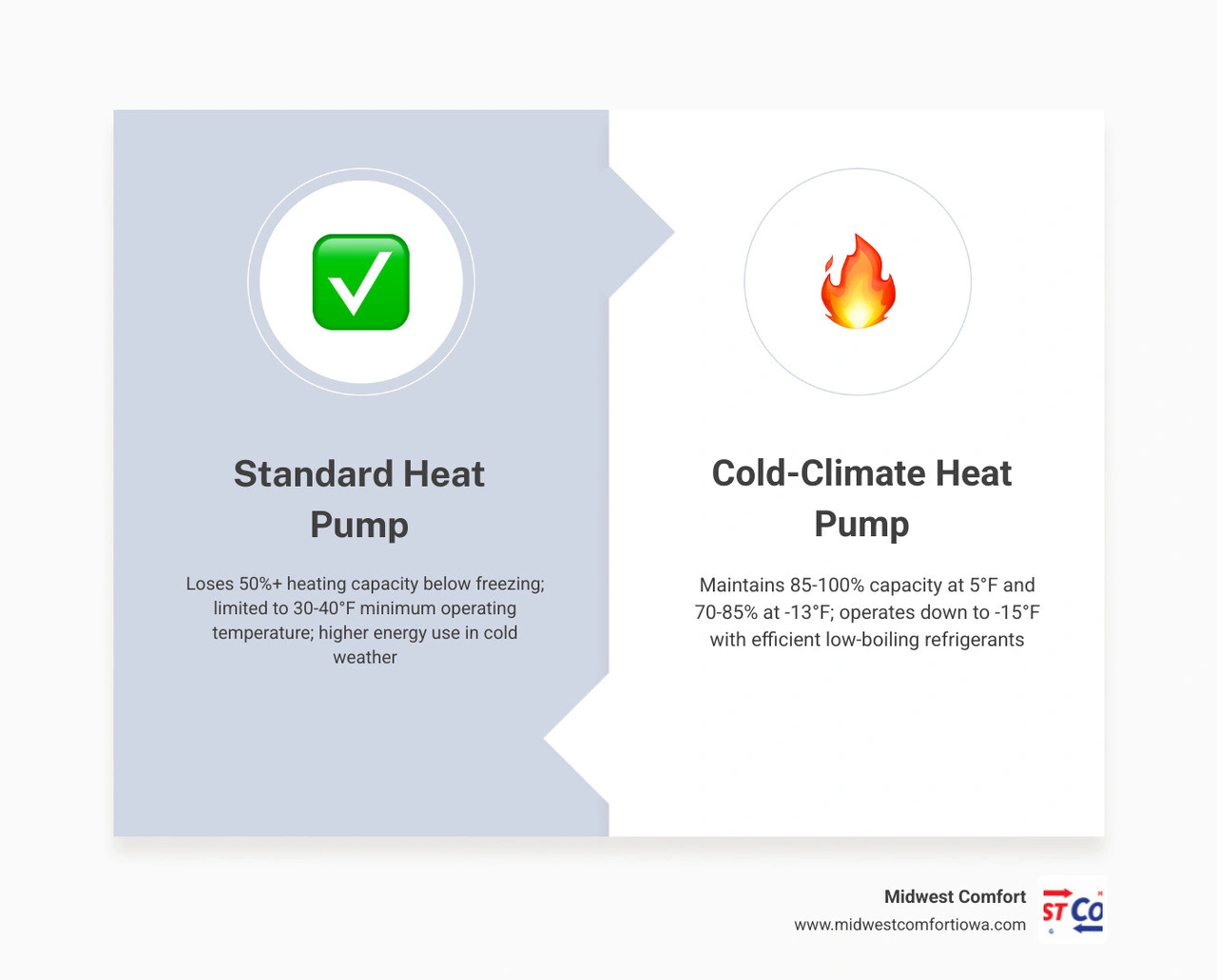
- Modern CCHPs maintain 85–100% of their rated heating capacity at 5°F, and 70–85% at -13°F
- A backup heat source (electric strips or a gas furnace in a dual-fuel setup) can assist on the very coldest days — typically only 2–4% of winter hours in Iowa
This is a dramatic improvement over older, standard heat pumps, which could lose 50% or more of their capacity once temperatures dropped below freezing. Today's cold-climate models are a different machine entirely, and field data from places like Maine, Minnesota, and Scandinavia backs that up. In fact, heat pumps now heat roughly half of all homes in Norway, Finland, and Sweden — some of the coldest countries on earth.
If you've heard that heat pumps "don't work in Iowa winters," that claim is rooted in technology that's more than a decade out of date.
The Science Behind How a Heat Pump Works in Extreme Cold Climates
To understand how a heat pump keeps your home warm during a freezing January night in Waukee or Ankeny, we first have to bust a major myth: the idea that cold air has no heat in it.
To us, 0°F feels freezing. But to a physicist, temperature is simply a measure of how fast molecules are moving. True "absolute zero"—the point where all molecular motion stops and absolutely no heat energy exists—is -459.67°F. This means that even when it is -15°F in Des Moines, the outdoor air still contains more than 75% of the thermal energy found in 140°F air.
A cold-climate heat pump does not generate heat like a gas furnace or an electric baseboard heater. Instead, it acts as a thermal vacuum cleaner, collecting the ambient heat that already exists outside and moving it indoors. This fundamental difference is why heat pumps are so incredibly efficient. While a high-efficiency gas furnace might achieve a 95% efficiency rating (meaning 5% of the fuel is wasted), a heat pump can achieve efficiencies of 200% to 400% because it is transferring heat rather than creating it.
For a deeper look at how these systems benefit local homes, check out our guide on Heat Pump Benefits for Iowa Homeowners.
Thermodynamic Principles of Heat Extraction
The magic of this process relies on a basic law of thermodynamics: heat naturally moves from a warmer place to a cooler place.
To pull heat out of freezing outdoor air, the heat pump must make its outdoor coil colder than the outside air. The system accomplishes this by expanding a specialized fluid called refrigerant. As the refrigerant expands through an expansion valve, its pressure drops rapidly, which causes its temperature to plummet far below the outdoor air temperature.
Once the refrigerant is colder than the freezing wind blowing through Grimes or Clive, the outdoor air naturally transfers its heat energy into the outdoor evaporator coil. Even though the air feels icy to you, it is relatively warm compared to the freezing refrigerant inside the coil.
Refrigerant Boiling Points in Sub-Zero Weather
The secret weapon of the modern cold-climate heat pump is the chemical composition of its refrigerant. Modern systems utilize advanced, eco-friendly refrigerants (such as R-32 or R-454B) designed specifically for low-temperature physics.
These refrigerants have incredibly low boiling points—often lower than -40°F. When the low-pressure, freezing liquid refrigerant enters the outdoor coil, the ambient outdoor air (even at -10°F) is warm enough to cause the refrigerant to boil and vaporize into a gas.
As the refrigerant evaporates, it locks that outdoor heat energy into its molecular structure. The gaseous refrigerant is then sent to the indoor compressor. By compressing this gas, the system dramatically increases its pressure and concentrates the absorbed heat, raising the temperature of the refrigerant to well over 100°F. This hot gas is then sent to your indoor coil, where a blower fan distributes the warm air throughout your home.
Key Technologies Powering Cold-Climate Heat Pumps (CCHPs)
Standard heat pumps of the past would struggle and shut down as temperatures approached freezing. To overcome this, manufacturers have introduced several engineering breakthroughs that allow modern cold-climate heat pumps (CCHPs) to maintain high efficiency and reliable heating capacity when the temperature drops.
If you are considering upgrading your home in Windsor Heights, you can explore your options further with our article on finding an Energy Efficient Heat Pump Windsor Heights.
To help visualize the differences between older technology and modern cold-climate systems, consider the comparison below:
| Feature | Standard Heat Pumps | Cold-Climate Heat Pumps (CCHPs) |
|---|---|---|
| Compressor Type | Single-stage or Two-stage | Variable-speed Inverter-driven |
| Capacity at 5°F | Drops to 40%–50% of rated capacity | Maintains 85%–100% of rated capacity |
| Capacity at -13°F | Drops to 20%–30% (or shuts off entirely) | Maintains 60%–85% of rated capacity |
| Average COP at 5°F | 1.0 (equivalent to electric resistance) | 1.75 to 2.2+ |
| Minimum Operating Temp | Around 15°F to 25°F | Down to -15°F to -22°F (or lower) |
| Technology | Standard expansion valves | Enhanced Vapor Injection (EVI) |
Variable-Speed Inverter Compressors
Older heat pumps used single-speed compressors that operated on an "all-or-nothing" basis. They turned on at 100% capacity, ran until the thermostat was satisfied, and then shut off. This constant cycling is highly inefficient and causes noticeable temperature swings.
Modern CCHPs utilize variable-speed, inverter-driven compressors. These systems can modulate their output in tiny increments, running anywhere from 10% to 120% of their rated capacity.
In milder weather (like a sunny 45°F autumn day in Johnston), the compressor runs at a low, whisper-quiet speed to maintain a steady indoor temperature. When a polar vortex hits and temperatures drop below zero, the inverter compressor ramps up to high speeds, extracting every available bit of warmth from the outdoor air. Because they run continuously at modulated speeds, they eliminate the energy spikes associated with turning on and off, keeping your home incredibly comfortable.
Enhanced Vapor Injection (EVI) Technology
When a compressor works hard in extremely cold weather, the refrigerant temperature and pressure rise significantly, which can cause the compressor to overheat. To prevent this, engineers developed Enhanced Vapor Injection (EVI).
EVI technology utilizes a dual-stage compression process. A small portion of the liquid refrigerant is diverted, expanded to a lower temperature, and injected directly into the middle of the compression cycle. This vapor injection cools the compressor, allowing it to compress the remaining refrigerant to much higher pressures without overheating.
This process increases the density of the refrigerant flowing through the system, which directly translates to a massive boost in heating capacity and efficiency when it is freezing outside.
How Does a Heat Pump Work in Extreme Cold Climates Compared to Standard Models?
The primary difference between a standard heat pump and a CCHP is how they handle capacity de-rating.
As outdoor temperatures drop, the heating load of your home increases (meaning your home loses heat faster), but the heating capacity of a standard heat pump drops. Standard units can lose up to half of their heating output by the time it reaches 25°F.
Cold-climate heat pumps are engineered to flatten this capacity curve. Thanks to variable-speed compressors and EVI, a certified CCHP can maintain 100% of its heating capacity down to 5°F and continue providing reliable, comfortable heat at -15°F or even -22°F.
If you are ready to make the switch to a highly efficient system, you might be asking: I'm Looking for Installers of a New Energy Efficient Heat Pump in Windsor Heights Who is Available. Our experienced team at Midwest Comfort is always ready to help you find and install the perfect system for your home.
Sizing, Installation, and Backup Heating Strategies
While cold-climate heat pumps are incredibly advanced, their real-world performance depends heavily on proper system design and installation. A poorly installed or incorrectly sized system will struggle to keep your home warm and can lead to high utility bills.
For a comprehensive look at what a professional installation entails, read our Best Heat Pump Installation Guide Des Moines IA.
Why Manual J Load Calculations Are Essential
In the past, many HVAC contractors sized heating systems using simple rules of thumb, such as square footage. For a variable-speed heat pump in a cold climate, this approach can be highly problematic.
To size a heat pump correctly, we must perform a room-by-room Manual J load calculation. This calculation takes into account:
- The local winter design temperature for the Des Moines metro area
- Your home’s insulation levels in the attic, walls, and crawlspaces
- The orientation of your home and the type of windows installed
- Air infiltration rates (how drafty the house is)
Under-sizing a heat pump means it won't be able to keep up on the coldest winter nights. However, oversizing a variable-speed system is also harmful. If a system is too large, it will short-cycle (turn on and off rapidly) during milder spring and autumn days. This short-cycling reduces the system's seasonal Coefficient of Performance (COP) by 10% to 20%, increases wear and tear on the compressor, and degrades humidity control.
If you are planning an upgrade, it is vital to work with a team that understands these calculations. When you say, I Need to Find a Reliable Company for Heat Pump Installation in Des Moines, Midwest Comfort is here to provide the precise, high-quality service you deserve.
How Does a Heat Pump Work in Extreme Cold Climates with Backup Heat?
Even the most advanced cold-climate heat pump will eventually reach its "balance point"—the outdoor temperature where the home’s heat loss exceeds the maximum heating capacity of the heat pump. In Central Iowa, this balance point is typically between 0°F and 10°F, depending on how well-insulated your home is.
To ensure your family stays warm when temperatures drop below this point, heat pumps are paired with a backup (or auxiliary) heating source. There are two primary ways to configure this:
- All-Electric with Resistance Heat Strips: In this setup, electric resistance coils are installed inside your indoor air handler. When the heat pump needs assistance, these coils turn on to provide a quick boost of heat. While electric resistance is 100% efficient (a COP of 1.0), it uses more electricity than the heat pump itself, so it is best used sparingly as auxiliary or emergency backup.
- Dual-Fuel (Hybrid) Systems: This is one of the most popular and practical configurations for Des Moines homeowners. It pairs an electric air-source heat pump with a high-efficiency gas furnace. During moderate winter days (25°F to 60°F), the heat pump handles the heating with incredible efficiency. When temperatures plunge below freezing, the system automatically switches over to the gas furnace, which easily handles the extreme cold.
For homeowners in Ankeny who need immediate assistance with their heating configuration, our Ankeny Emergency Heat Pump Install Guide is an excellent resource.
Winter Installation Best Practices for Snowy Climates
To ensure your heat pump operates reliably during a heavy Iowa snowstorm, our installation team follows several strict best practices:
- Elevation: The outdoor compressor unit must be elevated on a heavy-duty stand, typically 12 to 18 inches above the ground. This keeps the unit clear of snow drifts and allows meltwater to drain freely during the defrost cycle.
- Strategic Placement: We avoid placing the outdoor unit directly under roof eaves where heavy snow or icicles could fall and damage the fan. Placing the unit on the gabled side of the house is often the safest option.
- Wind Protection: Strong winter winds can interfere with the outdoor fan's airflow and blow freezing air back onto the coil during a defrost cycle. Installing a wind baffle or placing the unit in a semi-sheltered area can prevent this.
- Ductwork and Commissioning: We ensure that your home's ductwork is properly sealed and insulated. Since heat pumps deliver air that is warm and comfortable (typically 95°F to 105°F) rather than the hot blasts of a gas furnace (120°F+), duct leaks can quickly degrade comfort.
If you are located in Waukee and want to make sure your system is installed correctly before the winter weather hits, check out our Emergency Heat Pump Installation Waukee IA Guide.
Frequently Asked Questions About Cold-Weather Heat Pumps
Switching to a heat pump is an investment in your home’s comfort and efficiency. It is completely natural to have questions about how these systems perform when the snow starts falling. Here are some of the most common questions we hear from Des Moines area homeowners.
If you want to keep your system running smoothly year-round, you can read about Common Heat Pump Problems and How to Prevent Them.
What is the minimum operating temperature for a cold-climate heat pump?
Modern cold-climate heat pumps are engineered to operate at temperatures far below zero. Many leading models can continue extracting heat from outdoor air down to -15°F or -22°F.
While the system's efficiency (COP) decreases as it gets colder, it still remains more efficient than electric resistance heating. For example, at -15°F, a high-quality CCHP will still deliver a COP of 1.3 to 1.8, meaning it produces 30% to 80% more heat energy than the electricity it consumes.
Do heat pumps require special winter maintenance?
Yes, keeping your heat pump clear of snow and ice is vital for maintaining proper airflow. Here are a few simple maintenance steps you should take during the winter:
- Keep it Clear: Check the outdoor unit after a heavy snowfall and gently brush away any snow drifts or ice blockages.
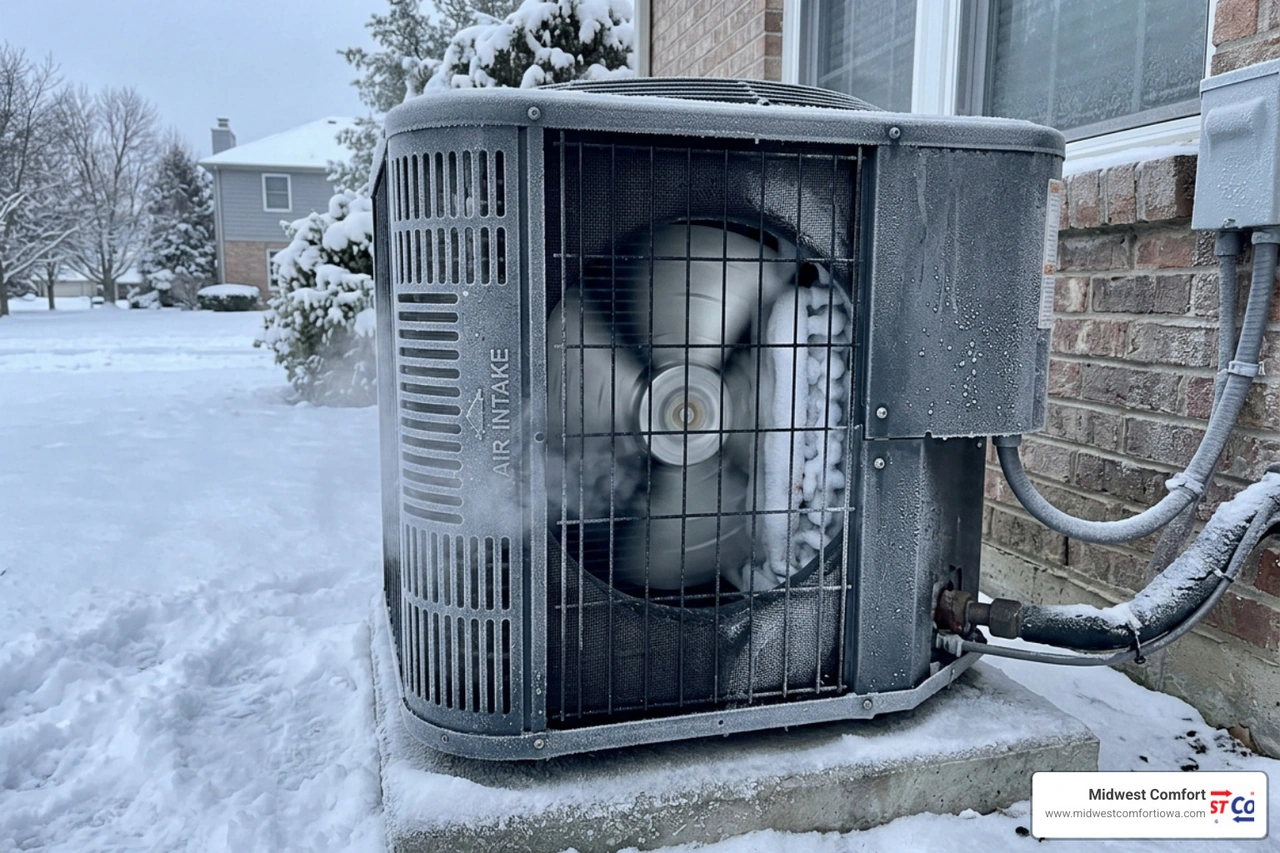
- Monitor the Defrost Cycle: It is completely normal for frost to accumulate on the outdoor coil in winter. The heat pump is programmed to automatically run a defrost cycle, which temporarily reverses the system to warm up the outdoor coil and melt the ice. Ensure that the drain holes at the bottom of the unit are clear so this water can escape.
- Change Filters Regularly: A clean air filter ensures optimal airflow, which is critical for heat transfer.
For a complete breakdown of seasonal care, refer to our Heat Pump Maintenance Checklist for Each Season and learn How Proper Maintenance Extends Heat Pump Lifespan.
Are heat pumps efficient in snowy regions like Iowa?
Absolutely. Real-world field data from cold regions like Minnesota, Maine, and Finland has proven that modern cold-climate heat pumps are highly efficient and reliable in snowy climates.
During the shoulder seasons (spring and fall) and milder winter days, a heat pump will operate at a COP of 3.0 to 4.0, delivering huge energy savings compared to traditional heating systems. When paired with a gas furnace in a dual-fuel configuration, a heat pump provides the ultimate balance of comfort, efficiency, and reliability for Iowa's variable winters.
To learn more about how these systems fit into your overall home HVAC strategy, check out our Heat Pump Services Complete Guide.
Conclusion
At Midwest Comfort, we believe that every Des Moines area homeowner deserves an honest, high-quality, and cost-effective approach to home comfort. As a family-owned business, we treat our customers like family, offering tailored heating and cooling solutions, loyalty programs, and flexible payment options to fit your needs.
Whether you live in Des Moines, Polk City, Granger, Waukee, Windsor Heights, Altoona, Dallas Center, Johnston, Adel, Runnells, Pleasant Hill, Grimes, Clive, Norwalk, Carlisle, or Ankeny, our experienced team is here to help you navigate your home heating options. Modern cold-climate heat pumps are a fantastic, energy-efficient solution that can keep your home cozy through the coldest Iowa winters while helping you manage your monthly energy usage.
Are you ready to explore how a high-performance heat pump can transform your home comfort? Schedule Your Professional Heat Pump Consultation Today with the friendly experts at Midwest Comfort, and let us help you find the perfect solution for your family.


Get Your HVAC Serviced Today


