
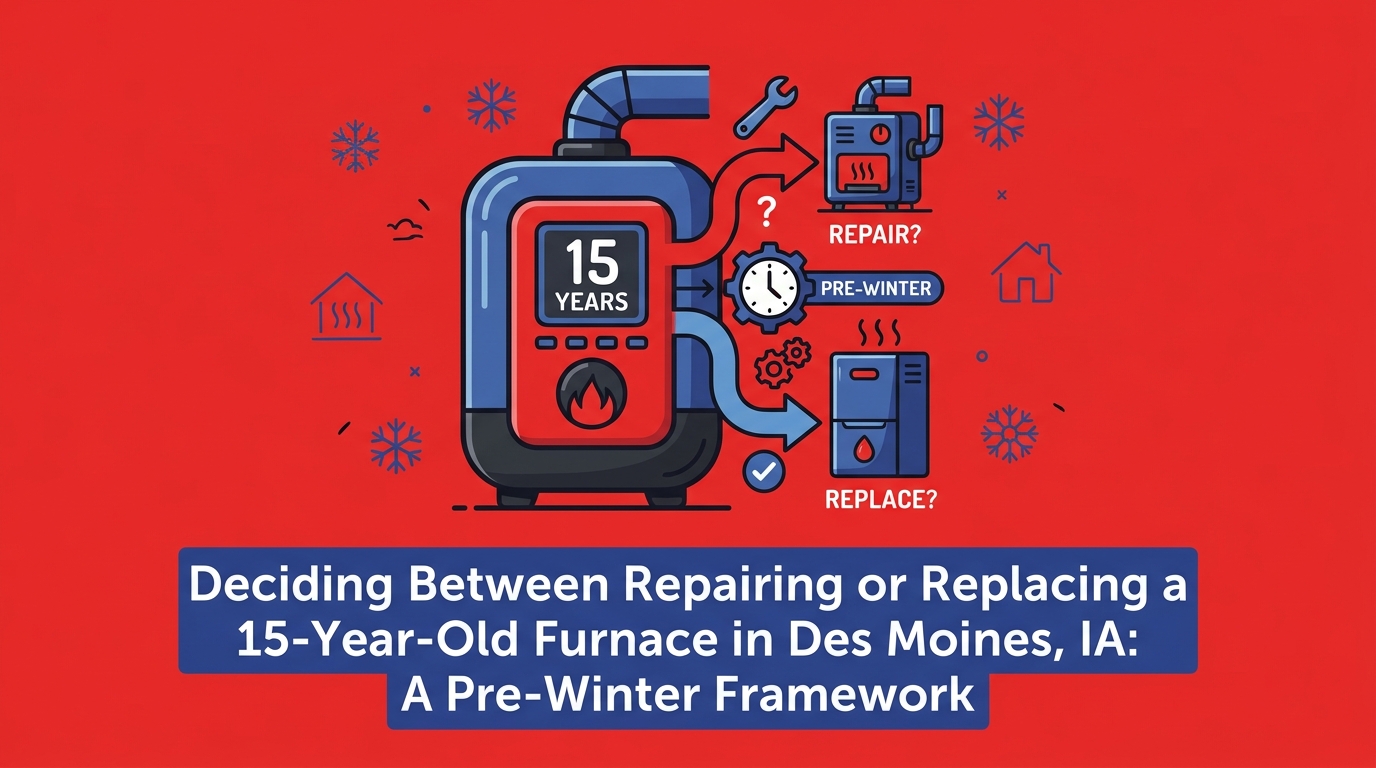
Facing a Major Heating Diagnosis Just Before Winter?
Is a sudden, massive repair bill forcing you into deciding between repairing or replacing a 15-year-old furnace in Des Moines right before the cold weather hits? You schedule a routine September pre-winter preparation tune-up, expecting a clean bill of health, only to have the technician show you a cracked heat exchanger. Suddenly, you are staring down a major, unexpected expense just weeks before the freezing temperatures arrive.
This is one of the most stressful positions a homeowner can be in. The pressure to make a fast choice is intense because the weather is turning, and living without heat is not an option. However, evaluating an older heating system requires looking far beyond the immediate repair bill. It involves assessing long-term safety, daily reliability, and your family's peace of mind. If you need comprehensive HVAC services to evaluate your system, having a clear framework makes all the difference.
Here is the thing: pouring funds into a depreciating asset rarely yields the comfort or security you actually need. We are going to walk through a non-monetary decision framework to help you evaluate the risks, understand the technology, and make the smartest, safest choice for your home this fall.
The Hidden Dangers of a Cracked Heat Exchanger in Older Units
To understand why this specific diagnosis forces a hard decision, you have to understand what a heat exchanger actually does. It is the metal chamber where the actual combustion of gas takes place. It acts as an absolute barrier between the toxic exhaust fumes created by burning fuel and the clean air that gets blown through your home's vents.
Over the course of a decade and a half, a 15-year-old aging furnace goes through tens of thousands of heating cycles. During every single cycle, the metal chamber heats up and expands, then cools down and contracts. This constant thermal expansion eventually leads to metal fatigue. Just like bending a paperclip back and forth until it snaps, the metal walls of the heat exchanger eventually develop stress cracks.
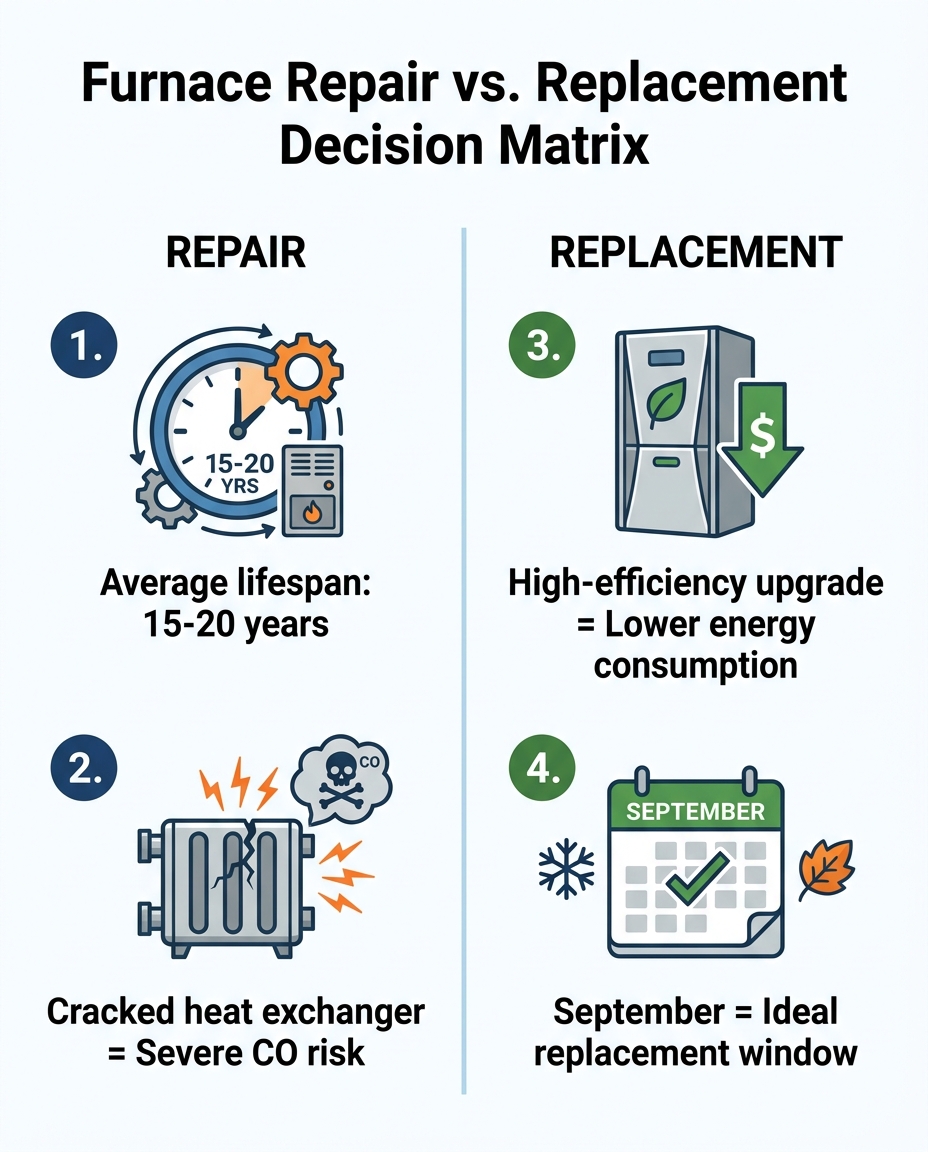
Once that metal barrier is compromised, the situation elevates from a mechanical failure to a severe life-safety hazard. A crack allows carbon monoxide (CO) and other dangerous combustion gases to leak directly into the breathable air circulating through your living spaces. The Environmental Protection Agency (EPA) explicitly warns about the severe health risks of carbon monoxide exposure, which is odorless, colorless, and potentially fatal.
Because of these extreme safety risks, a cracked heat exchanger is never a candidate for a temporary patch, a quick weld, or high-temperature tape. Temporary fixes will simply break open again during the next expansion cycle. This diagnosis requires a licensed professional to either perform a complete, invasive component replacement or recommend full heating replacement and repair solutions. There is no safe middle ground.
The True Cost of Patching a System at the End of Its Lifespan
The Problem: Sinking funds into a single major repair does not reset the clock on the rest of the unit. According to the Department of Energy, the average lifespan of a well-maintained residential furnace is 15 to 20 years. If your unit is already sitting at the 15-year mark, it has effectively reached the end of its intended operational life.
The Cause: Aging mechanical systems suffer from what industry experts call "domino failures." You might authorize the invasive, labor-intensive process of replacing the heat exchanger today. But next month, the aging blower motor might seize up. Two months later, the electronic control board could short out. One local homeowner reached out at 10 PM during a chilly fall evening when their aging heating system suddenly failed. A technician arrived the next morning and completed the repair within 30 minutes. While quick fixes like this are a massive relief in the moment, relying on them continuously for a 15-year-old aging furnace becomes a risky, exhausting gamble.
Furthermore, sourcing parts for obsolete units is becoming increasingly difficult. Manufacturers phase out parts for older models, meaning a breakdown in the middle of winter could leave you waiting days or weeks for a proprietary component to ship from across the country.
The Solution: Instead of viewing a replacement as a lost expense, reframe it as an investment in future reliability. Every dollar spent on an expiring asset is gone forever. Utilizing an HVAC replacement estimator can help you start visualizing how investing in a brand-new system provides a fresh warranty, guaranteed parts availability, and zero risk of domino failures.
Why Midwest Winters Demand Uncompromising Heating Reliability
The urgency of this decision is entirely driven by our local climate. Des Moines area homes face brutal, unforgiving winters. By December and January, average low temperatures routinely drop into the teens and single digits, accompanied by biting wind chills that strip heat away from your home's exterior.
In this environment, a mid-winter heating breakdown escalates from a mere inconvenience to an absolute emergency. Another local homeowner experienced a sudden furnace failure on a cold early November evening. A technician named Mick was dispatched quickly for emergency service, diagnosing the issue and returning with the necessary part to restore heat before the house dropped to dangerous temperatures. While emergency service saves the day, you never want to be in a position where your family's safety relies on a 15-year-old machine holding together through a blizzard.
If your heating system fails overnight in January, the internal temperature of your home will plummet rapidly. Beyond the severe discomfort and health risks to your family, you face the catastrophic threat of frozen and bursting water pipes, which can cause massive property damage.
This is why the September pre-winter preparation window is the absolute ideal time for proactive replacements. Deciding to upgrade now means you avoid the chaotic emergency rush when the first freeze hits. You have the time to research your options, schedule an installation at your convenience, and enter the winter season knowing your heating system is brand new, fully warrantied, and perfectly capable of handling sub-zero nights.
Efficiency Gains: Upgrading from 15-Year-Old Technology
If you are still on the fence, it helps to look at how far HVAC technology has advanced since your current unit was manufactured. A furnace built 15 years ago operates on outdated engineering, and upgrading brings massive improvements in both comfort and energy consumption.
Older units typically have an Annual Fuel Utilization Efficiency (AFUE) rating of around 70% to 80%. That means for every unit of gas burned, 20% to 30% of the heat is wasted straight up the exhaust flue. Modern high-efficiency systems boast AFUE ratings of 95% or higher, meaning nearly all the fuel you pay for is converted directly into usable heat for your home.
| Feature | 15-Year-Old Furnace | Modern High-Efficiency Furnace |
|---|---|---|
| AFUE Rating | 70% - 80% (High Waste) | 95%+ (Minimal Waste) |
| Blower Motor | Single-Speed (On/Off only) | Variable-Speed (Continuous, quiet airflow) |
| Heating Stages | Single-Stage (Blasts full heat) | Two-Stage or Modulating (Adjusts to exact needs) |
| Warranty Status | Expired | Full 10-Year Comprehensive Coverage |
Beyond raw efficiency, modern systems utilize variable-speed blowers and two-stage gas valves. Instead of turning on at full blast and shutting off entirely (which creates hot and cold spots), a variable-speed unit runs at lower, quieter speeds for longer periods. This provides incredibly consistent comfort, better humidity control, and superior indoor air quality because the air is constantly being filtered.
According to ENERGY STAR, upgrading to a high-efficiency model significantly reduces your monthly energy consumption. Additionally, many modern high-efficiency upgrades qualify for generally applicable federal tax credits or local utility rebate programs, making the transition to modern technology even more advantageous. Always consult your utility provider or a tax professional to verify current program eligibility.
Making a New System Accessible Without the Stress
We know that learning you need a full system replacement is overwhelming. It is rarely a planned expense, and the initial shock of the diagnosis can make patching the old unit feel like the only viable path. However, choosing replacement over repair does not have to be an unmanageable burden.
The goal is to remove the friction from this process so you can secure the safest, most efficient option for your family. Utilizing flexible HVAC financing options completely shifts the dynamic of the decision. Instead of facing a massive, immediate barrier, you can break the investment down into predictable, manageable monthly increments. Often, the monthly energy savings gained from a 95%+ AFUE system help offset the monthly financing, making the upgrade highly accessible.
Protecting Your Investment Long-Term
Once you make the smart choice to upgrade, protecting that new equipment becomes the priority. A new furnace is a precision-engineered machine that requires regular tuning to maintain its high efficiency and validate its manufacturer warranty. Enrolling in the Comfort Loyalty Program ensures your new system receives priority, ongoing maintenance year after year. This proactive care guarantees the unit runs at peak performance for its entire lifespan, catching minor adjustments before they ever become costly breakdowns.
Decision Checklist: Repair vs. Replace Indicators
If you are still weighing your options, use this straightforward checklist to determine which path makes the most sense for your specific situation. If you find yourself nodding along to the replacement indicators, it is time to take action.
- Age of the equipment: If your furnace is approaching or exceeding 15 years, the scale leans heavily toward replacement. Mechanical fatigue is unavoidable at this stage.
- Severity of the failure: A failed capacitor is a simple repair. A cracked heat exchanger is a severe, high-risk failure that demands an expensive, invasive teardown, making replacement the far safer choice.
- Frequency of recent service calls: If you have had technicians out multiple times over the last two winters for various failing components, you are experiencing domino failures. Cut your losses before the next breakdown.
- Safety concerns: Any risk of carbon monoxide exposure demands immediate, decisive action. You can never compromise on the air quality and safety inside your home.
- Efficiency and comfort goals: If your home suffers from cold spots, excessive dust, or high winter utility bills, upgrading to modern technology will solve these issues while a repair will leave you stuck with 15-year-old performance.
Making the right choice also means looking at the long-term support you will receive. Exploring Comfort Loyalty Program benefits shows how ongoing maintenance turns a stressful replacement into a protected, worry-free investment.

Secure Your Home's Comfort Before the First Freeze
Replacing an aging, compromised heating system is ultimately an investment in your family's safety and your home's long-term reliability. A 15-year-old unit with a cracked heat exchanger has given you all the life it has to give. Trying to force it through one more brutal Des Moines winter is a risk that simply isn't worth taking.
Remember, the September pre-winter preparation window is closing quickly. As the temperatures drop, emergency service calls skyrocket, and installation schedules fill up fast. Do not wait until your home is freezing to make this crucial decision. Reach out to a local heating expert today to discuss your replacement options, explore flexible financing, and schedule your estimate so you can enter this winter with total confidence.
Frequently Asked Questions
Is it worth repairing a 15-year-old furnace?
The short answer is usually no, especially for major component failures. At 15 years old, a furnace has reached the end of its expected lifespan. Spending a large sum on a repair does not prevent other aging parts, like the blower motor or control board, from failing shortly after. Upgrading to a new system provides better efficiency, a fresh warranty, and much greater reliability.
Is a cracked heat exchanger dangerous?
Yes, a cracked heat exchanger is one of the most dangerous issues a heating system can develop. The heat exchanger separates the toxic combustion gases from the air circulating in your home. When it cracks, carbon monoxide (CO) can leak directly into your living spaces, posing a severe, potentially fatal health risk to your family.
How long does a typical residential furnace last?
According to the Department of Energy, a well-maintained residential furnace typically lasts between 15 and 20 years. Once a unit crosses the 15-year threshold, it becomes highly susceptible to metal fatigue, mechanical wear, and efficiency drop-offs. Regular annual maintenance is the best way to help a unit reach the upper end of that lifespan safely.
What are the signs that my furnace is going bad?
Most homeowners do not realize that subtle changes indicate major systemic issues. Frequent cycling (turning on and off rapidly), strange rattling or grinding noises, uneven heating throughout the house, and steadily climbing energy bills are all red flags. If you notice these symptoms alongside an increase in repair calls, the system is likely failing.
Can a cracked heat exchanger be patched or welded?
No, patching or welding a cracked heat exchanger is never considered a safe or permanent solution by HVAC professionals. Because the metal chamber constantly expands and contracts with extreme heat, any weld or high-temperature tape will eventually fail and break open again. The only safe solutions are completely replacing the heat exchanger component or replacing the entire furnace.
How much energy can I save by upgrading a 15-year-old furnace?
The energy savings can be substantial, depending on your current unit's efficiency. A 15-year-old furnace might operate at 70% to 80% efficiency, wasting up to 30% of the fuel it consumes. Upgrading to a modern, high-efficiency model that operates at 95% or higher means nearly all the fuel is converted into heat, which significantly reduces your monthly energy consumption.
