
Are You Tired of Emptying Basement Dehumidifier Buckets?
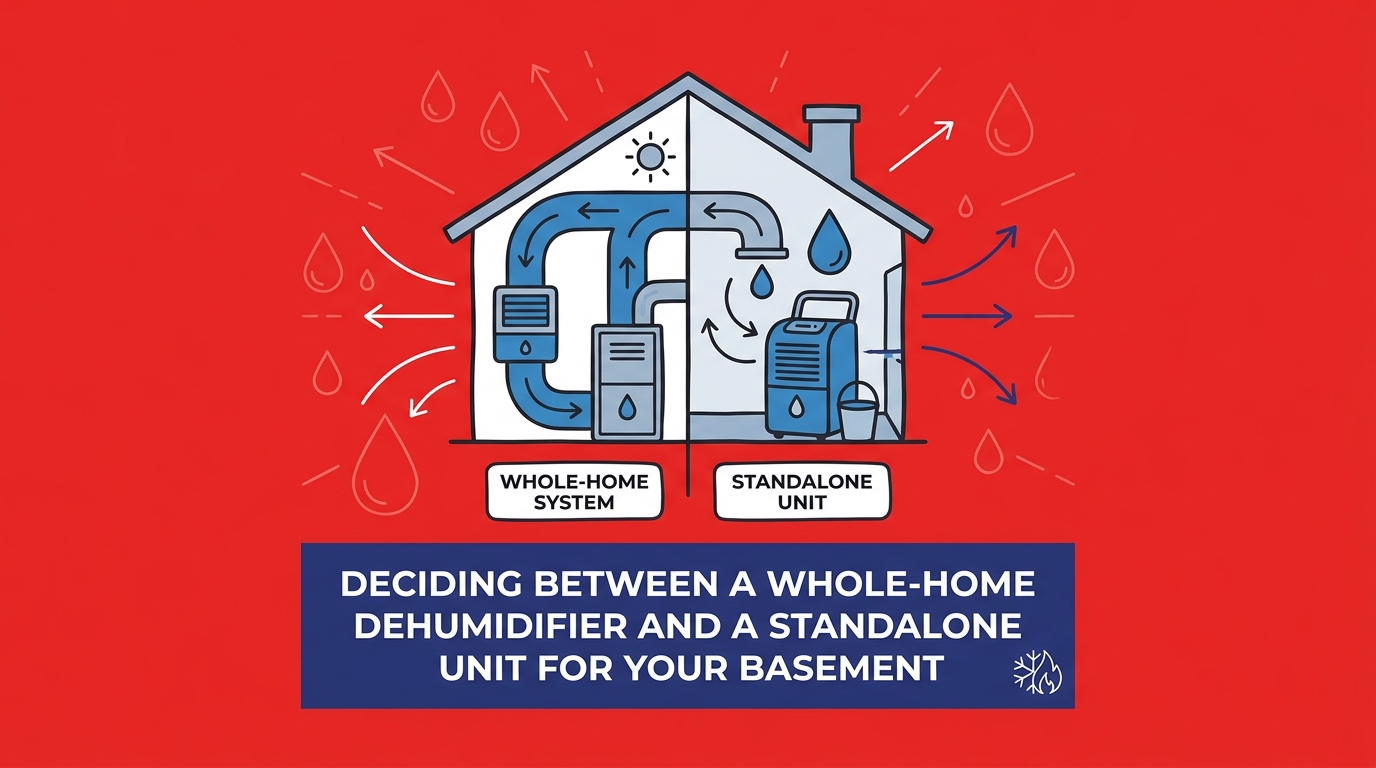
As the kids head back to school and August's late-summer humidity rolls into Des Moines, are you spending your evenings listening for the persistent beep of a full water bucket? When that late-summer mugginess settles in, managing indoor moisture can quickly feel like a tedious part-time job. Deciding Between a Whole-Home Dehumidifier and a Standalone Unit for Your Basement is one of the most common dilemmas we see homeowners face when they realize a damp downstairs is affecting their entire living space. At Midwest Comfort Heating & Cooling, we frequently hear from frustrated customers whose portable units are running nonstop, yet their air still feels heavy and uncomfortable. If this sounds familiar, it might be time to look at a more permanent, integrated solution.
Whether you are looking to upgrade your HVAC services or explore comprehensive indoor air quality solutions, understanding your options is the first step to a more comfortable home.
Basement moisture is rarely just an isolated nuisance. The air in your lower levels eventually circulates throughout the rest of the house, carrying excess humidity, musty odors, and potential allergens with it. A standalone unit offers a quick bandage for a localized puddle or damp corner, but our team typically sees these units struggle to keep up with the demands of a larger home during severe weather. By exploring how both portable and ducted options fit into your home's broader climate control strategy, you can make an informed choice that eliminates daily maintenance chores and significantly improves your overall comfort.
The Baseline: Understanding Standalone Basement Dehumidifiers
Standalone, or portable, dehumidifiers are the most common entry point for homeowners trying to tackle indoor moisture. These units operate by pulling air from their immediate surroundings over cold evaporator coils. The moisture in the air condenses into water droplets, falls into a collection bucket, and the dry air is exhausted back into the room. While they provide an accessible, immediate fix, they come with significant limitations when tasked with protecting expansive areas like Des Moines finished basements.
During the relentless mugginess of Des Moines in late summer, these portable units are forced to run constantly. On our late-summer AC maintenance calls, our technicians routinely see this heavy workload leading to premature wear and tear, forcing homeowners to understand why your basement dehumidifier is working overtime just to keep the humidity at a tolerable level.
Pros of Portable Units
- Lower upfront acquisition cost: You can purchase a portable unit at any local hardware store for a fraction of the cost of an integrated system, making it an easy impulse buy when a damp smell first appears.
- Plug-and-play setup: These units require absolutely no professional installation. You simply take it out of the box, plug it into a standard electrical outlet, and turn it on.
- Mobility: Because they are mounted on casters, you can easily roll the unit from the laundry room to the basement living area depending on where the moisture problem is most severe on any given day.
Cons of Portable Units
- Constant manual emptying: Unless you have the unit positioned directly over a floor drain with a continuous hose, you will find yourself carrying heavy, sloshing buckets of water up the stairs multiple times a day during peak humidity.
- Higher energy consumption: Portable units generally remove fewer pints of water per kilowatt-hour of electricity used, meaning they cost more to operate on a daily basis compared to high-efficiency models.
- Limited reach: A standalone unit only treats the air in its immediate vicinity. Air trapped in closed-off bedrooms, storage closets, or the far corners of an L-shaped finished basement remains vulnerable to high humidity and mold growth.
- Noise levels: Because the compressor and fan are located right in your living space, portable units can be disruptively loud, making it difficult to watch television or sleep while they are running.
The Upgrade: How Whole-Home Dehumidification Works
If you are exhausted by the daily chore of managing a portable unit, upgrading to a fully integrated system offers a dramatic improvement in both convenience and performance. A whole-home dehumidifier is a heavy-duty, high-capacity appliance designed to treat the air for your entire house, not just a single room. Instead of sitting on the floor in the corner of your basement, this equipment is installed directly alongside your central heating and cooling system.
The biggest mechanical advantage of this upgrade is that it completely eliminates the need for manual water collection. Integrated systems are plumbed directly into your home's wastewater drainage system or a dedicated condensate pump. The water extracted from your air flows away automatically, invisibly, and continuously. Because integrating a dehumidifier into HVAC ductwork requires specialized knowledge of airflow dynamics, electrical wiring, and plumbing codes, this is not a weekend DIY project. It requires professional assessment and installation by a licensed technician.
Seamless Ductwork Integration
The magic of a whole-home system lies in its ability to leverage your existing central air infrastructure. Here is how the integration process works to protect your entire home:
- Air Intake: The dehumidifier connects directly to your home's main return air duct. As your central fan runs, it pulls humid air from every room in the house—including the basement, main floor, and upper bedrooms—into the dehumidifier.
- Moisture Extraction: Before that air ever reaches your primary cooling equipment, it passes through the dehumidifier's high-capacity cooling coils. The machine aggressively strips the excess moisture from the air, draining it away automatically.
- Distribution: The newly dried, conditioned air is then routed into the supply ductwork. Your central blower pushes this comfortable, low-humidity air evenly out of every supply vent in your home.
- Independent Operation: Advanced whole-home units can operate independently of your air conditioner. If the house is cool enough but still feels damp, the dehumidifier can run its own internal fan to circulate and dry the air without overcooling your living space.
The Stack Effect: Why Basement Humidity Affects the Whole House
A common misconception is that what happens in the basement stays in the basement. In reality, the physics of air movement in a residential building dictate otherwise. This phenomenon is known as the stack effect. As warm air naturally rises and escapes through the upper levels of your home—such as through attic vents or poorly sealed upper-floor windows—it creates negative pressure in the lower levels.
This negative pressure acts like a giant vacuum, sucking replacement air in from the outside through foundation cracks, crawlspaces, and basement walls. Because the ground surrounding your basement is naturally damp, this incoming air brings a massive amount of moisture with it. Studies show that up to 50% of the air you breathe on your first floor actually originated in your basement or crawlspace.
When you leave basement moisture unmanaged, that heavy, humid air slowly rises into your main living areas. This puts an incredible strain on your air conditioning systems. Air conditioners are designed to cool the air, but they must first remove the latent heat—the hidden heat trapped in water vapor—before they can effectively lower the temperature. By managing the humidity at the source with an integrated system, you stop this upward migration of moisture, allowing your central cooling equipment to run far more efficiently and keeping your entire home comfortable.
Head-to-Head: Standalone vs. Whole-Home Systems
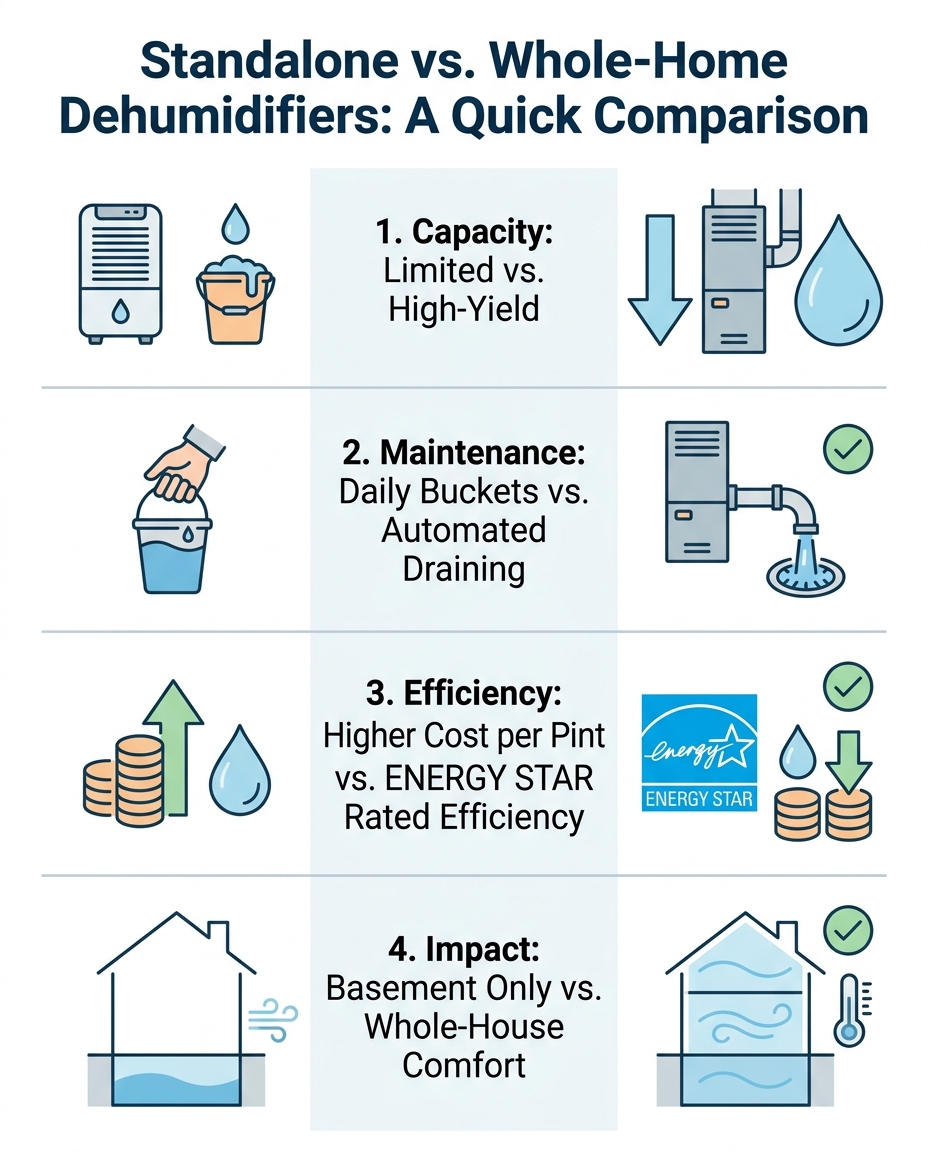
Making the right choice requires a clear understanding of how these two distinct approaches stack up against each other in real-world conditions. While both appliances serve the same fundamental purpose—removing water from the air—their capabilities, maintenance requirements, and overall impact on your property differ wildly.
| Feature | Standalone Portable Unit | Whole-Home Integrated System |
|---|---|---|
| Moisture Capacity | Typically 30 to 70 pints per day. | Typically 70 to 130+ pints per day. |
| Coverage Area | Limited to a single room or open basement area. | Treats the entire home via existing ductwork. |
| Maintenance Routine | Requires manual emptying of heavy water buckets daily. | Automated draining; requires only an annual filter change. |
| Aesthetic Impact | Takes up floor space and creates a tripping hazard with cords. | Hidden away in the utility room out of sight. |
| Noise Level | Loud compressor noise in the living space. | Quiet operation muffled by the utility room walls. |

Energy Efficiency and Operating Costs
When evaluating the cost of moisture control, you have to look beyond the initial purchase price. Whole-home systems are highly engineered appliances that remove significantly more water per kilowatt-hour of electricity consumed. Many of these integrated units carry strict ENERGY STAR ratings, proving their efficiency. Additionally, local utility incentive programs or generic energy efficiency rebates may apply to qualifying installations, so we always advise homeowners to verify current programs with their provider or a tax professional. Furthermore, because an integrated system reduces the overall cooling load on your house, your primary air conditioner doesn't have to work as hard. This synergy can lead to lower summer utility bills, offsetting the higher initial investment over the lifespan of the equipment.
Long-Term Property Protection
Humidity doesn't just make you feel sticky; it actively damages your home. Consistent, house-wide humidity control protects expensive hardwood floors from cupping, prevents wooden cabinetry from warping, and keeps structural elements safe from dry rot. A portable unit might keep the center of your basement dry, but it often misses localized damp spots in the corners. A ducted system ensures that dry air circulates into every corner of the property, offering comprehensive protection that standalone units simply cannot match.
Why Professional Assessment Outperforms Generic Sizing Charts
If you search online for dehumidifier sizing, you will inevitably find generic charts that tell you to buy a specific capacity based solely on the square footage of your basement. Relying on these charts is a mistake. In our years of servicing HVAC systems across Des Moines, our team at Midwest Comfort Heating & Cooling has seen firsthand how generic charts completely ignore crucial factors like the tightness of your home's envelope, the design of your existing ductwork, and the specific moisture loads generated by your local environment.
Choosing the right system requires an expert evaluation of your specific home layout and HVAC setup. A professional technician will measure the static pressure of your ductwork to ensure that adding a whole-home dehumidifier won't restrict airflow to your furnace or AC. They will also evaluate the best method for proper drainage routing and confirm that your electrical panel can support the dedicated circuit required for heavy-duty equipment.
Midwest Comfort Heating & Cooling provides tailored recommendations based on the unique layouts and specific moisture challenges of local homes we encounter every day, ensuring a perfect fit rather than a one-size-fits-all guess. We look at how your home actually breathes. Once installed, maintaining these advanced systems is incredibly simple and can easily be rolled into your routine HVAC maintenance schedule, requiring just a quick filter change and a drain line check once a year.
Frequently Asked Questions About Basement Dehumidification
Does a dehumidifier in the basement help the whole house?
A standalone unit placed in the basement only helps the immediate area surrounding the machine. Because it lacks the ability to push air through ductwork, the dry air it produces cannot reach the upper floors. However, a whole-home unit installed in the basement ductwork absolutely helps the entire house. By tying into the central return and supply lines, it actively pulls humid air from every room, treats it in the basement, and redistributes comfortable air back upstairs.
Is a whole house dehumidifier better than a portable one?
Yes, our team generally recommends a whole-house dehumidifier because it is vastly superior when it comes to energy efficiency, convenience, and comprehensive moisture control. While it requires a higher initial investment and professional installation, it offers superior long-term value. You gain back your floor space, eliminate the daily chore of emptying water buckets, and protect your entire home's structural integrity from mold and rot, rather than just treating a single room.
Does a whole house dehumidifier help with AC?
Yes, an integrated dehumidifier significantly helps your air conditioning system perform better. Air conditioners have to remove latent heat (humidity) from the air before they can effectively drop the temperature. By removing that moisture independently, the dehumidifier allows the AC to cool the home much faster and run less frequently. This reduces wear and tear on your cooling equipment and can extend its operational lifespan.
Can I just put a dehumidifier in the basement and leave it?
You can only leave a portable dehumidifier unattended if it is equipped with a continuous drain hose that is properly routed directly into a functioning floor drain. If you rely on the unit's internal collection bucket, it will automatically shut off as soon as the bucket is full—which can happen in just a few hours during peak summer humidity. Once it shuts off, your basement is completely unprotected until you manually empty the bucket and restart the machine.
How often does a whole-home dehumidifier need maintenance?
A whole-home dehumidifier is incredibly low-maintenance, typically requiring attention only once a year. Unlike portable units that demand daily manual emptying, an integrated system drains automatically. Annual maintenance usually consists of swapping out the internal air filter, inspecting the condensate drain line for any clogs or algae buildup, and verifying that the internal sensors are accurately reading the home's humidity levels.
Ready to Reclaim Your Basement and Improve Your Home's Air?
Upgrading from a struggling standalone unit to a fully integrated whole-home system is one of the most impactful improvements you can make for your indoor environment. It completely eliminates the daily hassles of carrying heavy water buckets while delivering superior, whole-house comfort and protecting your property from moisture damage.
The right choice ultimately depends on your specific home layout, existing ductwork, and the severity of your moisture levels. Don't settle for a damp basement and an overworked air conditioner as we transition out of summer. Reach out to Midwest Comfort Heating & Cooling for an expert assessment today, and let our professionals help you make an informed decision that prioritizes your family's comfort, convenience, and long-term peace of mind.
