
Facing a Late August AC Breakdown? The Big Decision
Are you wondering if the financial case for installing a heat pump during the late summer shoulder season makes sense when your aging AC is barely surviving the final heatwaves of the year? It is a frustrating position to be in. Your air conditioner is running nonstop, yet the house still feels uncomfortably warm. You know a replacement is likely necessary, but making a major purchase right before the weather cools down feels like poor timing. However, this specific window of time actually presents a unique opportunity to rethink your entire home comfort strategy.
If you are evaluating your home HVAC systems, now is the perfect time to consider installing a new heat pump instead of a standard air conditioner.
At Midwest Comfort Heating & Cooling, one pattern our team sees often involves Des Moines homeowners who have diligently scheduled routine maintenance over the years. A typical scenario involves a customer who has relied on our friendly technicians for twice-yearly service for over a decade, keeping their systems well-maintained and requiring minimal repairs. But eventually, even the most carefully serviced equipment reaches the end of its mechanical lifespan. When that failure happens during late August end-of-season cooling, the immediate reaction is often to panic-buy a direct replacement. The concrete problem is clear: you need cooling right now, but the Midwest fall heating season is just around the corner. Making a rushed decision to buy a standard AC solves today's problem, but it completely ignores the heating demands you will face in just a few short weeks. By pausing to evaluate a strategic upgrade, you can prepare your home for the impending autumn while securing the immediate relief you need today.
The Dilemma: Replacing a Dying Air Conditioner vs. Upgrading to a Heat Pump
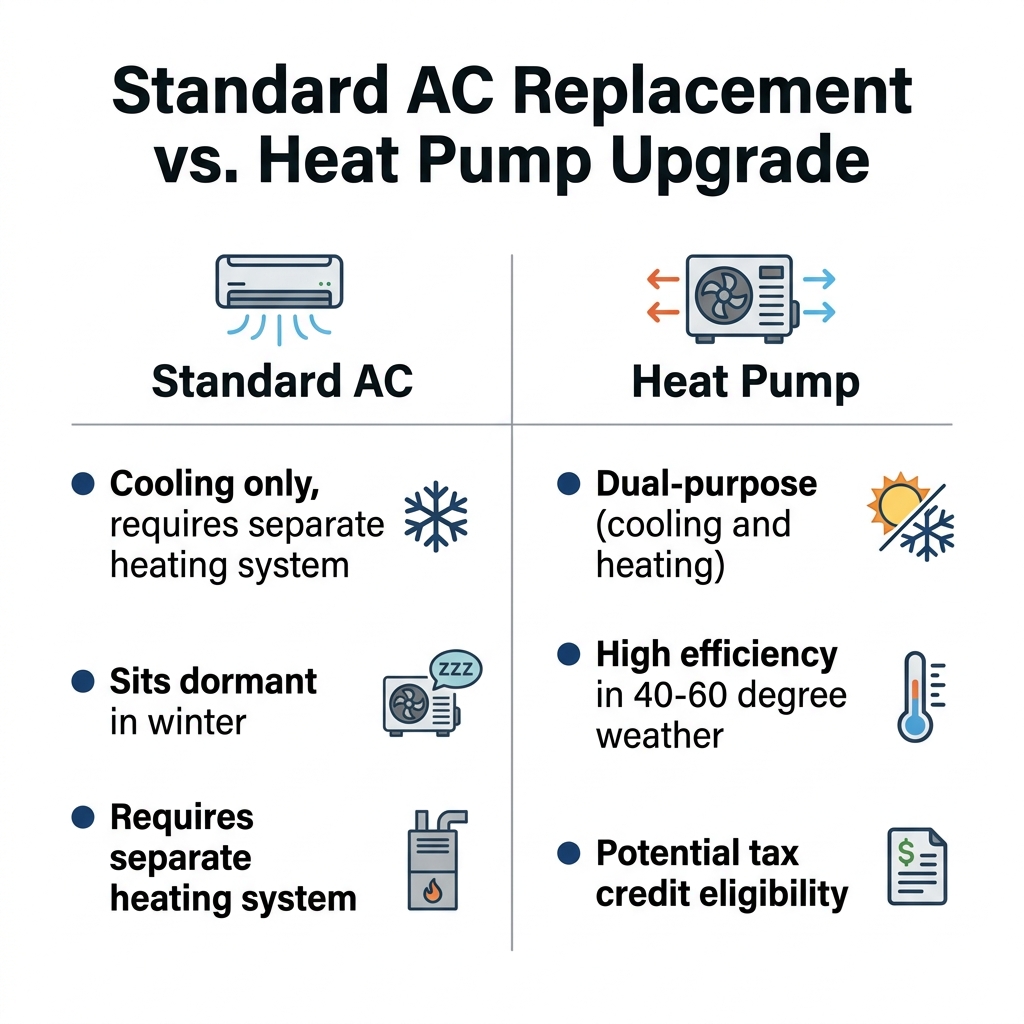
When our technicians respond to late-summer emergency calls, homeowners are often left weighing two distinct paths. The traditional route involves replacing a dying air conditioner with a standard central unit. This gives you the cold air you need for the rest of August and September, but that brand-new equipment will sit completely dormant as soon as October arrives. The alternative is choosing a dual-purpose heat pump vs standard central AC. A heat pump acts as a high-performance air conditioner during the summer, but it features a reversing valve that allows it to provide highly efficient heating during the fall and winter.
To help you weigh these options, let's look at a direct comparison of what each system brings to your home.
| System Feature | Standard Central AC | Dual-Purpose Heat Pump |
|---|---|---|
| Primary Function | Cooling only. Requires a separate furnace for heat. | Both cooling and heating in a single unit. |
| Winter Operation | Sits completely dormant for 6+ months of the year. | Actively heats your home throughout the colder months. |
| Energy Efficiency | High efficiency for cooling, but zero impact on heating bills. | High efficiency for cooling, plus highly efficient mild-weather heating. |
| Transition Readiness | Leaves you reliant on your aging furnace for the upcoming fall. | Instantly ready to switch to heating mode on the first chilly night. |
Immediate Cooling Relief
The first concern most homeowners share with us is whether a heat pump can handle intense summer heat. In our experience, the short answer is absolutely yes. In cooling mode, a heat pump operates exactly like a standard air conditioner. It uses refrigerant to absorb heat from inside your home and release it outside. Both standard ACs and modern heat pumps are highly effective at managing high humidity and peak temperatures. If you upgrade to a heat pump in late August, the cooling experience will be virtually identical to a premium air conditioner. You will get the immediate relief you need to comfortably get through the end of the summer.
Preparation for the Heating Season
The real divergence between the two systems happens when the weather shifts. A standard air conditioner is a single-use appliance. Once the temperature drops, that major investment shuts down and waits for spring. You are then forced to rely on your existing, potentially aging furnace. A heat pump, on the other hand, actively switches modes. By reversing the flow of refrigerant, it begins extracting ambient heat from the outdoor air and moving it inside to warm your home. This means the investment you make in August continues working for you in October, November, and beyond, providing a seamless transition into the heating season without requiring a separate, immediate heating upgrade.

Why the Midwest Shoulder Season Maximizes Heat Pump Efficiency
To fully understand the value of a late-summer installation, you need to understand the "shoulder season." This is the transitional period between the sweltering heat of late summer and the deep, freezing cold of winter. In our years serving the Des Moines metro area, our team knows firsthand the highly unpredictable shift from hot, humid Augusts to mild, fluctuating autumns. You might run the AC as the kids get off the school bus and need heat by the time the sun goes down. This specific climate creates the absolute ideal operational environment for an air-source heat pump.
Here is a step-by-step breakdown of why our installation experts see heat pumps thrive during this transitional weather:
- The mechanics of heat transfer: Unlike a traditional gas furnace that must burn fuel to create heat, a heat pump simply moves existing heat from one place to another. Even when it feels chilly outside, there is still thermal energy in the air.
- The role of refrigerant: The system uses cold liquid refrigerant to absorb that outdoor thermal energy, compresses it to raise the temperature, and transfers that warmth inside your home.
- The efficiency sweet spot: Heat pumps are measured by their Coefficient of Performance (COP). When outdoor temperatures are in the 40s, 50s, and 60s, a heat pump requires very little electricity to extract heat. The COP is incredibly high during these mild months.
- Lowering energy consumption: Because moving heat takes a fraction of the energy required to generate it, relying on a heat pump during the fall shoulder season translates to significantly lower energy consumption compared to firing up a traditional gas furnace early in the season.
By installing the system in late August, you position your home to take full advantage of this high-efficiency window from the very first day the temperature drops.
The Long-Term ROI: Energy Savings and Generic Incentives
Making a strategic HVAC upgrade is about looking beyond the initial installation and evaluating the long-term return on investment (ROI). Consolidating your heating and cooling into one high-efficiency system reduces your overall energy consumption year-round. Instead of maintaining and powering two completely separate, aging systems, you streamline your home's climate control into a single, highly advanced unit. This operational efficiency is a major factor in the financial case for upgrading.
Beyond daily energy savings, there are often broader financial incentives available to homeowners who choose energy-efficient technology. Qualifying high-efficiency heat pump installations may be eligible for federal tax credits under current energy initiatives. Additionally, many local utility providers offer generic utility rebates for upgrading to systems that reduce strain on the power grid. Because these programs change frequently and vary based on the specific equipment you choose, our team at Midwest Comfort Heating & Cooling always advises readers to consult with their utility provider or a qualified tax professional to understand exactly which current incentive programs apply to their installation.
Understanding SEER2 and HSPF2
When you start researching equipment, you will see two important acronyms that dictate the long-term ROI of the system. SEER2 (Seasonal Energy Efficiency Ratio 2) measures the cooling efficiency of the unit. A higher SEER2 rating conceptually lowers your monthly energy usage during the summer. HSPF2 (Heating Seasonal Performance Factor 2) measures the efficiency of the heat pump during the fall and winter months. Because a heat pump operates year-round, investing in a unit with strong SEER2 and HSPF2 ratings ensures you are maximizing your energy savings across all four seasons, rather than just during the summer.
Managing the Upfront Investment with Flexible Solutions
We know that upgrading to a premium, dual-purpose HVAC system represents a significant upfront investment. This is especially true when you are dealing with an unexpected AC breakdown in late August. Most homeowners do not plan for a major appliance failure, and the prospect of paying for a top-tier heat pump out of pocket can feel daunting. However, settling for a lower-tier, inefficient standard AC simply because it has a lower initial price tag often costs more in the long run through higher utility bills and the eventual need to replace your furnace anyway.
This is where exploring HVAC financing options becomes a critical part of the decision-making process. At Midwest Comfort Heating & Cooling, we offer flexible financing options designed to make the upfront investment manageable for local homeowners. By spreading the investment over time with predictable monthly payments, you can access a premium, high-efficiency heat pump today without draining your emergency savings.
There is immense strategic value in financing an upgrade now rather than paying out of pocket for a temporary fix or a lower-tier unit. A band-aid repair on a dying AC might get you through September, but it leaves you vulnerable to another breakdown next summer. Financing a heat pump solves your immediate cooling crisis, prepares your home for the fall heating season, and allows you to start benefiting from the system's energy efficiency immediately.
Looking Ahead: Transitioning from Fall to Deep Winter
A common question our installation crews hear from Midwest homeowners is how a heat pump will hold up once the mild shoulder season ends and the extreme cold of January arrives. It is a valid question. As temperatures drop below freezing, there is less ambient heat in the air for the system to extract, which naturally forces the heat pump to work harder.
Modern heat pumps are equipped with advanced technology that allows them to handle dropping temperatures far better than older models. However, for the extreme freezes we experience locally, our team typically recommends a dual-fuel or hybrid system as the most effective solution. In this setup, your new heat pump handles all the cooling in the summer and the highly efficient heating during the fall shoulder season. When the temperature plummets to a specific "balance point" in deep winter, a smart thermostat automatically switches the system over to a backup gas furnace. This ensures you always have reliable, powerful heat during the harshest weather, while still maximizing the efficiency of the heat pump for the majority of the year. If you want to dive deeper into this specific setup, you can read more about how heat pumps perform during harsh Iowa winters.
Frequently Asked Questions About Late Summer Heat Pump Installations
Is it better to replace an AC with a heat pump?
In our experience, upgrading to a heat pump offers significantly more long-term value than a standard AC replacement. A standard air conditioner only provides cooling, leaving you reliant on a separate furnace for heat. A heat pump acts as a high-efficiency air conditioner in the summer but reverses its operation to provide cost-effective heating in the fall and winter. This dual capability streamlines your home's HVAC system and maximizes your energy efficiency year-round.
How efficient is a heat pump in the fall?
Heat pumps are exceptionally efficient during the fall shoulder season. Because they move existing heat from the outdoor air into your home rather than burning fuel to generate heat, they require very little electricity to operate in mild weather. When outdoor temperatures are between 40 and 60 degrees, a heat pump operates at its peak Coefficient of Performance (COP), making it one of the most efficient ways to warm your home before deep winter sets in.
Can a heat pump cool in summer and heat in winter?
Yes, a heat pump is designed specifically to handle both cooling and heating. During the summer, it absorbs heat from inside your home and pumps it outside, functioning exactly like a traditional central air conditioner. When the weather turns cold, a reversing valve switches the flow of refrigerant, allowing the system to absorb thermal energy from the outdoor air and move it indoors to provide warm, comfortable heating.
When is the best time of year to install a heat pump?
Late summer and early fall are widely considered the best times to install a heat pump. By upgrading during the late August shoulder season, you secure immediate cooling relief for the final heatwaves of the year while proactively preparing your home for the upcoming heating season. This timing allows you to take full advantage of the system's high efficiency during the mild autumn months.
Do heat pumps qualify for energy efficiency tax credits?
Many high-efficiency heat pumps do qualify for federal energy efficiency tax credits and generic local utility rebates. Because these systems significantly reduce overall energy consumption, various programs exist to encourage homeowners to make the upgrade. We always recommend consulting with your utility provider or a tax professional to verify current program guidelines and ensure your specific installation meets the necessary efficiency ratings.
Will a heat pump completely replace my furnace in the Midwest?
While a heat pump can handle the vast majority of your heating needs, most Midwest homes utilize a dual-fuel setup for extreme winter weather. In this hybrid configuration, the heat pump provides all the heating during the fall and mild winter days. When temperatures drop into the deep freeze, a backup gas furnace automatically kicks in to handle the extreme load, ensuring you stay warm no matter how cold it gets outside.
Secure Your Fall Comfort with a Strategic Heat Pump Upgrade
Facing an air conditioning failure at the end of August is stressful, but it also presents a strategic opportunity to improve your home's overall climate control. By choosing to upgrade to a heat pump rather than simply replacing a dying standard AC, you secure the immediate cooling relief you need right now while proactively preparing for the upcoming fall heating season. You gain the advantage of high-efficiency shoulder season heating, the potential for generic tax credits, and the peace of mind that comes with a modernized, dual-purpose system.
If you are tired of pouring money into an aging unit and want a clear evaluation of why a heat pump makes long-term sense for your home, our team at Midwest Comfort Heating & Cooling is here to help. Reach out to the local experts today for a comprehensive evaluation and estimate, and take the first step toward securing efficient, year-round comfort.
