


The Ultimate Guide to Gas vs Electric Tankless Water Heater Differences


Discover the Essential Benefits of Regular Air Conditioning Maintenance
Regular maintenance of your air conditioning system ensures optimal performance and longevity. It helps prevent costly repairs while improving energy efficiency, keeping your home comfortable year-round.

Routine checks can significantly reduce energy bills and extend the life of your unit.


Gas vs Electric Tankless Water Heater Differences: What Des Moines Homeowners Need to Know
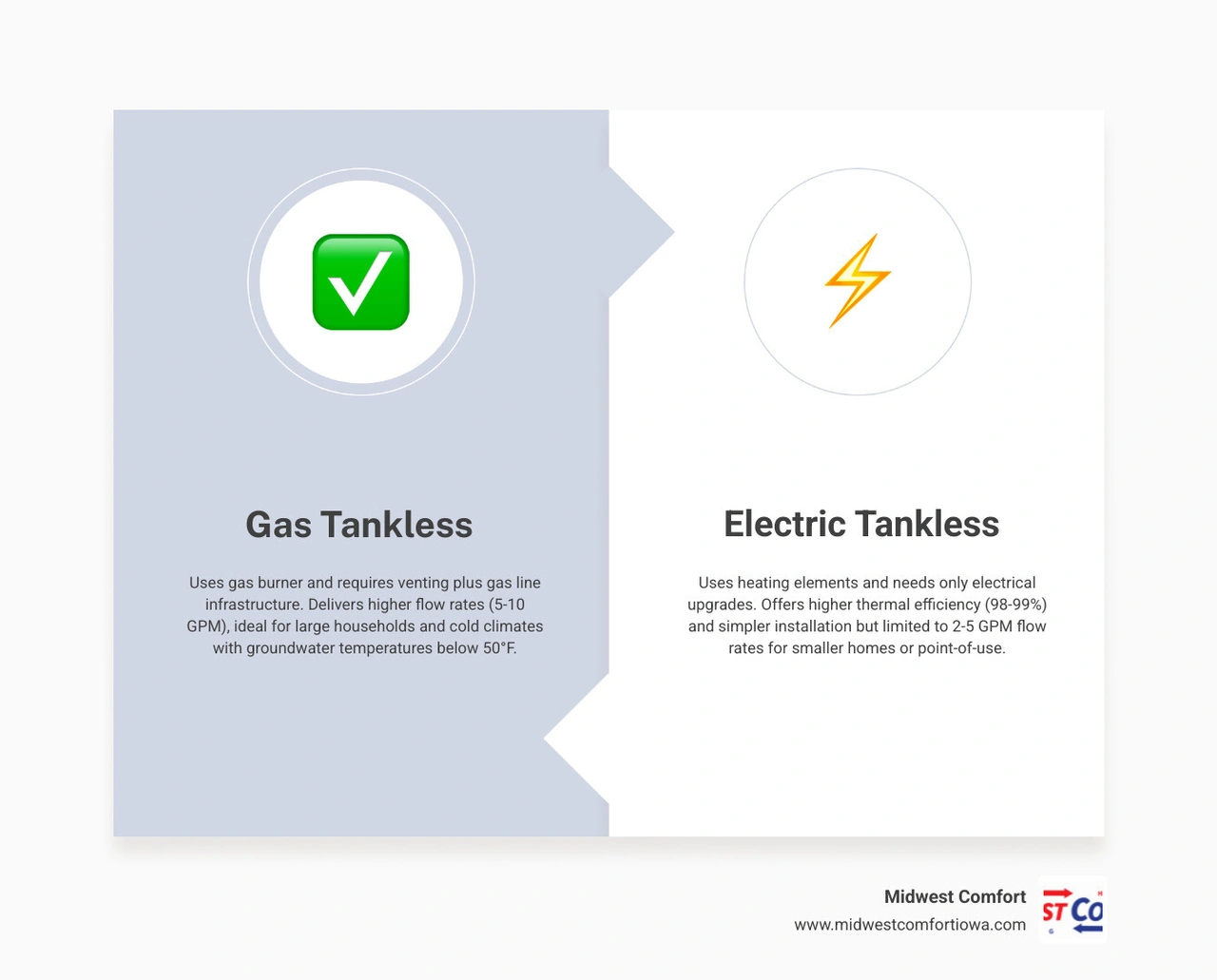
The key gas vs electric tankless water heater differences come down to five areas: upfront cost and installation, flow rate and performance, energy efficiency, maintenance needs, and long-term operating costs. Here's a quick breakdown:
| Factor | Gas Tankless | Electric Tankless |
|---|---|---|
| Flow Rate | 5–10 GPM | 2–5 GPM |
| Thermal Efficiency | 80–96% | 98–99% |
| Installation Complexity | Higher (venting + gas line) | Lower (electrical upgrade may be needed) |
| Best For | Large households, cold climates | Smaller homes, point-of-use |
| Lifespan | 15–20+ years | 15–20+ years |
When it's time to replace your old water heater, the choice between a gas and electric tankless model can feel like a bigger decision than it needs to be. Both types heat water on demand — meaning no tank sitting around losing heat all day — but they work differently, install differently, and perform differently depending on your home's setup and how much hot water your household actually uses.
For Des Moines homeowners dealing with Iowa winters and busy family schedules, getting this choice right matters. The wrong fit can mean lukewarm showers during peak morning hours or an expensive installation that didn't need to be that complicated.
This guide breaks down every major difference so you can make a confident, informed decision.
Core Gas vs Electric Tankless Water Heater Differences in Infrastructure
To understand why these systems perform so differently, we have to look at how they are built and what they require from your home's infrastructure. They do not just use different fuel sources; they require entirely different pathways to deliver that fuel safely and effectively.
The Heating Mechanism
A gas tankless water heater uses a powerful gas burner located at the bottom of the unit. When you turn on a hot water tap, cold water flows into the unit, and a sensor ignites the gas burner. The burning gas heats a metal component called a heat exchanger. As the water winds through the heat exchanger, it absorbs this intense heat and exits the unit at your desired temperature.
An electric tankless water heater, on the other hand, uses electric resistance heating elements. Instead of a flame, water passes over heavy-duty electric coils that heat up rapidly when electricity flows through them.
Venting and Combustion Air
Because gas units burn fossil fuels (either natural gas or liquid propane), they produce combustion byproducts, including carbon monoxide. This means they require a dedicated venting system to safely exhaust these gases outside your home. Depending on whether you choose a condensing or non-condensing gas model, you will need either specialized stainless steel venting or PVC venting. Additionally, gas units require a constant supply of fresh indoor or outdoor air to support combustion.
Electric units produce zero combustion byproducts, which means they require absolutely no venting. You can install an electric unit in a tight closet, under a sink, or in a crawlspace without worrying about exhaust pipes or fresh air access.
Fuel Lines and Electrical Panels
The power requirements for both systems are massive, but they impact your home in different ways:
- Gas Line Requirements: Gas tankless water heaters require a high volume of gas to ignite their powerful burners instantly. While a standard tank water heater might only need a 1/2-inch gas line, a gas tankless unit often requires a larger 3/4-inch or 1-inch gas line connected directly to your main gas supply. If your home's existing gas piping is too small, upgrading it is a necessary step.
- Electrical Panel Requirements: Electric tankless units do not need gas, but they demand an incredible amount of electrical current. A whole-house electric tankless unit can easily draw 120 to 150 amps of power. This means you will likely need a dedicated 240-volt circuit with multiple double-pole breakers. If your home in Johnston or Ankeny has a standard 100-amp or 150-amp electrical panel, you will almost certainly need to upgrade to a 200-amp or larger panel to support the system.
If you want to read more about how these utility demands compare in traditional systems, take a look at our Gas vs Electric Water Heater Comparison for Homeowners.

Performance, Flow Rates, and Climate Suitability
When we talk about performance, we are looking at how much hot water a unit can deliver at any given moment. This is measured in gallons per minute (GPM). The performance of your tankless system depends heavily on your household's peak demand and the climate where you live.
| Performance Metric | Gas Tankless Water Heaters | Electric Tankless Water Heaters |
|---|---|---|
| Average Flow Rate | 5.0 to 10.0 GPM | 2.0 to 5.0 GPM |
| Simultaneous Showers (Warm Climate) | 3 to 4 showers | 1 to 2 showers |
| Simultaneous Showers (Iowa Winter) | 1 to 2 showers | 1 shower (often at reduced pressure) |
| Recovery Time | Instantaneous | Instantaneous |
| Best Household Size | Large families (4+ people) | Small families or single occupants |
Flow Rate and Capacity: Gas vs Electric Tankless Water Heater Differences
Gas-fired tankless water heaters typically provide much higher flow rates than electric ones. A high-quality gas unit can deliver between 5 and 10 GPM. This high capacity makes gas units excellent for handling multiple simultaneous uses. If you have a busy morning routine in Waukee where someone is showering while the washing machine and dishwasher are running, a gas unit can keep up without anyone getting a sudden blast of cold water.
Electric tankless units typically range from 2 to 5 GPM. Because their heating elements cannot transfer heat to flowing water quite as rapidly as a gas burner, they struggle to support multiple high-demand fixtures at the same time. While a whole-house electric unit can usually run one shower and a sink simultaneously, running two showers at once often pushes them past their limit, resulting in lukewarm water. This makes them ideal for smaller households, apartments, or as point-of-use boosters for remote bathrooms.
If your current system is failing to keep up with your household's daily needs, it might be time to explore your options for a professional Water Heater Replacement.
Climate Impact: Gas vs Electric Tankless Water Heater Differences in Cold Weather
Climate plays a massive role in how tankless water heaters perform. A tankless unit has to raise the temperature of the incoming groundwater to your desired output temperature (usually around 120°F).
In Iowa, our winter groundwater temperatures can drop to a frigid 37°F to 45°F. To get that water up to 120°F, your water heater has to achieve a "temperature rise" of roughly 75°F to 83°F.
Because gas units have much higher heating capacities (measured in BTUs), they can handle this steep temperature rise while still maintaining a reasonable flow rate. An electric unit, however, will see its GPM capacity cut in half during a cold Des Moines winter. An electric unit that delivers 4 GPM in the summer might only manage 1.5 to 2 GPM in January, which is barely enough to run a single shower comfortably.
For anyone living in our local service areas like Grimes, Clive, or Altoona, understanding how winter temperatures affect your mechanical systems is crucial. You can learn more about local options by visiting our page on Water Heaters Des Moines IA.
Efficiency, Operating Lifespan, and Maintenance Needs
Both gas and electric tankless water heaters offer incredible longevity and efficiency compared to older tank models, but their day-to-day operations and maintenance requirements differ significantly.
Energy Efficiency and Standby Loss
Standard tank water heaters suffer from "standby energy loss" because they constantly heat and reheat a large volume of water even when you are asleep or at work. Tankless water heaters eliminate this issue entirely. According to the U.S. Department of Energy:
- For homes using 41 gallons or less of hot water daily, demand water heaters can be 24%–34% more energy efficient than conventional storage tank water heaters.
- For homes using around 86 gallons of hot water daily, they can still be 8%–14% more energy efficient.
When comparing the two tankless options, electric units are the clear winners in pure thermal efficiency. Electric tankless water heaters are 99%+ thermally efficient, converting nearly 98% to 99% of their electrical energy directly into heat. Gas tankless models typically range from 80% to 85% efficiency for non-condensing models, while high-efficiency condensing gas models can reach 90% to 96% Uniform Energy Factor (UEF). The slight drop in gas efficiency is due to heat escaping through the exhaust venting.
Lifespan and Long-Term Durability
Both gas and electric tankless water heaters can last 15–20 years or more with proper maintenance. This is a massive upgrade over traditional storage water heaters, which typically have a life expectancy of only 10–15 years. Because tankless units do not store water, they are far less prone to the rust, corrosion, and catastrophic tank ruptures that plague traditional models.
If you are tired of dealing with constant repairs on an old tank system, upgrading offers peace of mind. Check out the Benefits of Water Heater Replacement to see how a modern system can simplify your home life.
Maintenance Needs: Descaling and Inspections
To reach that 20-year milestone, both types of tankless water heaters require regular upkeep. Because these units heat water instantly at high temperatures, minerals like calcium and magnesium quickly settle out of the water and cling to the heating elements or heat exchanger. This is known as scale buildup.
- Annual Flushing: Both gas and electric units must be flushed and descaled at least once a year using a mild food-grade acid (like white vinegar) to clear out mineral deposits. If you have hard municipal water in areas like Pleasant Hill or Norwalk, you may need to flush the system even more frequently.
- Gas-Specific Maintenance: In addition to flushing, gas units require annual burner inspections, fan cleaning, and venting checks to ensure that the combustion process remains safe and that no blockages are forming in the exhaust pipes. Electric units have no burners or vents, making their maintenance routine slightly simpler.
Key Decision Factors for Des Moines Homeowners
Choosing between these two technologies requires looking closely at your current home setup, your family's daily habits, and safety considerations.
Existing Infrastructure
If your home already has an active natural gas line and a proper venting pathway, installing a gas tankless water heater is often the most practical choice. However, if your home is entirely electric, switching to gas requires running new gas lines and cutting vent holes through your exterior walls, which can make the installation process highly complex.
Conversely, if you want to install an electric unit, you must verify that your electrical panel has enough open space and amperage to handle the massive load. If you have to upgrade your entire electrical service to 200 amps just to run the water heater, that extra step should be factored into your decision.
Safety and Venting
Safety is always our top priority. Gas units bring combustible fuel and carbon monoxide into your home. While modern gas tankless water heaters are packed with safety sensors, they must be vented perfectly to comply with local building codes and protect your family. Electric models eliminate the risk of gas leaks or carbon monoxide exposure entirely, making them a highly appealing choice for homeowners who want to minimize combustion appliances in their living spaces.
To make sure your new system is installed safely and up to local codes, check out our comprehensive Water Heater Installation Guide Des Moines IA.
Utility Rates and Energy Trends
While electric units are more efficient on paper, electricity is often more expensive per unit of energy than natural gas in many parts of Iowa. However, natural gas prices have historically shown more volatility than consumer electricity prices. When planning for the next 15 to 20 years, many homeowners choose to go electric to align with home solar panels or to avoid long-term fossil fuel reliance.
Frequently Asked Questions About Tankless Water Heaters
Do tankless water heaters work during a power outage?
No, neither gas nor electric tankless water heaters will work during a power outage. While it is obvious why an electric model won't work, many homeowners assume a gas unit will keep running because it uses natural gas for fuel. However, gas tankless water heaters rely on an electronic ignition system, digital control panels, and safety sensors that all require electricity to function. If the power goes out, the gas unit will remain in standby mode and will not produce hot water unless you have it connected to a backup battery or home generator.
How long do gas and electric tankless water heaters last?
With proper care and annual maintenance, both gas and electric tankless water heaters can easily last 15 to 20 years, and many well-maintained units reach 25 years of service. This is nearly double the lifespan of standard tank models. The heat exchanger in a gas unit or the heating elements in an electric unit are built to be highly durable, but they must be kept free of mineral scale to reach their maximum lifespan.
If you want to know if your current water heater is nearing the end of its useful life, read our guide on When to Replace Your Water Heater.
Does hard water affect tankless water heater performance?
Yes, hard water is the number one enemy of tankless water heaters. When hard water passes through the intense heat of a tankless unit, minerals quickly bake onto the heating surfaces. Over time, this scale acts as an insulating blanket, forcing your water heater to work harder and run hotter to heat the same amount of water. This decreases your system's efficiency, can cause temperature fluctuations, and may eventually lead to system overheating and premature failure. Regular descaling is essential to protect your investment.
To learn how to spot the early warning signs of mineral scale in your home, read about the Signs of Sediment Buildup in Water Heater.
Conclusion
At Midwest Comfort, we believe that choosing the right mechanical systems should be a straightforward, stress-free experience. Whether you decide that a high-capacity gas tankless unit is perfect for your large family or that a highly efficient electric model fits your home's modern setup, our family-owned team is here to help. We are proud to provide honest, high-quality, and tailored comfort solutions to our neighbors across the Des Moines metro area, including Waukee, Ankeny, Johnston, and beyond.
If you are ready to make the switch to endless hot water on demand, we invite you to explore our services and schedule a professional consultation. Visit our dedicated page for Water Heaters Des Moines to take the first step toward a more comfortable, efficient home today!


Get Your HVAC Serviced Today


