
Why Uneven Home Temperatures Are Such a Common Problem
How mini splits solve hot and cold spots in your home comes down to one simple idea: instead of forcing one temperature on every room, they let each space control its own climate independently.
If you've ever noticed your upstairs bedrooms feeling stuffy in summer while the living room stays cool, or a back bedroom that never quite warms up in winter no matter what you set the thermostat to, you're not alone. In multi-story homes, upstairs rooms can run 5 to 10 degrees warmer than the floors below. Add in long duct runs, leaky ductwork losing up to 25-30% of conditioned air, and rooms with big windows or poor insulation, and the result is a home where some spaces feel comfortable and others never do.
Traditional central HVAC systems weren't designed to fix this. They treat your entire home as a single zone, controlled by one thermostat that can't account for the real differences between rooms.
Mini-split systems take a completely different approach. Here's a quick breakdown of how they address the problem:
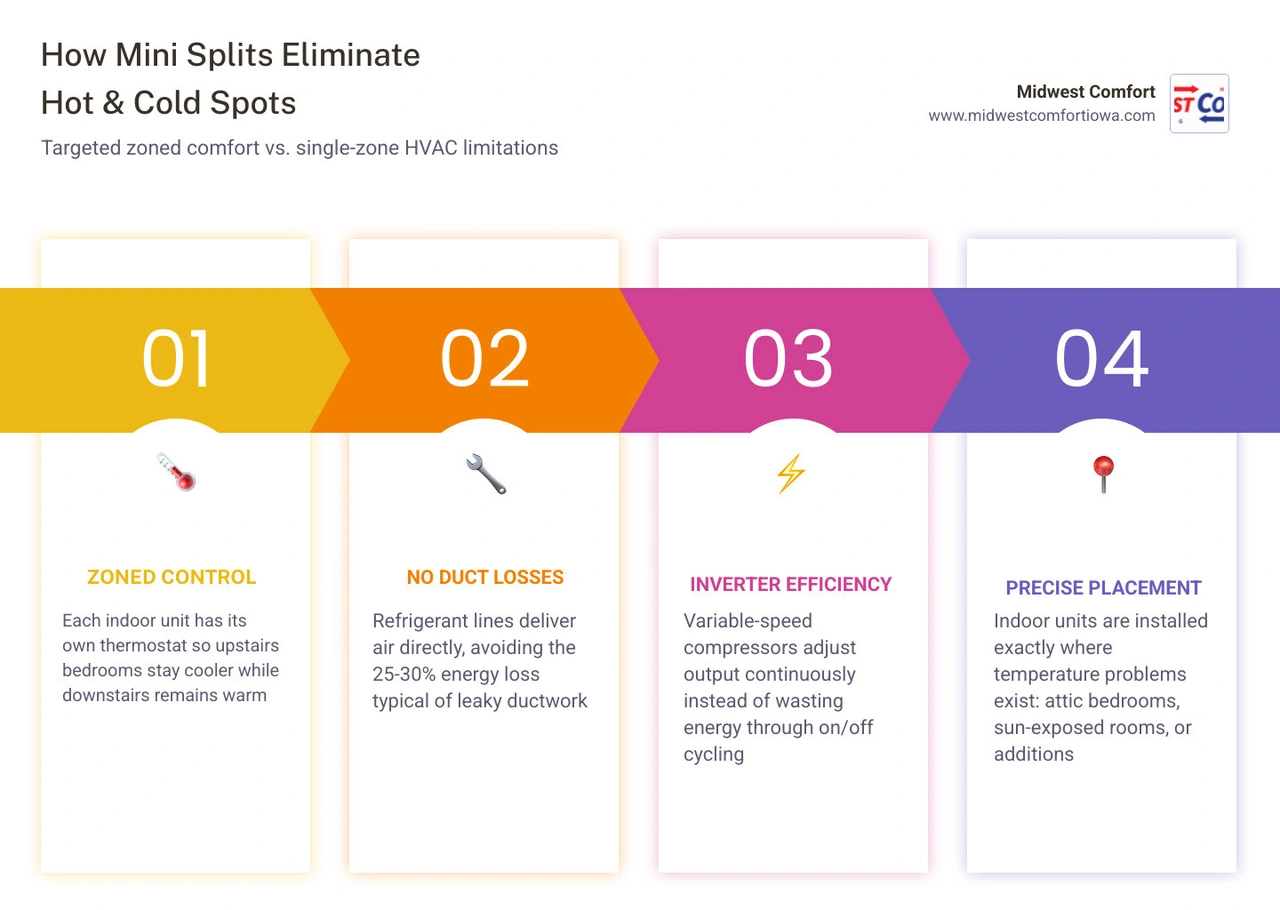
- Zoned control - Each indoor unit handles its own space with an independent thermostat
- No duct losses - Refrigerant lines deliver conditioned air directly, bypassing leaky ductwork
- Inverter technology - The system adjusts output continuously instead of cycling on and off
- Targeted placement - Units go exactly where temperature problems exist
- Year-round performance - Works for both heating and cooling in Iowa's seasonal extremes
Whether you're dealing with a hot attic bedroom, a cold basement, or a room addition that never feels right, mini-splits offer a direct fix without overhauling your entire HVAC setup.
Why Traditional HVAC Systems Fail to Eliminate Uneven Temperatures
To understand why your home has developed its own microclimates—with some rooms feeling like the Sahara and others like Antarctica—we have to look at how traditional central heating and cooling systems operate.
The core issue with standard central HVAC is the single-thermostat limitation. Think of your thermostat as a dictator. It sits in one central hallway or living room, measures the temperature in that exact spot, and decides the fate of your entire house based on that single reading. If your thermostat is downstairs in a shaded living room, it will happily shut off the air conditioner once it hits 72 degrees. Meanwhile, your south-facing upstairs bedroom with three large windows is still baking at 80 degrees.
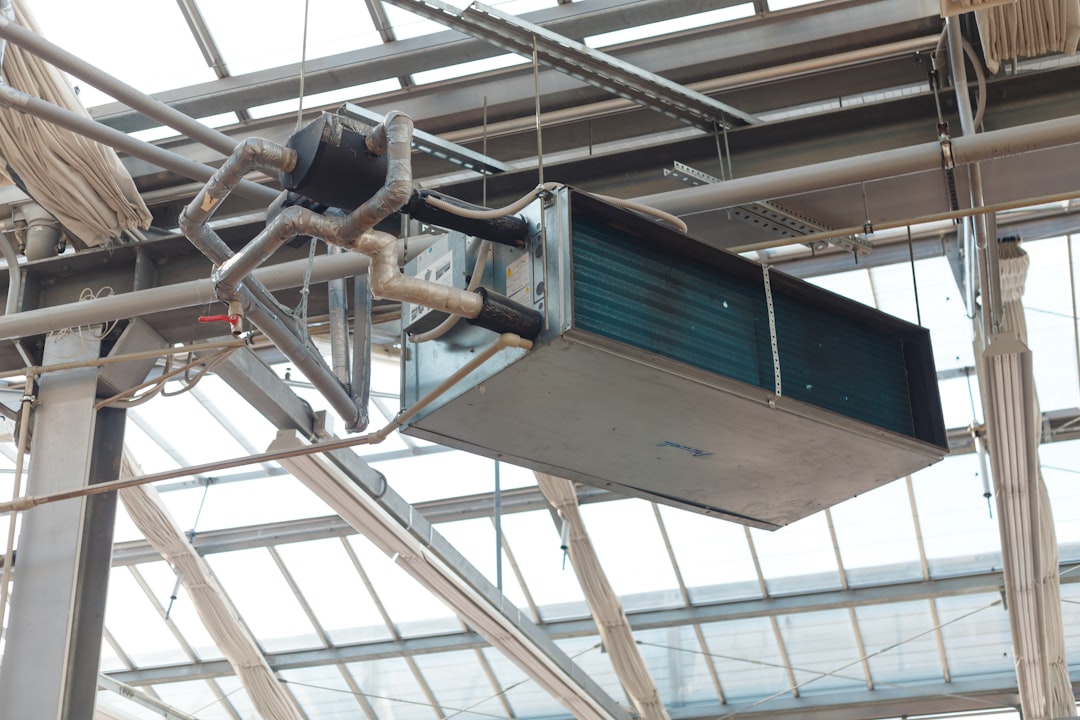
Additionally, traditional systems rely on a complex web of metal ductwork to push air through your home. The further a room is from the main furnace or air handler, the weaker the airflow becomes. By the time conditioned air travels through dozens of feet of twists, turns, and narrow ducts to reach a distant bedroom, it has already lost much of its heating or cooling power.
When you evaluate a Central AC vs Ductless Mini Split Comparison, it becomes clear that central systems are simply not built for room-by-room precision. They treat your home as one giant, uniform block, ignoring the fact that different spaces have vastly different heating and cooling needs.
The Impact of Leaky Ductwork on Home Comfort
Even if your central HVAC system is sized perfectly, it has to rely on ductwork to deliver comfort. Unfortunately, standard residential ductwork is notoriously inefficient. Over time, joints expand, seals degrade, and small holes develop.
According to industry data, traditional ducted systems lose an astonishing 25% to 30% of their conditioned air through leaks before it ever reaches your living spaces. Imagine buying a gallon of milk, but nearly a third of it leaks out of the jug on your way home from the grocery store. That is exactly what is happening to your heated and cooled air.
This massive loss of air pressure leads directly to weak airflow in your furthest rooms. Because the air escapes into your attic, crawlspaces, or wall cavities, your system has to run much longer to try and satisfy the central thermostat. This overworks your equipment, spikes your utility bills, and leaves distant rooms feeling incredibly uncomfortable. By choosing a Ductless System Johnston homeowners can completely bypass this leaky infrastructure, ensuring that 100% of the comfort they pay for is delivered directly into their rooms.
Architectural Challenges in Iowa Homes
Our homes in the Greater Des Moines area are full of character, but they also present unique architectural challenges for traditional HVAC systems.
In multi-story homes, the laws of physics are always at play: warm air naturally rises, while cool air sinks. During our humid Iowa summers, this natural draft makes upstairs bedrooms significantly warmer than downstairs living spaces. If you have a single central system, trying to balance these floors is nearly impossible.
Other common architectural features that create stubborn hot and cold spots include:
- Vaulted Ceilings: High ceilings look gorgeous, but they trap warm air high above your living space in the winter, leaving you shivering on the couch.
- Sunrooms and Large Windows: Rooms with heavy southern exposure absorb intense solar heat, making them much hotter than the rest of the house during the day.
- Finished Basements: Because basements are surrounded by cool earth, they naturally stay much colder than upper floors, often requiring heating even when the rest of the house needs cooling.
- Home Additions: Extending existing ductwork to a new addition or converted garage often starves the rest of the house of airflow, creating new temperature imbalances.
Understanding the Ductless Mini Split Benefits for Iowa Homeowners is essential for anyone dealing with these architectural quirks. Ductless systems allow you to target these specific areas without putting additional strain on your existing system.
How Mini Splits Solve Hot and Cold Spots in Your Home
So, how exactly do ductless mini-split systems banish these frustrating temperature swings? The answer lies in their decentralized design.
Instead of forcing a single, centralized unit to do all the heavy lifting, a mini-split system breaks your home down into individual "zones." Each zone is equipped with its own indoor air handler, which is controlled by its own dedicated thermostat. This means you can keep your home office cool and crisp during a busy workday without freezing your family members who are relaxing in the living room.
Furthermore, mini-splits utilize highly advanced inverter-driven compressors. While traditional systems operate like a standard light switch—turning completely on at full blast and then shutting completely off—inverter technology works like a dimmer switch. It constantly modulates its speed to match the exact heating or cooling demand of the room. This continuous, low-energy operation ensures a steady, comfortable climate without the dramatic temperature swings associated with cycling central systems.
Investing in Comfort with a Mini Split AC System means enjoying tailored, steady temperatures in every corner of your home, regardless of what the weather is doing outside.
Understanding How Mini Splits Solve Hot and Cold Spots in Your Home
To appreciate how efficient these systems are, it helps to understand how they are built. A ductless mini-split system consists of two primary parts: an outdoor condenser unit and one or more indoor air handlers.
These components are connected not by bulky, dirty ducts, but by a small conduit containing refrigerant lines, a power cable, and a condensate drain line. This conduit only requires a small three-inch hole through an exterior wall for installation.
The system works by transferring heat rather than generating it:
- In Cooling Mode: The indoor unit absorbs excess heat from the room's air and sends it outside through the refrigerant lines, releasing it via the outdoor condenser.
- In Heating Mode: The process reverses. Even in cold weather, the outdoor unit extracts heat energy from the outside air and transfers it indoors to warm your space.
Because there are no ducts, there is zero opportunity for air loss. By installing Mini Split AC Systems for Home Comfort, you ensure that heated or cooled air is delivered directly into the room where the air handler is mounted, providing instant, efficient relief.
Real-World Scenarios: How Mini Splits Solve Hot and Cold Spots in Your Home
Let's look at a few common real-world situations where mini-splits truly shine:
- The "Sauna" Attic Conversion: Transforming an attic into a guest bedroom or playroom is a great way to add space, but these rooms are notoriously hot. A single-zone mini-split can easily keep an attic bedroom perfectly cool without forcing you to run your main home AC at freezing levels.
- The Icebox Room Above the Garage: Rooms built over uninsulated garages are notoriously difficult to keep comfortable. Because they are exposed to cold air from below, they stay drafty all winter. A wall-mounted mini-split provides localized heating to keep this space cozy.
- The Humid Basement: Finished basements often feel damp and chilly. Mini-splits provide excellent, independent dehumidification and heating, turning a dark basement into a warm, comfortable family room.
- New Room Additions: If you've added a sunroom or extended your living area, adding a Ductless AC Ankeny IA zone is often much simpler and more reliable than trying to tie into your existing ductwork.
Comparing Mini-Splits to Other Zoning Solutions
When trying to solve uneven home temperatures, homeowners often look at a few different options. Let's compare ductless mini-splits to traditional zoning with dampers and standard window units:
| Feature | Ductless Mini-Splits | Central HVAC Zoning (Dampers) | Window AC Units |
|---|---|---|---|
| Zoning Precision | Excellent (Room-by-room control) | Moderate (Usually grouped by floor) | Poor (Single-room only) |
| Energy Efficiency | Extremely High (No duct losses, inverter technology) | Moderate (Still subject to duct leaks) | Very Low |
| Noise Level | Whisper-Quiet (20-49 dB) | Moderate (Air rushing through closed dampers) | Loud (50-60+ dB) |
| Installation Impact | Minimal (Requires a small 3-inch hole) | High (Requires cutting into existing ducts) | Low (But blocks windows) |
| Year-Round Use | Yes (Heating & Cooling) | Yes | No (Cooling only, must be removed in winter) |
While central zoning with motorized dampers can help direct airflow, it still relies on your central blower pushing air through leaky ducts. If dampers close off airflow to certain zones, it can increase static pressure in your system, leading to extra wear and tear on your fan motor.
On the other hand, window units are loud, block your natural light, and are highly inefficient. If you are exploring options, reading about Mini Split Air Conditioners will show you why ductless technology is the cleanest, quietest, and most reliable zoning method available.
Energy Efficiency and Operational Savings
One of the biggest reasons homeowners upgrade to ductless mini-splits is the incredible impact on their monthly energy bills. Because mini-splits don't suffer from the 25% to 30% energy loss associated with traditional ductwork, they are inherently more efficient. In fact, ductless mini-splits can be 20 to 30 percent more efficient than traditional ducted systems.
Additionally, because you can control each zone independently, you no longer have to pay to heat or cool empty rooms. If you spend your day in your home office, you can set the rest of the house to an energy-saving temperature while keeping your workspace perfectly comfortable.
Many homeowners experience 15-30% energy savings with proper zoning. Combined with variable-speed inverter compressors that draw only the minimum power needed, these systems pay for themselves over time in reduced utility costs. To learn more about maximizing your home's efficiency, check out our Ductless Replacement Waukee Guide.
Quiet Operation and Indoor Air Quality
If you've ever tried to watch a movie or have a conversation while a window AC unit or a loud central furnace kicks on, you know how disruptive traditional systems can be.
Mini-split indoor units are designed for whisper-quiet performance, typically operating between 20 and 49 decibels. To put that in perspective, a quiet library is about 40 decibels, while a traditional indoor HVAC system or window unit can easily roar at 50 to 60 decibels. Because the noisy compressor is located outside, all you hear indoors is a gentle, barely audible hum of air.
Beyond quiet comfort, mini-splits provide a massive boost to your indoor air quality. Traditional ductwork is a magnet for dust, pet dander, pollen, and mold spores, which are continuously blown throughout your home every time the system turns on. Ductless systems completely eliminate this issue. Plus, each indoor air handler features its own multi-stage filtration system that actively scrubs dust and allergens out of the room's air. For details on keeping your system running cleanly, refer to our Mini Split Service Windsor Heights Guide.
Key Considerations for Mini-Split Installation and Maintenance
While mini-split systems are incredibly versatile, they are not a "one-size-fits-all" product. Proper planning and professional installation are absolutely critical to ensuring they perform correctly.
The most important step in the installation process is professional sizing. An oversized mini-split will cool a room too quickly without properly dehumidifying it, leaving the space feeling clammy and cold. An undersized unit will run constantly, struggling to keep up and driving up your energy bills.
To prevent this, a qualified technician must perform a room-by-room Manual J load calculation. This calculation takes into account your room's square footage, ceiling height, insulation levels, window sizes, and local climate to determine the exact BTU capacity your space requires. If you are ready to explore your options, scheduling a professional Mini Split AC Installation Urbandale IA is the best way to guarantee a perfect fit.
Selecting Single-Zone vs. Multi-Zone Systems
When designing your comfort solution, you'll need to choose between a single-zone or a multi-zone configuration:
- Single-Zone Systems: Consist of one outdoor condenser connected to a single indoor air handler. This is the ideal, cost-effective solution for a single problem area, such as a new sunroom addition, a converted garage, or a cold attic room.
- Multi-Zone Systems: Feature a larger outdoor compressor that can power multiple indoor air handlers (typically up to five units). This allows you to create independent temperature zones across your entire home, such as setting different temperatures for each bedroom and the main living room.
No matter your home's layout, we can help design a custom layout that fits your family's routine. Explore our options for Mini Split AC Des Moines IA to see how we customize these systems for local properties.
Routine Maintenance for Long-Term Performance
To keep your mini-split system running at peak efficiency for its entire 15-to-20-year lifespan, regular maintenance is essential. Fortunately, basic upkeep is incredibly simple:
- Clean the Filters: Every few weeks, simply pop open the front panel of your indoor air handler, slide out the reusable air filters, rinse them under warm water, let them dry, and slide them back in. This keeps your airflow strong and your air clean.
- Clear the Outdoor Unit: Ensure that leaves, snow, grass clippings, and weeds are kept at least two feet away from your outdoor condenser so it can breathe properly.
- Schedule Annual Professional Service: Once a year, have a professional technician inspect your refrigerant levels, clean the coils, and check the condensate drain lines to prevent any unexpected issues.
Investing in regular upkeep, such as scheduling a Mini Split Service Ankeny IA, ensures your system remains reliable and highly efficient for years to come.
Frequently Asked Questions about Eliminating Uneven Temperatures
Can mini-splits be used alongside an existing central HVAC system?
Absolutely! In fact, this is one of the most common ways homeowners use ductless technology. You don't have to tear out your existing central furnace and air conditioner to solve a hot or cold spot.
Instead, you can use a single-zone mini-split as a supplemental system. By letting your central system handle the main parts of your home while the mini-split manages a tricky space—like a master bedroom or a finished basement—you get the best of both worlds. This hybrid approach takes the strain off your main system and keeps your whole home comfortable. Learn more about this setup by checking out our guide on Mini Split AC Waukee IA.
How do mini-splits perform during extreme Iowa winters?
Modern ductless heat pumps are incredibly resilient and are built to handle our freezing Midwestern winters. Thanks to advanced cold-climate heat pump technology and reversing valves, high-performance mini-splits can operate reliably even when outdoor temperatures drop well below zero.
They work by extracting trace amounts of heat energy from the freezing outdoor air and concentrating it to warm your home. To find the right system for our local climate, read about Mini Split AC Urbandale IA options designed specifically for cold-weather performance.
Do ductless mini-splits require major home renovations to install?
Not at all! Unlike traditional ducted systems, which require tearing open walls and ceilings to run bulky metal ductwork, mini-split installation is quick and non-invasive.
An experienced installation team can typically complete a single-zone installation in just one day. The only structural modification required is a small three-inch hole through an exterior wall to run the refrigerant and power lines. This makes it an incredibly clean and seamless upgrade for historic homes or finished spaces. For more details on the process, read about a professional Ductless Installation Polk City.
Conclusion
No one should have to avoid certain rooms in their own home because they are too hot in the summer or too cold in the winter. Your home should be a sanctuary of consistent, reliable comfort.
At Midwest Comfort, we are proud to be a family-owned business providing honest, high-quality, and cost-effective HVAC services throughout the Greater Des Moines area. We take a truly family-oriented approach to heating and cooling, which means we don't believe in high-pressure sales pitches or cookie-cutter solutions. Instead, we focus on tailoring our services to your family's unique layout, routine, and comfort goals. Plus, with our loyalty programs and flexible payment options, we make it easy to get the comfort you deserve.
If you are ready to banish your home's hot and cold spots once and for all, we are here to help. Contact us today to schedule a consultation and learn more about our professional Mini Split AC Installation Ankeny IA services!
