
Why Midwest Homeowners Struggle to Keep Their AC Running Long-Term
How to extend the life of your AC in the Midwest is one of the most important things you can do to protect your home comfort and your wallet — especially in Des Moines, where summers bring punishing heat and humidity that push cooling systems to their limits.
Here's a quick answer to get you started:
- Change your air filter every 1–3 months (more often with pets or allergies)
- Schedule professional maintenance every spring before the heat arrives
- Keep the outdoor unit clear with at least 2 feet of space on all sides
- Set your thermostat to 78°F and use programmable schedules
- Seal air leaks and improve insulation to reduce how hard your system works
- Address odd noises, warm air, or rising energy bills right away — don't wait
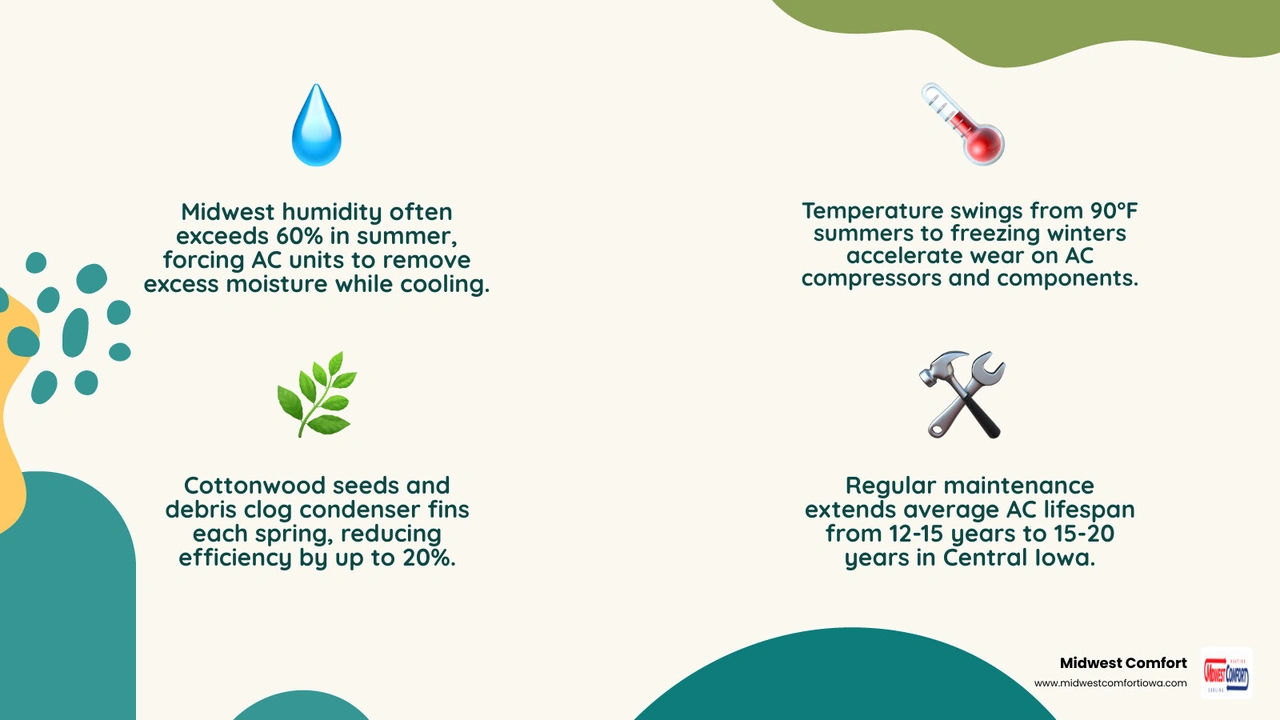
The Midwest is hard on AC systems. Humidity in Central Iowa can climb well above 60% during peak summer months, forcing your air conditioner to work overtime removing moisture while also cooling your home. Add in dramatic temperature swings between seasons, cottonwood seeds clogging condenser fins each spring, and long stretches of heavy use — and it's easy to see why the average AC in Des Moines lasts just 12–15 years without consistent care.
The good news? Well-maintained systems regularly reach 15–20 years. That's a significant difference — and it comes down to a handful of habits that aren't complicated or expensive.
Proven Strategies on How to Extend the Life of Your AC in the Midwest
When we talk about how to extend the life of your AC in the Midwest, we often think of it in terms of "mileage" rather than just years. An air conditioner in a home with poor insulation and leaky ducts is like a car driven 30,000 miles a year — it’s going to wear out much faster than a unit that only has to run for short, efficient cycles.
In our neck of the woods, the climate is a major factor. Central Iowa experiences extreme temperature fluctuations. One week it’s 65 degrees, and the next, we’re hitting 95 with a dew point that makes the air feel like a wet blanket. These swings cause the metal components in your system to expand and contract, which can lead to refrigerant leaks or electrical wear over time.
Furthermore, the humidity in places like Ankeny and Johnston isn't just uncomfortable for you; it’s a heavy workload for your AC. Your system has to condense gallons of water out of the air every single day. If the system is dirty or poorly maintained, this process becomes incredibly inefficient.
The Lifespan Gap: Maintained vs. Neglected
To put it into perspective, look at how regular care changes the math for your home investment:
| Maintenance Level | Typical Lifespan in Iowa | Efficiency Rating | Breakdown Risk |
|---|---|---|---|
| Neglected | 12–15 Years | Drops 5-10% annually | High (80% of calls) |
| Well-Maintained | 15–20 Years | Stays near peak | Very Low (95% fewer) |
By staying on top of AC Maintenance Boost Performance, you aren't just preventing a breakdown today; you're essentially buying yourself an extra five to eight years before you have to write a check for a full system replacement.
Essential DIY Maintenance for Central Iowa Homeowners
You don't need a toolbelt and a van to make a huge difference in your system's longevity. There are several tasks we recommend for every homeowner in Polk City, Granger, and Waukee that keep the air moving freely. Airflow is the lifeblood of your HVAC system. When airflow is restricted, the blower motor has to work harder, the coils can freeze, and the compressor — the most expensive part of your unit — can overheat and fail.
One of the most common issues we see is Address Poor Airflow from AC Vents. Often, this is caused by simple things like furniture blocking return grilles or rugs covering floor vents. Make sure your home can "breathe" by keeping all interior doors open and ensuring vents are clear.
How to extend the life of your ac in the midwest with regular filter changes
If there is one "magic pill" for AC health, it’s the air filter. Think of your filter like a breathing mask for your home. If it’s clogged with dust, pet dander, and Iowa pollen, your system is essentially trying to breathe through a plastic bag.
- Frequency: In the humid Midwest summer, we recommend checking your filter every month. If you have pets in a home in Windsor Heights or Altoona, you’ll likely need to change a standard 1-inch pleated filter every 45–60 days.
- MERV Ratings: While it’s tempting to buy the highest MERV rating possible to catch every speck of dust, be careful. Filters that are too thick can actually restrict airflow. A MERV rating between 8 and 11 is usually the "sweet spot" for residential longevity.
- The Impact: Dirty Air Filters Impact HVAC Performance by forcing the system to run longer cycles. This extra "mileage" adds up, leading to premature component failure.
Maintaining outdoor unit clearance and airflow
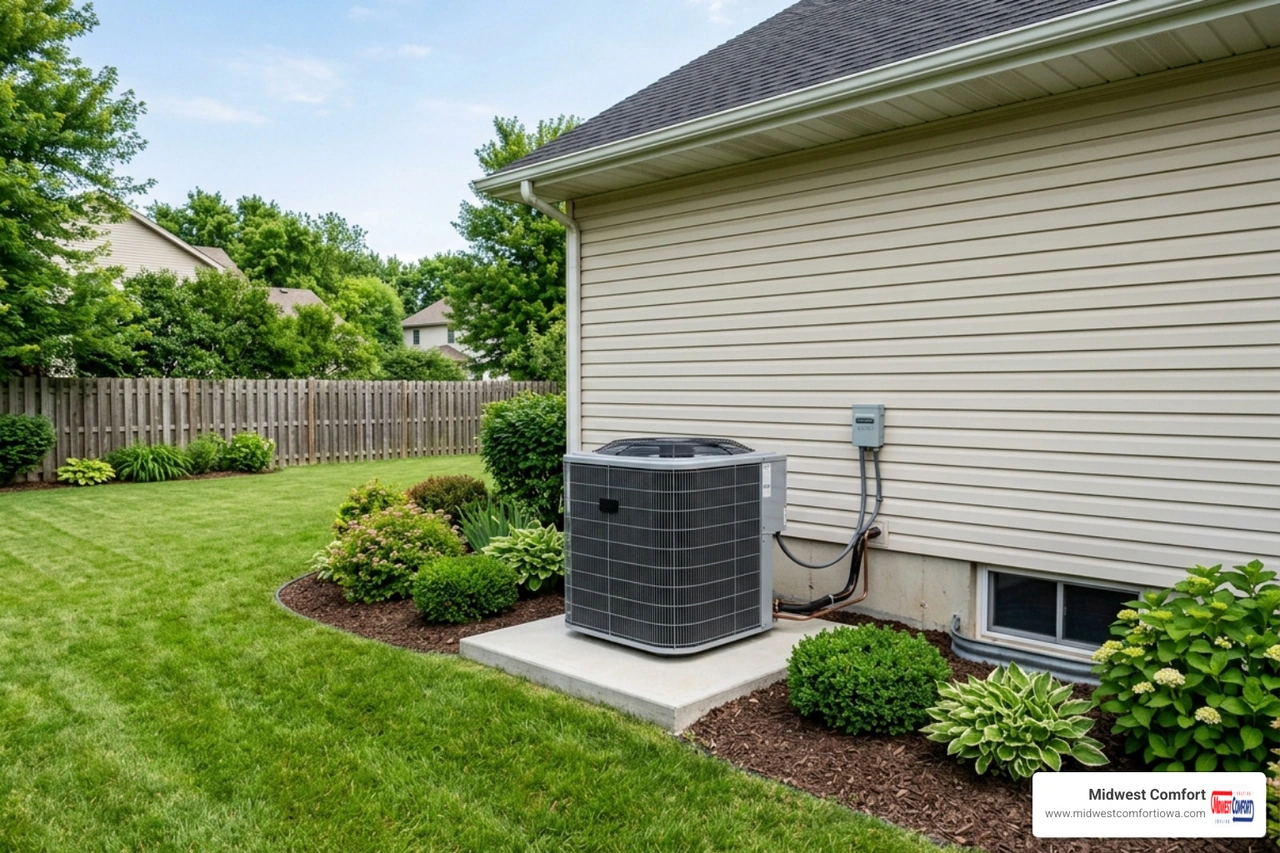
Your outdoor condenser unit is responsible for releasing the heat collected from inside your home. If it’s buried in tall grass or surrounded by decorative shrubs, that heat has nowhere to go.
In the spring, Central Iowa is notorious for cottonwood seeds. These fluffy white seeds act like a blanket, wrapping around your condenser fins and choking off the air. We recommend keeping at least a two-foot clearance on all sides of the unit and five feet of clear space above it.
Every time you mow the lawn in Dallas Center or Adel, take a quick peek at the unit. If you see grass clippings or debris stuck to the sides, you can gently rinse it off with a garden hose (never use a power washer, as it will bend the delicate fins). Following a basic Guide to Air Conditioner Maintenance for your outdoor unit can prevent the compressor from "slugging" or burning out during a July heatwave.
The Role of Professional Tune-Ups in System Longevity
While DIY tasks are essential, they only cover about 20% of what a system needs to survive 20 years. The other 80% happens inside the cabinet where high-voltage electricity and high-pressure refrigerant live.
A professional tune-up is like a physical for your AC. We look for the "silent killers" — the small issues that don't cause a breakdown immediately but strain the system until something major snaps. For example, a failing capacitor is a relatively simple fix, but if ignored, it can cause the compressor to fail, which often means the end of the unit's life.
During a professional visit, we ensure Regular AC Maintenance for Optimal Performance by cleaning the evaporator and condenser coils, checking refrigerant levels (a 10% loss in refrigerant can increase energy use by 20%!), and tightening all electrical connections.
How to extend the life of your ac in the midwest through smart thermostat usage
Your thermostat is the brain of your cooling system. If the brain is confused, the body suffers. We often see homeowners in West Des Moines struggling because their AC Thermostat is Failing or is placed in a spot that gets direct sunlight, causing the AC to cycle on and off too frequently.
- The 78-Degree Rule: The Department of Energy recommends setting your thermostat to 78°F when you are home. Every degree lower increases the workload on your system significantly.
- Smart Scheduling: Use a programmable or smart thermostat to raise the temperature by 7-10 degrees when you are away at work in Runnells or Pleasant Hill. This "rests" the system and reduces total run time.
- Avoid "Cranking It Down": Setting your thermostat to 60°F won't cool the house any faster; it just tells the AC to run longer, which can lead to frozen coils and unnecessary wear.
Why annual spring service is non-negotiable
In the Midwest, your AC sits idle for nearly six months. During that time, mice might nest in the cabinet (chewing on wires), and dust settles on the components. Starting a system "cold" in May without an inspection is a recipe for a June breakdown.
Professional service is also often a requirement for your manufacturer’s warranty. If a major part fails in year nine of a ten-year warranty, the manufacturer may ask for maintenance records. If you haven't had annual service, they could void the warranty. Our HVAC Maintenance Des Moines Guide emphasizes that these visits pay for themselves by catching leaks and electrical issues before they become four-figure repairs.
Optimizing Your Home Environment to Reduce Cooling Load
If you want to know how to extend the life of your AC in the Midwest, look at your attic. Your AC is only half of the equation; the other half is your home’s "envelope."
In the Des Moines area, many older homes have insulation that has settled or was never sufficient to begin with. We recommend attic insulation levels of R-49 to R-60. When your attic stays cooler, your AC doesn't have to fight the 130-degree heat radiating through your ceiling.
- Duct Sealing: The average home loses about 25% of its cooled air through leaky ducts in the attic or crawlspace. Sealing these leaks ensures the air you're paying to cool actually reaches your living room in Grimes or Clive.
- Window Shading: Solar heat gain through windows is a massive load on your AC. Closing blinds or using awnings on the south and west sides of your home can drop the indoor temperature by several degrees naturally.
- Duct Cleaning: Especially after a remodel or if you have pets, professional duct cleaning every few years can prevent dust from recirculating and coating your AC’s internal coils.
Investing in these home improvements means your AC runs fewer hours per day. Fewer hours equals less wear, which is the ultimate secret to longevity. As we like to say, HVAC Maintenance Saves You Money both on monthly bills and by delaying the cost of a new system.
Recognizing Signs Your System Needs Professional Attention
Sometimes, despite your best efforts, your system will give you a warning sign that it’s struggling. Ignoring these signs is the fastest way to shorten your AC’s life. If you notice any of the following, it's time to call in the pros:
- Strange Noises: Squealing, grinding, or banging sounds usually indicate a belt or motor issue.
- Short Cycling: If the unit turns on and off every few minutes, it’s under immense stress and may have an electrical or airflow problem.
- Warm Air: If the air coming from the vents isn't icy cold, your system might be low on refrigerant or have a clogged coil. Why is my AC blowing warm air? is a common question we answer, and the fix is often simpler than you think if caught early.
- Ice on the Lines: If you see ice on the copper pipes leading to your unit, stop! Turn the system off and call us. Running an iced-over unit can destroy the compressor.
Knowing the Signs AC Needs Immediate Repair can save you from a total system failure. For a deeper dive into what to look for, check out our AC Repair Des Moines IA Complete Guide.
Frequently Asked Questions about Midwest AC Longevity
How long does an AC unit typically last in the Midwest?
In Central Iowa, an AC unit typically lasts 12 to 15 years if it's neglected. However, with consistent annual maintenance and regular filter changes, many of our customers in Norwalk and Carlisle see their systems last 18 to 20 years. The humidity and seasonal transitions are the biggest factors that determine that lifespan.
How often should I schedule professional AC maintenance in Des Moines?
We recommend professional maintenance once a year, ideally in the early spring (March or April). This allows us to clear out any debris from the winter and ensure the system is ready for the first 90-degree day.
What are the most common mistakes that shorten AC life?
The "big three" mistakes are:
- Skipping filter changes: This is the #1 cause of system failure.
- Closing vents in unused rooms: This actually increases pressure and strain on the blower motor.
- Ignoring minor noises: A $150 repair today can prevent a $5,000 replacement tomorrow.
Conclusion
At Midwest Comfort, we understand that your air conditioner is a major investment in your family's comfort. As a family-owned business serving the Des Moines metro, from Pleasant Hill to Adel, we take a "family-first" approach to HVAC. We aren't just here to fix a machine; we're here to ensure your home remains a sanctuary, even when the Iowa humidity is at its worst.
By following the steps in this guide — changing your filters, keeping your outdoor unit clear, and scheduling that vital spring tune-up — you can significantly extend the life of your AC in the Midwest.
If your system is making a strange noise, blowing warm air, or if it’s just been a few years since its last check-up, don't wait for the hottest day of the year to find out there's a problem. We offer tailored solutions and loyalty programs designed to keep your system running efficiently for the long haul.
Ready to ensure your AC survives another Iowa summer? Contact us today to schedule your maintenance and keep your cool all season long!
