
The Mini Split vs Central AC Cost Comparison Most Homeowners Get Wrong
When homeowners start researching the mini split vs central AC cost comparison, they usually focus on the sticker price alone — and that's where the confusion begins. The real answer depends on a handful of factors that go well beyond what you pay on installation day.
Here's a quick breakdown to answer the core question:
| Factor | Mini Split | Central AC |
|---|---|---|
| Best for homes without ductwork | Yes | No (adds significant cost) |
| Best for homes with existing good ductwork | Not always | Yes |
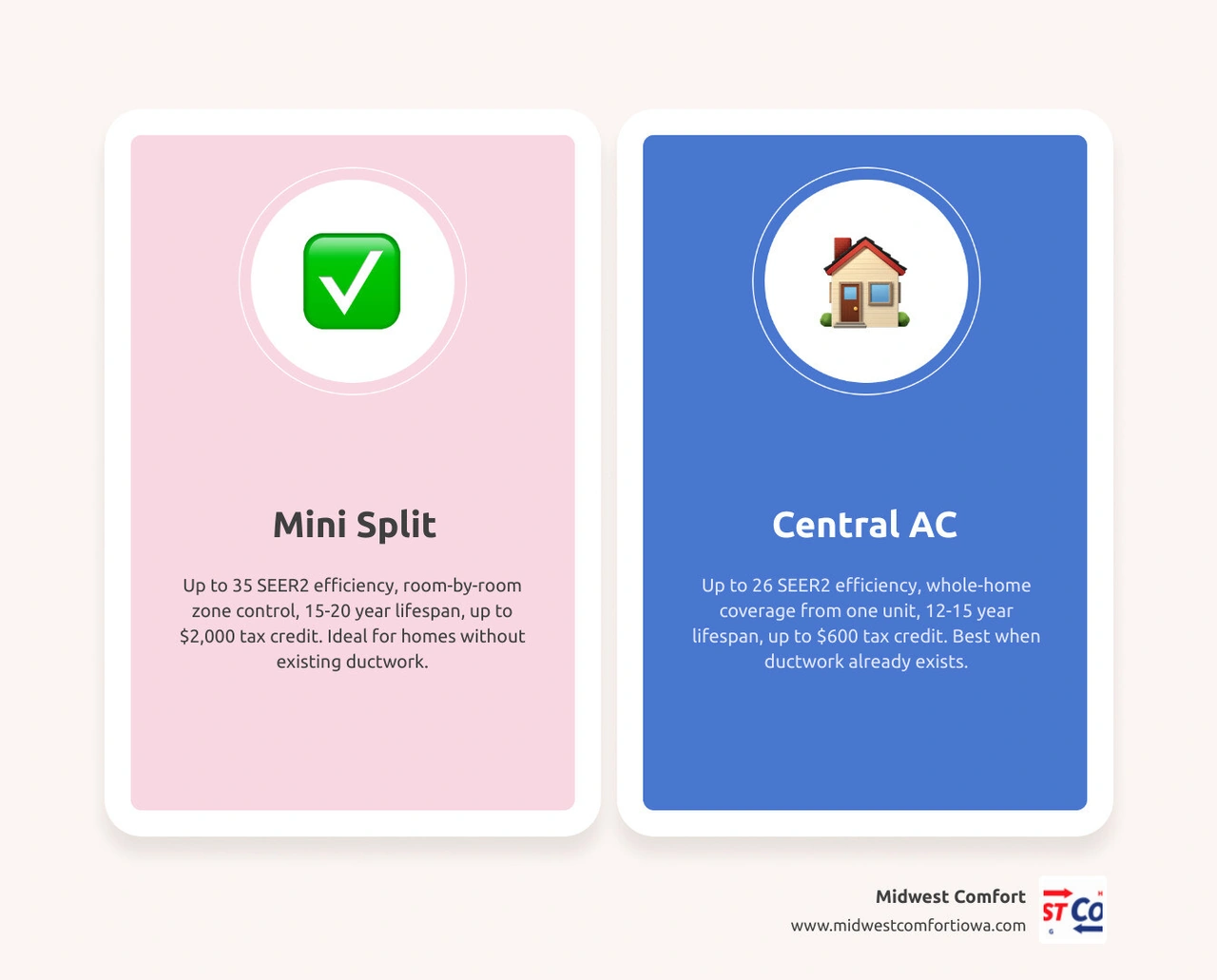
| Energy efficiency (SEER2) | Up to 35 SEER2 | Typically up to 26 SEER2 |
| Whole-home coverage from one unit | No | Yes |
| Zone control (room by room) | Yes | Limited |
| Installation disruption | Low | Higher without ducts |
| System lifespan | 15-20 years | 12-15 years |
| Federal tax credit eligibility | Up to $2,000 | Up to $600 |
The short answer: if your home already has ductwork in good condition, central AC is usually cheaper upfront. If it doesn't, a mini split almost always wins on total cost.
But for most Des Moines homeowners, the decision is rarely that simple. Older homes, room additions, unfinished basements, and aging duct systems all change the math. And when you factor in monthly energy bills, maintenance, system lifespan, and available rebates, the picture shifts again.
Heating and cooling make up roughly half of a typical home's energy bill, according to the U.S. Energy Information Administration. That means choosing the wrong system doesn't just affect your comfort — it affects your budget every single month for the next 15 to 20 years.
This guide walks you through every layer of the cost comparison so you can make a confident, informed decision for your home and family.
Mini split vs central ac cost comparison glossary:
- adding cooling without ductwork options compared
- central ac vs ductless mini split comparison
- when is a mini split better than central ac
Key Factors in the Mini Split vs Central AC Cost Comparison
When evaluating a new cooling system, you cannot look at the equipment in a vacuum. The architectural layout, age, and existing infrastructure of your home dictate which system is more practical and cost-effective.
A traditional central air conditioner relies on a single outdoor condenser and an indoor evaporator coil paired with a blower motor (usually part of your furnace) to push chilled air through a network of sheet metal or flexible ducts. A ductless mini split, on the other hand, bypasses the duct network entirely. It uses an outdoor condenser connected directly to one or more indoor air-handling units mounted on your walls or ceilings.
This fundamental difference in design creates a divergence in installation requirements. To understand how these systems stack up structurally, let’s look at a Central AC vs Ductless Mini Split Comparison of the core physical demands of each option:
| Installation Factor | Ductless Mini Split | Central Air Conditioning |
|---|---|---|
| Ductwork Requirements | None (100% ductless) | Requires a complete network of supply and return ducts |
| Electrical Upgrades | Often requires a dedicated 220V circuit; may require panel upgrade for multi-zone | Typically runs on existing central HVAC electrical infrastructure |
| Structural Impact | Minimal (requires a small 3-inch hole in the exterior wall per indoor head) | Significant if retrofitting ducts (cutting into drywall, ceilings, and closets) |
| Zoning Flexibility | Built-in (each indoor unit operates independently) | Requires specialized, expensive dampers and multiple thermostats |
| Indoor Footprint | Wall-mounted, floor-mounted, or ceiling cassette units visible in each room | Completely hidden behind registers and grilles |
How Existing Ductwork Impacts Your Mini Split vs Central AC Cost Comparison
The single most critical hinge point in your financial math is whether your home has functional, well-designed ductwork.
If you live in a newer home in Waukee, Johnston, or Ankeny that already has a modern ducted heating system, installing a new central air conditioner is highly straightforward. The infrastructure is already there. Replacing an old condenser and coil is the path of least resistance, making central AC highly cost-effective upfront.
However, if your home does not have ducts—common in older historic homes in Des Moines or homes with boiler systems and radiator heat—the comparison changes entirely. Retrofitting a home with new ductwork is a massive, invasive project. It involves opening up walls, sacrificing closet space to run chases, and rebuilding ceilings to hide the bulky metal pipes. In this scenario, choosing a mini split is almost always the more cost-effective choice because it completely bypasses the labor, mess, and structural modifications associated with duct installation.
Furthermore, we must look at the condition of your existing ducts. Even if you have ductwork, it may not be in good shape. According to the Department of Energy, the average home loses 20% to 30% of its conditioned air through leaks, loose connections, and uninsulated duct runs. If your ducts are old, leaky, or poorly sized, a new central AC will waste a significant portion of its cooling capacity before the air ever reaches your living room. When deciding When is a Mini Split Better than Central AC, the presence of failing, unsealed ductwork is a major indicator that ductless technology will save you more money over time.
Upfront Installation Complexity and Disruption
The process of bringing these systems into your home looks very different from a construction standpoint.
A central AC installation in a home with existing ducts is relatively quick, often completed in a single day. The technicians swap out the outdoor unit, install the new indoor coil, connect the refrigerant lines, and test the system. Disruption is minimal, and your daily routine is barely interrupted.
Conversely, installing a multi-zone mini split system takes more coordination but remains highly localized. Instead of one central unit, we install individual air handlers in each designated zone. Each indoor head requires mounting, running a drain line for condensate, and routing a bundle of refrigerant and communication lines through a small three-inch hole to the outdoor unit.
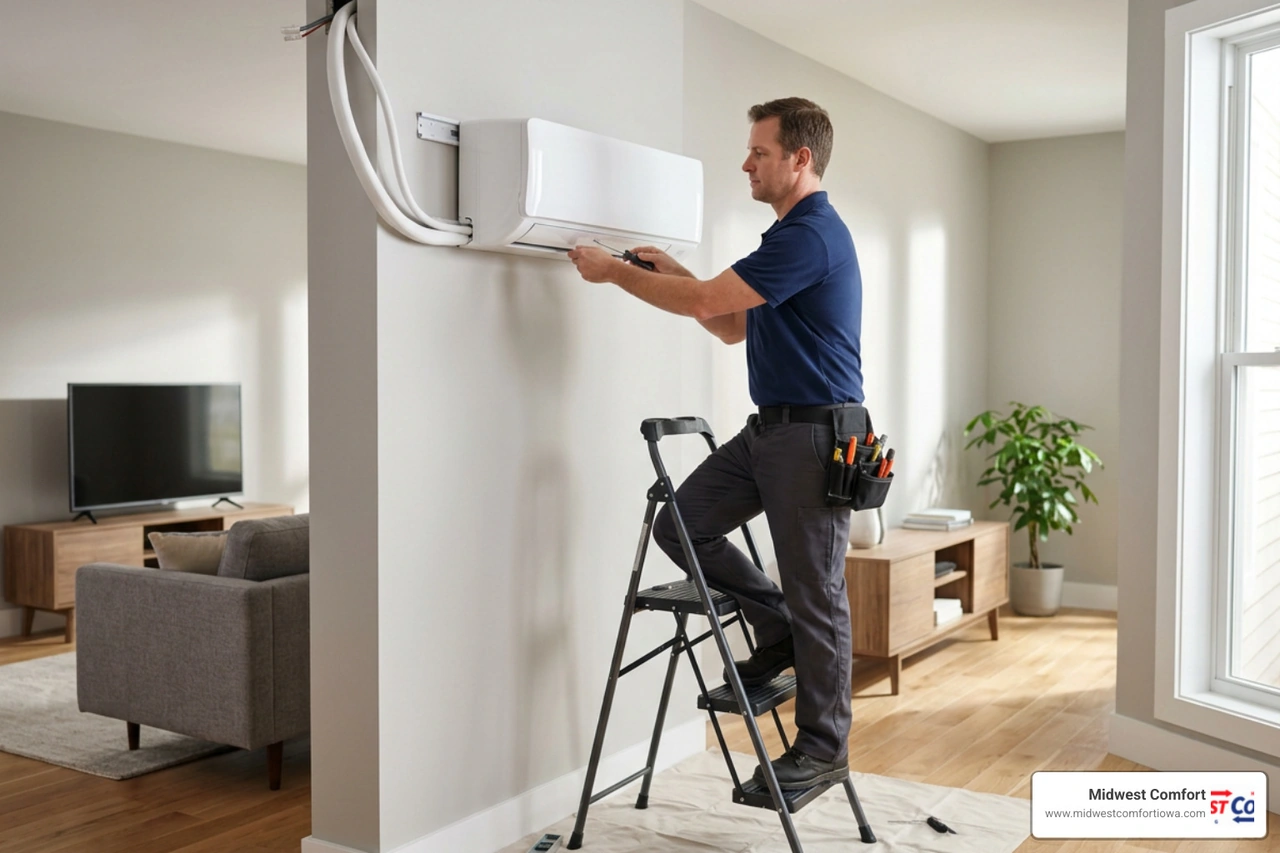
While this sounds complex, it is far less disruptive than retrofitting ducts. There is no major construction, no drywall dust coating your furniture, and no need to vacate your home. Most multi-zone mini split installations are completed in one to two days, leaving your home's structural integrity completely intact.
Energy Efficiency and Monthly Utility Bill Savings
Once the installation crew packs up their tools, the upfront cost fades into the background, and your monthly operating costs take center stage. This is where the mini split vs central AC cost comparison begins to favor ductless technology.
With hot, humid Iowa summers demanding constant climate control, monthly utility bills can fluctuate wildly. Choosing a highly efficient system is the best defense against rising energy rates in communities like Clive, Grimes, and Altoona.
For a deeper look at how these efficiency gains benefit local homeowners, check out our guide on Ductless Mini Split Benefits for Iowa Homeowners.
Inverter Technology and SEER2 Performance
To understand why mini splits are so efficient, we have to look under the hood. Traditional central air conditioners typically use single-stage compressors. These systems operate like a light switch: they are either 100% on or completely off. When your home warms up, the system kicks on at full blast, runs until it hits the target temperature, and then shuts off. This constant cycling creates massive energy spikes, subjects components to wear and tear, and results in noticeable temperature swings.
Most modern mini splits utilize advanced inverter-driven, variable-speed compressors. Instead of turning on and off, an inverter compressor acts like cruise control on the highway. It starts up slowly and continuously adjusts its speed to match the exact cooling load of the room. By running at lower, steady speeds for longer periods, it prevents energy spikes and maintains a perfectly consistent indoor climate.
This technological edge is reflected in SEER2 (Seasonal Energy Efficiency Ratio 2) ratings, which measure cooling efficiency over an entire season.
- Standard central air conditioners typically feature ratings ranging from 14 to 21 SEER2.
- High-efficiency Mini Split Air Conditioners frequently achieve ratings from 20 to 30+ SEER2, with some advanced single-zone systems reaching up to 35 SEER2.
Operating a system with a higher SEER2 rating directly correlates to lower monthly electric bills, allowing you to recoup any upfront efficiency premium over time.
Zone Control and Eliminating Duct Energy Loss
While high SEER2 ratings are impressive, the real-world energy savings of a mini split come from two practical design advantages: the elimination of duct loss and the power of zone control.
As mentioned, typical duct systems lose a massive percentage of their cooling capacity to conduction and leakage, especially if those ducts run through hot, unconditioned spaces like an attic or crawlspace. Because mini splits deliver conditioned air directly into the room from the indoor head, they suffer 0% duct loss. Every bit of cooling you pay for is delivered straight to your living space.
Additionally, mini splits provide built-in zone control. With a central AC system, you have one thermostat controlling the temperature of the entire house. If you want to cool your upstairs master bedroom at night, you have to cool the empty downstairs kitchen, living room, and dining room too.
With a ductless system, each indoor head has its own thermostat. You can turn off or turn down the cooling in guest rooms, formal dining areas, or basements when they aren't in use, focusing your energy spend only on the rooms you are actively occupying. You can learn more about how this works by reading about How Ductless Systems Save Energy with Zone Control.
Ten-Year Total Cost of Ownership and Lifespan
To find the true winner of the mini split vs central AC cost comparison, you have to look at the ten-year total cost of ownership. This calculation combines your initial investment, cumulative monthly utility savings, routine maintenance costs, and potential repair expenses over a decade of operation.
Financial incentives play a major role in lowering the lifetime cost of high-efficiency systems. Under Section 25C of the Energy Efficient Home Improvement Credit, homeowners can claim a federal tax credit of 30% of the project cost, capped at $2,000 per year, for qualifying energy-efficient heat pumps and ductless mini splits. Traditional central air systems typically qualify for lower credits, capped at $600. Additionally, local Iowa utility providers often offer substantial rebates for installing systems that meet high SEER2 thresholds, helping to offset the initial installation.
Maintenance Requirements and System Longevity
To keep either system running efficiently for a decade or more, regular maintenance is non-negotiable. However, the hands-on requirements differ between the two designs.
For a central AC system, maintenance is relatively hands-off for the homeowner. You need to replace the central return air filter every one to three months and keep the outdoor condenser free of leaves and debris. We recommend scheduling a professional tune-up once a year to clean the coils, check refrigerant levels, and inspect electrical connections.
Mini splits require a bit more regular attention from the homeowner. Because the indoor units are smaller and draw air directly from the room, their built-in mesh filters clog more quickly. You should pop open the front panel of each indoor head and rinse the filters under a tap every two to four weeks. Neglecting this simple step can restrict airflow, reduce efficiency, and put extra strain on the compressor.
Additionally, mini splits benefit from professional deep cleaning every one to two years to prevent dust and organic growth from building up on the indoor blower wheels and condensate pans. For more tips on keeping your system running smoothly, check out our guide on Comfort with a Mini Split AC System.
In terms of longevity, both systems perform exceptionally well when cared for properly:
- Central air systems typically last 12 to 15 years on average.
- Ductless mini splits regularly achieve a lifespan of 15 to 20 years, with premium brands often pushing past the two-decade mark due to their variable-speed operation and reduced wear and tear.
Long-Term Value: Sizing Your System for a Mini Split vs Central AC Cost Comparison
To maximize the lifespan and efficiency of your cooling investment, proper sizing is absolutely critical. An oversized system will cycle on and off rapidly (short-cycling), which spikes your energy bills, leaves excess humidity in the air, and wears out the compressor prematurely. An undersized system will run constantly without ever reaching your desired comfort level, leading to high utility bills and early system failure.
To prevent these issues, we perform a detailed Manual J load calculation before recommending any equipment. This calculation takes into account:
- The square footage and layout of your home
- Wall orientations and window locations
- Insulation levels in your walls, attic, and floors
- Local climate patterns in the Des Moines metro area
- Internal heat gains from occupants and appliances
By matching the system's capacity precisely to your home's unique thermal profile, we ensure you get the maximum comfort and efficiency out of your investment. You can read more about how proper sizing impacts your home's climate control in our article on Mini Split AC Systems for Home Comfort.
Frequently Asked Questions About Home Cooling Systems
Making a major investment in your home's comfort naturally brings up practical questions. Here are the most common questions we hear from homeowners across the Des Moines area.
Which system is more effective for home additions or older homes?
For home additions, finished basements, converted garages, or historic properties, the mini split is the undisputed champion.
Historic homes in older neighborhoods often lack the wall cavities and ceiling clearance required to install ductwork without destroying original plaster walls, woodwork, and architectural character. Mini splits allow us to bring modern comfort to these beautiful homes with virtually zero structural impact.
For home additions, extending your existing central ductwork is often a bad idea. Your existing furnace and AC were sized specifically for your home's original square footage. Adding a new room to that system will overload the equipment, leading to poor airflow, hot and cold spots, and premature system failure. A single-zone mini split operates independently, providing perfect comfort to the new space without unbalancing the rest of your home.
Learn more about these targeted applications by reading about Mini Split Benefits for Additions Garages and Bonus Rooms.
Do ductless systems provide both heating and cooling for year-round use?
Yes! Most modern mini splits are actually heat pumps. This means they feature a reversing valve that allows them to provide highly efficient cooling in the summer and powerful heating in the winter.
Because they transfer heat rather than creating it through combustion or electric resistance, they are incredibly efficient. Modern cold-climate mini splits are designed to maintain excellent heating performance even when outdoor temperatures drop below freezing, making them a viable, comfortable, year-round comfort solution for Iowa winters.
How do noise levels compare between ductless and central systems?
Ductless mini splits are exceptionally quiet. Because the noisy compressor and condenser fan are located outdoors, the only sound inside your home is the gentle whisper of the indoor air handler's fan. On low speeds, indoor mini split heads operate at decibel levels as low as 19 dB—which is quieter than a human whisper or rustling leaves.
Central air systems are also relatively quiet inside, but they do produce noticeable sound. You will often hear the rush of air through the ductwork, the hum of the furnace blower motor, and the occasional creaking or popping of sheet metal ducts as they expand and contract when the air kicks on.
Conclusion
At the end of the day, there is no single "winner" in the mini split vs central AC cost comparison. The right choice depends entirely on your home's unique footprint, your family's comfort goals, and your long-term budget.
If your home already has a well-designed, modern duct network, upgrading to a high-efficiency central air conditioner is a highly practical, cost-effective choice. If you are dealing with a historic home, a new room addition, a finished attic, or leaky, inefficient ductwork, investing in a ductless mini split system will deliver unmatched comfort, flexibility, and monthly energy savings for decades to come.
To help you explore your options further, check out our comprehensive Best Mini Split Des Moines Guide or read about our localized services for homeowners looking for Ductless AC Ankeny IA.
As a family-owned business, we are proud to provide honest, high-quality, and cost-effective HVAC services across the Des Moines metro area—including Polk City, Granger, Waukee, Windsor Heights, Altoona, Dallas Center, Johnston, Adel, Runnells, Pleasant Hill, Grimes, Clive, Norwalk, Carlisle, and Ankeny. We take a family-oriented approach, offering tailored solutions, loyalty programs, and flexible payment options designed to fit your unique needs.
Ready to find the perfect cooling solution for your home? Schedule professional cooling services with Midwest Comfort today, and let our family take care of yours.
