
Preparing for Fall: Why Your Living Room Layout Matters to Your Furnace
As the September pre-heating season arrives in Des Moines, many homeowners begin preparing their indoor spaces for cozy evenings and holiday hosting, but few realize the hidden risks of blocking return vents with fall furniture rearrangements. At Midwest Comfort Heating & Cooling, our technicians frequently see homeowners decide to shift the living room sectional closer to the fireplace or roll out a heavy, festive area rug to warm up the hardwood floors. In the process, a large floor or low-wall grille often gets covered up. Because these grilles are rarely considered the focal point of a room's design, hiding them feels like an easy aesthetic win.
Here is the thing: that innocent interior design choice actively starves your heating system of the necessary airflow it needs to function. A furnace operates as a closed-loop breathing system. It cannot push warm air into your home if it cannot pull cold air back in. Addressing these layout choices early ensures your HVAC services and equipment operate efficiently, safely, and reliably all winter long.
The true cost of a hidden grille:
- Restricted air circulation: The system struggles to pull in enough air to heat the house.
- Increased energy consumption: The blower motor runs longer and harder to compensate for the blockage.
- Uneven room temperatures: The room with the blocked vent often becomes stagnant, while other rooms overcompensate.
- Accelerated wear and tear: Mechanical parts degrade much faster when fighting against restricted airflow.
Before you finalize your autumn living room layout, you need to understand how strategic furniture placement directly impacts the lifespan of your furnace.
Understanding Your System's Lungs: Supply vs. Return Vents
To protect your furnace, you must first understand the fundamental difference between the two types of vents in your home. Think of your heating system as a pair of lungs. It has to exhale warm air, but it also has to inhale cold air to keep the cycle going. Many Des Moines area homes feature a network of both supply and return vents to manage this continuous cycle.
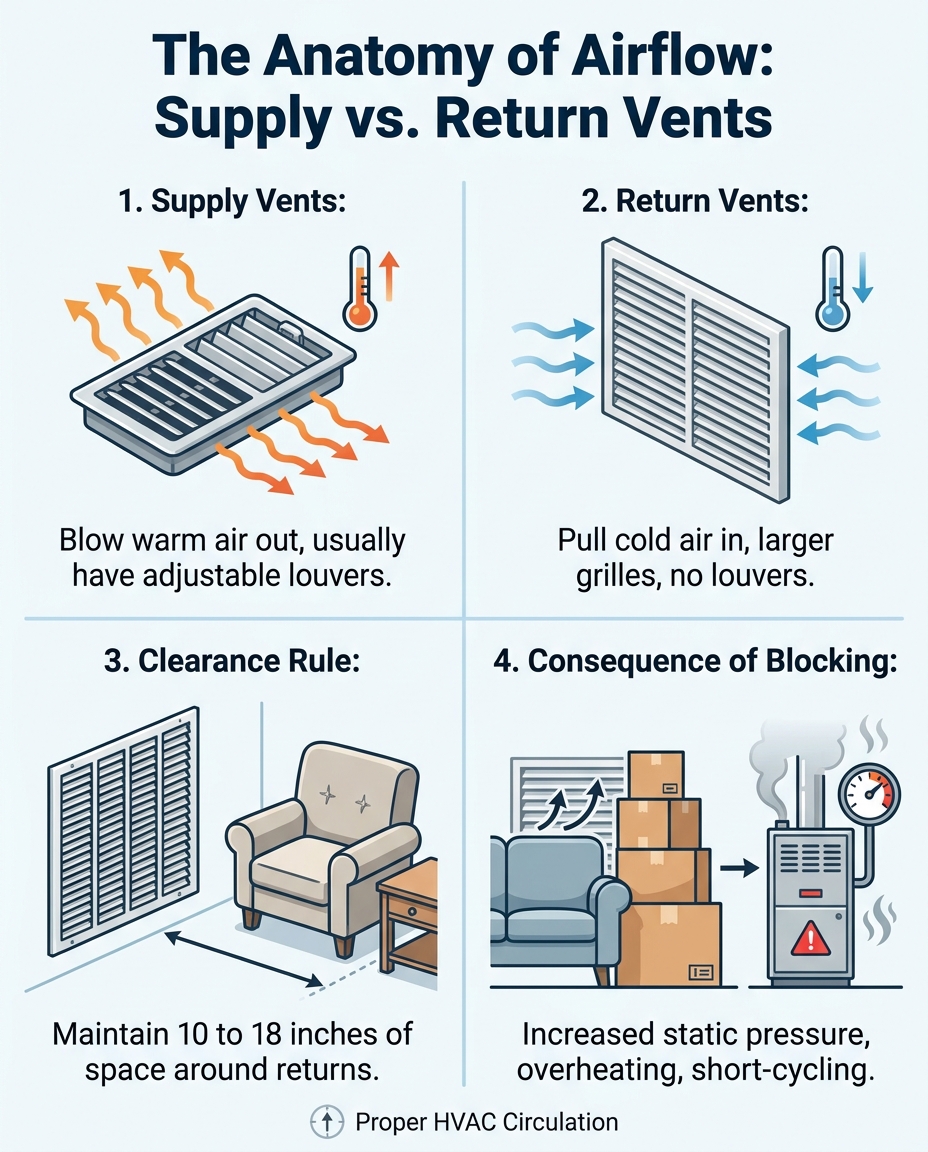
Supply vents are the pathways that blow warm, conditioned air into your living spaces. These are the vents you typically feel air rushing out of when the furnace kicks on. Return vents, on the other hand, are the critical intakes that pull cold room air back into the ductwork to be filtered, heated, and redistributed. They act as the literal lungs of the system. If you block a supply vent, a single room might feel a little chilly. If you block a return vent, you choke the entire system, drastically reducing your overall heating system performance.
How to visually identify your vents:
| Feature | Supply Vents | Return Vents |
|---|---|---|
| Airflow Direction | Blows warm air into the room | Pulls cold air out of the room |
| Size & Shape | Typically smaller (e.g., 4x10 inches) | Significantly larger, often wide rectangles |
| Hardware | Usually features adjustable louvers or dials | Fixed grilles with no adjustable moving parts |
| Location | Found in every room, often under windows | Located in central hallways, stairwells, or large living areas |
Because return vents need to pull in a massive volume of air, they are designed to be large. Blocking even a portion of this intake forces the entire mechanical system to work against a severe deficit.

The Mechanics of Airflow: Static Pressure and Overheating
When a large piece of furniture covers a return vent, it changes the physics inside your ductwork. The primary force at play here is called HVAC static pressure. In simple terms, static pressure is the resistance to airflow within the ducts. Your furnace is calibrated to operate within a very specific static pressure range. When you block the intake, you dramatically increase that resistance, much like trying to drink a thick milkshake through a very narrow cocktail straw.
As static pressure spikes, the blower motor has to work significantly harder to pull in the required volume of air. This extra effort draws more electricity and generates excessive heat within the motor itself. More importantly, because less air is flowing over the furnace's heat exchanger, the heat exchanger cannot cool itself down. The internal temperature of the furnace begins to spike rapidly.
The overheating sequence:
- Airflow drops: The blocked return vent prevents adequate cold air from entering the system.
- Heat builds up: The heat exchanger warms up the limited air too quickly, trapping intense heat inside the cabinet.
- Safety triggers trip: Internal sensors detect the dangerous temperature spike and immediately shut down the burners to prevent a fire or a cracked heat exchanger.
- The blower runs on: The fan may continue running in an attempt to cool down the overheated metal components.
This mechanical strain is especially dangerous during the September pre-heating season. As Des Moines experiences sharp temperature drops in early fall, a system struggling with high static pressure is highly vulnerable to sudden, catastrophic breakdowns just as a severe cold snap hits. Preparing your layout now prevents these mechanical failures from catching you off guard.
Recognizing the Symptoms: Is Your Furnace Short-Cycling?
If your furniture arrangement is actively harming your heating equipment, your furnace will usually try to tell you before it fails completely. The most common warning sign is a phenomenon known as short-cycling. Short-cycling happens when a furnace turns on, runs for a brief period (often just a few minutes), and shuts off prematurely before reaching the temperature set on the thermostat.
This rapid on-and-off behavior is not a glitch in your thermostat; it is the direct result of tripped high-limit safety switches. When the blocked return vent causes the system to overheat, the safety switch kills the flame. Once the furnace cools down a few minutes later, it tries to run again, only to overheat and shut down once more. Over time, this constant starting and stopping destroys the blower motor.
In our experience serving Des Moines area neighborhoods, our technicians at Midwest Comfort Heating & Cooling regularly encounter this exact scenario. Just last fall, our team responded to a cold snap emergency where a homeowner's heat stopped working entirely and refused to push out warm air. Our technicians diagnosed the issue as a faulty blower motor caused by severe system strain from a newly placed sectional blocking the main return vent. Fortunately, replacing the motor restored the system and avoided a full furnace replacement, but it perfectly illustrates the heavy toll restricted airflow takes on moving parts.
Other symptoms of a blocked return vent include:
- Weak airflow: Supply vents barely push out any warm air, even when the fan is running at full speed.
- Unusual noises: A straining, whining, or humming sound coming from the furnace cabinet as the blower motor fights high static pressure.
- Whistling grilles: A high-pitched whistling sound near the return vent as air squeezes through the small gaps around your furniture.
- Uneven heating: Certain rooms remain freezing cold while the room with the thermostat becomes overly warm.
When to Call a Professional
If you notice your system short-cycling, your very first step should be to walk through the house and check every return vent. Pull couches away from the walls and roll back heavy rugs. However, if clearing the vents does not resolve the short-cycling within an hour, or if the blower motor continues to make loud, straining noises after the obstruction is removed, you need to call a professional. Prolonged overheating may have already damaged the high-limit switch or compromised the motor's internal bearings.
Furniture Clearance Guidelines for Proper HVAC Airflow
Protecting your furnace does not mean you have to sacrifice a beautiful living room layout. It simply requires following a few practical clearance guidelines to ensure the system can breathe freely. The industry-standard rule for airflow is to leave at least 10 to 18 inches of unobstructed clearance around all return vents. This gap allows the system to pull in an adequate volume of air without creating a vacuum effect against your upholstery.
If you have a large sectional or a heavy sofa, consider "floating" the furniture in the middle of the room rather than pushing it flush against the walls. Floating furniture not only creates a modern, conversational seating arrangement for fall hosting, but it naturally keeps the perimeter walls (where return vents are often located) completely clear.
Step-by-step clearance strategies:
- Measure the gap: Use a tape measure to ensure there is a minimum of 10 inches between the face of the vent and the back of your couch, bookcase, or media console.
- Swap solid furniture for open legs: If you must place a piece of furniture near a vent, choose a table or sofa with elevated legs rather than a solid base. This allows air to flow underneath.
- Keep rugs clear of floor grilles: Never lay an area rug, runner, or heavy textile over a floor return vent. Even if the rug feels porous, it acts as a massive filter that chokes the system.
- Check the curtains: Ensure heavy fall or winter drapes do not hang directly over low-wall returns when drawn closed.
Maintaining proper clearance is one of the simplest ways you can support your system. Adhering to these spacing rules ensures your equipment runs safely and protects your HVAC investment over the long term, preventing premature failures caused by easily avoidable static pressure.
How Blocked Vents Compromise Indoor Air Quality
The consequences of a blocked return vent extend far beyond mechanical strain; it also directly impacts the air your family breathes. Return vents are the designated pathways where indoor air is pulled through the furnace filter. When you block these vents, you prevent the system from effectively circulating and filtering out the dust, pet dander, and fall allergens that accumulate inside Des Moines area homes.
During the fall, homes are typically sealed up tighter to keep the chill out. Without proper airflow through the return vents, the air inside your living room becomes stagnant. Dust settles on surfaces faster, and allergens remain trapped in the breathing zone rather than being captured by the pleated media filter in your ductwork.
Furthermore, high static pressure forces the blower motor to seek air from wherever it can find it. If the primary return vent is blocked by a couch, the powerful suction of the blower can actually pull unconditioned, dirty air through tiny leaks and gaps in the ductwork located in your attic, crawlspace, or basement walls. This means you could be inadvertently pulling fiberglass dust, mold spores, or stale crawlspace air directly into your living spaces. Keeping your vents completely clear is always the fundamental first step in any effective indoor air quality solutions strategy.
Protecting Your Heating Equipment Before Winter Hits
Uncovering your vents and rearranging your furniture is a crucial first step for the September pre-heating season, but it is only part of the equation. If your system has been running with restricted airflow for any length of time, the blower motor and heat exchanger have already been subjected to significant stress. A system that has been strained by high static pressure often requires a professional inspection to ensure no permanent damage has occurred.
This is where a comprehensive fall tune-up becomes invaluable. During a seasonal check, our technicians will test the blower motor's electrical draw, verify that the high-limit safety switches are responding correctly, and inspect the heat exchanger for any hairline cracks caused by overheating. Consistent, routine care prevents minor airflow issues from escalating into major winter breakdowns when you need your heat the most.
For example, one local family who has relied on our team for routine seasonal care for over ten years notes that their systems remain incredibly well-maintained and ready for sudden weather shifts, largely because minor issues are caught and corrected early. At Midwest Comfort Heating & Cooling, we believe proactive homeowner education—like understanding how your room layout affects your furnace—is a core part of ensuring long-term system longevity. Pairing this knowledge with a comprehensive preventative maintenance plan provides the ultimate peace of mind as the harsh weather approaches.
Keep Your Home Warm and Your Airflow Unrestricted
The short answer is that a few inches of space between your couch and a return vent can literally save your furnace from overheating and shutting down. By understanding that your heating system needs to breathe just as much as it needs to blow warm air, you can make smarter interior design choices as you prepare your home for the colder months.
Take ten minutes today to do a quick walk-through of your home. Check behind every sofa, under every area rug, and behind every heavy curtain to ensure your grilles are completely unobstructed. If you suspect your system has already suffered from short-cycling, or if you simply want to ensure your equipment is running at peak efficiency, reach out to schedule a thorough seasonal check-up before the freezing weather settles in.
Frequently Asked Questions
What happens if a cold air return is blocked?
Blocking a cold air return forces the furnace blower motor to work significantly harder to pull in air. This increases static pressure inside the ductwork, which can cause the heat exchanger to overheat. Eventually, this overheating triggers internal safety switches that shut the furnace down prematurely.
How far should a couch be from a return vent?
You should leave at least 10 to 18 inches of clear space between a couch and a return vent. This gap provides enough room for the HVAC system to pull in the necessary volume of air without creating a vacuum effect. If you cannot leave that much space, consider using a sofa with elevated legs to allow air to pass underneath.
Why is my furnace short-cycling?
Short-cycling usually occurs when the furnace overheats and the high-limit safety switch turns off the burners to prevent damage. A blocked return vent, a clogged air filter, or a failing blower motor are the most common culprits for this rapid on-and-off behavior. If clearing the vents and replacing the filter does not stop the short-cycling, a professional diagnostic is required.
How do I know if my return vent is blocked?
You will likely notice weak airflow coming from your supply vents, even when the furnace sounds like it is running at full capacity. You may also hear a high-pitched whistling sound near the return grille as air squeezes past the obstruction. Uneven room temperatures and a furnace that turns on and off constantly are also strong indicators.
Can you put a rug over a floor return vent?
No, you should never place an area rug or heavy textile over a floor return vent. Even rugs that seem thin or porous act as massive, dense filters that severely restrict the airflow your furnace needs to operate. Always keep floor grilles completely exposed.
What is the difference between a supply and return vent?
Supply vents blow warm, conditioned air into your rooms and typically feature adjustable louvers to direct the air. Return vents pull cold, stale air out of the room and back into the furnace; they are usually larger and feature fixed grilles with no moving parts.
Will blocking vents save money on heating bills?
No, blocking vents actually increases your heating bills and damages your equipment. Restricting airflow raises the static pressure in the ductwork, forcing the blower motor to consume more electricity while reducing the overall efficiency of the heating cycle. To save energy, keep all vents open and unobstructed.
