


Discover the Essential Benefits of Regular Air Conditioning Maintenance
Regular maintenance of your air conditioning system ensures optimal performance and longevity. It helps prevent costly repairs while improving energy efficiency, keeping your home comfortable year-round.

Routine checks can significantly reduce energy bills and extend the life of your unit.


When Is a Mini Split Better Than Central AC in Des Moines, IA?
When is a mini split better than central AC? Here are the most common situations where a ductless mini split wins:
- No existing ductwork - Retrofitting ducts into an older home can cost thousands and require tearing into walls, ceilings, and floors
- Home additions or bonus rooms - Extending existing ductwork can throw your whole system out of balance
- Hot and cold spots - Specific rooms that never reach the right temperature despite a functioning central system
- Maximum energy efficiency - Mini splits avoid the 20-30% energy loss that happens when conditioned air leaks through ductwork in unconditioned spaces
- Year-round comfort from one system - Most mini splits work as heat pumps, handling both heating and cooling without a separate furnace
- Zoned control - You only condition the rooms you're actually using, not the whole house
For Des Moines homeowners, this decision usually comes down to one thing: do you already have ductwork in good condition, or not? If you do, central AC often makes sense for whole-home cooling. If you don't — or if you're dealing with a stubborn problem room — a mini split is almost always the smarter choice.
Central AC and ductless mini splits work in fundamentally different ways. Central systems push cooled air through a network of ducts that run through your attic, walls, and floors. Mini splits, on the other hand, connect a small outdoor unit directly to one or more indoor air handlers through a narrow refrigerant line — no ductwork needed. That single difference drives nearly every advantage and trade-off between the two systems.
If you're weighing your options for home cooling in Des Moines, you're not alone. This is one of the most common questions Iowa homeowners face when an old system fails or when they're finishing a new space and need to add comfort without a full renovation.
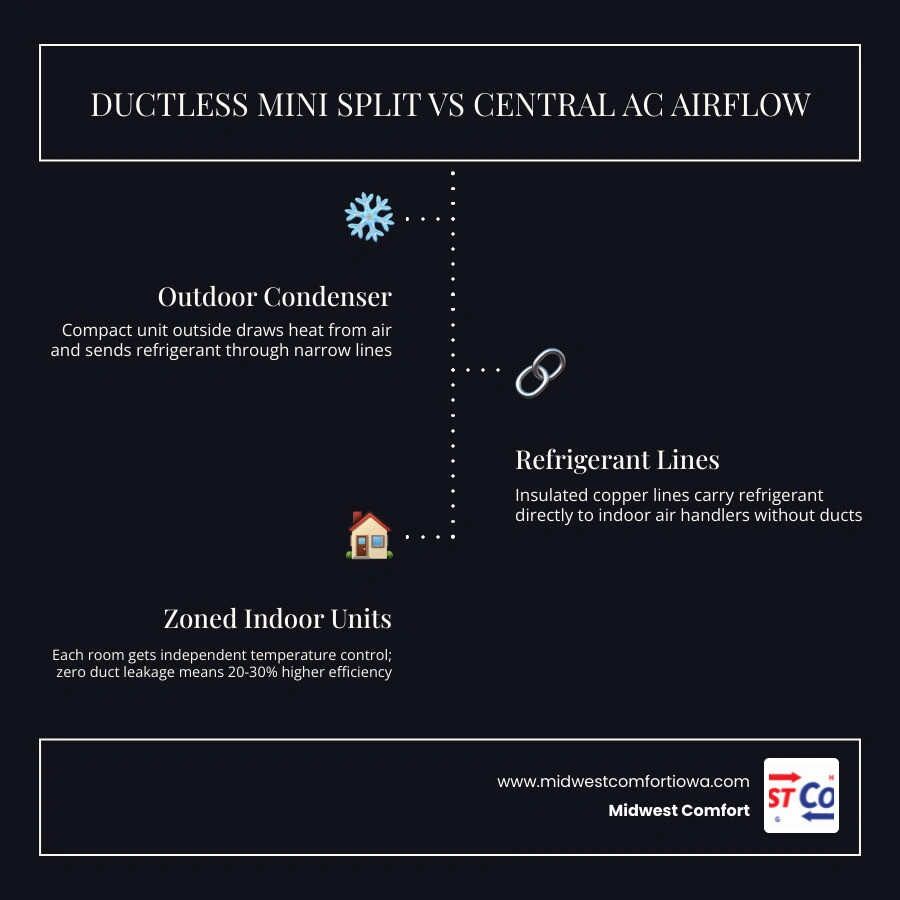
Core Architectural Differences: Ductless vs. Ducted Systems
To understand why one system might outperform the other in your home, it helps to look under the hood. The fundamental difference between these two cooling options lies in how they transport and distribute conditioned air throughout your living spaces.
A traditional central air conditioning system is a ducted, split system. It relies on a single, large indoor evaporator coil (typically sitting on top of your furnace in the basement or a utility closet) and a massive outdoor condenser unit. The system cools the air in one central location and then uses a powerful blower fan to push that air through a complex network of sheet metal or flexible ductwork hidden behind your walls, ceilings, and floors. The air enters your rooms through registers and returns to the central unit through return grilles to be cooled again.
A ductless mini split system, as the name suggests, bypasses the ductwork entirely. It still utilizes an outdoor condenser unit, but instead of routing air to a central indoor coil, it pumps liquid and gaseous refrigerant directly to individual indoor air handlers installed on the walls, ceilings, or floors of specific rooms.
These indoor units are connected to the outdoor condenser by a small utility bundle containing:
- Copper refrigerant lines
- A power cable
- A communication wire
- A condensate drain line
This bundle is incredibly compact, requiring only a small three-inch hole through your exterior wall to connect the indoor and outdoor components. Because each indoor air handler operates independently, a mini split system allows you to cool (or heat) only the specific spaces where the units are installed.
When evaluating these designs, it is clear that each has its place. For a deeper dive into how these physical layouts impact your home, explore our detailed Central AC vs Ductless Mini Split Comparison.
When Is a Mini Split Better Than Central AC?
While central air conditioning has long been the default standard for American homes, modern home layouts and lifestyle preferences have made ductless systems incredibly popular. There are several distinct scenarios where installing a mini split is not just a viable alternative, but the superior choice for your comfort and peace of mind.
One of the most common situations where a mini split shines is during a home renovation or room addition. If you are finishing a basement in Ankeny, adding a sunroom to your home in Waukee, or building a bonus room over your garage in Johnston, your existing central HVAC system is likely not sized to handle the extra square footage.
Attempting to tap into your existing ductwork to heat and cool a new space can lead to two major problems:
- System Overload: Your current central AC unit will have to work much harder to condition the extra space, which can lead to premature system failure and higher utility bills.
- Imbalanced Airflow: Adding new branches to your ductwork can throw the static pressure of your entire system out of balance, leaving you with weak airflow in the new room and cold spots in the rest of your home.
A ductless mini split solves this problem by acting as a completely independent comfort zone. It provides dedicated, powerful cooling and heating directly to the new space without putting any strain on your main home system.
To learn more about how these systems can elevate your home's comfort, take a look at our guide on Ductless Mini Split Benefits for Iowa Homeowners.
When Is a Mini Split Better Than Central AC for Older Homes Without Ductwork?
Central Iowa is home to beautiful, historic neighborhoods with houses built long before residential air conditioning became common in the 1950s. Many of these historic properties in Des Moines, Windsor Heights, and Adel rely on hot water radiators or boiler systems for winter heating and have no ductwork at all.
If you own one of these classic homes, adding central air conditioning can feel like a logistical nightmare. To install the necessary ductwork, contractors would have to build soffits, drop ceilings, and cut through original plaster walls and historic woodwork. This process is highly invasive, messy, and can permanently alter the architectural charm and structural integrity of your home.
This is precisely when is a mini split better than central ac for historic preservation. Because a mini split only requires a small hole through an exterior wall for the refrigerant lines, we can install the system with virtually zero disruption to your home's historic plaster walls or beautiful crown molding.
The outdoor line sets can be neatly concealed inside protective "line hides" that are painted to match your home's siding, preserving its classic curb appeal. If you are looking to preserve your home's historic charm while enjoying modern comfort, check out our specialized services for Mini Split AC Des Moines IA.

When Is a Mini Split Better Than Central AC for Solving Hot and Cold Spots?
Have you ever noticed that your upstairs bedrooms feel like a sauna in the middle of a hot Iowa summer, while your basement feels like a refrigerator? Or perhaps you have a sunroom with large windows that gets uncomfortably warm in the afternoon, despite your central AC running constantly.
These temperature imbalances are incredibly common in multi-story homes and spaces with high solar heat gain. Traditional central AC systems rely on a single thermostat, usually located on the main floor. Once that thermostat is satisfied, the system shuts off, regardless of how hot it still is upstairs or in your sunroom.
A ductless mini split is the ultimate problem-solver for these stubborn hot and cold spots. By installing a single-zone mini split in a troublesome room, you can take control of that specific space's climate.
The mini split will run independently of your central system, keeping your upstairs bedroom or sunroom perfectly cool without freezing out the rest of your family downstairs. Discover how you can eliminate these uncomfortable temperature swings with our guide on How Mini Splits Solve Hot and Cold Spots in Your Home.
Efficiency and Performance: SEER2 Standards and Duct Loss
When comparing the long-term operational performance of these two systems, energy efficiency is a major factor. This is where the engineering behind modern ductless mini splits truly sets them apart from traditional central air conditioners.
The primary reason mini splits are exceptionally efficient is their use of advanced inverter-driven, variable-speed compressors. Traditional central AC systems typically use single-stage or two-stage compressors that operate on an "all-or-nothing" basis. They turn on at 100% capacity, run until the thermostat is satisfied, and then shut off. This constant on-and-off cycling is highly inefficient — much like driving your car in stop-and-go city traffic.
In contrast, an inverter-driven mini split compressor acts more like cruise control on the highway. It starts up smoothly and continuously adjusts its speed to match the precise cooling load of the room. Once the desired temperature is reached, the compressor slows down to a low, highly efficient speed to maintain that temperature, consuming only a fraction of the electricity.
Furthermore, ductless systems completely eliminate the single biggest source of energy waste in residential cooling: duct loss. According to the U.S. Department of Energy, ducted central air systems lose an average of 20% to 30% of their conditioned air through leaks, loose connections, and poor insulation in unconditioned spaces like attics, crawlspaces, and basements. Because mini splits deliver air directly into the room from the indoor air handler, their duct loss is exactly 0%.
| Performance Metric | Traditional Central AC | Ductless Mini Split |
|---|---|---|
| Peak Efficiency (SEER2) | Up to 20 - 26 SEER2 | Up to 30 - 38+ SEER2 |
| Ductwork Energy Loss | 20% to 30% loss | 0% loss (direct delivery) |
| Compressor Technology | Single-stage or Two-stage | Inverter-driven (Variable-speed) |
| Temperature Control | Single-zone (Whole-home average) | True individual room zoning |
This combination of inverter technology and ductless design allows mini splits to achieve incredibly high SEER2 (Seasonal Energy Efficiency Ratio 2) ratings. While high-efficiency central AC systems max out around 20 to 26 SEER2, premium mini split systems can reach ratings of 30 to 38+ SEER2.
Over the course of a hot summer, this efficiency gap can translate to significant savings on your monthly energy bills. For a deeper understanding of how these efficiency ratings translate to real-world home comfort, explore our article on Mini Split AC Systems for Home Comfort.
Heating Capabilities and Zoned Comfort Control
While we often focus on keeping our homes cool during the humid summer months, Iowa winters require a powerful, reliable heating source. This is another area where modern ductless mini splits offer a unique advantage over traditional air conditioners.
Traditional central air conditioners are strictly cooling-only systems. To heat your home in the winter, they must be paired with a separate heating system, such as a natural gas or electric furnace.
Most modern mini splits, however, are heat pumps. This means they are dual-purpose systems capable of both cooling and heating your home. In the summer, they extract heat from inside your home and pump it outdoors. In the winter, they reverse this process, extracting heat from the outdoor air and transferring it inside.
While older heat pumps struggled when temperatures dropped below freezing, modern cold-climate mini splits are engineered to deliver reliable heating even in sub-zero temperatures. Many premium systems can operate at 100% heating capacity down to 5°F and continue providing efficient warmth even when outdoor temperatures drop well below zero.
In addition to year-round versatility, mini splits offer unmatched zoned comfort control. With a multi-zone mini split system, you can connect up to eight indoor air handlers to a single outdoor condenser. Each indoor unit is controlled by its own independent thermostat or remote control.
This zoning capability allows you to customize the temperature in each room based on personal preference and occupancy:
- Keep your home office cool and comfortable during the day while you work.
- Keep guest bedrooms unconditioned when they are not in use to save energy.
- Allow family members to set their own bedroom temperatures at night, ending the "thermostat wars" for good.
This level of customized control is simply impossible with a standard single-zone central AC system. For more insights on maximizing your year-round comfort with these systems, read about achieving Comfort with a Mini Split AC System and browse our overview of Mini Split Air Conditioners.
Maintenance, Lifespan, and Aesthetic Considerations
To keep any HVAC system running at peak performance, regular maintenance is essential. However, the day-to-day care and long-term upkeep of these two systems look very different.
For a central air conditioner, maintenance primarily involves replacing the return air filter every 30 to 90 days, keeping the outdoor condenser clear of debris, and scheduling annual professional tune-ups. You also need to keep an eye on your ductwork, ensuring it is clean, sealed, and free of dust or mold buildup.
Mini split systems require a slightly different approach. Because the indoor air handlers pull air directly from the room, their filters are smaller and tend to collect dust more quickly. To maintain optimal airflow and efficiency, you should clean the washable filters inside each indoor unit every two to four weeks.
Fortunately, this process is incredibly simple:
- Lift the front panel of the indoor unit.
- Slide out the mesh filters.
- Rinse them under warm water in your sink.
- Let them dry completely and slide them back in.
In addition to regular filter cleaning, both systems require professional annual maintenance to inspect electrical connections, verify refrigerant levels, and clean the coils. If you are in the Windsor Heights area, check out our comprehensive Mini Split Service Windsor Heights Guide to keep your system running smoothly.
When it comes to aesthetics, central air conditioning is virtually invisible, with only flat metal grilles on your walls or floors. Mini splits, however, require an indoor unit to be mounted within the living space.
While some homeowners are hesitant about the look of wall-mounted units, modern manufacturers have made great strides in design. Today's wall mounts are sleek, compact, and feature neutral finishes that blend in with modern decor.
If you prefer a more discreet look, there are several alternative indoor unit styles available:
- Ceiling Cassettes: These units install flush with your ceiling, with only a flat grille visible.
- Ducted Mini Splits: These compact air handlers are hidden in a closet or attic space and distribute air through short, localized duct runs to small, subtle vents.
- Floor-Mounted Units: These units sit low on the wall, similar to a traditional radiator, making them an excellent choice for historic homes or attic spaces with low ceilings.
In terms of lifespan, both central AC systems and mini splits typically last 15 to 20 years with proper installation and regular professional maintenance.
Decision Framework: Choosing the Right System for Your Iowa Home
Choosing between a mini split and central AC is a significant decision that will impact your home's comfort and energy bills for years to come. To help you make the right choice, we have put together a simple decision framework based on your home's layout, existing infrastructure, and comfort goals.
When to Choose Central AC
- Your home already has a functional, well-insulated ductwork system in place.
- You prefer a completely invisible system with no visible indoor units on your walls or ceilings.
- Your family uses almost every room in the house consistently throughout the day, making whole-home cooling a priority.
- You want to integrate advanced indoor air quality products, such as whole-home humidifiers, dehumidifiers, or high-efficiency air purifiers, directly into your HVAC system.
When to Choose a Ductless Mini Split
- Your home does not have existing ductwork (e.g., homes with boiler/radiator heating).
- You are building a home addition, finishing a basement, or converting a garage into a living space.
- You have specific "problem rooms" that are always too hot or too cold, despite your central AC running.
- You want the ultimate in energy efficiency and wish to avoid the energy losses associated with leaky ductwork.
- You want independent temperature control in different areas of your home to accommodate different family members' preferences.
- You are looking for a dual-purpose system that can handle both your heating and cooling needs in one efficient package.
If you are ready to explore your options or need a professional assessment of your home's layout, our team is here to help. Check out our Best Mini Split Des Moines Guide or schedule a consultation for your home with our experts in Mini Split Installation Ankeny IA.
Frequently Asked Questions About Mini Splits and Central AC
Do mini splits work as heat pumps for Iowa winters?
Yes, modern ductless mini splits are highly efficient heat pumps designed to provide both heating and cooling. While older heat pump technology struggled in freezing temperatures, modern cold-climate mini splits are engineered specifically to handle harsh Midwestern winters. Many premium systems can maintain high heating capacities down to 5°F and continue operating efficiently at temperatures well below zero, making them a reliable primary or supplemental heating source for your Iowa home.
Are mini splits quieter than traditional central AC systems?
Absolutely. Mini split systems are dramatically quieter than traditional central air conditioners. In a central AC system, the loud blower fan is located indoors, often creating a noticeable rushing sound through your vents when the system kicks on.
With a mini split, the compressor and major moving parts are located in the outdoor unit. The indoor air handlers utilize small, whisper-quiet fans that operate at decibel levels as low as 19 to 26 dB(A) — which is quieter than a soft whisper or rustling leaves.
Can a mini split system cool an entire house?
Yes, a multi-zone mini split system can easily cool an entire home. By connecting multiple indoor air handlers to a single outdoor condenser, you can create a customized comfort network that covers every room in your house.
This approach is highly popular for older homes without existing ductwork, allowing homeowners to enjoy complete, whole-home cooling and heating without the need for invasive and messy renovations.
Conclusion
At Midwest Comfort, we understand that every home in the Des Moines metro area is unique. Whether you are living in a historic home in Windsor Heights, finishing a brand-new basement in Ankeny, or simply trying to cool down a stubborn upstairs bedroom in Waukee, there is no one-size-fits-all solution for your home comfort.
As a family-owned, local business, we pride ourselves on our honest, family-oriented approach to HVAC service. We don't believe in high-pressure sales or cookie-cutter recommendations. Instead, we work closely with you to understand your home's layout, your comfort goals, and your family's needs to recommend the system that makes the most sense for you.
If you are ready to upgrade your home's cooling system or have questions about whether a mini split is the right choice for your space, we are here to help. Schedule professional cooling services with Midwest Comfort today, and let our family keep your family comfortable all year round.


Get Your HVAC Serviced Today


