
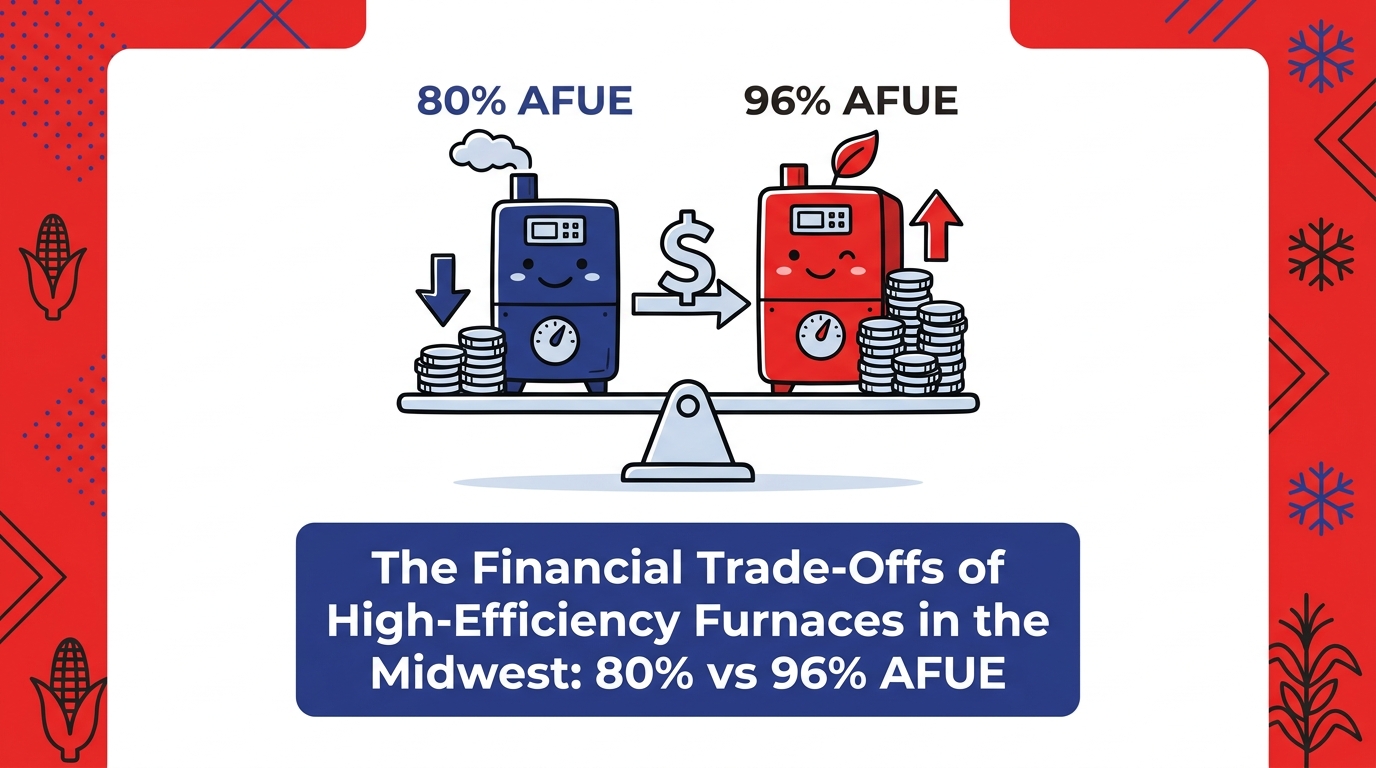
Myth: The Lowest Initial Equipment Cost Equals the Best Long-Term Value
Many homeowners believe that selecting the equipment with the lowest price tag is the smartest financial move, but understanding the financial trade-offs of high-efficiency furnaces in the Midwest reveals a very different reality. The common misconception is that a standard 80% AFUE furnace is automatically the most cost-effective option simply because the barrier to entry is lower. While the upfront requirement is indeed smaller, this perspective completely ignores the ongoing, compounding costs of operating a less efficient system through a grueling Iowa winter.
The concrete problem you face is weighing the higher initial installation requirement of a 96% AFUE furnace against the substantial, long-term gas savings it provides over its lifespan. It is a balancing act between what you commit today and what you save every month for the next fifteen to twenty years. Making this evaluation during the early fall pre-heating season is the smartest strategy. Waiting until January forces a rushed decision based on panic rather than a careful review of long-term efficiency.
Right now, before the freezing temperatures set in, you have the time to explore professional HVAC services and thoughtfully plan a heating system upgrade that aligns with both your immediate budget and your long-term energy goals.
The Technology Gap: Condensing vs. Non-Condensing Furnaces
To understand the 16 percent efficiency gap between an 80% AFUE and a 96% AFUE furnace, we have to look under the hood at how these systems actually generate and distribute heat. We can skip the basic definitions of AFUE (Annual Fuel Utilization Efficiency) and dive straight into the mechanical differences that drive your monthly gas consumption.
The mechanics of a standard 80% AFUE furnace:
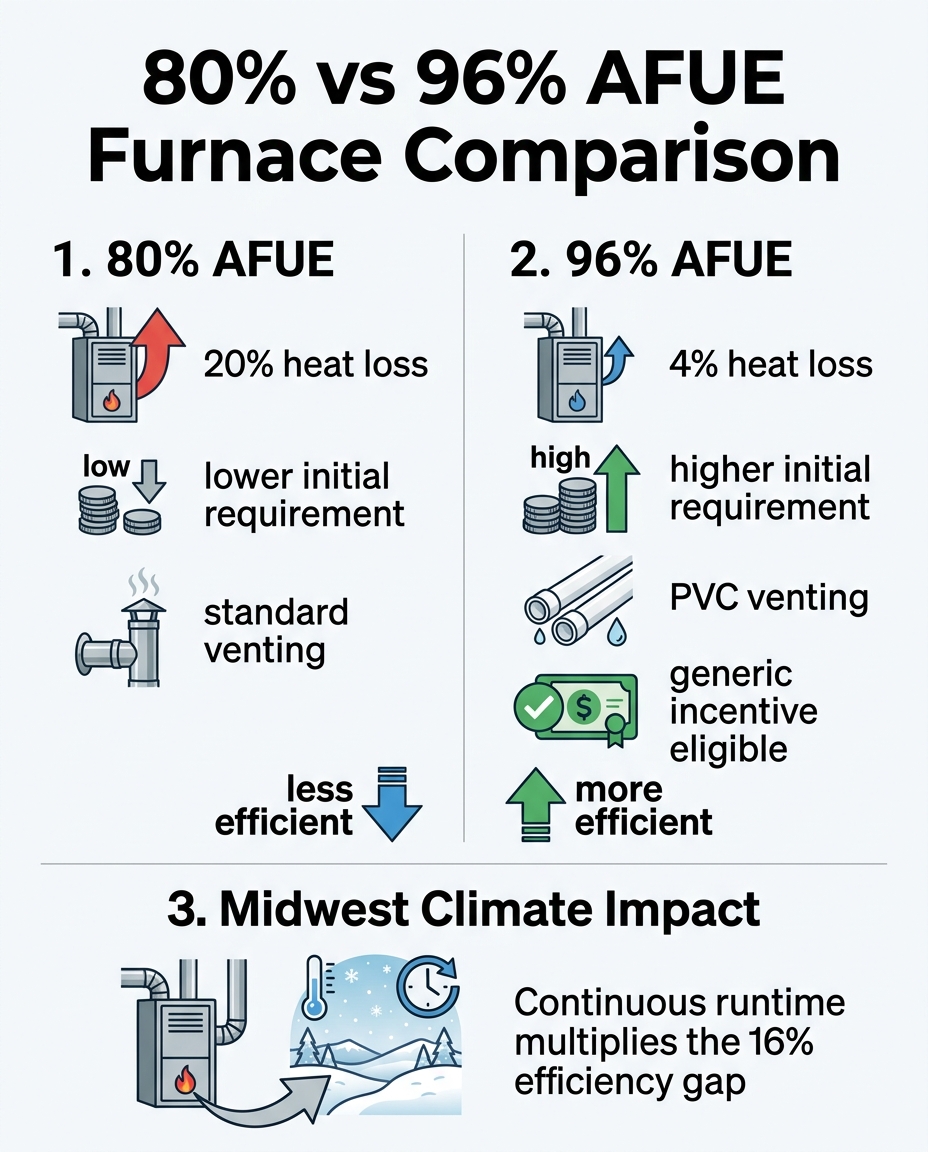
Standard efficiency models are known as non-condensing furnaces. They utilize a single, primary heat exchanger. When the burners ignite the natural gas, the heat exchanger warms up, and the blower fan pushes air over it to heat your home. However, the combustion process creates exhaust gases that are incredibly hot. Because there is only one heat exchanger, all of that residual heat travels straight up the metal flue and out of your roof. You are essentially paying to heat the sky. A full 20 percent of the fuel you purchase is lost as exhaust waste.
The mechanics of a high-efficiency 96% AFUE furnace:
A 96% AFUE vs 80% AFUE comparison comes down to one crucial component: the secondary heat exchanger. High-efficiency models are known as condensing furnaces. After the primary heat exchanger does its job, the hot exhaust gases are routed into a secondary heat exchanger. This component extracts almost all the remaining thermal energy from the exhaust. As the heat is extracted, the exhaust gases cool down so much that they condense into a liquid water vapor.
Because the system captures this latent heat, it converts 96 percent of the fuel you buy into usable warmth for your home. Only 4 percent is lost. This massive technological advantage translates directly to significantly reduced monthly gas consumption, as the furnace requires far less fuel to produce the exact same amount of heat.
The Climate Multiplier: Continuous Winter Runtime in Iowa
Furnace efficiency ratings are tested in controlled, standardized laboratory environments, but your real-world savings depend entirely on how often the unit actually runs. This is where the local climate becomes the ultimate multiplier for high-efficiency technology. Des Moines winters feature prolonged freezing temperatures that force heating systems into continuous operation for weeks or even months at a time. The 16 percent efficiency gap between standard and high-efficiency models becomes exponentially more impactful here than it would in milder southern climates.
How continuous runtime multiplies your savings:
- Short cycling vs. continuous operation: In a mild climate, a furnace might turn on for ten minutes, satisfy the thermostat, and turn off for an hour. In sub-freezing Iowa weather, the furnace must run almost continuously just to counteract the thermal loss through your walls and windows.
- Compounding efficiency: Saving 16 percent on a small amount of gas is negligible. Saving 16 percent on the massive volume of gas required to run a furnace 24/7 during a January deep freeze represents a highly significant operational reduction.
- Wear and tear: High-efficiency condensing furnaces often feature variable-speed blower motors and multi-stage gas valves. Instead of blasting at 100 percent capacity and shutting off, they run continuously at lower, more efficient speeds, maintaining an even temperature across Des Moines area homes without the harsh spikes in energy usage.
When evaluating heating methods for deep freezes, traditional gas furnaces remain a powerhouse. However, it is also worth exploring alternative technologies to see how they stack up. For instance, understanding cold climate heat pump performance can provide a well-rounded view of how different systems handle the intense demands of continuous winter runtime.
Navigating the Initial Installation Requirement
The primary hurdle most homeowners face when considering a high-efficiency upgrade is the initial installation requirement. A 96% AFUE furnace inherently demands a larger upfront commitment because of the advanced internal components—specifically the secondary heat exchanger and variable-speed technology. But the equipment itself is only part of the equation; the installation process also requires specific modifications to your home's infrastructure.
Installation complexities of condensing furnaces:
- PVC Venting: Because a condensing furnace extracts so much heat from the exhaust, the remaining gases are cool enough to be vented through PVC pipes rather than a traditional metal chimney flue. This often requires running new venting out the side of your house.
- Condensate Drainage: The condensation process creates an acidic liquid byproduct. Your installation team must route a dedicated PVC drain line from the furnace to a floor drain or condensate pump to safely remove this liquid.
- Intake Air: High-efficiency furnaces typically use a two-pipe system, pulling fresh combustion air directly from outside rather than using the conditioned air from inside your basement or utility closet.
These necessary modifications add to the initial scope of work. To help you set realistic expectations for your specific project without surprises, utilizing an HVAC installation estimator is an excellent first step. It provides clarity on what the transition entails for your unique property layout.
Choosing the right installation team is just as crucial as choosing the right equipment. You need a team that can seamlessly manage these property upgrades. Even when dealing with unexpected heating failures, an honest assessment makes all the difference. For example, one local homeowner reached out during a winter freeze when their system stopped pushing warm air, fearing they needed a complete system replacement. Because they called a trusted team, they received a transparent evaluation identifying only the blower motor as the issue—avoiding an unnecessary replacement and building trust for when an upgrade is eventually needed.
Maximizing Conceptual ROI: Gas Savings and Generic Incentives
The decision between an 80% and a 96% AFUE system ultimately comes down to maximizing your conceptual return on investment. You are balancing a higher initial commitment against lower continuous operational costs. When you stretch that equation over the 15 to 20-year lifespan of a modern furnace, the financial trade-offs strongly favor high-efficiency technology in a cold climate.
You do not have to shoulder the entire initial requirement at once. Utilizing flexible financing options allows you to spread out the initial commitment into manageable monthly increments. When you structure the upgrade this way, the monthly gas savings generated by the 96% AFUE unit actively help offset the investment. Instead of sending that money to the utility company for wasted exhaust heat, you are investing it into the equity and comfort of your own home.
Furthermore, upgrading to high-efficiency HVAC equipment often qualifies Des Moines area homes for generic federal tax credits and local utility rebates. While specific programs and eligibility criteria change frequently, government and utility initiatives heavily incentivize the adoption of condensing furnace technology to reduce overall grid strain and carbon emissions.
Common incentive pathways include:
- Federal Energy Efficiency Tax Credits: Programs designed to reward homeowners who install equipment meeting strict ENERGY STAR efficiency guidelines.
- Local Utility Rebates: Natural gas providers frequently offer post-installation rebates for upgrading from standard to high-efficiency models.
- Manufacturer Promotions: Seasonal incentives offered directly by equipment manufacturers during the spring and fall transition periods.
Always consult a qualified tax professional or check with your local utility provider to confirm current eligibility requirements. Combining these generic incentives with flexible financing tools and decades of gas savings creates a highly favorable conceptual ROI.
Proactive Fall Replacement vs. Emergency Winter Upgrades
Timing plays a massive role in the financial trade-offs of heating upgrades. The early fall pre-heating season is universally the optimal window for evaluating and replacing an aging furnace. Waiting for a catastrophic failure in the middle of winter drastically alters the decision-making landscape, usually to the homeowner's detriment.
The risks of emergency winter replacements:
- Rushed Decisions: When your house is 40 degrees inside during a November deep freeze, you do not have the luxury of carefully weighing 96% AFUE vs 80% AFUE efficiency ratings. You just need heat immediately.
- Limited Inventory: During peak winter breakdowns, you are often limited to whatever equipment the HVAC contractor has sitting on the truck or in the local warehouse that day, which may not be the optimal high-efficiency model for your home.
- Financing Friction: Arranging optimal financing terms takes a little bit of time. Emergency scenarios often force homeowners to use less favorable credit options just to get the system running.
Proactive checks and planned installations offer total peace of mind. Consider the experience of a customer who scheduled a routine maintenance check during the summer. The technicians provided a thorough review, answered all their questions, and delivered reasonably priced service that left the homeowner completely confident in their system's performance. By planning ahead, you retain total control over the equipment selection, the installation schedule, and the financial strategy, ensuring you enter the harsh winter with a reliable, high-efficiency system.
Side-by-Side Comparison: 80% vs. 96% AFUE Furnaces
To finalize your decision, it helps to view the core differences in a structured format. Both systems will heat your home, but the way they utilize fuel, the way they are installed, and their long-term operational profiles are vastly different. Upgrading an aging system requires coordination and expertise. For instance, when one local homeowner was replacing a 30-year-old AC and furnace unit, the installation team had to work around a concurrent driveway replacement, coordinating seamlessly with other contractors and neighbors to get the new system installed on time. Professional installers know how to handle the specific requirements of either system profile.
Standard 80% AFUE Profile
The standard efficiency option remains a viable choice for specific situations, particularly in milder climates or for properties where long-term operational savings are not the primary goal.
- Initial Requirement: Lower initial installation commitment.
- Venting: Uses traditional metal chimney flue venting, making it an easier swap for older homes.
- Heat Loss: Loses 20 percent of generated heat to the exhaust.
- Operational Costs: Higher continuous operational costs during harsh winters due to lower fuel utilization.
- Technology: Single primary heat exchanger, typically non-condensing.
High-Efficiency 96%+ AFUE Profile
The high-efficiency option is engineered for maximum fuel utilization, making it the superior choice for regions that experience prolonged freezing temperatures.
- Initial Requirement: Higher initial installation commitment due to advanced components.
- Venting: Requires dedicated PVC venting and condensate drainage routing.
- Heat Loss: Converts 96 percent (or more) of fuel into usable heat, losing only 4 percent to exhaust.
- Operational Costs: Maximizes long-term gas savings through highly efficient continuous winter operation.
- Incentives: Frequently eligible for generic tax credits and local utility rebates.
| Feature | 80% AFUE Furnace | 96% AFUE Furnace | Midwest Climate Impact |
|---|---|---|---|
| Fuel Utilization | 80% usable heat, 20% waste | 96% usable heat, 4% waste | Continuous winter runtime multiplies the value of the 16% gap. |
| Venting Type | Metal Chimney Flue | PVC Piping (Side-wall) | PVC prevents corrosive condensation damage in older chimneys. |
| Heat Exchangers | Single Primary | Primary + Secondary | Secondary exchanger captures latent heat otherwise lost to the sky. |
| Initial Commitment | Lower barrier to entry | Higher initial requirement | Offset over time by continuous gas savings and potential incentives. |

Consult a Local Expert to Weigh Your Heating Options
Ultimately, the right choice for your Des Moines area home depends on balancing your immediate installation capabilities with your long-term energy efficiency goals. A clear, conceptual understanding of these financial trade-offs makes the decision process significantly easier and removes the stress of uncertainty. You do not have to figure out the complexities of PVC venting, condensate drainage, or generic tax incentives on your own.
Reaching out for a personalized assessment before the harsh winter weather arrives ensures you get expert advice tailored specifically to your home's layout and your family's comfort needs. A professional evaluation will provide the clarity necessary to choose the perfect system, ensuring your home stays warm, safe, and highly efficient no matter how cold the Iowa winter gets.
Frequently Asked Questions
Is a 96% efficient furnace worth it in the Midwest?
Yes, a 96% efficient furnace is highly advantageous in the Midwest due to the prolonged freezing temperatures. Because the system runs almost continuously during the winter, the 16 percent increase in fuel efficiency compounds rapidly, leading to significant reductions in continuous gas consumption over the lifespan of the unit.
What is the exact difference between an 80% and 96% AFUE furnace?
The exact difference lies in how they handle exhaust heat. An 80% AFUE furnace loses 20 percent of its generated heat through a metal flue, while a 96% AFUE furnace uses a secondary heat exchanger to capture that exhaust heat, condensing it and converting 96 percent of the fuel into usable warmth for your home.
Do high-efficiency condensing furnaces run more often?
High-efficiency condensing furnaces are designed to run for longer, continuous cycles at lower speeds rather than blasting on and off frequently. This continuous, low-speed operation maintains a much more consistent indoor temperature and uses less energy than the constant starting and stopping of a standard single-stage furnace.
Are there generic tax incentives or rebates for high-efficiency furnaces?
Yes, upgrading to a 96% AFUE furnace frequently qualifies homeowners for generic federal energy tax credits and local utility rebates. Because these programs are designed to reduce grid strain and improve energy efficiency, they often help offset the higher initial installation requirement, though you should always consult a tax professional for current eligibility.
How does continuous winter runtime affect the lifespan of a 96% AFUE furnace?
Continuous winter runtime is actually easier on a 96% AFUE furnace than short, frequent cycling. Because these units are built with variable-speed technology, running continuously at a lower capacity reduces the mechanical stress and wear-and-tear associated with constantly turning the system on and off, promoting a healthy 15 to 20-year lifespan.
