
The Late-Summer Spike in Cooling Costs
You open your utility statement, expecting a typical summer bill, but the number makes you do a double-take. Your air conditioner has been running nonstop, yet the house still feels slightly warm, and the impact of clogged outdoor AC coils on your August energy bill is staring you right in the face. By late summer, your outdoor condenser unit has accumulated months of environmental debris, turning a highly efficient cooling machine into a struggling energy hog. You face a clear choice: you can either accept higher energy consumption as an inevitable part of August late-summer cooling, or you can address the physical blockage to restore your system's efficiency.
If you want to get your system back on track, exploring professional HVAC services is the best place to start.
The reality of late-summer cooling: Many homeowners assume that a massive spike in electricity usage is just the cost of doing business during the hottest part of the year. While extreme temperatures certainly force your system to work harder, a sudden, sharp increase in consumption often points to a mechanical restriction rather than just the weather. Your air conditioner relies on a precise balance of airflow and refrigerant pressure to keep your home comfortable. When that balance is disrupted by a physical barrier on the outside unit, the entire system suffers.
Understanding the root cause: The outdoor portion of your air conditioner, known as the condenser, sits outside 24 hours a day, seven days a week. From the moment you turn it on in the spring, it acts like a giant vacuum, pulling in air to cool the hot refrigerant inside. Unfortunately, it also pulls in everything floating in that air. By the time August arrives, the accumulation of dirt, dust, and organic matter has reached a critical mass. Recognizing this as a mechanical issue—rather than just a symptom of hot weather—is the first step toward lowering your monthly energy consumption and protecting your equipment from premature failure.
The Mechanics of Heat Transfer in Your Outdoor Condenser
The Problem: You might notice your air conditioner running for hours at a time, but the air coming out of your vents doesn't feel as crisp as it did in June. At the same time, you are seeing increased kilowatt-hour (kWh) consumption on utility statements. This disconnect between how hard the system works and how well it cools usually comes down to a failure in heat transfer.
The Cause: To understand why this happens, you have to look at how an air conditioner actually works. Your AC does not magically create cold air; instead, it acts as a heat sponge. The indoor coil absorbs heat and humidity from the air inside your house, and the refrigerant carries that heat outside to the condenser. The outdoor unit's job is to release that trapped heat into the outdoor air. This process relies heavily on the condenser's delicate aluminum fins, which provide a massive surface area for heat to dissipate. However, for this heat transfer to happen, fresh air must pass freely over and through those fins. If the fins are blocked, the heat stays trapped inside the refrigerant, and the system cannot complete its cycle efficiently.
The Solution: Restoring the free flow of air across the condenser coil is the only way to fix this heat transfer failure. When the coils are clean, the system can expel heat rapidly, allowing the compressor to cycle off sooner. This shorter run time directly translates to lower energy usage. If your system is struggling to keep up with the thermostat, reaching out for professional air conditioning services ensures that the delicate components of your condenser are properly evaluated and restored to peak operating condition.
How Summer Debris Creates an Insulating Blanket
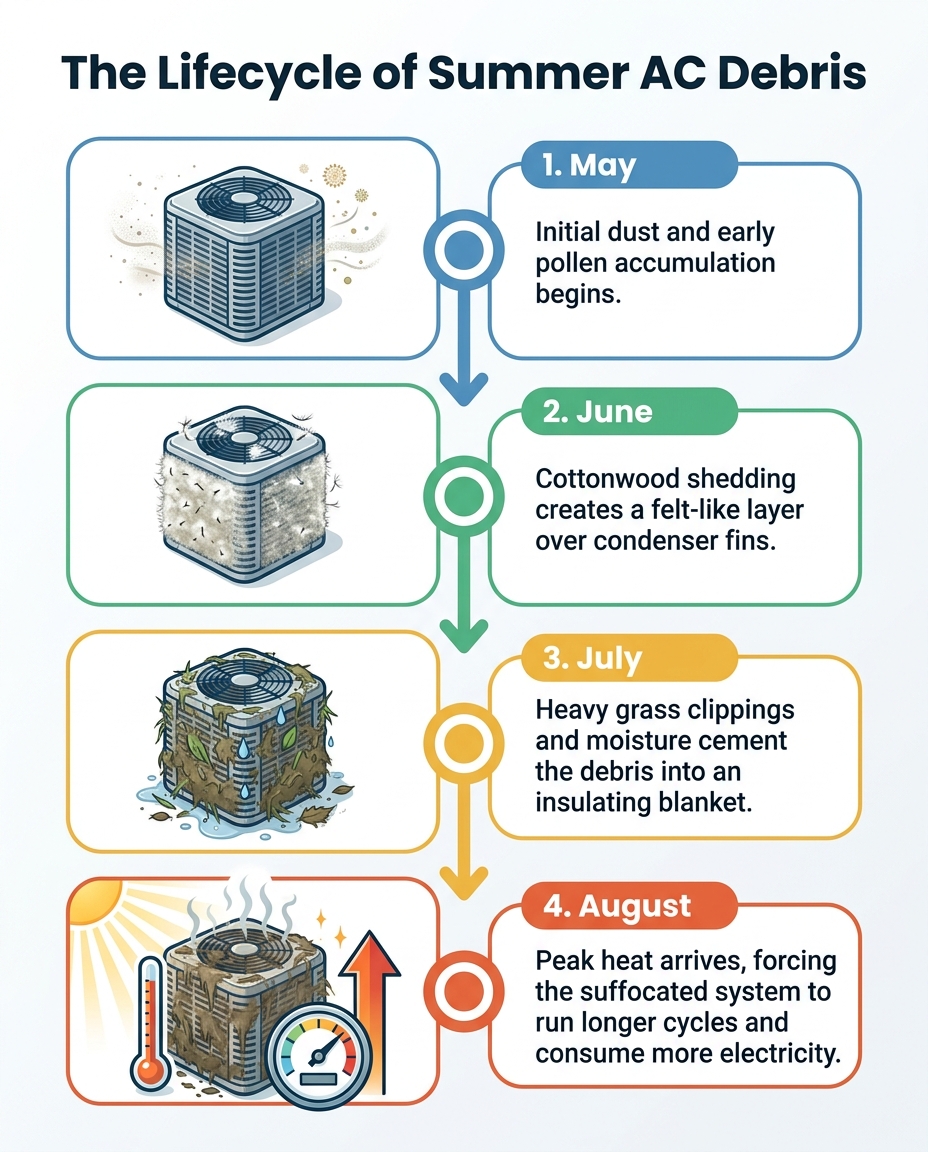
The journey from a clean, highly efficient air conditioner in May to a suffocated, energy-draining unit in August happens gradually. It is a cumulative timeline of environmental exposure that builds up layer by layer, eventually forming a dense, felt-like mat over your condenser fins.
The timeline of accumulation:
- May: The cooling season begins. The outdoor unit starts pulling in early spring dust, pollen, and lingering debris from the winter months. At this stage, the buildup is light and rarely impacts performance.
- June: This is when our technicians see the real trouble begin for Des Moines properties with mature cottonwood trees. The air fills with fluffy white seeds that are easily sucked into the narrow spaces between the aluminum condenser fins.
- July: Heavy Midwest grass clippings join the mix. As you mow your lawn week after week, the mower kicks up fine grass particles, dirt, and dust. When combined with high summer humidity and rain, this mixture turns into a sticky paste that binds with the cottonwood fluff.
- August: By late summer, the mixture of dust, seed fluff, and grass clippings has baked in the sun, creating a literal "insulating blanket" wrapped tightly around the internal coils.
The insulating effect: Think about wearing a heavy wool sweater on a 95-degree day. Your body would struggle to release heat, causing you to sweat profusely and exhaust yourself quickly. Your air conditioner experiences the exact same phenomenon. The blanket of debris traps the heat inside the unit instead of letting it dissipate into the outdoor air. This physical barrier forces the compressor to work exponentially harder, running continuously in a desperate attempt to achieve the desired indoor temperature.

Weather-Driven vs. Blockage-Driven Energy Spikes
It is perfectly normal to see your energy usage increase when the intense late-summer heat and humidity typical of Des Moines in August finally arrive. Extreme weather naturally increases the cooling demand on your home. However, there is a distinct difference between a system working hard to combat 95-degree weather and a system working hard because it is suffocating under a layer of debris.
Differentiating between normal high-temperature operation and the excessive strain caused by a blocked condenser is crucial for protecting your equipment. When heat transfer is blocked, the system runs drastically longer cycles, dramatically increasing electricity consumption beyond what the weather alone dictates. You will see this reflected as a massive spike in increased kilowatt-hour (kWh) consumption on utility statements.
| Symptom | Weather-Driven Operation (Normal) | Blockage-Driven Operation (Abnormal) |
|---|---|---|
| Cycle Length | Longer cycles during the heat of the day, but eventually cycles off when the target temperature is reached. | Runs constantly without ever shutting off, even after the sun goes down. |
| Indoor Comfort | The home maintains the set temperature, though it may take slightly longer to cool down. | The house feels warm and humid, and the thermostat never reaches the set point. |
| Airflow Temperature | Air coming from the indoor vents feels crisp and significantly colder than room temperature. | Air coming from the vents feels lukewarm or barely cool to the touch. |
| Energy Bill Impact | A moderate, expected increase aligned with historical usage for hot summer months. | A sudden, unexpected spike in kWh usage that far exceeds previous years' identical weather patterns. |
The value of consistent care: In our years of keeping Des Moines homes comfortable, our team at Midwest Comfort Heating & Cooling has noticed a clear pattern: homeowners who rely on our professional maintenance generally only need twice-yearly check-ups. Because their equipment is always clean and optimized, they avoid these massive blockage-driven spikes. When minor emergencies do arise, our technicians respond quickly, ensuring their system remains reliable. If you are unsure whether your high bills are due to the weather or a dirty unit, exploring reliable cooling solutions with our professionals can provide the clarity you need.
The Chain Reaction: From Restricted Airflow to System Strain
Running an air conditioner with clogged coils does much more than just inflate your monthly energy bill. It triggers a mechanical chain reaction that puts immense stress on the most expensive components of your HVAC system. What begins as a simple airflow restriction during August late-summer cooling can quickly escalate into a catastrophic system failure if left unchecked.
Here is exactly how a dirty condenser coil damages your system step-by-step:
- Restricted Airflow: The insulating blanket of debris physically blocks the fan from pulling fresh air across the aluminum fins. The heat absorbed from inside your home has nowhere to go.
- Elevated Refrigerant Temperatures: Because the heat cannot dissipate, the temperature of the refrigerant returning to the compressor remains dangerously high. The system is essentially trying to cool your house with hot refrigerant.
- Increased Pressure and Amperage: To compensate for the lack of heat release, the compressor has to work harder to pump the refrigerant through the lines. This raises the internal pressure of the system. As the compressor strains against this high pressure, it draws significantly more electrical current (amperage), which is exactly what drives up your utility costs.
- Accelerated Component Wear: The compressor is the heart of your air conditioner, and it is designed to operate within a specific temperature and pressure range. Constant strain causes the compressor to overheat, degrading the lubricating oils inside and accelerating wear and tear on vital moving parts.
- Premature System Failure: Eventually, a compressor forced to run hot and hard for weeks on end will fail completely. Replacing a burnt-out compressor is one of the most expensive repairs in the HVAC industry, often prompting a full system replacement.
Addressing these issues before the cooling season ends prevents minor blockages from becoming major, costly repairs. For more detailed insights on keeping your system running smoothly, check out this AC tune-up guide for Iowa homeowners.
The Hidden Dangers of DIY Coil Cleaning
The Problem: When you walk outside and see a thick layer of fluff and dirt coating your air conditioner, the immediate temptation is to grab a garden hose or a pressure washer and blast it clean. After all, it looks like a simple cleaning job. However, for Des Moines properties with mature cottonwood trees, the debris is often deeply embedded in the unit.
The Cause: The aluminum fins on your outdoor condenser are incredibly fragile—often no thicker than a few sheets of heavy foil. They are designed this way to maximize heat transfer, but this makes them highly susceptible to physical damage. If you spray them with high-pressure water, those delicate fins will instantly bend and flatten out. Once the fins are flattened, airflow is permanently blocked, completely ruining the coil's ability to release heat. Furthermore, superficial rinsing with a standard garden hose from the outside often just pushes the dirt, mud, and cottonwood fluff deeper into the center of the coil matrix, packing it tighter and worsening the restriction.
The Solution: Thoroughly and safely removing the "insulating blanket" requires cleaning the coils from the inside out. This process requires removing the outer cabinet panels of the air conditioner. Removing these panels exposes dangerous, high-voltage electrical components, including the capacitor and contactor, which hold lethal electrical charges even when the unit is turned off. Because of the extreme electrical hazards and the risk of permanently damaging the equipment, removing panels to clean the coils should absolutely never be attempted as a DIY project. It is a task strictly reserved for licensed professionals with the proper training and specialized, non-corrosive chemical coil cleaners.
Restoring Peak Efficiency Before the Season Ends
The professional approach: Positioned against the risks of DIY damage, professional maintenance is the only safe, effective resolution to the insulating blanket problem. When an HVAC technician arrives to service your outdoor unit, they bring a comprehensive approach designed to protect your equipment while restoring maximum performance. They safely disconnect the high-voltage power, carefully remove the necessary access panels, and apply specialized, foaming chemical cleaners that safely dissolve compacted organic debris without damaging the fragile aluminum fins. They then flush the system from the inside out, ensuring the coil matrix is completely clear.
Immediate efficiency gains: The results of a professional coil cleaning are often instantaneous. Once proper airflow is restored, the system's amperage draw immediately drops back to normal manufacturer specifications. The compressor no longer has to strain against high pressure, and the refrigerant can easily release its heat into the outdoor air. This immediate reduction in electrical strain reflects positively on your future energy consumption, helping to tame those high bills associated with August late-summer cooling.
The Midwest Comfort difference: When you sign up for our professional maintenance plans at Midwest Comfort Heating & Cooling, you gain access to thorough, safe coil cleaning processes that protect your equipment while restoring efficiency. As we always tell our customers, investing in a clean system pays dividends in both daily efficiency and long-term equipment longevity.
Real-world reliability: Just last August, our team responded to a local customer whose air conditioner stopped working entirely under the heavy strain of a late-summer heatwave. Because they reached out to us for professional help, one of our technicians arrived in under two hours and repaired the AC, getting the house cool again before the kids got home from school. Routine care prevents these sudden breakdowns entirely. Ensure your system finishes the hottest part of the year strong by signing up for a routine HVAC maintenance plan.
Frequently Asked Questions About Late-Summer AC Efficiency
Can dirty AC coils cause high electric bills?
Yes, dirty coils act as a thick insulator, physically preventing the release of heat from your system. Because the heat cannot escape, your air conditioner is forced to run much longer cycles to cool your home. This continuous, strained operation directly increases the amount of electricity your system consumes, leading to noticeably higher utility bills.
Why is my AC running constantly in August?
While high late-summer temperatures certainly play a major role in increased run times, an air conditioner that runs constantly without ever shutting off often indicates the system cannot expel heat efficiently. A summer's worth of accumulated debris—like cottonwood seeds, dust, and grass clippings—on the condenser is a primary culprit. When the system is suffocated by this debris, it simply cannot keep up with the thermostat setting.
How much does a dirty condenser affect efficiency?
According to the Department of Energy, dirty condenser coils significantly increase energy consumption and reduce the overall cooling capacity of the system. While the exact financial impact varies based on the size of the unit and the severity of the blockage, restricted airflow always results in a measurable, substantial drop in efficiency. In severe cases, it can increase energy consumption by up to 30 percent.
What happens if you don't clean your outside AC unit?
Ignoring the outdoor unit leads to compounded debris buildup that thickens year after year. This ongoing neglect causes higher energy bills, poor indoor cooling performance, and severely increased wear on the compressor. Eventually, the constant overheating and high pressure will lead to a complete system breakdown, often requiring expensive component replacements.
Is it safe to remove the AC panels to clean the coils myself?
No, removing the outer cabinet panels of your air conditioner exposes dangerous, high-voltage electrical components that can hold a lethal charge even when the power is shut off at the breaker. Additionally, the internal aluminum fins are incredibly delicate and easily ruined by improper cleaning techniques. This level of deep maintenance should exclusively be performed by licensed HVAC professionals.
Reclaim Your Energy Efficiency
The bottom line: Higher utility bills do not have to be an accepted, inevitable part of late summer. While August weather will always demand more from your cooling system, the sudden, painful spike of increased kilowatt-hour (kWh) consumption on utility statements is frequently tied to a suffocating blanket of yard debris on your outdoor unit. A clear, mechanically sound condenser is the absolute key to lowering your electrical consumption and keeping your home consistently comfortable.
Take action today: You don't have to limp through the rest of the cooling season with a struggling, energy-wasting system. By addressing the physical blockage on your outdoor condenser, you immediately restore heat transfer efficiency, drop your system's amperage draw, and protect your compressor from premature failure. We encourage you to explore professional maintenance options today to ensure your air conditioner finishes the summer strong, runs efficiently, and keeps your monthly energy costs exactly where they belong.
