
The Sticky Reality of Late-Summer Cooling in the Midwest
If you are trying to figure out why your heat pump struggles to dehumidify during muggy Iowa afternoons, you are not alone. At Midwest Comfort Heating & Cooling, our team fields dozens of calls every August from Des Moines homeowners dealing with that frustrating, clammy chill inside the house. You set the thermostat to a comfortable 72 degrees, the system kicks on, and cold air blows from the vents. However, your skin still feels sticky, the floors feel slightly damp, and the indoor air feels heavy. The temperature on the wall says you should be comfortable, but your body tells a completely different story.
During late-August muggy afternoons, the outdoor air carries a massive moisture load. When that heavy, humid air infiltrates your living space, it fundamentally changes how your home feels. While modern heat pump systems are incredibly efficient at managing indoor temperatures, handling extreme water vapor requires a different approach. To truly solve that sticky feeling without overworking your equipment, our technicians often recommend looking toward comprehensive indoor air quality solutions. Let's break down exactly why this moisture imbalance happens and what you can do to restore true comfort to your home.
Sensible Heat vs. Latent Heat: Why Your Thermostat is Lying to You
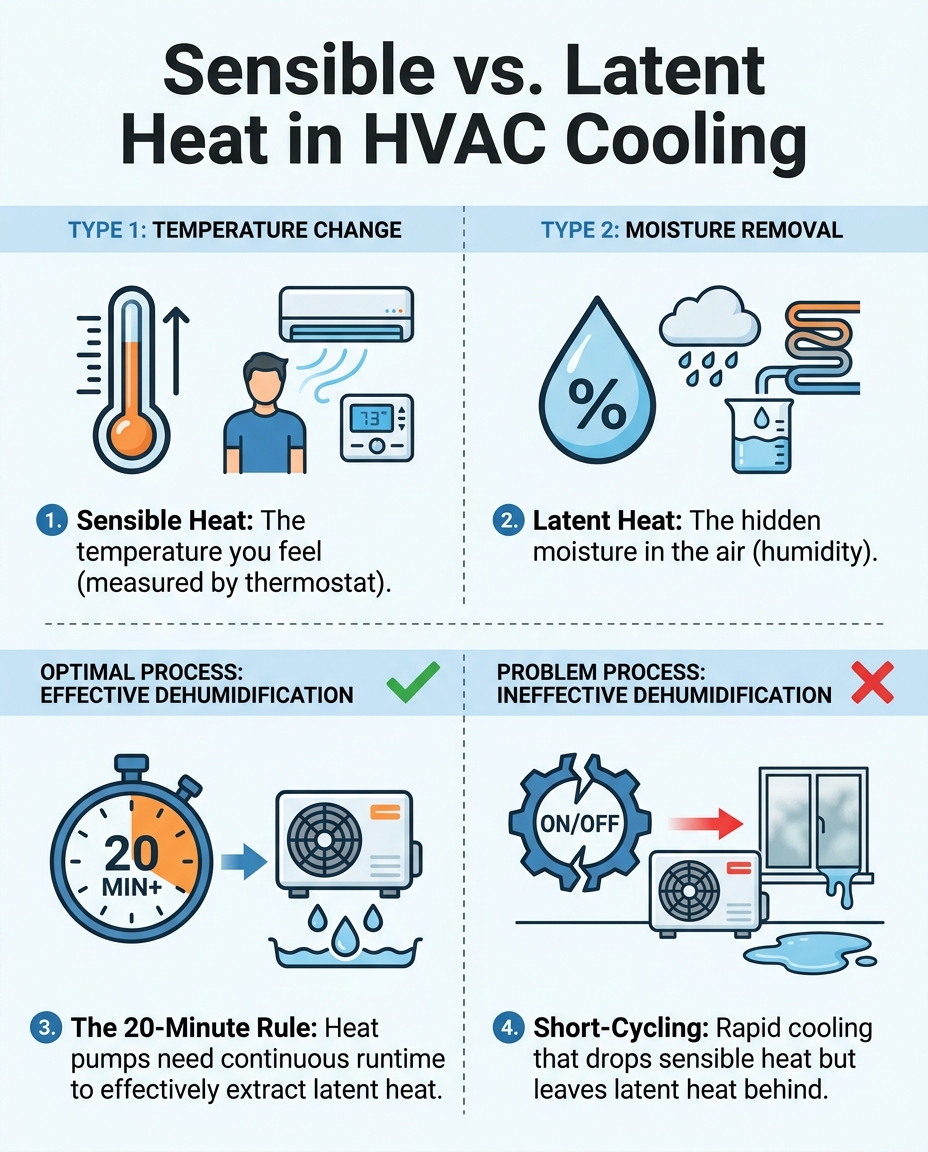
To understand why your home feels damp even when it is cool, you have to look at the two distinct types of heat your HVAC system is fighting against. A standard thermostat only measures one of them, which is why the reading on the wall does not always match your actual comfort level. Des Moines frequently experiences relative humidity exceeding 70% during late summer, and in our years of servicing local homes, we have found that hidden moisture is the primary enemy of your indoor comfort.
| Type of Heat | What It Is | How It Is Measured | HVAC Action Required |
|---|---|---|---|
| Sensible Heat | The actual thermal energy you can feel on your skin. | Measured by a standard thermometer or thermostat. | Requires the system to drop the air temperature (cooling). |
| Latent Heat | The hidden thermal energy trapped inside airborne moisture. | Measured by a hygrometer (relative humidity percentage). | Requires the system to extract water vapor (dehumidifying). |
Cooling the air and dehumidifying the air are two completely separate physical processes that happen at different rates. Lowering the sensible heat is relatively fast. Extracting latent heat takes significantly more time and energy because the system has to physically condense water vapor out of the air and drain it away.
The 20-Minute Dehumidification Rule
For a heat pump to pull moisture out of the air, the indoor evaporator coil needs to get freezing cold and stay that way. As warm, damp indoor air blows across this chilled metal coil, the moisture condenses into water droplets, much like water sweating on the outside of a cold glass of iced tea. Those droplets then drip into a pan and drain out of your house.
Here is the catch: it typically takes about 20 minutes of continuous, uninterrupted runtime for meaningful dehumidification to even begin. For the first 10 to 15 minutes of a cooling cycle, the system is primarily just lowering the sensible heat. If your heat pump shuts off before it hits that 20-minute mark, the moisture stays trapped inside your home.

The Short-Cycling Dilemma in Older Single-Stage Heat Pumps
Our technicians frequently discover that the root cause of a clammy house comes down to the operational limits of the equipment itself. Most older single-stage heat pumps operate with a very simple binary design: they are either running at 100% capacity, or they are completely off. They have no middle ground and no ability to adjust their output based on the specific weather outside.
When you have a single-stage system running at full blast, it pushes a massive amount of cold air into the house very quickly. On a moderately warm day, or if the unit is highly efficient, it might satisfy the thermostat's sensible temperature setting in just 10 or 15 minutes. Once the thermostat reads 72 degrees, it commands the heat pump to shut down.
Because the system shuts off before reaching the 20-minute dehumidification window, the sensible heat drops, but the latent heat remains untouched. This rapid on-and-off operation is known as short-cycling. It leaves your living room feeling like a cold, damp cave. This is an operational limit of single-stage technology design, not necessarily a mechanical failure.
Why Oversizing is the Enemy of Humidity Control
A common misconception we hear in the field is that a "bigger" system is always better. In reality, oversizing a heat pump is the worst thing you can do for humidity control. An oversized unit is so powerful that it blasts the house with cold air and satisfies the thermostat in a fraction of the time a properly sized unit would take.
The larger the unit, the shorter the cooling cycle. The shorter the cooling cycle, the less time the evaporator coil has to sweat out the airborne moisture. If your home has always felt sticky during the summer, regardless of the thermostat setting, an oversized single-stage unit is a highly probable culprit.
Diagnosing the Clammy House: Is Your Heat Pump Actually Broken?
While design limitations and short-cycling explain many humidity complaints, you also need to rule out actual equipment malfunctions. Sometimes, a heat pump fails to dehumidify because a critical component is struggling or failing. Knowing the difference between an operational limit and a broken part helps you decide when to call our team for help.
Signs your humidity issue requires a repair:
- Warm air from vents: If the air blowing out is lukewarm instead of crisp and cold, the system cannot remove moisture.
- Iced-over coils: If you see ice forming on the indoor or outdoor unit, airflow is severely restricted, or refrigerant levels are compromised.
- Strange noises: Grinding, squealing, or rattling sounds indicate a failing blower motor or compressor.
- Constant running with no cooling: If the unit runs for hours but the temperature never drops, a mechanical failure has occurred.
Before assuming the worst, check your thermostat settings. Ensure your fan is set to "AUTO" rather than "ON." If the fan is set to "ON," it continues to blow air over the wet indoor coil even after the cooling cycle ends, re-evaporating the water and blowing the humidity straight back into your living space.
If you have ruled out the thermostat setting and suspect a failing part, prompt professional air conditioning services can quickly restore proper function. Real-world breakdowns happen, especially under heavy late-summer workloads. For example, our team recently helped a local homeowner who reached out during a back-to-school heatwave when their system suddenly required a replacement part to function. Our technician diagnosed the issue quickly. Even though they had to wait until the next day for the specific part to arrive, we installed it immediately the following morning, and the heat pump was repaired and running efficiently in no time.
How End-of-Season Wear and Tear Reduces Moisture Removal Power
By the time late August rolls around, your heat pump has been running hard for several months. That sustained workload takes a toll on the system's efficiency, specifically impacting its ability to transfer heat and remove moisture. End-of-season wear and tear is a major factor in why homes suddenly feel stickier as summer draws to a close.
Here is how late-season fatigue impacts your comfort:
- Dust accumulation on the coil: Over months of operation, microscopic dust passes through the filter and sticks to the damp indoor evaporator coil. This layer of grime acts as an insulator, preventing the cold refrigerant from absorbing heat and condensing moisture effectively.
- Clogged air filters: A filter that hasn't been changed since June is likely packed with pet dander, pollen, and dust. This restricts airflow, meaning less humid air crosses the cooling coil per minute.
- Struggling blower motors: Fighting against a clogged filter forces the blower motor to work harder, reducing the overall volume of air circulating through the home.
- Outdoor unit blockages: The outdoor condenser coil often gets coated in grass clippings, dirt, and cottonwood fluff by late summer, trapping heat inside the system and reducing cooling capacity.
You should never skip late-season filter changes just because autumn is approaching. A clean filter is your first line of defense against poor airflow. Beyond the filter, scheduling routine HVAC maintenance ensures the internal coils are professionally cleaned and the system's ability to extract humidity is fully restored by a trained technician.
Tailored IAQ Solutions: Defeating Midwest Moisture Beyond the Thermostat
If your heat pump is properly sized, well-maintained, and functioning perfectly, but you still feel sticky, you are simply up against the extreme limits of the regional climate. Pushing the thermostat lower is not the answer. Dropping the setting to 68 degrees will just make your house freezing cold, force the system to run longer, and drive up your energy bills without fully solving the clammy feeling.
For many Des Moines area homes, the most effective strategy our team recommends is to separate temperature control from moisture control entirely. Whole-home dehumidifiers are designed to do exactly this. Unlike portable units that only handle a single room and require constant emptying, whole-home systems integrate directly into your existing ductwork.
These dedicated systems pull damp air from the house, extract the water vapor, drain it automatically into your plumbing system, and return dry, comfortable air to every room. Because they operate independently of your heat pump's cooling cycle, they can run on mild, muggy days when your house does not actually need air conditioning.
Maintaining indoor humidity between 30% and 50% provides massive comfort and health benefits, preventing mold growth, protecting hardwood floors, and making 74 degrees feel incredibly comfortable. Midwest Comfort Heating & Cooling's expertise lies in diagnosing the actual root cause of comfort issues in Iowa. We pride ourselves on providing tailored indoor air quality solutions that fix the specific problem rather than just offering generic, one-size-fits-all equipment swaps.
Variable-Speed Technology: The Ultimate Upgrade for Iowa Summers
If your older single-stage unit is nearing the end of its lifespan, replacing it with variable-speed technology is the ultimate long-term solution for extreme humidity. Also known as inverter-driven systems, variable-speed heat pumps completely eliminate the short-cycling problems that plague older designs.
Instead of turning on at 100% capacity and shutting off 10 minutes later, a variable-speed compressor can adjust its output in tiny increments. On a muggy, moderately warm afternoon, the system might choose to run continuously at just 30% capacity. By running low and slow, the evaporator coil stays consistently cold for hours at a time, constantly wringing moisture out of the air without overcooling the physical space.
This continuous, low-speed operation is remarkably energy-efficient. It takes far less electricity to maintain a steady speed than it does to constantly stop and start a heavy motor. We always advise homeowners that many of these high-efficiency systems also qualify for various federal tax credits or local utility incentives, making the upgrade more accessible when you are looking to improve your comfort.
Beyond summer humidity control, variable-speed technology offers incredible benefits year-round. These advanced systems provide vastly superior cold climate heat pump performance in Iowa winters, maintaining their heating capacity even when temperatures drop well below freezing.
Frequently Asked Questions About Heat Pumps and Humidity
Why does my heat pump cool but not dehumidify?
It is likely short-cycling. The system cools the air to the target sensible temperature too quickly and shuts off before it has time to extract the latent moisture from the air. We often see this happen if the unit is oversized or if it is an older single-stage model.
Do heat pumps remove humidity in the summer?
Yes, heat pumps naturally dehumidify as part of the cooling process. As warm indoor air passes over the freezing cold evaporator coil, condensation forms and drains away, successfully removing moisture from your living space.
Why is my house so humid with the heat pump running?
Your thermostat fan may be set to "ON" instead of "AUTO", which blows moisture back inside after the cooling cycle ends. Alternatively, the unit may be oversized, short-cycling, or struggling with a dirty evaporator coil that restricts airflow.
How do I get my heat pump to dehumidify better?
Ensure your thermostat fan is set to "AUTO", schedule routine professional maintenance to clean the internal coils, and consider adding a whole-home dehumidifier to handle extreme summer moisture loads without overcooling the house.
Will lowering my thermostat reduce indoor humidity?
Lowering the thermostat will force the system to run longer, which does extract more moisture, but it will also make your home uncomfortably freezing cold and significantly increase your monthly energy bills.
Restore Your Home's Comfort Before Summer Ends
A sticky, clammy house in late August is a completely solvable problem. Whether the solution involves routine end-of-season maintenance, adding a whole-home dehumidifier, or upgrading an aging system to variable-speed technology, you do not have to settle for poor indoor air quality. Consult with our local experts at Midwest Comfort Heating & Cooling to evaluate your home's specific moisture load and system performance. By exploring comprehensive air quality options with our team, you can get a clear technical explanation of your system's limits and take actionable steps to secure total comfort for the rest of the season.
