
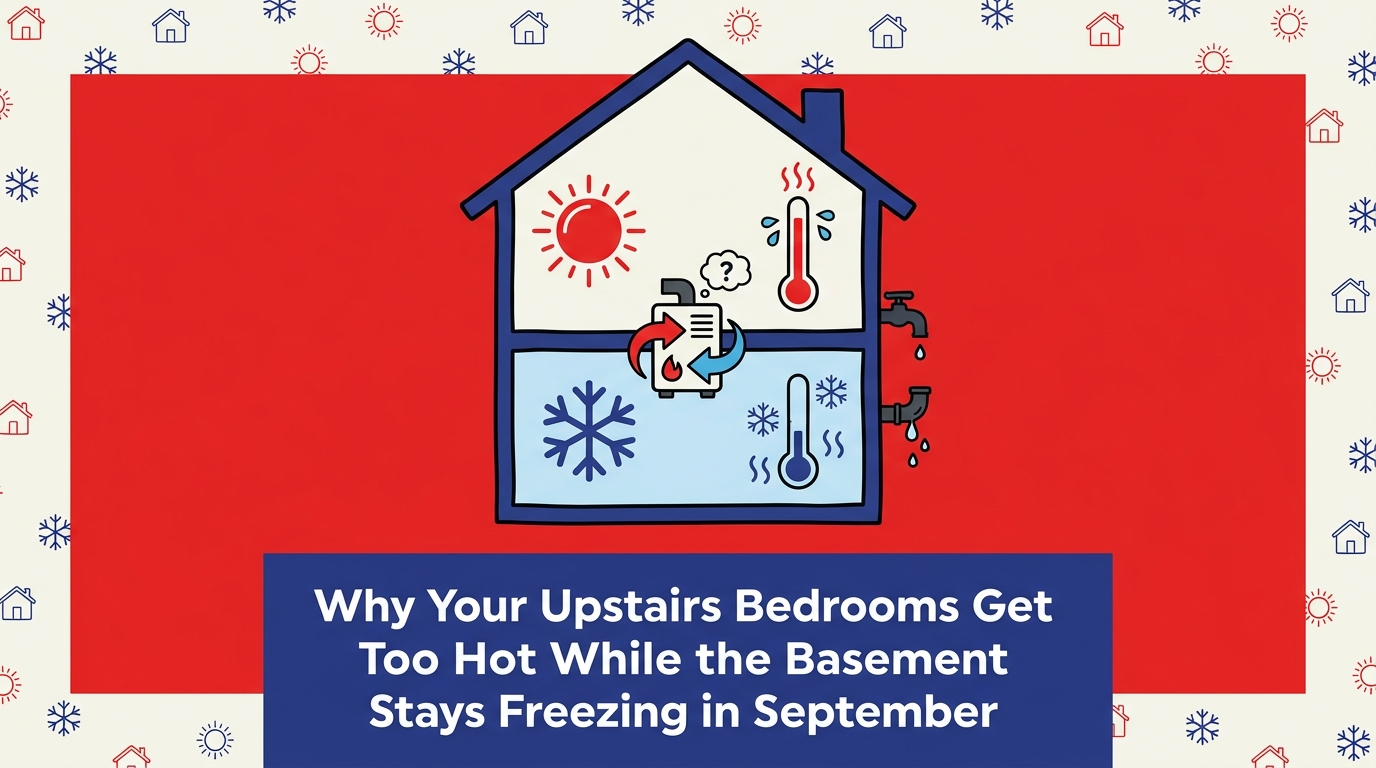
The September Comfort Clash: Why Your Upstairs Bedrooms Get Too Hot While the Basement Stays Freezing in September
Before the first frost arrives, you might find yourself wondering exactly why your upstairs bedrooms get too hot while the basement stays freezing in September. You are not alone in this frustration. At Midwest Comfort Heating & Cooling, our team fields countless calls from Des Moines homeowners dealing with this exact issue every early fall. Trying to sleep in a stifling second-story bedroom while the lower level of your home feels like an icebox is a measurable result of physics interacting with your home's architecture. During the unpredictable September transition from cooling to heating, warm afternoons and chilly nights force your home's climate control system to rapidly cycle. This early fall weather uniquely exposes the hidden vulnerabilities in your home's airflow and ductwork design. Addressing this severe temperature imbalance requires understanding thermal dynamics rather than just constantly adjusting the dial on your wall.
To fully understand and permanently resolve this issue, you need to look closely at your HVAC system and explore targeted air conditioning solutions that balance your home.
Understanding the Stack Effect in Multi-Story Homes
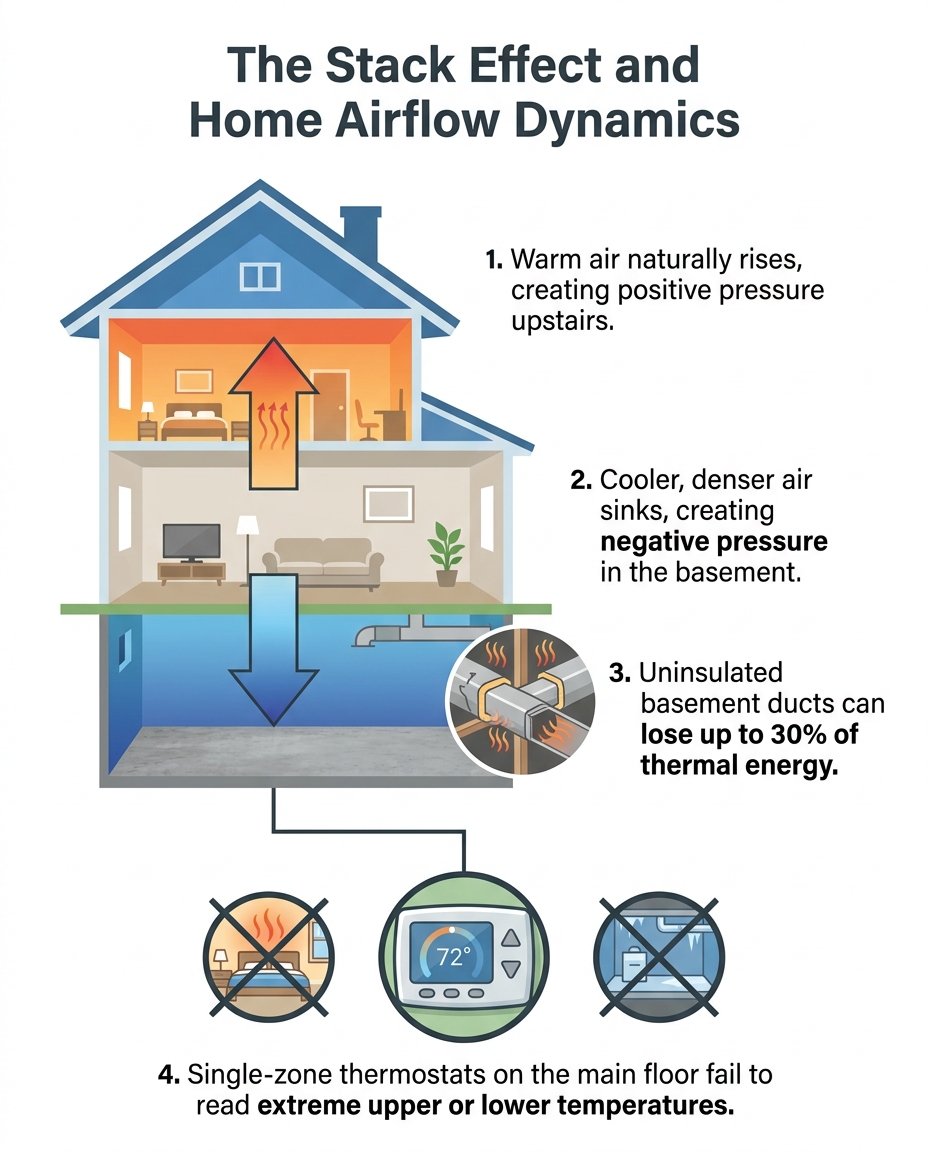
The primary culprit behind your uneven home temperatures is a natural physical phenomenon known as the "stack effect." In any enclosed structure, warm, buoyant air naturally rises to the highest possible point. As this warm air pushes upward into your second-story bedrooms, it creates a positive pressure zone at the top of the house. Simultaneously, this upward movement creates a pressure differential that actively draws cooler, denser air down into the lower levels, resulting in a negative pressure zone in your basement.
This natural physical process actively fights against your forced-air equipment. In our years of servicing older Des Moines homes with multi-level ductwork and basements, our technicians routinely see central blower motors working incredibly hard to push conditioned air against these natural pressure zones. While the stack effect happens year-round, it becomes hyper-noticeable during transitional seasons when the outdoor temperature fluctuates wildly, making the top floor unbearably warm and the bottom floor uncomfortably cold.
How Air Pressure Dictates Home Comfort
The mechanics of airflow: Your home is essentially a large envelope of moving air. When pressure zones become imbalanced, conditioned air takes the path of least resistance. The positive pressure trapped in your second-story rooms acts like an invisible wall, preventing the cool air from your vents from properly entering the space.
| Home Level | Air Pressure Status | Thermal Dynamic |
|---|---|---|
| Second Story Bedrooms | Positive Pressure | Warm air accumulates and becomes trapped, creating stifling heat that resists incoming conditioned air. |
| Main Floor | Neutral Pressure | Generally balanced and comfortable; this is typically where the thermostat takes its temperature reading. |
| Basement | Negative Pressure | Cool, dense air sinks and pools here, often drawing in outside drafts and creating a permanent icebox effect. |

How Autumn's Fluctuating Temperatures Confuse Your Thermostat
The weather whiplash of early fall creates a specific catalyst for extreme temperature imbalances. In regions like Des Moines, September features significant diurnal temperature variation—meaning you might experience highs in the 80s during the afternoon and lows dropping into the 50s at night. This rapid fluctuation creates a unique challenge for single-zone thermostats located on the main floor.
During the warm September transition from cooling to heating, a hot afternoon triggers your system to push cool air. However, because the main floor reaches the target temperature relatively quickly, the thermostat shuts the system down long before that cooling relief can fight its way up to the second-story bedrooms. Conversely, when the chilly night sets in, the system might switch to heating prematurely. This phenomenon is known as "thermostat confusion."
The short-cycling problem: Because the thermostat is only measuring the neutral air on the main floor, the system short-cycles during mild weather. Short-cycling prevents the blower motor from running long enough to fully circulate air to the furthest reaches of the home. As a result, the main floor stays perfectly comfortable, while the extremes—your stifling upstairs bedrooms and your freezing basement—are completely neglected by the system.
The Hidden Thermal Sink: Heat Loss in Basement Ductwork
Before the conditioned air even has a chance to reach your upper floors, it faces another massive hurdle: your basement ductwork. In many older Des Moines homes with multi-level ductwork and basements, aging, uninsulated sheet metal ducts act as a massive thermal sink. As conditioned air travels through the freezing basement, the bare metal ductwork rapidly absorbs the thermal energy.
According to energy efficiency standards, 10 to 30 percent of the energy used to heat or cool your home can be lost in unconditioned spaces like basements. If you are trying to cool your upstairs bedrooms, that cold air is being warmed by the ambient heat of the ductwork before it ever reaches the vent. If you are trying to heat the home on a chilly September night, the warm air loses its heat to the freezing basement air surrounding the thin metal ducts.
This thermal loss results in weak, tepid airflow by the time it finally reaches the second-story bedroom vents. At Midwest Comfort Heating & Cooling, our technicians have extensive expertise in diagnosing the specific ductwork architecture challenges common to the local area. When we perform pre-heating-season tune-ups, we frequently find that addressing this hidden thermal sink is the crucial first step in restoring whole-home comfort.
Why Closing Vents is a Dangerous DIY HVAC Myth
When faced with a freezing basement and a hot upstairs, a common homeowner instinct is to walk around the main floor and basement, shutting all the supply vents. The logical assumption is that closing these vents will "force" all the conditioned air upstairs. Unfortunately, our service team can tell you firsthand that this is a dangerous DIY myth that can cause catastrophic damage to your equipment.
Forced-air systems are meticulously designed to operate with a specific amount of open airflow. When you close vents, you do not magically redirect the air; instead, you drastically increase the static pressure inside the ductwork. In older Des Moines homes with multi-level ductwork and basements, this added pressure creates a severe bottleneck.
The True Cost of Restricted Airflow
Increasing static pressure by closing vents forces your blower motor to work against a wall of trapped air. This is especially dangerous for modern Electronically Commutated Motors (ECM), which will ramp up their speed to try and overcome the blockage, leading to overheating and premature failure.
- Blower motor burnout: The increased strain can cause the motor to overheat and fail completely.
- Frozen evaporator coils: In cooling mode, restricted airflow prevents enough warm air from passing over the coils, causing them to freeze solid.
- Cracked heat exchangers: In heating mode, trapped heat can cause the furnace's heat exchanger to crack, creating a serious safety hazard.
- Increased energy bills: The system runs longer and harder, consuming significantly more electricity or gas without improving your comfort.
"As we frequently remind our customers, modifying ductwork or adjusting dampers to change air pressure requires precise calculations by a licensed professional. Guessing at airflow loads by closing vents almost always leads to expensive equipment failures." — The Midwest Comfort Heating & Cooling Team
Professional Solutions for Whole-Home Temperature Balancing
Instead of relying on harmful DIY band-aids or temporary space heaters, the correct approach involves professional airflow balancing and targeted system enhancements. Preparing your home during the September transition from cooling to heating ensures you are ready for the heavy winter use ahead.
Here is how our professionals evaluate and permanently fix uneven home temperatures:
- Professional Airflow Balancing: A technician will measure the static pressure and adjust the mechanical dampers inside the ductwork—not the room vents—to properly distribute conditioned air evenly across all floors.
- Duct Sealing and Insulation: Sealing leaks and wrapping basement ductwork in proper insulation prevents the thermal loss that robs your second floor of conditioned air.
- Blower Motor Assessment: Ensuring your blower motor is operating at the correct speed to overcome the natural stack effect of your home.
- System Maintenance: Cleaning the ductwork and optimizing the equipment significantly improves overall indoor air quality and environmental health.
Ignoring these imbalances can lead to sudden breakdowns when the weather turns severe. For example, our team received a frantic call from a local homeowner on a Wednesday in early November when their furnace required an immediate repair after struggling to heat the house evenly. Our technician Mick arrived by noon, diagnosed the underlying airflow and mechanical issue, retrieved the necessary part, and had the furnace up and running quickly. Proactive balancing prevents these urgent calls.
Targeted Relief for Stubborn Second-Floor Hot Spots
Sometimes, the architectural design of a house simply cannot push enough air upstairs, even with perfectly sealed ducts and balanced dampers. Based on the hundreds of installations we've performed across the metro area, we often find that in many older Des Moines homes with multi-level ductwork and basements, the central system was never sized to handle the thermal load of the second story.
When traditional ductwork falls short, ductless mini-splits offer the ultimate solution for targeted relief. These highly efficient systems bypass the central ductwork entirely, delivering conditioned air directly to the rooms that need it most.
Bypassing the Ductwork Dilemma
Zoned comfort control: By installing a ductless unit in the upstairs bedrooms, you create a dedicated climate zone. This allows you to set the upstairs thermostat to a comfortable sleeping temperature without freezing out the basement or over-conditioning the main floor. Because these units operate independently, they provide precise temperature control regardless of what the central system is doing.
Furthermore, modern heat pumps power these ductless systems, meaning they can provide both powerful cooling during hot September afternoons and highly efficient heating during chilly autumn nights. You only pay to condition the rooms you are actively occupying, making them an incredibly energy-efficient upgrade. (Note that federal tax credits may apply to qualifying heat pump installations—we always advise checking with your tax professional for current programs.)
Prepare Your Home's Airflow for the Winter Ahead
An uncomfortable September is often a glaring warning sign of how your system will struggle during the deep winter months. If your upstairs is stifling and your basement is freezing now, the extreme cold will only magnify these architectural vulnerabilities. Permanent solutions exist well beyond opening windows or plugging in dangerous space heaters.
While the weather is still transitional during the September transition from cooling to heating, it is the perfect time to schedule a professional airflow evaluation with our team. Whether your home needs precise duct balancing, strategic insulation, or you are interested in adding cooling without ductwork, our professional assessment will restore your whole-home comfort. Take action now to ensure every room in your house remains perfectly comfortable, no matter what the forecast brings: exactly why your upstairs bedrooms get too hot while the basement stays freezing in September is a problem you can finally leave in the past.
Frequently Asked Questions
Why is my upstairs so hot while my basement is freezing?
This temperature imbalance is caused by the stack effect, where warm air naturally rises to the top floor while cool air sinks to the basement. Additionally, your main floor thermostat often shuts the system off before conditioned air can reach the upper bedrooms. Uninsulated ductwork in the basement can also absorb the thermal energy before the air reaches the second story.
How does the stack effect impact home cooling and heating?
The stack effect creates a positive pressure zone upstairs and a negative pressure zone downstairs. This natural physical process fights against your forced-air HVAC system, making it very difficult for the blower motor to push cool air up into the hot bedrooms or warm air down into the drafty basement. It forces your system to work harder to overcome these natural pressure barriers.
Can duct insulation fix uneven room temperatures?
Yes, insulating your ductwork is one of the most effective ways to improve temperature balance. Uninsulated sheet metal ducts in a cold basement can lose up to 30 percent of the thermal energy passing through them. Wrapping these ducts ensures the conditioned air retains its temperature all the way to the second-story vents.
Does closing downstairs vents help cool the upstairs?
No, closing vents is a dangerous myth that does not effectively push air upstairs. Instead, it drastically increases the static pressure inside your ductwork, which strains the blower motor and can lead to overheating, frozen coils, or a cracked heat exchanger. Airflow should only be adjusted via mechanical dampers by a licensed professional.
How do I balance the temperature in a two-story house?
Balancing the temperature requires a multi-step approach that includes professional damper adjustments, sealing leaky ductwork, and insulating exposed pipes in unconditioned spaces. If the home's architecture still prevents even airflow, installing a ductless mini-split system upstairs is the best way to create a dedicated, comfortable climate zone.
Is it normal for my thermostat to short-cycle during the fall?
While common, short-cycling is not ideal and indicates that your thermostat is only reading the ambient temperature of the main floor. During mild fall days with warm afternoons and cool nights, the main floor reaches the target temperature quickly, causing the system to shut down before it can adequately condition the upstairs or downstairs.
