


The Definitive Guide to Mini Split Benefits for Additions, Garages & Bonus Rooms


Discover the Essential Benefits of Regular Air Conditioning Maintenance
Regular maintenance of your air conditioning system ensures optimal performance and longevity. It helps prevent costly repairs while improving energy efficiency, keeping your home comfortable year-round.

Routine checks can significantly reduce energy bills and extend the life of your unit.


Why So Many Des Moines Homeowners Are Turning to Mini-Splits for Extra Rooms
The mini split benefits for additions, garages, and bonus rooms are hard to ignore — especially when those spaces feel like a sauna in July and a freezer in January. If you have a finished room over your garage, a converted workspace, or a new home addition in Des Moines, you already know the problem: your central HVAC system just can't keep up.
These spaces were never part of your home's original heating and cooling design. And forcing your existing system to handle them rarely works well.
Here's a quick look at why mini-splits are the go-to solution for these problem spaces:
Top mini split benefits for additions, garages, and bonus rooms:
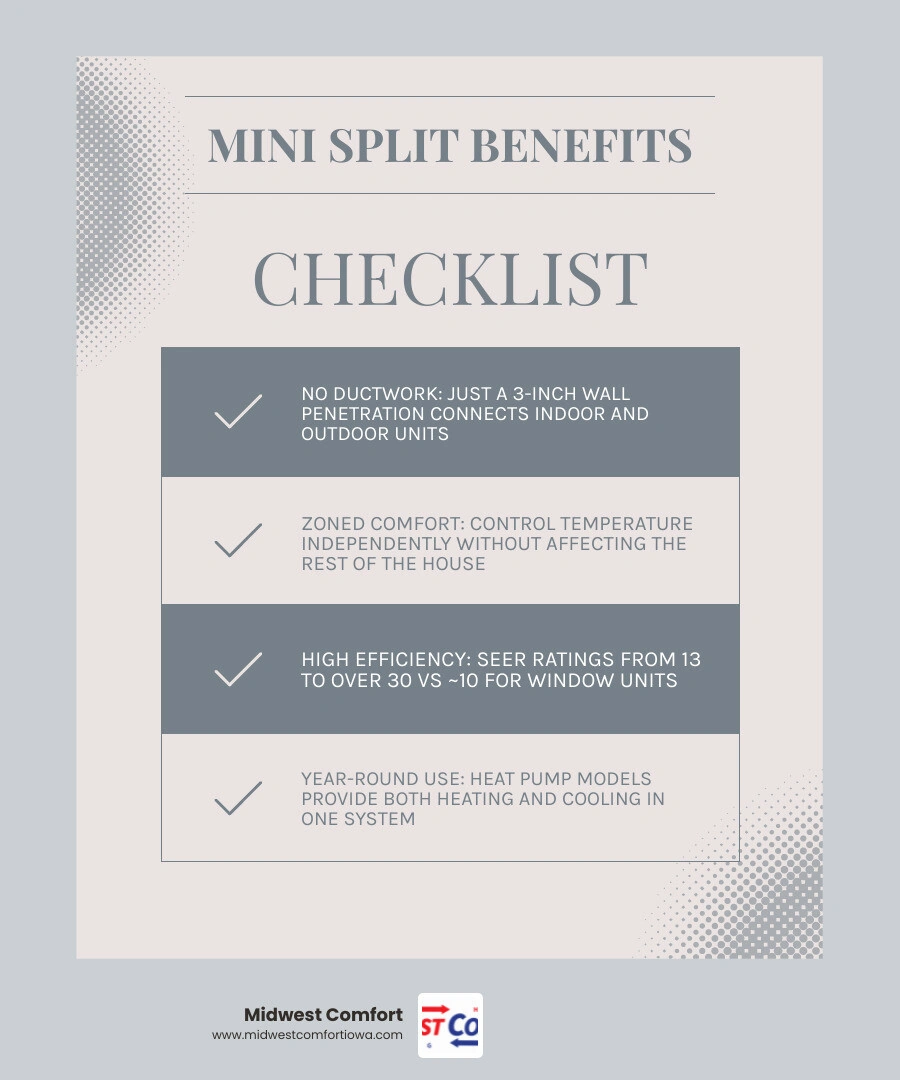
- No ductwork needed — only a small 3-inch hole in the wall connects the indoor and outdoor units
- Zoned comfort — control the temperature in that one room independently, without affecting the rest of the house
- High efficiency — mini-splits start at SEER 13 and reach 30+, far outperforming window units (around SEER 10)
- Year-round use — most mini-splits are heat pumps, meaning they heat and cool with one system
- Quiet operation — indoor units run as low as 19 decibels, quieter than a library
- Better air quality — multi-stage filtration reduces dust, allergens, and odors
- Less energy waste — traditional ductwork can lose more than 30% of cooling energy, especially through unconditioned attics and garages
- Fast installation — a professional installation typically takes just a few hours with minimal disruption
Rooms over garages are some of the hardest spaces to condition in any home. They can run 5 to 10°F hotter than the rest of the house due to heat rising from an uninsulated garage below, combined with direct roof exposure and limited airflow from the central system. A ductless mini-split addresses all of those problems directly, without putting extra strain on your existing equipment.
In this guide, Midwest Comfort walks you through everything you need to know — from why traditional HVAC struggles with these spaces, to how to size and install the right system for your Des Moines home.
Mini split benefits for additions garages and bonus rooms terms to learn:
- ductless mini split benefits for iowa homeowners
- how ductless systems save energy with zone control
- how mini splits solve hot and cold spots in your home
Why Traditional HVAC Systems Struggle with Extra Spaces

When we add a new room to our home, convert a garage, or finish an attic space, our natural instinct is to try and extend our existing central HVAC system. It seems like the easiest option on paper. However, traditional forced-air systems are carefully designed and balanced for the original footprint of your home. Introducing a completely new zone throws that entire balance out of whack.
Traditional ducted systems suffer from major efficiency losses. In fact, standard ductwork can lose up to 30% of its cooling energy through leaks, cracks, and conduction, particularly when those ducts run through unconditioned attic spaces or crawlspaces. Forcing a central system to push conditioned air to a distant addition or a room above a garage often results in weak airflow and severe temperature imbalances.
By understanding the ductless mini split benefits for Iowa homeowners, you can see how independent zoning completely bypasses these structural limitations. Instead of fighting static pressure and duct losses, a mini-split delivers comfort directly to the space where it is installed.
The Thermal Challenges of Finished Rooms Over Garages (FROGs)
Finished Rooms Over Garages — commonly referred to as FROGs — are notoriously difficult to keep comfortable. These spaces are surrounded by unconditioned zones. Below them sits a cold or hot garage slab, and above them is a roof absorbing direct sunlight.
Because garages are rarely insulated to the same standards as living spaces, heat easily transfers upward through the floorboards. In the summer, the rising heat turns the bonus room into an oven. In the winter, the uninsulated floor acts like a giant ice block, leaving you shivering.
Standard central air vents simply do not have the power to overcome these extreme thermal swings. Installing a dedicated system allows you to achieve true, reliable comfort with a mini split AC system, neutralizing the unique structural challenges of a FROG.
Why Extending Central Ductwork is Often Inefficient
Trying to extend central ductwork to a new addition or garage conversion can cause serious mechanical issues for your main HVAC system. Your existing furnace and air conditioner were selected based on a specific square footage calculation. Adding more space to their workload is like hitching a heavy trailer to a sedan — it strains the engine and shortens its lifespan.
Furthermore, extending ductwork requires major structural modifications. You have to cut through walls, bulkheads, and ceilings to run new ducts. Even if you manage to route the ductwork, the central blower motor may lack the static pressure needed to push air that far. This leaves the new room under-conditioned while overworking the main system.
When you look closely at a central AC vs ductless mini split comparison, it becomes clear that a mini-split is the far safer and more efficient choice for protecting your primary HVAC investment.
Key Mini Split Benefits for Additions Garages and Bonus Rooms
Ductless mini-split systems are designed to solve the exact problems that make extra rooms so frustrating. Because they bypass ductwork entirely, they deliver 100% of their conditioned air directly into the living space. This makes them incredibly efficient, quiet, and versatile.
Whether you are converting a detached garage into a home office, building a sunroom, or finishing a play space for the kids, a mini-split provides targeted climate control that adapts to how you actually use the room. Let us look at how how ductless systems save energy with zone control to keep your utility bills manageable while maximizing your comfort.
Independent Zone Control for Custom Comfort
One of the greatest advantages of a mini-split system is independent zone control. Traditional central systems rely on a single thermostat to regulate the entire house. If your upstairs bonus room is hot, you have to turn down the thermostat for the whole home, freezing everyone on the main floor just to make the bonus room livable.
A mini-split gives the new space its own dedicated thermostat. You can set the temperature in your converted garage gym to a cool 65°F for a workout, while keeping the rest of the house at 72°F. Even better, if the room is not in use, you can turn the unit off or set it to an eco-mode, preventing you from wasting energy on empty space. This level of customization is why we recommend mini split AC systems for home comfort in any multi-use household.
Maximizing Mini Split Benefits for Additions Garages and Bonus Rooms with Inverter Technology
Traditional air conditioners operate on a simple on-and-off cycle. When the temperature rises, the compressor kicks on at full blast until the room cools down, then shuts off entirely. This creates noticeable temperature swings, drafts, and high energy spikes.
Modern ductless mini-splits utilize advanced inverter technology. Think of an inverter compressor like a cruise control system for your climate. Instead of turning completely off, the compressor runs continuously at variable speeds, adjusting its output to match the precise heating or cooling load of the room.
This continuous modulation is a hallmark of high-quality mini split air conditioners. It keeps the temperature incredibly stable and dramatically improves dehumidification. By running at lower speeds for longer periods, the system constantly pulls moisture out of the air, making a warm Iowa summer afternoon feel much cooler and more comfortable.
Comparing Mini-Splits to Alternative Cooling Solutions
When looking for ways to cool or heat a new space, homeowners usually consider three main options: extending the central HVAC, buying a window/portable unit, or installing a ductless mini-split.
To help you make the best decision for your Des Moines home, we have put together a comparison of these three approaches:
| Feature | Ductless Mini-Split | Central HVAC Extension | Window / Portable Units |
|---|---|---|---|
| Ductwork Required | None (3-inch wall penetration) | Yes (extensive construction) | None |
| Energy Efficiency | Ultra-High (up to 30+ SEER2) | Moderate (loses ~30% in ducts) | Low (typically ~10 SEER) |
| Operating Noise | Whisper Quiet (19–32 dB) | Moderate (airflow noise) | Very Loud (50+ dB) |
| Home Security | High (fully sealed wall) | High | Low (easy entry point) |
| Aesthetic Appeal | Sleek, modern wall/ceiling mount | Hidden (but requires bulkheads) | Bulky, blocks window views |
| Zoning Capability | Independent room control | Dependent on main thermostat | Single-room only |
While window units (often called "window shakers") and portable air conditioners have a lower upfront purchase price, they are noisy, highly inefficient, and block your natural light. They also create a significant home security risk by leaving a window partially open.
When you analyze when is a mini split better than central AC, it becomes clear that for independent, unconditioned spaces, a mini-split wins on comfort, safety, quietness, and long-term energy savings.
Sizing and Installation Considerations for Des Moines Homeowners
Getting the most out of your mini-split requires careful planning. You cannot simply grab a unit off a shelf and hope for the best. Proper sizing and professional installation are absolutely critical to ensuring the system operates efficiently and lasts for its full 15-to-20-year lifespan.
At Midwest Comfort, we use a comprehensive Manual J load calculation to determine the exact heating and cooling needs of your space. This process looks far beyond simple square footage to ensure your system is perfectly matched to your home. You can learn more about our local recommendations in our best mini split Des Moines guide.
Sizing a Mini Split Benefits for Additions Garages and Bonus Rooms Project Correctly
Sizing a mini-split for a garage or a room over a garage is very different from sizing one for a standard bedroom. These spaces have unique thermal characteristics that must be accounted for:
- Ceiling Height: Vaulted ceilings in bonus rooms increase the overall volume of air that needs to be conditioned.
- Insulation Quality: Garage walls and floors are often poorly insulated, requiring a higher BTU capacity to counteract heat transfer.
- Garage Doors: A standard, uninsulated garage door can act like a giant radiator. If your garage door is uninsulated, we typically recommend increasing the system's BTU capacity by roughly 25%.
- Solar Heat Gain: Sunrooms or additions with large, south-facing windows absorb massive amounts of solar heat, requiring a larger unit to keep the space cool in the summer.
As a general rule of thumb, a standard 150-to-300 square foot room with good insulation might only need a 9,000 BTU system. However, a 250-to-300 square foot bonus room over an uninsulated garage will often require a 12,000 BTU unit to handle the extra heat load. Oversizing a system is just as bad as undersizing it; an oversized unit will short-cycle, leading to poor humidity control and premature wear on the compressor.
Frequently Asked Questions About Mini-Splits for Extra Rooms
Can a mini-split provide both heating and cooling year-round in Iowa?
Yes! Modern ductless mini-splits are heat pumps that utilize reverse-cycle technology. In the summer, they extract heat from inside your home and dump it outdoors. In the winter, they reverse the process — extracting heat from the cold outdoor air and transferring it inside.
While older heat pumps struggled in extreme cold, today’s cold-climate rated mini-splits can operate highly efficiently even when Des Moines winter temperatures drop well below freezing, providing reliable, energy-efficient warmth all winter long.
How do mini-splits improve indoor air quality in converted garages?
Garages are hubs for dust, exhaust fumes, paint odors, and lawnmower gas smells. When you convert a garage into a living space, keeping that air clean is a top priority.
Ductless mini-splits feature multi-stage filtration systems that actively pull dust, pollen, allergens, and odors out of the air. Because they do not share ductwork with the rest of your home, they also prevent garage fumes and workshop dust from migrating into your main living areas.
Do mini-splits increase home resale value or help with ADU compliance?
Absolutely. Adding a highly efficient heating and cooling source to a finished bonus room or garage conversion officially turns it into usable, year-round square footage. This directly boosts your home’s appraised value.
Additionally, if you are building an Accessory Dwelling Unit (ADU) or a mother-in-law suite, local zoning and building codes often require independent climate control. A mini-split is the easiest, most cost-effective way to achieve full compliance without the massive expense of installing a second ducted system.
Conclusion
At Midwest Comfort, we believe your entire home should be comfortable and usable, no matter the season. If you are tired of avoiding your bonus room in the summer or shivering in your garage workshop in the winter, a ductless mini-split is the perfect solution.
As a family-owned local business, we pride ourselves on providing honest, high-quality, and cost-effective HVAC services tailored to the Des Moines metro area. Whether you live in Ankeny, Johnston, Waukee, Grimes, or Clive, our team is here to help you find the perfect system for your home.
Ready to take back your extra space? Contact us today to schedule your professional mini-split installation in Ankeny and Des Moines and experience true year-round comfort!


Get Your HVAC Serviced Today


